
Part 4 of a series about Carl Jung’s thoughts.
In the first three posts in this series, I talked about works by Carl Jung that have shaped my understanding of the unconscious. In this post, I will share my understanding of the term collective unconscious as he presented it, along with my own questions and reflections.
Jung’s “collective unconscious” is “the unconscious psyche.” For any given person, it includes anything and everything that we know or have known but is not immediately obvious to the conscious mind. It includes ideas that came to us before we were even born, and “archetypes,” or the myths and symbols that recur time and again. It includes the “anima,” or the woman’s spirit in the man, as well as the “animus,” or the man’s spirit in the woman. It includes the “shadow,” which represents the parts of our psyche we try to repress. It can be observed with science and perceived through art and dream, but is more than those parts. For a person to become whole, they must approach it.
But here is my first question: is the collective unconscious simply a pattern of thought that each person is born with, or does it also connect us together? People build community. We share art and story. Do our unconscious thoughts mingle? That’s not even taking into account the animals, plants, and rocks. Do we share the dreams of a cat?
And my second question: is the collective unconscious an unchanging inheritance? Or is it malleable? Do we change it when we dream, and write stories, and make art? Is there a two-way relationship between our conscious and unconscious minds?
And my third question, as a lover of time travel: does the collective unconscious move forward and backward in time?
These are not questions to be answered by science. They live in the imagination, art, stories, music, religion, poetry, street protest, random acts of violence, random acts of kindness, and of course, dreams.
My own answers to the three questions I posed are yes, yes, and THAT WOULD BE SO COOL. In my imaginings, just as we are interconnected in the material world, so too are we connected in the world of the unconscious, the wellspring of creativity. We learn from it, but we speak to it also. In this sense, our art has a power that requires respect, awareness, and love. (As to the third question, heck yeah there’s gotta be a TARDIS spinning along, and a Doctor whose hope is to fix everything.)
We have to pay attention. The collective unconscious matters. It matters a lot, and especially now, when computer networking and artificial intelligence have changed the way our conscious minds encounter reality. We speak faster than we feel. We spit out memes as though the words came from us. This is an ignorance that is already exacting a high price.
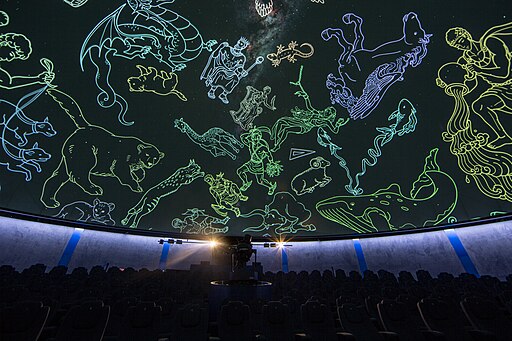
The featured image from this post comes from a planetarium.
In my next post I will move on to the book The Undiscovered Self, which Jung published in 1959, a time of crisis.

 Kristin Ann King
Pingback: Revisiting Carl Jung, Part 1: Introduction | Kristin Ann King