On tidying papers

Starting month three of a major decluttering event, based on Marie Kondo’s The Life-Changing Magic of Tidying Up. (See my previous posts here and here and here and here.) I finished going through my clothes, books, CDs, DVDs, doll furniture, and floppy disks (egad!). That was all exhilarating. Now it’s papers.

Papers are not fun.

Marie Kondo’s advice: “My basic principle for sorting papers is to throw them all away.” If only it were that easy! Over the last four decades I’ve kept a lot of papers, some for the right reasons and some for the wrong. I have three filing cabinets, ten stack files, and at least a couple of boxes, just for my own papers.

They’ve been bogging me down. It’s gotten to the point where I can’t look at a stack of papers without wincing, so then I don’t touch it, and it’s a downward spiral from there! I have organized files carefully over the years, but still, I have papers of sentimental value mixed in with papers of no use entirely.

So far I’ve gone through all my filing cabinet drawers and rid myself of about half the papers. I am nowhere near throwing them all away — nor, as a writer, should I be. I have about two filing cabinet drawers full of things I’ve written over the course of my life, from preschool-era stuff to the half-finished novel from high school to the story I’m in the middle of right now. I have a drawer devoted to classes I have taught once, and several files devoted to the technical writing career. I have drawers full of research materials for stories and essays I might write.

Going through all these has given me a chance to think about where my life has been and where it is going. What am I doing with myself, anyway? I’m a stay-at-home writer mom, doing work that fulfills me absolutely, but in a culture that values neither writers nor SAHMs. I’m missing the kind of respect you can get from the workplace, and to be honest, it’s affected my self-esteem. In one year I will have exited the “kids in elementary school” stage and could re-enter the workforce with reasonable confidence my family could cope. A lot of my friends are doing that. Am I just spinning my wheels?

Welcome to my midlife crisis, brought on by a filing cabinet!

What am I doing with myself? Well, treating my writing career like a spare-time activity, and treating my work itself like a blog entry, to be tossed in the wind and left behind. Time for a change. Not a return to the daily grind, not right now, anyway, but time for me to take myself and my work seriously.

On reading Orson Scott Card

I was a diehard fan of Orson Scott Card from maybe 1987 until the time I got to the end of his novel Treasure Box, sometime after 1996, and then I suddenly wasn’t. I gave my reasons in a previous blog post, which you can search for if you like, but this post isn’t about that.

It’s about what it was like to be a reader of his work between 1987 and 1992. In 1987, I was in high school, living in Utah as a non-Mormon with mostly Mormon friends. Utah, well . . . back when the Mormons first settled it, it was supposed to be a theocracy. The State of Deseret, with the church and business leader Brigham Young at its head. By 1987 a lot had changed, of course, but the LDS church had quite a bit of influence over business and government.

Non-Mormons were (and still are) in a strange place culturally. I don’t think there’s anything like it anywhere else in the world. If you want a little taste of it, see this review of the play Saturday’s Voyeur, a parody of Mormon culture and politics that has been put on by the Salt Lake Acting Company since the late 1970s.

Part of the strangeness was that we were a minority culture subordinate to and in opposition to another minority culture. In many places outside of Utah, Mormons were looked upon skeptically. In Utah, though, they were the political power.

Another part of the strangeness was that many non-Mormons were ex-Mormons. They had belonged to the Church, and maybe their whole family and all their friends belonged to the Church, and then they had left it. That meant leaving a whole community, but still living in the same place.

Our family was kind of like that. My mom had been Mormon and had left the church because of, well, some stuff. And my dad had some Mormon roots as well. I am the descendant of Mormon converts, polygamists, “Jack Mormons,” ex-Mormons, and anti-Mormons. There’s a history. And a complicated cultural divide. My parents had their own stories to tell, and the occasional frustrated “Oh, those Mormons!” comments.

Orson Scott Card bridged the cultural divide, and he did it well. He was enjoyed and respected by Mormons and non-Mormons alike — including my dad and me. He put out quality work.

What did we read? Well, everything we could find. We blazed through the Ender’s Game series. And we read the Alvin Maker series. And the novel Saints, which had as its protagonist a polygamous woman from the early days of the church. We both felt she had done a good job of conveying a woman’s point of view and that the historical information was really compelling. On my own, I also read and loved his novel Songmaster and his short story collection Folk of the Fringe.

Around that same time I had an on-again, off-again Mormon boyfriend, also a big fan of Orson Scott Card. He told me stories about how the top leadership of the church would come to him saying, “Well, we heard about such-and-so in your book, and we’re concerned about it,” and he would point-by-point defend his works. I was duly impressed.

Within the broad science fiction and fantasy community, outside of Utah, I would have guessed that his Mormon identity would be a liability. But I don’t think it was. Actually, he was pretty mainstream.

How mainstream? Well, check out this list I found while going through old papers.  (I’m tidying.) It’s an article that appeared in Fantasy & Science Fiction in 1989, titled “Books to Look For” by Orson Scott Card.

I only have the first half of the article, but here were his selections:

  • Cyberbooks by Ben Bova (TOR)
  • Imago by Octavia Butler (Warner)
  • Nemesis by Isaac Asimov (Doubleday/Foundation)
  • On My Way to Paradise by Dave Wolverton (Bantam)
  • Tourists by Lisa Goldstein (Simon & Schuster)
  • Eva by Peter Dickinson (Delacorte)
  • The Golden Thread, Suzy McKee Charnas (Bantam)
  • The Jedera Adventure by Lloyd Alexander (Dutton)
  • The Boat of a Million Years by Poul Anderson (TOR)
  • The Divide by Robert Charles Wilson (Doubleday/Foundation)
  • Castleview by Gene Wolfe (TOR)

Back then, I looked at this list and thought, “Wow, what a lot of great books!” I didn’t see then what was obvious now: only three of ten of the authors are women, and only one is black. I didn’t think much about the gender of authors or protagonists, and I didn’t think about race at all. (I probably wouldn’t even have noticed that Octavia Butler was black, unless I had read her book and looked at her picture.) That was the mainstream, or maybe to the left of it. Those were the kind of demographics you’d see even now from a lot of reviewers.

Well, that was then. A lot of things happened in the meantime. I took eye-opening feminist theory courses from Katherine Stockton, learned a lot about racism and sexism, joined the Mormon church, left the Mormon church, left Utah, went to graduate school, and learned more about racism and sexism, and then found Octavia Butler (WOW!), then learned more about systemic racism, misogyny, rape culture, collective liberation, and intersectional feminism.

I’m an entirely different reader.

Meanwhile, the science fiction and fantasy community is different, and so is the publishing landscape, and the demographic makeup of authors and readers. There are some people who have made the same journey as me, and some people (supporters of Theodore Beale, for instance) who have moved in the opposite direction.

And then there are the people in the middle. People who think, as I used to think, that demographics don’t matter, that there is some universal standard that makes a book excellent or mediocre. Such people can change. They can go in one direction or the other, or they can stay put.

If I were to start fresh, right now, and reread all those same books for the first time, I would probably say they were damn fine books with some seriously problematic elements.

The same, though, could be said about quite a few of my best beloved books. Rereading favorite children’s books to my daughter, I have to gag and skip over some of it. Other parts I have to explain. (“Well, it used to be considered acceptable to hit children.”) Or (“Well, back then, some people thought black people weren’t human.”) Or (“That’s because women were considered men’s property.”)

Would I ever reread any of Orson Scott Card’s books? Likely not, with the possible exceptions of SongmasterSaints, or Folk of the Fringe. But I am going to give him cred for recommending Octavia Butler.

Here’s what he says:

“Butler caps the series that began with Dawn and Adulthood Rites with this story of human beings struggling for species identity in the face of a genetic challenge from ruthless-yet-compassionate aliens. Which is more important, asks Butler, what we were or what we are becoming?”

Onward to the future.

Spaceship_Kawaii

Linkspam: The ethics of self-publishing

Yesterday I got into a great conversation with interesting people, and the topic of self-publishing came up. It brought me back to the ethical issues I’ve faced along the road of publishing Misfits from the Beehive State, so I figure it’s time for a tiny bit of background and helpful resources.

When I self-published Misfits from the Beehive State,  my number one consideration was that it not be “vanity press,” and the way I made that distinction was to keep overhead so low that it made an actual profit. At the time, using CreateSpace was the way to do it. And I made my book available on Amazon, because that’s how a lot of people wanted to buy it.

I maybe wouldn’t do a second book the same way. That’s because my book is one part of a larger ecosystem of readers, books, publishers, distributors, and bookstores, and what I do as an author has an impact on that ecosystem. Here are three links from my website that touch on the issue:

On small publishers and indy bookstores – I propose “We need to band together and support the small presses and independent bookstores we eventually hope will support us.” (March 2014)

What I learned about working with small bookstores – I report on a Pacific Northwest Booksellers Association event “Working with PNBA and NW Bookstores” (May 2014)

Misfits available on IndyBound – I explain how and why I made my book accessible to independent bookstores, and why to buy for them. (May 2014)

Here’s a link that discusses the problem of Amazon:

Ursula Le Guin on Amazon and market-based censorship – a little intro to the problem Amazon poses to small publishers and independent bookstores. Quote from my #1 favorite author Ursula LeGuin: “We’re talking about censorship: deliberately making a book hard or impossible to get, ‘disappearing’ an author,” Ms. Le Guin wrote in an email. “Governments use censorship for moral and political ends, justifiable or not. Amazon is using censorship to gain total market control so they can dictate to publishers what they can publish, to authors what they can write, to readers what they can buy. This is more than unjustifiable, it is intolerable.”

Finally, here are links to some potentially viable alternatives to CreateSpace and Amazon.

Roundup of self-publishing services – includes not only CreateSpace but also XLibris and Smashwords

IngramSpark – a self-publishing service that can make your books readily available to bookstores

How to make your book available through IndyBound – a way to make even CreateSpace books available in many indy bookstores

There’s a lot more to be said on this topic, but I need breakfast!

scoobydoogang01

Neo-fascism in science fiction, 2013 to 2015

DSC00443

Here’s a bizarre little story. In 2013, ten percent of a major science fiction / fantasy organization votes for a man who later turns out to be organizing neo-fascists and miscellaneous hate groups. The organization later ignores a complaint about the man sending extreme hate speech over an official Twitter feed, and then takes ten weeks of debate before it decides to expel him. In 2014, a publishing company is started by this man — in Finland, of all places. In 2015, a rather surprising number of people are mobilized to take an action that shakes the science fiction / fantasy community — a hijacking of the Hugo Award nominations.

I’m not using the name of the person here partly because everybody’s sick of talking and thinking about it, partly because the person has already too much publicity, and partly because the person appears to be using that publicity to draw fascists to his site. You can certainly google it, but in the words of author Amal El-Mohtar, only do it “if your day is suffering from a surfeit of happiness and sunshine.”

But I will give the context: for the last three years, a group called the “Sad Puppies” have published a slate of candidates to be nominated for the Hugo Awards, in protest against what they see as the “establishment.” This year, though, somebody else jumped on board with a “Rabid Puppies” slate, almost identical to the “Sad Puppies” one and made a call-out to the Gamergate folks. (That somebody is the same one who was expelled for hate speeech.) Now, some of the awards are populated exclusively by Sad Puppy and/or Rabid Puppy nominations.

So I got curious about the Rabid Puppies story. For such an organized action to succeed suggests to me that somebody has money they’re throwing around for some purpose beyond their stated goals.

So that’s how I accidentally started reading a blog I never would otherwise. And oh, my. It’s kind of like somebody went to the website of the Southern Poverty Law Center, which tracks hate groups, and decided to see how many varieties of hate speech they could include.

But I let’s go back a minute. I said neo-fascist, and here’s why. It’s an excerpt from the blog, in a section on how to submit to the publishing house.

coded fascism

It doesn’t say, “Hello, fascists, come join our publishing house!” But it’s suspiciously close.

The first full sentence here is a question addressed to the owner of the publishing house, and the second is the answer. With some help from Google Translate and a friend knowledgeable about fascism, I got the general gist. “How do Italians see the core difference between Nazism and Italian Fascism, beyond the added-on race stuff?” “I don’t believe this question is appropriate here, but in any case, I recommend such-and-so book by such-and-so author.”

Such-and-so book explains that the failure of the glorious leadership of Mussolini and co. was caused not only by military defeat but also by the supporters not being wholly committed to the cause.

It would be a bit dodgy to go calling somebody a neo-fascist for a statement like this, so I didn’t. But there’s more. Here’s a secondhand account of some holocaust-denial, ethnic cleansing hate speech that is no longer online.

From http://mediamatters.org/blog/2010/05/11/wnds-vox-day-on-reclaiming-traditional-white-an/164574

From mediamatters.org, 5/11/2010

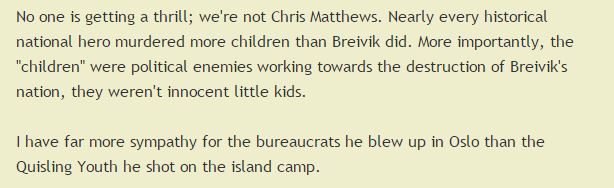
And here’s some more hate speech commentary on a terrorist attack in which actual children were actually killed. This is from August 10, 2013.
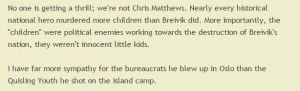
example of hate speech

Other stuff on the blog is calling out to Finnish fascists and other groups, as has been mentioned by authors Charlie Stross and Philip Sandifer.

These other groups, they’re not just mucking around in the field of books. No, they’re trying to ban immigrants of color, they’re hoping for a medical “solution” for homosexuality, they’re beating their wives at home. There are some real-world consequences for these views, which is exactly why hate speech is illegal.

And of course, fascism in its “Golden Age” was all about military and killing and all.

As you might expect, I quite naturally felt a bit alarmed at the thought of organized neo-fascism in the science fiction and fantasy community.

Fortunately, author N.K. Jemison calmed me down somewhat by giving some historical perspective. See, I was thinking of fascism in science fiction as this new thing that’s popping up, but really, it’s just an attempt to return to business as usual, to the “Golden Age of Science Fiction.”

As Jemison explains back in 2013,

“Straight white men have dominated the speculative literary field for the past few decades; their dominance is now going the way of the dinosaur; most are OK with that but a few (and their non-straight-white-guy supporters) are desperately trying to figure out how to bring things back to the way they were.”

So, I was thinking, it’s a garden-variety conservative backlash. But I disagreed, thinking, It’s a neo-fascist backlash, which is different. With all the hate speech going around, someone could get hurt!

But then I kept reading and came across this:

“Which I guess is why I’ve recently had to add some new entries to the file of death and rape threats I’ve already gotten over the years (pretty much since around the time I started publishing professionally, if you’re wondering).”

So I had to smack myself in the head for forgetting all the violence that is routinely being done to people of color, and once again for forgetting it while my Facebook feed is full of stories of people who “just happened” to have their spines break while in police custody.

But then I thought, “That’s racism and violence, not fascism,” because there is a line that divides fascism from other things. So then I had to ask, “What exactly is that line?”

And also, “How do you figure out where a person stands in relation to that line?”

One might wonder, “If somebody ends up accidentally supporting a neo-fascist, what’s their next step? Do they step back carefully, double down, or sit comfortably in a state of denial?” I think it would be fair to ask such a person: “Do you oppose fascism, support fascism, or are you neutral on fascism?”

(And yes, of course nobody can be neutral on fascism.)

Or I could just wait until the next thing happens, whatever this is, because this is an organized attack on feminists of all sorts, and see who sides with whom, and add 2016 to the title of this blog post.

So then the question became, “How do you counter fascism in science fiction and fantasy?”

And that was too big a topic for me to address before lunch, so I’ll just finish up with another couple quotes by N.K. Jemison:

“. . . all this anger and discussion reflects a struggle for the soul of the organization, which is in turn reflective of a greater struggle for the soul of the genre, and that overall struggle taking place globally.”

and

“SFF is going to become more diverse, with women and people of color taking their place as equals within its hierarchies, whether the scared white manly men want it to or not.** Nothing can stop this now; it’s inevitable.”

Oh yes, and the one action I’m going to take after all this research? Read a good book.  I have three new authors on my “to-read shelf” — N.K. Jemison, Charlie Stross, and  Philip Sandifer.

(Note: I edited this on 5/5/2015 and again on 5/7/2015 to include a little more context & details.)

tidying, day 30

It’s been about 30 days since I picked up the short and lovely book titled the life-changing magic of tidying up, by marie kondo. The book’s rather intriguing promise is that if you complete the full decluttering process, you won’t rebound. I think it’s true, for two reasons: 1) The tidying method changes your relationship to your possessions; and 2) If you’re going to rebound, you probably won’t finish in the first place anyway. Will I make it to the finish line? Well, I do intend to, but even if I don’t, my home and my heart are already breathing easier.

I haven’t been tidying for 30 days, mind you. There are some mega-tidy days in there, where I might spend 6 to 8 hours in a day — maybe 2 for the clothes and 2 for the books — plus some “I have a couple hours here or there” kind of days.

I’m going forward mostly in the order she recommends. First I went through and tidied my clothes — I took down and handled every last scrap, using the touch of my hands and the feeling in my heart to decide whether I wanted it or not. Next, books. Books, as you might imagine, are extra complicated for a writer. I wrote abut those here and here.

Next, papers! The short version of the story is that I’ve spent about a week, on and off, and our four-foot-tall recycling bin is full. I still have two filing cabinets to go through, plus some stack files. Oh yes, and multiple boxes of kids’ art and schoolwork. All these years, I’ve done a fabulous job of organizing a whole lot of papers . . . papers that I’ll probably never need! I didn’t realize I was setting myself up for hours and hours of archaeology — the meticulous digging for the papers I actually do want or need.

In the years before I had my last child, I taught a number of technical and business writing classes at the UW and local community colleges. I saved a whole lot of papers. I need to save some of them. But which? And for what purpose?

What I have now, more or less, is one file cabinet full of teaching portfolio materials and course materials organized by subject matter rather than course. More importantly: an easy mind. I know I haven’t left a difficult task for later.

Oh, and as a bonus: I found a super awesome handout called “Calculating a Fog Index.” It’s a simple method for taking a writing sample of but 100 words and finding out the reading level by grade (7th through college graduate). Now, where was that SBAC practice test again, hmm?

Inklewriter in the classroom

I’m volunteering in my son’s fourth/fifth grade classroom, and we’re putting together a Choose Your Own Adventure based on the Iliad and the Odyssey. It’s been a whole lot of work but even more fun! That’s because we’re using a free online tool that’s just amazing.

Here’s their website and their description:

At inkle, we believe it takes great writers to tell great stories.

That’s why we’ve created inklewriter, to help writers tell interactive tales with the minimum of fuss. inklewriter keeps your branching story organised, so you can concentrate on what’s important – the writing.

inklewriter is a free tool designed to allow anyone to write and publish interactive stories. It’s perfect for writers who want to try out interactivity, but also for teachers and students looking to mix computer skills and creative writing.

Yep. On the first day in the classroom, I logged on and started typing, based on student feedback. It turned out that the protagonist was a 12-year old thief from Ithaca, happening upon the Trojan War. After the first paragraph, I entered two options: investigate or run away.

The next step was to organize the students into groups, and work with each group. Because the tool is so flexible, I didn’t have to do it in the order the story branched.  Instead, I assigned groups based on location and student interest. The groups were:

  • Battle of Troy
  • Sailing with Odysseus
  • Sirens
  • Death
  • Hades
  • Mount Olympus
  • Modern Day

(I fought valiantly against having a Modern Day category, to keep it in ancient Greece, but the Percy Jackson contingent was just too darn excited.)

After I got the Battle of Troy group started, I moved on to the Odysseus and Sirens groups. I typed in their pieces and added the necessary links from one section to another.

As you might imagine, it got pretty complicated pretty fast. But that was OK, because there are some awesome tools. For instance, there’s a map tool, which shows you a tree of the story structure, with one box per paragraph. You can click on any box to see the path that gets you there, and you can double-click on it to close the map and get straight back into the story in that exact paragraph. There’s also a searchable panel of paragraphs to the right, and it shows you any loose ends (options that lead nowhere) and paragraphs that aren’t connected to anything. That makes it really simple to unattach one paragraph and re-attach it somewhere else.

Smooth, elegant, intuitive, easy.

Not that the process itself was easy. Keeping track of student drafts, making sure all the students knew what they were doing, and making sure the students all had something to do — that was hard. Fortunately, the classroom teacher is experienced and basically fabulous, and I was able to work with students a handful at a time.

After the Battle of Troy, Odysseus, and Sirens groups were mostly done, I moved on to Death, Hades, and Mount Olympus. By then I had figured out how to manage groups a little more easily. I brought a packet for each group, containing their planning and rough draft documents, and I handed it out at the beginning of each session and then collected it at the end, to review and enter their drafts.

One thing you wouldn’t know unless you were a classroom teacher is that the kids all finish up at different times, produce wildly varying quantities of work, and require either no support or intense one-on-one support. Again, thank goodness for a classroom teacher who knows how to manage that kind of thing. For that last category I did scribing — that is, they spoke and I typed or wrote.  I love doing that, because my hope is for every student to grow up feeling confident about their writing, and scribing is an important tool for some.

After that, I worked with the Modern Technology group.

At some point, the work of entering and organizing the student work got ahead of me, and I ended up taking some time off to enter it. But once I had done so, I was ready to show it off to the class! That was so fun. The teacher chose students to read passages, alternating between girls and boys, and when we came to an option the class voted. We went through about four storylines and then we cut it off.

The best moment? Seeing the smile on the face of one of the students I had scribed for, as that student’s work was read.

There is still work to do. I had the challenge of how to help the students edit not only their own work but also its connection to work that came before and after. To do that, I printed a hard copy of the story-in-progress that I had copied into a Word document.

Copying it over was complicated. I titled each section with the name of the student who had written it, the group they were in, and, if they had written multiple sections, which one it was. At the beginning of each section, I used bracketed text to indicate where it had come from, and at the end of each section, I used bracketed text to indicate where the options led.

Then I handed it out, group by group, to be checked over by the students who were done with their first drafts. Students who were still working on their first drafts kept on working.

Now I have some new text to enter and some edits to make. I’m looking forward to it!

inklewriter-release-banner

three days of book tidying

Day three and I’m halfway through the process of tidying my books. I’ve gone through about half my books, and six boxes have left the house. I’m so glad they’re gone — not because they were taking up space, but because they were sucking out psychic energy and dragging me down. Now they will enjoy a new life in somebody else’s hands. And I will enjoy new books.

This tidying process is from the book the life-changing magic of tidying up by marie kondo. I have written more about it here and here. I followed the process as closely as I could, but because I’m a writer, and books are my business, it was not entirely applicable. It’s right for me to keep many books that don’t “spark joy.” So, I substituted some of kondo’s rules for my own.

What I did:

Day One: I gathered every single book I owned from every corner of the house. We have fourteen bookshelves altogether–three in my office, two in the kids’ rooms, and nine in other parts of the house. I got all the books that were outside my office and put them on the floor of my office. Then I got two boxes of books from the storage room and put them there too. It was mighty crowded by then!

Day Two: I got myself into a good psychic space and started going through my books, one by one, sorting them into categories and handling them to see if they sparked joy. Quite a few of them did the opposite! So I put them in boxes to go. I erred on the side of keeping books I wasn’t sure of, but even so, I filled six boxes. As I filled them, I put them outside my room. I took frequent breaks, but even so, after about four hours I was fried! I took a good long break, ate a bunch of food, and then started up again in the late afternoon. Another hour or two and I was done.

Only trouble: the rest of the books, from all over the house, were on the floor of my room! I spent an hour trying to shelve books, but they won’t all fit on my own shelves, and I don’t know yet which ones I want to keep outside my office. To make matters worse, those other nine bookshelves are crowded with other people’s books.

Day Three: I stopped worrying about where to put my books and focused on getting those six boxes out the door. It was harder than I thought. If I had it to do over again, I would have just put them in the trunk of the car and driven them straight to a thrift store. Instead, I took them to a local to sell. They took a lot fewer books than I had expected, leaving me with five boxes I still had to take to the thrift store.

But now they’re gone, and I feel great!

I’m going to wait a week or so before I finish up the rest of my books. It’s been emotionally difficult and I’m fried! But the rest won’t be anywhere near as hard.

What I learned:

  • Books hold emotions and memories and have a physicality of their own.
  • It matters where I put my books. There are some spots on the bookshelf I look at every day. Those are not the places to put the books I keep meaning to read.
  • Some books are the wrong size for their text. For instance, I had two copies of Vonda McIntyre’s The Moon and the Sun, one hardback and one paperback. Before I started the process, I figured I would donate the hardback and keep the paperback. I did the opposite.
  • I don’t much like dust jackets. If a book has a dust jacket that’s torn or fading, the book is doomed to leave my house.
  • I’m under no obligation to read any book I own.
  • If somebody I know and like has written a book and I have purchased it, I am under no obligation to read it, and I am also under no obligation to give it away. I can keep it on my shelf and feel pleased for my friend.
  • My collection of books has some gaps I didn’t see until I got rid of what I didn’t want. I owned some books by authors whose books I read and enjoyed twenty years ago. But I didn’t own those exact books. I’m sure they’re out there somewhere.

Enjoy yourselves, dear books, and farewell.

from Pinterest/wimmink

from Pinterest/wimmink

on tidying books

Yesterday I spent several hours finding every single book that I own (except all the ones my family uses and all the children’s books) and putting them on the floor of my room. Now I’m sorting through them, and it’s excruciating. Not because I don’t know which too keep and which to give away, but because I’m actually sorting through twenty-five years of my past, and not all the memories are happy ones. I have little resentments and disappointments — not a big deal all in all, but all piled on my floor . . . ugh.

I’m doing this as part of the process in the book the life-changing magic of tidying up, which I posted about yesterday. This is the second stage of tidying. The first was clothes. I gathered every last item of clothing I owned and decided whether or not they “sparked joy.” Taking the time to consider each item one by one was indeed “life-changing magic,” because it tuned me in to my emotional response to all the times. Turns out, some of them just made me feel bad about myself. They’re gone now, and I wish them well in their new life!

The same is happening with books, but it’s much stronger and harder. Once I’m done, though, I’m going to look at my bookshelves and feel good about every single thing I see!

scoobydoogang01

on tidying

There I was at the bookstore, haggling with my children over how many books they were allowed to buy, knowing that most likely my daughter’s books would be read before the weekend was out and they would just hang out on our bookshelf as clutter . . . and then I saw this lovely little title.

tidying up

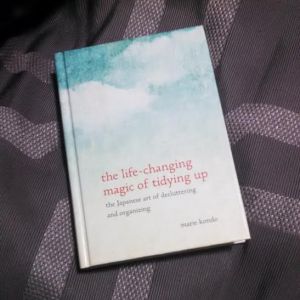
the life-changing magic of tidying up, by marie kondo.

It feels good in the hand, with just the right heft. The front cover is clear and lovely, and the back cover has poetry and a pretty woman. A sneak peek inside showed me prose that was clean, smooth, and encouraging.

I bought it.

There’s a paradigm shift here. You don’t do it a little at a time, and you don’t focus on what to get rid of, and you don’t use reason to decide what to toss.

Instead, you tackle items one category at a time, in marathon sessions. You decide what you want to keep, rather than what you want to get rid of, and you make that decision by feel. Her rule of thumb is to touch each item to see if it sparks joy.

Most importantly, though, you change your relationship to objects. You treat them like living things, thanking them for what they have done for you. When you discard them, you are releasing their energy.

I’ve seen a lot of people talk about her book as “new agey” or “woo woo.” Actually, though, it’s influenced by the ancient Japanese practice of Shinto, which includes the concept that objects have souls, or energy. This is a very practical way to think, because it helps us treat them respectfully.

If you asked me if I thought objects had souls or feelings, I would have said no. But the reason I kept all that stuff in the first place was that I felt guilty for throwing it out. And why did I feel guilty? Who would it hurt for me to discard something that only I used? For good or ill, I have a relationship with my stuff. We all do. We anthropomorphize our objects.

Once I realized that, I was ready to go.

Two weeks later, and my relationship with my possessions is different. My closet and dresser are filled with only the clothes and shoes I want and no more. (About fifteen bags of clothes and shoes went to Value Village.) At the same time, I found all my nice dresses! My pantry doesn’t scare me any more. I can open two of my kitchen drawers without yanking. This is a good start.

The next step, according to Kondo’s recommendation, would be to go through the books. But I would really want to set aside a whole day for that, and I’m not ready. So I’m working on papers. Forty pounds recycled today, along with some emotional baggage they’ve been carrying. But within those forty pounds, I found some buried treasures. I revived good memories of courses I taught at the community college, and I found an article that is of immediate use to me.

I feel different in my own skin, too. I feel more free.

So would I recommend this book? It depends on what you want. I was the poster child for needing this book. When I got toward the end and read this passage I had to smile.

“Although I have spent this entire book talking about tidying, tidying is not actually necessary. You won’t die if your house isn’t tidy, and there are many people in the world who really don’t care if they can’t put their house in order. Such people, however, would never pick up this book. You, on the other hand, have been led by fate to read it, and that means you probably have a strong desire to change your current situation. . . ”

Yes, that’s me. Clutter has been in my top three list of stressors ever since my son was in preschool, and I was absolutely ready to let it go. This was just the right book, at just the right time.

At the same time, I’m pretty sure I’ve doomed myself to six months of intensive tidying! If that’s not what you want, don’t read the book.

A Conversation about Common Core

After a year of grappling with the new Common Core standards, I feel mixed. I oppose the new Common Core assessments because they’re all part of privatization, top-down control of schools, and high-stakes testing — all those things that have come to be known as “corporate education reform.”

But I’m not sure I’m against the Common Core standards. Yes, they’re deeply flawed. They are copyrighted by a private sector organization, which means the public — that’s you and me — has no control over their content. On the other hand, I think national standards make sense. They are a way to communicate to parents what their kids are expected to be learning, and we definitely need that. Having just one set of standards also makes it easier to develop and plan curriculum at lower cost. So I’m asking myself: might it make sense to keep the standards, but ditch the high-stakes assessments?

That’s why I was excited when I saw a friend start a Facebook conversation on the topic. With the permission of the participants, I’m reposting it here — not as a debate, or the last word on the subject, but as part of the ongoing conversation on what kind of education real parents want for their kids.

Zara: I’m out of alignment with my Party and my usual allies on this one. I’ve had qualms about Common Core, especially about its sloppy, rushed, improperly-supported and counterproductive implementation. I was angry about the way it was developed, like so many recent reforms, without real educator influence and with much pressure by wealthy private individuals. However, Democrats and Progressives are very much disappointing me in their all-or-nothing, un-nuanced approach to the reality of CCS.

To throw it out wholesale at this point would be incredibly disruptive. How, instead, can we organize to make sure Common Core works the way it should? How can we assure that the test results are not used inappropriately and harmfully?

(They should NOT be tied to teacher evaluations – neither as sticks nor carrots. They should NOT be used to grade or rate schools. They should NOT be a trigger for punitive measures against schools. They SHOULD be a signal that a school needs greater, long-term, stable support – not short-term interventions (such as three-year grants) or threats of mass firings or closure.

CCS is deeply imperfect (as I understand it). The assessments are even less perfect (as I understand them) and the profit to be made from them is troubling. But I don’t believe they’re the educational, social-justice napalm my friends do. And the response from my own corner of the ring strikes me as short-sighted, stubborn, slightly paranoid and possibly harmful to our school systems, given the phase of CCS we have already reached.

I know I’ll get criticized by my allies for being ignorant or co-opted or some other unhappy thing. I’m not looking forward to it, but I felt I had to speak up – under my own name – no matter how unpopular or suspect it might make me in the anti-reform circles I generally respect so well.

Kim: People I’ve talked with would rather revert to standards we had in place prior to CCSS, and then with educator input, tweak those. And then there are others who really value a national set of standards, but they need to be developmentally appropriate, created by educators, and minimal so as not to drive everything happening in schools. Also, Pearson and Gates need to be uninvolved.

Sandi: Zara, I agree with you! I want my kids to have the same expectations and learning opportunities in our public school kids that the kids in the best public and private schools across the nation offer. If that takes a set of “standards” then so be it. I’ve always agreed to the concept, but not this current incarnation of the implementation and tests.

Recess is being cut even more than before, and kids’ progress is charted and managed like vacuum sales results, project based learning is gone in some places, and pre-scripted curriculum is rampant.

Teachers are not truly being allowed to develop curriculum to meet the standards, but are being told what to teach, when, and how.

The focus is still “learn this to pass the test,” not “learn to love learning and learn this because it is knowledge and process that will help you develop and find your passions.”

Kristin:  I’ve been thinking the same thing as you, Zara. There is benefit to be had in common state standards. And yes, changing them NOW would disrupt kids for another two to five years. On the other hand, though, they are copyrighted and can’t be tweaked.

Kim: Teacher driven education is key, and to let the testing madness continue is to let the community believe that test scores matter in ways that they do not. As Sandi points out, the testing is the serious problem. The standards are flawed, but I bet we can find flaws in all standards. And so it goes back to data collection, excessive time at the computer, too much emphasis on test scores, not enough time on subjects that aren’t tested, and so on.

Thanks to everybody for letting me post your thoughts. Readers, what do you think?

By dotmatchbox at flickr [CC-BY-SA-2.0] , via Wikimedia Commons

By dotmatchbox at flickr [CC-BY-SA-2.0] , via Wikimedia Commons