Days 4-8 of the Fanfiction Workshop

This is part of a series on a fanfiction workshop for kids. Earlier posts are: On Teaching a Fanfiction Workshop for Kids, Writers in the Schools – A Second Time Round, Day One, Day Two, and Day Three.

Day 4: Starting the Rough Draft

On Day 4, we started the rough draft.

10 minutes: General comments

I started off with some Q&A and then gave some general comments about writing and myself as a writer. As show and tell, I brought some work that I had done when I was in fourth and fifth grade. I talked about how I had felt embarrassed about my own writing, but how, looking back, I see my work in a much more positive light! I talked about how one of my biggest mistakes as a young writer was asking others their opinion about my writing and emphasized the importance of practice.

5 minutes: Freewrite activity

I actually didn’t do this activity, but should have. It should have happened at the beginning of every writing day!

5 minutes: Check-in and review

I asked the kids to get out their “Some Ways to Start Stories” worksheet and look it over. I asked where they were at. Some kids were done and ready to write.

20 minutes: Rough draft

We got started on the rough draft! Many kids were stuck, so the teacher and I went around the room and talked over their character, setting, and ideas for starting the stories.

20 minutes: Sharing

A few kids wanted to share to the whole class, so we did that, and then we did some sharing in small groups.

Day 5: Continuing on the rough draft

Day 5 was a lot like Day 4.

10 minutes: General comments

I made more general comments about writing, gave encouragement, asked questions, and checked in.

5 minutes: Freewrite

30 minutes: Rough draft and cover page

Some of the kids finished up here and asked what to do, so I asked them to start working on a cover page with name, title, and illustration.

20 minutes: Sharing

The Days I Didn’t Do (But Should Have)

I thought this whole thing could be wrapped up in eight sessions, but ended up coming back for more, because half the kids finished when I expected they would, but the other half were still working. I expressed my surprise to the teacher and asked what to do, and she told me it’s always like that. What a challenge. I don’t know how teachers do it!

Instead, I asked the kids to start in on editing. Bad plan! It meant the teacher and I were rushing around the classroom on the one hand helping out kids who were stuck and on the other hand helping out kids who were editing.

If I do this workshop again, I’ll ask the teacher to help me prepare some activities for the kids who finish up first. They could write a sequel, or a second story, or a character sketch, or a setting description. Or they could pair up with kids who were stuck and give suggestions.

Next up: Getting to the Ending


By dotmatchbox at flickr [CC-BY-SA-2.0] , via Wikimedia Commons

By dotmatchbox at flickr [CC-BY-SA-2.0] , via Wikimedia Commons

Day Three of the Fanfiction Workshop

This is part of a series on writing fanfiction for kids. Earlier posts are: On Teaching a Fanfiction Workshop for Kids, Writers in the Schools – A Second Time Round, Day One, and Day Two.

Day 3: A Flurry of Activity

Day 3 was a mad dash to get the rest of the prewrite exercises out of the way so the kids could start their drafts the next day. Some of the kids had already jumped in to doing drafts, or started in the middle of filling out worksheets. Others were struggling to fill in worksheets. None of the kids filled in any of the worksheets all the way, but all the kids got some details to use in their stories.

Overheads:

Handout:

5-10 minutes: Review of Day 2

I answered various questions, told the kids we STILL weren’t doing rough drafts yet, checked in about the other worksheets.

5-10 minutes: Talking about setting

I showed the overhead “Setting and the Five Senses” and we brainstormed some kinds of setting details for each sense. Then I showed the overhead “More About Setting.”

15 minutes: Setting worksheet

I handed out the “About the Setting” worksheet and kids started filling it out.

10 minutes: Ideas for starting stories

I showed the overhead “Some Ways to Start Stories”

10 minutes: group discussion

Kids broke up into groups and started talking about their story ideas

Next up: Diving right in!

By Jens Rötzsch (Jens Rötzsch) [CC-BY-SA-3.0 (http://creativecommons.org/licenses/by-sa/3.0) or GFDL (http://www.gnu.org/copyleft/fdl.html)], via Wikimedia Commons

By Jens Rötzsch (Jens Rötzsch) [CC-BY-SA-3.0 (http://creativecommons.org/licenses/by-sa/3.0) or GFDL (http://www.gnu.org/copyleft/fdl.html)%5D, via Wikimedia Commons

Day Two of the Fanfiction Workshop

This is the third post in a series on writing fanfiction for kids. Earlier posts are: On Teaching a Fanfiction Workshop for Kids, Writers in the Schools – A Second Time Round, and Day One: Introducing Fanfiction.

Day Two: The Prewrite

On day two, some of the kids were ready and raring to write, but we had some preparations to do first. Our school uses a writer’s workshop model that includes a prewrite, rough draft, and final draft, so everyone was familiar with the concept of prewrite. We worked on getting rough ideas for character and plot.

Handouts:

5 to 10 minutes: Talking about being a writer

I talked more about what it was like to grow up reading and writing, and how I had written fanfiction as a child before the word fanfiction was even invented. I discussed writer’s block a little bit more. Then I touched on the idea of using established characters but changing their names, to make the story more their own.

5 to 10 minutes: Group Discussion

The kids broke up into small groups and discussed their characters. Everybody picked a character they would like to use and decided whether they would like to use the character’s name as is or change it.

20 minutes: All About My Character

I asked the kids to think up as many details about their character as they could and write them down. I also suggested that if they didn’t know the answer to a question that they make it up. I explained that they might not use all those details, but the details would help them imagine the characters better. Next time I would be a little firmer on this and require the kids to make up three details.

Once they had gotten a start on that, they broke up into small groups and talked about their characters.

20 minutes: Where’s the Story

I discussed common types of plots. Then I asked each of them to write down three types as story ideas. They didn’t have to use one of them, but they could.

As the kids were working, the teacher and I went around the classroom talking to kids who were feeling stuck or weren’t sure their ideas would make good stories.

By the end of day two, most of the kids knew who they were going to write about and what kind of story they were going to tell.

By Громыко Григорий Олегович (Own work) [CC-BY-SA-3.0 (http://creativecommons.org/licenses/by-sa/3.0)], via Wikimedia Commons

By Громыко Григорий Олегович (Own work) [CC-BY-SA-3.0 (http://creativecommons.org/licenses/by-sa/3.0)%5D, via Wikimedia Commons

Day One: Introducing Fanfiction

This is the third post in a series on writing fanfiction for kids. Earlier posts are: On Teaching a Fanfiction Workshop for Kids and Writers in the Schools – A Second Time Round.

Day One: Introducing Fanfiction

On the first day, I introduced the concept of fanfiction and started in on the prewrite process.

5 to 10 minutes: Introducing myself

I introduced myself and talked a little about what it was like to be a writer, and what kinds of things I had written. I had learned from my Writers in the Schools experience that having a bit of an “author glamour” helps keep students engaged and interested. I also touched on writers block as a lead-in to the next activity.

5 to 10 minutes: Warmup

This idea came from the teacher and is great! I handed out half-sheets of lined paper. The teacher took a wastepaper basket and put it on the front desk. The students wrote for three minutes, then crumpled the papers and threw them toward the basket.

Of course the question came up: “But what if I like what I wrote and don’t want to recycle it???” I gave them The Look and then said, “Okay, fine, but then you don’t get to play basketball!”

10 minutes: General concepts

  • Fanfiction means writing a story using characters from a book, TV show, or movie.
  • It’s great practice for writing short stories using your own characters.
  • Since many books, TV shows, and movies are copyrighted, there are various laws about what you can and can’t do. Writing fanfiction in a classroom but not publishing it is called “fair use.” Just like you cite sources when you write research papers, it’s important to say which book, TV show, or movie you used.
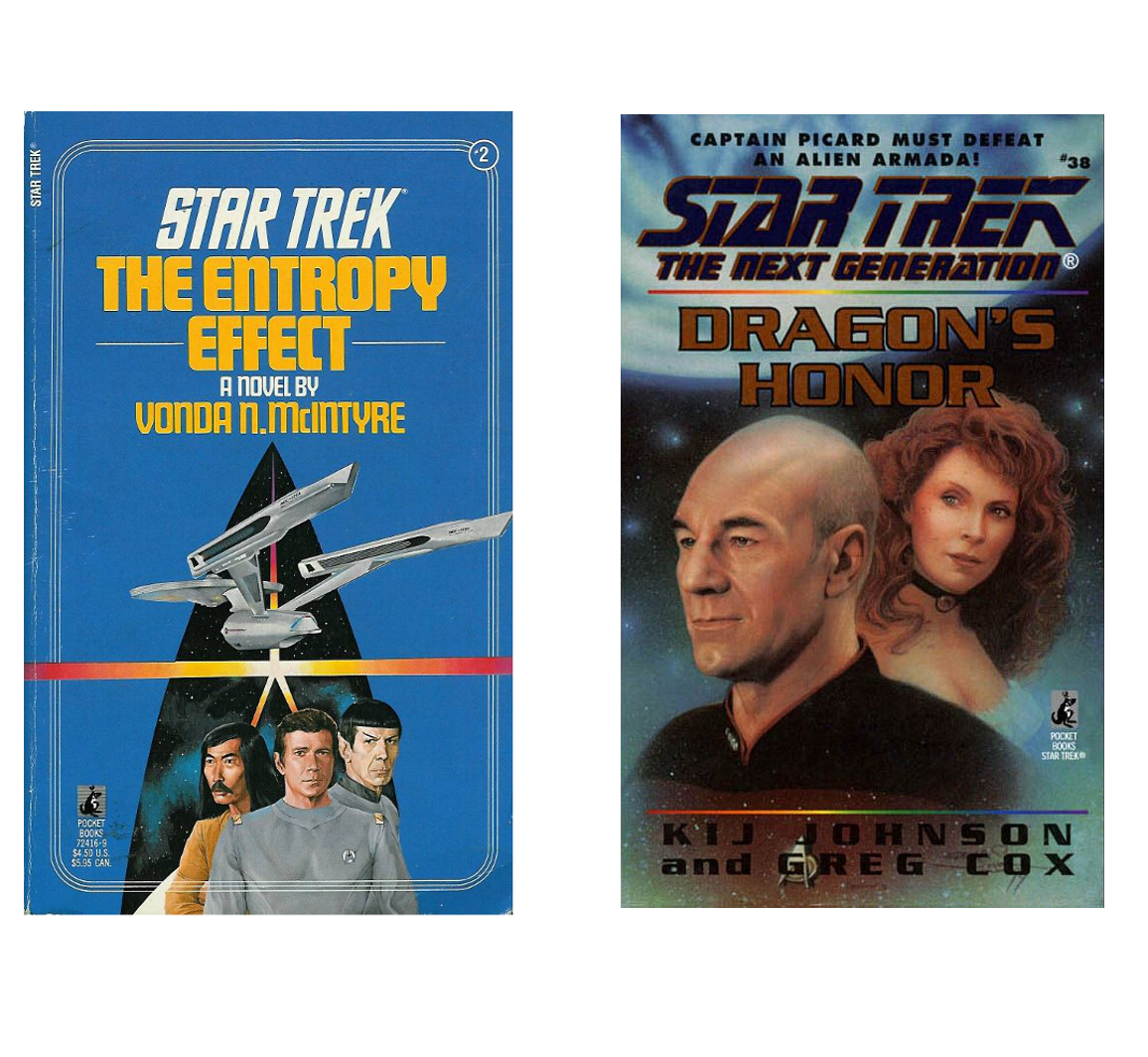
  • Examples of two authors who wrote fanfiction books and then went on to write their own novels: Kij Johnson and Vonda McIntyre. I showed them my copies of Kij Johnson’s Dragon’s Honor (Star Trek novel) and The Fox Woman, as well as my copies of The Entropy Effect (Star Trek novel) and The Moon and the Sun.

20 minutes: Brainstorming

Then we brainstormed a list of books, movies, and TV shows that the kids might like to use, and the students broke up into groups to discuss the ideas. Each student then picked one they wanted to use.

We ended the day with the kids full of energy.

Next up: Day Two

Entropy Effect and Dragons Honor

Writers in the Schools — A Second Time Round

(This is Part Two in a series on teaching a fanfiction workshop. Part One is here.)

When planning the fanfiction workshop, I had the benefit of experience to look back on. The MFA program at the University of Washington offered an internship called “Writers in the Schools.” I worked with a classroom teacher at a local school to teach short story writing to a class of 7th graders. That was a challenging job and although we all made it through, with some great short stories, I never quite felt I was up for the task. I was pretty shy and had absolutely no idea how to keep the attention of thirty teenagers! They were awestruck for the first few weeks, but when my “author glamour” wore off, it was a struggle to keep them quiet enough so that I could give my lessons.

On top of that, after the class was over I felt that I had taught them the wrong things. I spent so much time explaining the conventions of the short story form, the mystery genre, the adventure genre, and so forth, when many of these conventions are already imprinted on our brains. I spent much less time with confidence-building and tips and tricks for getting unstuck. And when their stories were finished I critiqued them in the same way adult writers critique each other’s stories, not understanding that I was sending a message that a Professional Stamp of Approval would be required for their art.

I gave it my best, and I did a good job, but still . . . . I wanted a do-over!

Since then, I’ve had a lot more experience with teaching and public speaking. I now know that teaching is as much performance art as it is transmission of information. It’s about knowing when kids’ attention is lagging and how to get it back.

I’ve also had a lot of time to think about what kinds of help young writers actually do and don’t need. In general, it’s helpful if it’s about how to get ideas out of your brain and onto the paper. It’s not helpful if it’s about how to do it correctly. It’s helpful if it’s about practice. It’s not helpful if the initial focus is on final product.

Above all, it’s helpful if it’s fun.

Enter the fanfiction component.

Next up: Day One

NEWS-Classroom-01-480x205

On teaching a fanfiction workshop for kids

This year I volunteered in the classroom to teach a group of 4th and 5th graders how to write fanfiction stories. It was a great experience! I got the chance to see some really excited writers and read their work, and the kids got the chance to have fun writing.

When planning it, I thought about what would have helped me as a young writer. I was constantly writing stories, but I felt like they all had the same character in them . . . a girl with an embarrassing similarity to me! There’s nothing wrong with that, but it made me feel self-conscious about my writing. I was also self-conscious about writing stories featuring my favorite book characters. I didn’t realize that authors are always borrowing characters and plots and then reworking them.

I also thought about what would be helpful for kids who think they can’t write. Grownups make writing quite difficult for kids by insisting it be done “the right way.” That’s why so many adults have writer’s block. In some ways, schooling seems to have improved — I’m seeing more focus on starting out with a rough draft and not worrying about spelling and punctuation in that rough draft. But at the same time, there’s a much smaller emphasis on teaching handwriting, and that hinders kids’ fluency and their feelings about their own writing. So writer’s block isn’t going away anytime soon!

Teaching fanfiction instead of regular fiction had big advantages for both these groups. Self-conscious writers don’t have to worry that their characters or plots suck, because somebody else made them up. And they don’t have to worry so much about pleasing adults — only themselves.

In the next few blog posts, I’ll be writing about my experience. I also have some worksheets to share, so I’ll be uploading them to this blog for general use.

Next up: Writers in the Schools, The Second Time Round

– Kristin

scoobydoogang01

What I learned about working with bookstores

One of the things I learned by self-publishing my book is that I am now not only an author, but a publisher. And that I would do well to behave as one, and to learn the ins and outs of the trade. So when I found out about a local book publishing organization that includes self-published authors among its members, I called them up and found out about the speaker event “Working with PNBA and NW Bookstores,” and then I went. It was well worth my time!

The speaker, Tegan Tigani, is a woman with many hats: board president, bookseller, children’s book buyer, book editor, blog editor, freelance writer, and children’s enrichment tutor. How she finds the time to do all that, and then come do a speaking engagement, I have no idea!

She was there speaking partly about the upcoming fall trade show for the Pacific Northwest Booksellers Association and partly about how to respectfully work with bookstores. Sounds like the trade show has educational book tabling opportunities for authors. There is also an annual award competition, which she encouraged people to submit to. The cost of submitting would be the cost of mailing the book to the committee members.

The Pacific Northwest Booksellers Association has a relationship with Book Publishers Northwest. Book Publishers Northwest always has a booth at the trade show, and members can make use of it. They can leave copies of their books for trade show members (including booksellers and librarians) to read through, and then any display books left over afterward are donated to rural libraries. (Massively cool!)

As for working with local bookstores, Ms. Tigani referred us to a post by author Mark Holtzen, “Advice for self-published authors.” She suggested reaching out with an email first, because some booksellers might want to see the book and some might want a sheet with talking points instead. If you provide a sample, don’t ask for it back . . . because apparently bookseller’s offices are really cluttered up with books. And to be respectful, don’t mention that your book is available on Amazon, because Amazon’s business practices are problematic for brick-and-mortar bookstores and publishers. 

Some bookstores will work on consignment, but some, like Queen Anne Books, don’t like to do that, because it’s so much easier to deal with invoices and returns for one distributor than a bazillion authors. It’s easiest if a book is available through a distributor like Ingram, Partners West, or Baker & Taylor. I asked about CreateSpace, since that’s where I had my book printed, and it turns out that yes, it is possible to make a book printed through CreateSpace available through Ingram. (And when I went home, I found out that yes, it was!) If it’s available through Ingram, many independent bookstores will carry it.

As for asking a bookstore to host an event, Ms. Tigani pointed out that authors have to do most of their own promotion. From my experience reading at Weller Book Works and Third Place Books, I’d say that’s spot on! She suggested pitching an event as a pair or a trio, because each author then brings a fan base, so more people attend the reading. Good plan.

She mentioned that ebooks published on the Kobo platform will work on all newer e-readers, including the Kindle Fire, and someone else mentioned that a good way to get it onto the Kobo platform, as well as other platforms, is through BookBaby or Smashwords. I looked into that, and found out two cool things: one, Smashwords will provide an ISBN for free; and two, Smashwords will make books available to libraries — at way more reasonable terms than publishers currently offer.

 I think I have my work cut out for me now . . .

Misfits now available through Third Place Books and Indy Bound

My collection Misfits from the Beehive State is on the shelves now in Seattle at Third Place Books — both Ravenna Third Place Books and Third Place Lake Forest Park.

It’s also now available through Indy Bound. What’s that? A way to support independent bookstores, which are a really important part of our communities! Just enter your zip code, and you get a list of local independent bookstores that can sell it to you. Then click on the name of a bookstore and you’ll get its address. Or, if it’s an independent bookstore that offers books for sale online, it can ship it to you just as fast as Amazon, and for the same price. For instance, you can buy it online from Queen Anne Books.

Why support independent bookstores? Here are some great reasons (excerpted from the Indy Bound FAQ):

  • Spend $100 at a local and $68 of that stays in your community. Spend the same $100 at a national chain, and your community only sees $43.
  • More of your taxes are reinvested in your community–where they belong.
  • Buying local means less packaging, less transportation, and a smaller carbon footprint.
  • More independents means more choice, more diversity, and a truly unique community.

My local independent bookstore has been a lifeline for me as an author, reader, and mom. When my kids were little, I was lonesome and a bit stir-crazy. But I could always pack up the kids in their double stroller and head over there for a cup of coffee and to browse Brain, Child and Hip Mama Magazine. Oh, and the Reality Mom zine that Corbin Lewars put out — somebody else on the same wavelength! When I was researching Sumer for the story “Mystery of the Missing Mothers,” which appeared in Missing Links and Secret Histories, I found a bunch of used books on Sumer by Samuel Kramer. Most recently, they saved my son from boredom by recommending the Nicholas Flamel series.

Anyway, indy bookstores are great. Support them!

The Frozen arts festival

Yesterday our elementary school had a fantastic arts festival. It happens every year — volunteers work hard to put it on. Art gallery, craft and activity tables, bake sale, lemonade, performance stage. Kids sign up for song, spoken word, instrument — whatever they think they want to do. This year, right about half of the songs were from Frozen.

If you missed it, go see it, rent it, watch youtube videos of the songs, or whatever you’re up for. I love it. It’s the anti-Disney-princess Disney princess musical. I mean it takes all the horrible tropes of fairy tales and subverts them. Prince and princess who fall in love and get married and live happily after? In one glorious song, they head toward that ending, and then the song is over and the whole thing turns out to be a con. And by the way, men pick their noses. The kiss of true love? Not what everybody expected. (Oh, and did I mention, it turns Hans Christian Anderson’s Snow Queen upside down too?)

Anyhow, the story isn’t about a prince and princess. It’s about a princess and her sister. Passes the Bechdel test with flying colors. It’s going to influence an entire generation of girls, but even more than that, so are the songs. My daughter and I have all but memorized “Let it Go” and “Do You Want to Build a Snowman?” — and it’s those two songs that made an appearance at the festival.

Couple lyrics from “Let it Go”:

Don’t let them in, don’t let them see
Be the good girl you always have to be
Conceal, don’t feel, don’t let them know
Well, now they know

Let it go, let it go
Can’t hold it back anymore
Let it go, let it go
Turn away and slam the door

I don’t care
What they’re going to say
Let the storm rage on,
The cold never bothered me anyway

Here’s a link to the singalong youtube video.

This taps in to something so deep: the expectation that girls hold in all their feelings and act like perfect little goody-goodies, and the passion that’s let loose if we decide to throw it all to the wind. I feel it myself and that’s why I keep singing it. 

Anyhow, it was performed three times at the arts festival.

“Do You Want to Build a Snowman” must also tap into something deep, because it was also performed three times. In it, a little girl keeps knocking on the door of her moody teenage sister asking her to come out and play. Maybe it’s about girl friendships generally.

Here’s a link to the singalong video.

A bonus, and not from Frozen, was a performance of “Brave.”

Say what you wanna say

And let the words fall out

Honestly, I wanna see you be brave

This was especially cool because I am so conditioned to hearing sappy love songs that I always thought it was “I wanna see you tonight!” But nope, like “Let it Go,” it’s a song about letting out what we think and feel.

Anyhow, it was a great arts festival all around, and . . .

girl power!

The author versus the person

It’s nature’s joke that introverts should be authors. We don’t want to be the center of attention, but at the same time we’re compelled by our art and craft to lay out our dreams on the page to be seen by friends and strangers alike. So far, a fair number of people have bought my book and are reading it. Success! says the author. Um, are you sure you wanted to let everybody see that story? says the person. I’m getting more and more queasy as my first reading approaches. It will be so exciting to see so many people I know, and I’ll have a great time up in front of the microphone bringing my characters to life, but the anticipation is rough. Antacids ahoy.