Category Archives: books, movies, tv, music

A book, a movie, a show, a song. Was it amazing? Fun? Did I hate it? Am I now thinking deep thoughts about it? Come along for the ride.

Potlatch/Foolscap – the Book of Honor

Well, I introduced my weekend at Potlatch/Foolscap in yesterday’s post. Today I’ll say a little bit about the Potlatch Book of Honor. (Potlatch has a tradition of having a Book of Honor rather than a Guest of Honor. Everyone reads the same book and discusses it throughout the con.)

This year the Book of Honor was Among Others by Jo Walton. That deserves its own post, but in brief it is a coming-of-age story of a person with a disability who is also a fan of 1970s SF/F. Mori, the main character, is sent away to a boarding school and has to deal with otherness surrounding both her disability and her love of classic sci-fi. Along the way she encounters fairies that come straight out of . . . not The Lord of the Rings, but from the actual mythology that inspired Tolkien. The book is thought-provoking and heartwarming, won a Hugo award, and is well worth the read!

One of the more interesting aspects of the book is the concept of a “karass.” The term comes from Kurt Vonnegut’s novel Cat’s Cradle, and it mean — very satirically — a “group of people who, often unknowingly, are working together to do God’s will.” It means something different in Among Others. There it means something like “a group of people who don’t fit in with regular people due to fannishness, and who might have the good fortune to find each other and, for the first time in their lives, fit in.” There’s a sense of community, and also a sense of having a similar world view because of having read the same books.

Potlatch is quite a bit like that. Many of the people who have kept it going all these years grew up on science fiction / fantasy from a similar era. For some, it’s the 1970s, and for some, it’s even earlier. There are people who got to know each other by passing around fanzines through the mail. (This was pre-Internet.) These are often thoughtful and beautifully done. There is a tradition of an active participation by fans in the writing of SF/F — readers would write into SF/F magazines asking for more stories from a particular author, or praise or criticize something an author had said or done, and there would end up being two-way communication. Somewhere along the way a local writer’s workshop developed, Clarion West, and many of the people involved with Potlatch are also involved with Clarion West. That means the local fans have built a community that supports the authors of tomorrow, which is awesome.

You can find out more about Walton and her book by reading this interview with Jo Walton.

A Weekend at Potlatch/Foolscap

I spent the weekend at a “reader’s spa.” Chocolate fondue, rest time, reading time, conversation, coffee, brunch, board games, even a masseuse at the ready.

Actually, it’s not called a spa.You could call it a weekend-long book group meeting, with food.

But it’s not called a book group either. It’s called a con, short for convention. But it’s unlike any other con I know about. I’m not altogether sure how to explain it. First off, it was a hybrid between two different cons — Potlatch and Foolscap. I’ve never been to a Foolscap, but I’ve been going to Potlatch for years. It is all about science fiction/fantasy book fandom, and beyond that it means different things to different people. There’s a hospitality suite with free food (and a donation kitty, of course) and hardworking volunteers. There’s a “book of honor” rather than a “guest of honor”, and the book provides a focal point for conversations that take place. As for the conversations, there are two kinds of programming: panels and microprogramming. The panels are decided in advance and involve lots and lots of audience participation. Usually the audience talks more than the panelists. The microprogramming are events that get decided on the spur of the moment. People write them up and then people attend them.

(Now when I said there was a book of honor rather than a guest of honor, that only applied to the Potlatch side of things. Foolscap has a guest of honor – in fact, two. Nancy Pearl, celebrity librarian, and Michel Gagné, artist and cartoonist. And they were responsible for the chocolate fondue.)

Potlatch is extremely well suited for introverted readers and writers. We just plain have difficulty with conversation. Not only that, but we do conversation differently. Actually, what I mean is that *I* do conversation differently. I hear something, and it sets something off in my mind, and then I take a long time to mull it over. Or I read something in a book, and although I might like to talk to somebody about it, maybe nobody around me has read the same book and then before long I forget whatever it was I wanted to say. So in general, in my daily life, I simply don’t talk about what matters most to me.

Put another way, cocktail party conversation is hell for me.

At Potlatch, on the other hand, I might attend a panel with something pre-prepared to say. Or I might spark off some idea somebody else had. Or I might derive some casual conversation to share with somebody later in the elevator. Or I might just remain silent and then go home and write about it later.

That would be now.

Doctor Who Carousel Ride

Three Doctors hitch a ride on a carousel with Ace and Santa. But when a Dalek appears to spoil the fun, who will save them? Raggedy Man to the rescue.

My animated gif here:

http://kristinking.livejournal.com/22747.html


Censorship on overdrive

What is censorship? A central committee allowing publication and distribution of approved items only? 

What’s the role of a public library? Historically they’ve taken a stand against book-banning.

What is censorship in the digital age?

What is the role of a public library in the digital age?

All these questions and others have been churning around in my mind ever since reading this post:

http://aqueductpress.blogspot.com/2012/03/what-most-people-dont-know-about-e.html

Overdrive, the (for-profit) provider of ebooks for public libraries, holds a monopoly on providing ebooks, probably for purely pragmatic reasons (they’re the first to come up with a system the library could actually use), which would be one thing if they allowed for downloading of ALL books, but they don’t. Only approved books–that is to say, only books put out by major publishers–that is to say, only books with the information that the corporate interests who control the publishing industry want us to have.

I’m wondering about intellectual freedom for my children, brave new pioneers of the “screen-time generation.”

Judy Moody Goes to College!

I spent last year volunteering part-time in a second grade classroom, working with the kids at math. Although many of them were “at standard,” to me it seemed like they were seriously lacking in math fundamentals – not so much arithmetic as “number sense” – an intuitive understanding of numbers and how they work together. How do you help your kids develop that?

Read this book.

(Whether you have a boy or a girl, but especially if you have a girl who needs confidence in math)

Judy Moody Goes to College by Megan Mcdonald

http://www.powells.com/biblio/1-9780763628338-0

It’s a kid’s book. Read it out loud to your kid, even if she’s a reader herself. Why? Because, like the Mrs. Piggle-Wiggle series, it has as much to teach parents as kids.

In Awe of “The Doctor’s Wife”

Last week’s Doctor Who episode “The Doctor’s Wife,” written by acclaimed novelist Neil Gaiman, was fabulous. I don’t want to say much more than that, for fear of “spoilers,” but I will say that it perfectly summed up my opinions about a certain aspect of the show. It also definitely answered a question I posed in my essay  “Feminist Take on Doctor Who’s Amy Pond” (http://kristinking.livejournal.com/13762.html).

Let’s end with a quote (this is from memory, so it’s likely paraphrased):

“Biting is excellent! It’s like kissing, only there’s a winner!”

Makes me want to be a biting madwoman.

Inanna and Nanshe

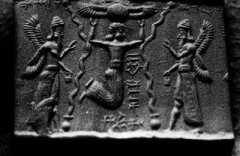
I learned about the Greek and Roman gods and goddesses as a child. But the Sumerian ones? Only recently. Here are a few tantalizing details about Inanna (goddess of writing, civilization, war, love, sex changes, and much more) and Nanshe (goddess of social justice).

Inanna

She’s a major god in the Sumerian pantheon, a direct descendant of Nannu, the primeval mother of heaven and earth. She was worshipped for thousands of years and bears a strong resemblance to other lands’ goddesses, such as Ishtar, Aprhodite, and Venus. Sumerians sang many hymns and told many stories about her.

Enheduanna, the first person ever to sign her name to a work of writing, prayed to Inanna as her personal god.

Inanna is the one who first brought civilization to the people. Sumerians tell of the divine me’s — no translation is possible because they’re laws, events, and qualities; for instance: irrigation, the flood, suffering, joy. Once upon a time, Enki had all the me’s, and Inanna, his daughter, journeyed to visit him. They drank a lot, and then he gave her all the me’s. He later regretted it and sent minions after her to retrieve them, but too late!

In another story, Inanna journeys to the underworld, just because she can. Her sister, who rules the underworld, has her stripped naked and killed, but she gets out again with the help of her faithful assistant. But the underworld demanded somebody in her place, and that somebody turned out to be her faithless husband Dumuzi.

Nanshe
Nanshe is the goddess who looks out for widows, orphans, beggars, the debt-slave — the socially disenfranchised. She’s in charge of making sure that weights and measures are fair and accurate. And boy, does she run her temple like a tight ship. For instance, her temple hymns say:

“If the grain does not suffice for these rites and the vessels are empty and do not pour water, the person in charge of the regular offerings does not receive extra.”

I should think not!

The hymns also specify that priests can be fired or denied rations if they step out of line. People who ate and say they didn’t are also in trouble, as are mothers who deny food to their children.

She’s a powerful goddess, Nanshe, who “cares for all the countries,” who delivers the powerful to the powerless, who “sees into the heart of the Land as if it were a split reed.”

If You Had to Choose
Sumerians worshipped the entire pantheon, but they had one god in particular as their personal god. If you had to choose between these two, which would you serve? This question has special significance to me right now, because with everything going on in Libya, in Wisconsin, etc., it seems like right now is the time for some good social justice action — but what my soul craves is a long bath in the sea of story. I haven’t been writing stories in a year or more, and the lack is painful. Can I do both?

More Goddessy Goodness

For the authentic best-guess translations of Sumerian texts, check out the Electronic Text Corpus of Sumerian Literature. That’s where I snagged the quotes about Nanshe (A hymn to Nanshe: translation).

Nanshe, along with Inanna, also appears in Enheduanna’s temple hymns. There’s a lovely PDF of some of the hymns here.

I first met Enheduanna in the book Humming the Blues: Inspired by Nin-Me-Sar-Ra, Enheduanna’s Song to Inanna by Cass Dalglish.

The best place for a retelling of Inanna’s stories is the book Inanna by Kim Echlin and Linda Wofsgruber. It made me want to cry for poor Dumuzi, and for Inanna, who apparently regretted banishing him to the underworld. The somewhat stilted language of the “authentic” translation is made more accessible in this retelling, and the poetic spareness lets the beauty of the story shine through.

Previous Post: Enheduanna and Gilgamesh

Enheduanna and Gilgamesh

I’ve been fascinated by Mesopotamia ever since my tenth grade history class, when my outstanding teacher, Mr. Felt, taught me about the birthplace of writing. (Although I’ve since learned that it writing was developed in other places at around the same time, give or take a thousand years.) I’ve also been in love with the epic of Gilgamesh ever since I read the novelization Gilgamesh the King by Robert Silverberg.

But I had absolutely no idea of how much Sumerian literature survives, nor the extent to which goddesses figured in Sumerian story, myth, and poem. And I also did not know that the first person ever to sign her name to a text was a woman.

Her name was Enheduanna. Her father, Sargon, came to Sumer from the nearby country of Akkadia, and conquered the city-states that had previously been warring. He appointed Enheduanna as high priestess. She collected all the temple hymns from all the city-states in one place. At the end of it, she wrote:

“The compiler of the tablets was En-edu-ana. My king, something has been created that no one has created before.”

I get chills when I read that.

I first learned about Enheduanna a year or so back I went to a reading by Cass Dalglish, who wrote Humming the Blues: Inspired by Nin-Me-Sar-Ra, Enheduanna’s Song to Inanna.. It’s a “jazz translation” rather than a literal one, which makes the text come alive with passion and music. Dalglish points out that most translations of the cuneiform fix a single meaning to the words, but multiple readings are possible. So for each line, she took all the possible readings and then wrote a verse of poetry.

Having read Humming the Blues, I couldn’t help but wonder: what does the more traditional translation look like? I wanted the “authentic,” “authoritative” reading of the text. But I wanted the impossible. Sumer vanished with the birth of the Babylonian empire, and what’s left of their culture comes to us in stories passed on to other peoples and fragments of broken clay tablets.

I also couldn’t help but wonder: when did Enheduanna live, relative to the epic of Gilgamesh?

And so I began a journey into the heart of Sumer.

In the next post, I’ll write about Inanna and Nanshe — the goddess of writing and the goddess of social justice.

Nifty links about Sumerian literature

Wikipedia: Gilgamesh, Sumerian King List

Enheduanna’s writing: http://www.gatewaystobabylon.com/myths/texts/enheduanna/enhedwriting.htm

Essay on Enheduanna: http://www.cddc.vt.edu/feminism/enheduanna.html

Bibliography:
Betty De Shong Meador. Inanna, Lady of Largest Heart: Poems of the Sumerian High Priestess Enheduanna. 2001.

Samuel N. Kramer, Diane Wolkstein. Inanna: Queen of Heaven and Earth. 1983.

Research page:
http://www.angelfire.com/mi/enheduanna/

PDF of hymns:

Click to access page_15.pdf

Excerpts at:
http://home.infionline.net/~ddisse/enheduan.html

Book group dilemma

My book group has shrunk in size, and I’m now facing a dilemma. Grow it or leave it? One of the members recently expressed dissatisfaction at the lack of seriousness – people showing up without having read the book, and showing up not ready for a good discussion. I realized I’ve been batting fifty/fifty for a little while now. Last year I read ’em all, but this year there’s a higher proportion of books that I don’t like. And really, if I don’t like a book, there’s no way I’m going to finish it.

Our most recent book group meeting was pretty unfortunate. I actually read the book – in fact, I spent weeks struggling through it. But my kid vomited that morning, my spouse was working overtime, and on top of that, we were expecting house guests. So I didn’t go, and neither did one of the other four – which left two people, one who had read the book and one who had only gotten part of the way through.

The two things we need, if book group is to keep going, is: 1) more serious members; and 2) one or more people to enforce our rules. I don’t want to be a rule-enforcer. Too burned out by life generally.

Am I really a book group person? I’m not sure. I wouldn’t be in book group if the selection of books, generally speaking, wasn’t so fabulous. I get exposed to books I would never otherwise read, like The Brief Wondrous Life of Oscar Wao, Affinity, and What is the What?

Here’s our list for the past three years:

2010-2011
> 1. other voices, other rooms – truman capote (august 3)
> 2. south of broad – pat conroy
> 3. affinity – sarah waters
> 4. tam lin – pamela dean
> 5. the housekeeper & the professor – yoko ogawa
> 6. logicomix: epic search for truth – apostolos doxiadis
> 7. the forgotten garden – kate morton
> 8. brick lane – monica ali

2009-2010
Marjane Satrapi, Persepolis
Jamie Ford, Hotel at the Corner of Bitter and Sweet
Gwyneth Jones, Life: a novel
Junot Diaz, The Brief Wondrous Life of Oscar Wao
Marge Piercy, Woman on the Edge of Time
May Sarton, A House By the Sea

List 2008-2009
June 17, 2008
Animal, vegetable, miracle : a year of food life
Kingsolver, Barbara

July 29, 2008
What is the what : the autobiography of Valentino Achak Deng : a novel
Eggers, Dave

September 9, 2008
The beautiful things that heaven bears
Mengestu, Dinaw

October 21, 2008
Moral disorder : stories
Atwood, Margaret Eleanor

December 2, 2008
Let the Northern Lights erase your name : a novel
Vida, Vendela

January 13, 2009
If on a winter’s night a traveler
Calvino, Italo

February 24, 2009
Cat’s Cradle
Vonnegut, Kurt

April 7, 2009
Oh pure and radiant heart
Millet, Lydia