Category Archives: public education

Public schools belong to the people, not corporate interests. Teachers organizing professionally and politically is A Good Thing. And every students needs something different to learn well.

Teachers, take heart!

What am I thankful for on this Thanksgiving holiday? A lot of things, but specifically . . .

. . . TEACHERS.

My teachers, my kids’ teachers, my friends who are teachers. Where would we be without them?

Why do I feel the need to call it out right now? Because from what I can tell, a lot of K-12 teachers are feeling discouraged and disrespected. They’re facing some specific challenges that a lot of people aren’t aware of, such as increased job insecurity, overly controlling administrations, age discrimination, and increased pressure to “teach to the test.”

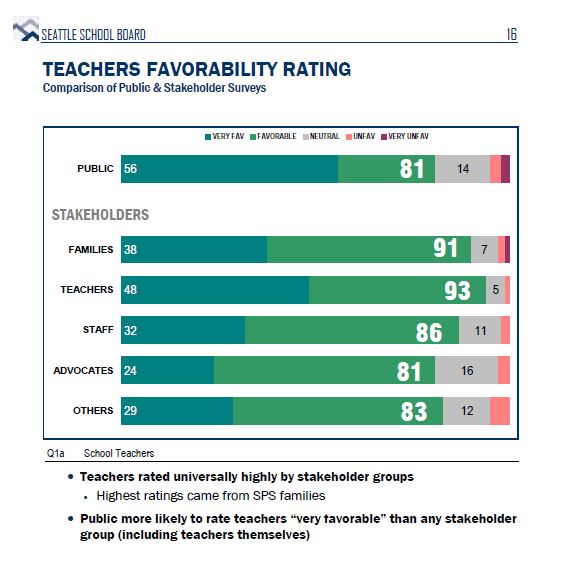
And why do I think that? Because the vast majority of parents like their children’s teachers. The Seattle School District recently surveyed parents and community members, and a whopping 91% of parents felt “very favorable” or “favorable” about teachers. Here’s the bar graph.

This is an overwhelming supermajority of support. It means that whenever teachers are under attack, parents are potential allies. I say “potential” because it doesn’t always work that way. If parents don’t know about the challenges teachers are facing, they’ll stay on the sidelines. And if they can be convinced that the needs of teachers are in conflict with the needs of children, they’ll take the side of whoever claims to represent children.

But when teachers reach out to parents and tell their side of the story, it makes a huge difference. And when teachers ask for help we come through. Tacoma is a case in point. Dring the Tacoma teacher’s strike, parents backed teachers on the picket line, “walking with them and bringing coffee and snacks.” Not only that, but parents got organized and formed a group to support public education, “Parents and Friends of Tacoma Public Schools.

So take heart, teachers. You have friends.

Washington State, you let us down

As a parent of a child in Seattle Public Schools, I am bitterly disappointed in the results of the 2012 elections. Not the charter school vote – I oppose it, but I don’t see it as the most important issue this election season. The votes on taxation.

Our state and our schools have seen cut after cut and we are having trouble with basic health and safety, with school supplies, and with finding seats for all our kids. The Washington State Supreme Court reaffirmed – once again – that our state is failing in its constitutional mandate to fully fund education. We’re short by about 3-4 billion dollars per year. Social services have been hit hard too, with 40% of children living in families that struggle to meet basic needs for food, housing, and healthcare.

We need money, but where is it going to come from? It is easy and popular to blame the legislature. But guess what? Washington voters just tied their hands. In every single county, voters said that the legislature would need a 2/3 majority to pass any new taxes. That includes the closing of corporate tax loopholes.

Not only that, but in an “advisory vote,” Washington voters also told the legislature that the two tax increases it managed to pass last year, which closed some corporate tax loopholes, would be repealed. All but two or three counties went for this.

We can blame the legislature if we like, we can blame Tim Eyeman (the guy who keeps putting this 2/3 requirement on the ballot), and we can blame the big money that heavily promoted these ballot measures. That’s all fine and dandy if it makes us feel better.

But the people who voted for these measures are our friends, neighbors, and family. In my opinion, they let our kids down.

If we really want our schools to be fully funded, as mandated by our state constitution, if we really want our kids to have a great education and a secure future, that’s who we need to convince.

In the meantime, parents and teachers, brace for a storm. We’re not getting relief any time soon.

By which I mean:

Shall I go on? Are those cuts enough? How many more cuts is it going to take before we turn around as a state and say we value our kids?

Judy Moody Goes to College!

I spent last year volunteering part-time in a second grade classroom, working with the kids at math. Although many of them were “at standard,” to me it seemed like they were seriously lacking in math fundamentals – not so much arithmetic as “number sense” – an intuitive understanding of numbers and how they work together. How do you help your kids develop that?

Read this book.

(Whether you have a boy or a girl, but especially if you have a girl who needs confidence in math)

Judy Moody Goes to College by Megan Mcdonald

http://www.powells.com/biblio/1-9780763628338-0

It’s a kid’s book. Read it out loud to your kid, even if she’s a reader herself. Why? Because, like the Mrs. Piggle-Wiggle series, it has as much to teach parents as kids.

Don’t punish the teachers . . .

Across the country, school districts are implementing something called “value-added measures” in determining teacher bonuses, evaluations, and in the case of Washington D.C., even their jobs. “Value-added” means that teachers are judged based on student performance on standardized tests. They’re touted as “objective” even if “not perfect” (a euphemism for “not accurate.”)

How not accurate?

Twenty-five to thirty-five percent, according to this Washington Post article “Study: Error rates high when student test scores used to evaluate teachers” by Valerie Strauss, July 29th, 2010.

Here in Seattle, the school superintendent tried to implement a Washington DC-style policy that would let her fire teachers based on a value-added measure. The teacher’s union fought back hard, but remnants of it are still in the labor contract. I’ll be keeping my eye out to see what the district does. As a parent, I support my kids’ teachers!

Good Teacher, Bad Teacher

Good Teacher, Bad Teacher

When I first had children I had a rude awakening: messages about “bad mothers” were everywhere. If you didn’t nurse, you were a bad mother. If you let your baby “cry it out”, you were a bad mother. If you ran out of diapers and took your baby to the grocery store buck naked (yep, I did that), you were a bad mother.

Of course, there were plenty of messages about “good mothers.” But many of them were conditional on certain behaviors. Good mothers attend to their babies when they cry, never yell at their babies, don’t keep their babies cooped up in carseats all day, don’t let their babies sleep on their stomachs. This is all good advice, but it’s absolutely impossible to follow perfectly, which leads new mothers to wonder: am I a good mother or a bad mother?

Fortunately, not everybody expects perfection from mothers. Pediatrician Winnicot pioneered the concept of a “good enough” mother. She is an “ordinary devoted mother” who attends to their children most of the time, but she leaves them to fend for themselves sometimes. She might slip up and yell, but then she takes a step back and apologizes, and she tries to do it better next time. As it turns out, children actually benefit when mothers and fathers make mistakes, because they learn to rely on their own resources. They learn to cope in an imperfect world.

Now, in the media, there is a lot of talk about “bad teachers” in our K-12 school system. Just as I take affront with the concept of “bad mothers” (and “bad children,” for that matter), I am offended by the concept of “bad teachers.”

Don’t get me wrong. There are some teachers who shouldn’t be in the classroom — sexual offenders, adults who otherwise abuse children, and teachers who don’t care or who gave up.

But these teachers are vastly outnumbered by good teachers – who, unfortunately, often get dissed right along with the bad ones. When people start talking about “bad teachers,” sometimes they’re talking about people who are or could become good teachers. In the first five years on the job, teachers are still learning their trade. They make mistakes. The first year, especially, is a hard one. I learned that when I taught at the college level. My first quarter, I agonized over all the things I was doing wrong, but I also had a friend who was more experienced and helped me put it in perspective.

“It’s a dirty secret and nobody likes to talk about it,” she said. “But the first year, everybody’s a crappy teacher. Just don’t tell your students you’re new, or they’ll eat you alive.”

Was I a “bad teacher” then? One of my students, who cussed me out, thought so.

Or was I a “good enough” teacher – that is, a teacher who made some mistakes? I learned from them, and after some experience and professional development, I got better. Some students called me a “good teacher” or even “one of my best” teachers. Some learned a lot, and others didn’t learn anything at all.

Was I a “good teacher”? Or was I a “good enough” teacher? How could anybody know? And on what basis could anybody make that decision? I got good course evaluation ratings – but not as good as the teacher who neglected to stop his students from plagiarizing.

Although it’s important to have high expectations of teachers, it’s equally important to make sure they’re reasonable. Not everybody will win the “Teacher of the Year” award. But the vast majority of teachers are good – or good enough. Their kids learn. They take professional development courses and continue to improve their teaching. They’re the ordinary, devoted teachers who make a positive impact.

But when the media obsesses over bad teachers, to the point of ignoring the vast majority of good teachers, it hurts teachers overall.

Even worse, good teachers run the risk of losing their jobs. This focus on bad teachers is also paired with an attack on teacher seniority, so that the concepts of “bad teacher” and “senior teacher” have been getting muddled together. But most experienced teachers do better than new ones – so if the experienced teachers lose their jobs, our schools will be left with lower teaching quality overall. This is bad for our schools, bad for our teachers, and bad for our children.

My kids have excellent teachers this year, and I’m glad of it. But I also understand that some years won’t be like that. Some years, the teaching quality will go down a little. My kids might learn less academically, but they might learn better how to cope in an imperfect world.

And that’s plenty good enough for me.

Charter Schools and the Reason Foundation

Charter schools are on the rise nationally, despite no evidence of success and evidence of real harm to students. Seattle has voted down charter schools time after time, but 2010 might be the year they establish a firm foothold in our most vulnerable neighborhoods. Charter school companies like KIPP and GreenDot are coming to town to give public and private lectures, probably in an effort to pass state legislation allowing charter schools. Meanwhile, the school superintendent seems to be pushing to close schools that have failed under No Child Left Behind.

What’s behind this huge push?

A previous blog post talked about the influence of billionaires Fordham, Gates, and Broad in the recent anti-union efforts of the organization NCTQ. These billionaires have charter school plans as well, which I’ll discuss in another post.

But another key player is the Reason Foundation, a major libertarian organization partly funded by billionaire David H. Koch. (The Koch brothers fund the Tea Party, and their father, Fred Koch, was a founding member of the John Birch society.)

Through this foundation, Koch has been gaining greater and greater power over public policy. This power is leading to changes in our laws that the vast majority of Americans probably do not want.

The mission statement of the Reason Foundation says:

“We use journalism and public policy research to influence the frameworks and actions of policymakers, journalists and opinion leaders. Reason Foundation’s nonpartisan public policy research promotes choice, competition, and a dynamic market economy as the foundation for human dignity and progress.”

This agenda of “choice, competition, and a dynamic market economy” is especially dangerous for our public schools. But that’s the direction our nation’s schools are taking, and it’s because of the behind-the-scenes power of billionaires and organizations like the Reason Foundation and the Fordham Institute.

The Reason Foundation policy paper “Fix the City Schools: Moving All Schools to Charter-Like Autonomy” by Lisa Snell, proposes that schools perpetually compete with one another based on the results of standardized tests, and perpetually close when they fail to meet standards that have been imposed by the top.

Snell writes: “The bottom line is that the district seeks continuous improvement by assessing performance of all schools, closing the lowest performing schools and creating alternate opportunities for students in the least productive schools.” In other words, “the essence of this policy brief” is to “close failing schools, open new schools, replicate great schools, repeat.”

What makes this technique so damaging to students is that charter schools, on the whole, don’t provide a better education. One third of charter schools do worse than public schools – while only one sixth do better, and one half do about the same. This means that approximately one third of students in these closed schools will move on to an even worse education. And every time a school closes, all the students face severe disruptions.

These are not just theoretical outcomes, but represent the actual, lived experience of millions of students in districts where charter schools have taken hold, as in cities like New Orleans, Chicago, and New York. (David H. Koch, by the way, is the richest and most powerful resident of New York City.) It has been devastating for the most marginalized children – poor children, children of color, special education children, and English language learners.

But the actual suffering of children does nothing to deter the Reason Foundation or school district leaders in cities targeted for charter schools. Snell interviewed Louisiana State Superintendent Paul Pastorek and described his vision for public schools:

“There was an article written the other day called ‘Try, Try Again,’ and I think it epitomizes our strategy. We’ll give it to a charter operator. We’ll let them work it. If they fail, we’ll bring in another charter operator and if they fail, we’ll bring in another charter operator until they get it right.”

Our struggling kids can’t wait while policymakers and state superintendents try out this charter experiment. They need real change now. They need an end to the punitive measures in No Child Left Behind.They need librarians, counselors, social services, and tutoring. They need equal access to excellent education, regardless of income, race, ability, or language. They need qualified, experienced teachers with union protections. They need small class sizes.

Because there are no quick fixes.

Because education isn’t about “high performing” or “productive” schools.

It’s about the kids.

Florida and Washington anti-education efforts

I ran across an article on the Web page for the National Education Association about anti-education reform education: “Crist Vetoes SB 6, Takes Bold Stand for Florida Schools.” The Florida Senate had introduced a bill that was so bad that the Republican governor voted against it. In a state that has had trouble with teacher shortages, it would have lowered pay and eliminated job security for teachers.

What struck me is that one of the provisions in this bill were very similar to the SERVE proposal that the Seattle superintendent tried to introduce at the last minute into the teacher contract. The SERVE proposal would have based half of the teachers’ evaluations on the results of a student standardized tests – although research has shown this to be ineffective. Likewise, Florida SB6 would have “required that all teachers be retained, certified and compensated based on student test scores on standardized tests.” The final labor contract in Seattle ended up with some elements of the SERVE proposal, but much weaker.

Another provision bears similarity to a Senate bill that was passed here in Washington, SB 6696. Florida SB6 would have extended the probationary period for teachers to five years. Likewise Washington SB 6696 extended the probationary period from two to three years. Again, it’s much weaker, but it’s the same general concept.

What accounts for these similarities? Basically, the rich and powerful who are pushing for nationwide “education reform” have about the same goals. So anti-education organizations are using the same tactics across all our states and cities.

What’s the bad news? Anti-education efforts are far from over in Seattle. What’s going to happen in the next legislative session? Will we see bills like S B6?

And what’s the good news? Grassroots efforts can stop them. In the case of Florida, tens of thousands of people wrote and called the governor in opposition to the bill. And in the case of Seattle, even though the SERVE proposal was introduced at the last minute, teachers got the word out, and people protested.

If Florida did it, so can we.

Billionaires Vs. The Teachers’ Unions

With the current funding crisis, billionaires in the United States have been donating millions and millions of dollars to education. That’s good, right?

Not really. Their money comes with strings attached. Billionaires have a reform agenda that most people would not support if they knew the full agenda. They have been pushing it aggressively within the last few years, not only at the federal and state levels but also at the levels of individual school districts and local grassroots groups.

This post takes an in-depth look at one small example of how the billionaire reform agenda has affected local education policies in Seattle by showing how billionaires Fordham, Gates, and Broad influenced the local teacher contract negotiations. Why look at local politics? Because that’s where parents and teachers have the strongest voice, and if we can see what’s happening, we can make a difference.

In Seattle, one key link between the billionaires and the Seattle School District is the National Council for Teacher Quality (NCTQ), a nonpartisan research and advocacy group committed to restructuring the teaching profession. Key funders include billionaires Fordham, Gates, and Broad.

Their “About Us” Web page gives a pretty clear idea of the goals of NCTQ, if you look past the fancy language. They want to make “significant reform in how we recruit, prepare, retain, and compensate teachers.”

Was the NCTQ planning to listen to teachers’ voices in making these reforms? Not so much. According to the “About Us” page, they were founded “to provide an alternative national voice to existing teacher organizations.” The NCTQ follows the lead of the Fordham Institute in describing teachers as “human capital.” You don’t listen to capital; you spend it.

Over the years, the NCTQ has collected in-depth information of collective bargaining agreements, including a database of one hundred agreements from all fifty states. It has an analysis of how collective bargaining agreements and state law work together to shape policy. And it is using this information to help enact the reforms it wants.

During the Seattle teacher contract recommendations, the NCTQ made recommendations to the district. Before negotiations began, it produced a report called “Human Capital in Seattle Public Schools.” This report was funded by the Gates Foundation and by an organization called The Alliance for Education, which is funded by billionaires Gates and Broad. It called for changes such as establishing merit pay, halting salary increases after teachers become certified, ending certain seniority privileges, increasing teachers’ work hours, evaluating teachers more strictly, making it harder for teachers to become certified, and using the results of student standardized tests to evaluate teachers and identify the “high performing” and “low performing” teachers.

This last point was most controversial for teachers. Can the results of student standardized tests accurately measure teacher performance? Education research says no, it does not. But education reformers badly want a number to measure performance, something that can be called an objective measurement, and something that can be used as a factor in layoffs and firings.

During contract negotiations, the NCTQ came out with a second report that analyzed the district and union proposals and giving its own recommendations. It listed them as either “important” or “must haves.”

“Must-haves” included:

  • Ending a “super-seniority” policy of factoring seniority into teaching assignments – which means that senior teachers can be laid off more easily
  • Establishing a system of merit pay
  • Using the results of student standardized tests to evaluate teachers

Curiously, in the final contract, the NCTQ got all of its “must-haves.” Why? Partly because it caught teachers and parents unaware and unprepared to make an effective resistance, and partly because the billionaire influence was hidden.

This teacher contract was only one step along the road to education reform for NCTQ and billionaires like Fordham, Gates, and Broad. State law has also advanced the billionaire reform agenda, and we can expect further changes to state law in the upcoming legislative session. This is an explicit goal of the NCTQ, as stated in its article “Invisible Ink in Teacher Contracts.”

This is only one small example of how billionaires have shaped education reform in Seattle. As the diagrams in the Seattleducation2010 blog post “The Lines of Influence in Education Reform” shows, billionaire money has gone to the League of Education Voters; to the Seattle school superintendent; to grassroots groups such as Alliance for Education and Stand for Children; to marketing firms; and to charter schools.

The good news is that if we can watch where reform efforts are coming from, we can start to make an important distinction between the changes that billionaires are advocating and the changes that parents, teachers, and students actually want. We can make an important distinction between billionaire-funded grassroots groups and true bottom-up grassroots groups. And then we can speak up.

Because if it’s a choice between the billionaires and the teachers, I’m going with the teachers.

Why teachers’ unions matter

Teachers’ unions have been getting bad press in the media in the past few years. The media has blamed them for protecting “bad” teachers and ignored their contribution to the stability and quality of our public education system. So what do teachers’ unions do and why does it matter?

If you went to public school, think back to all the good teachers you had. Some of them were probably new, but most had probably been in the education system for a while. During the first difficult year, teachers are still learning the ropes and tend to make all sorts of mistakes. It takes practice before teachers can even get kids to behave. After a couple of years, when good teachers have hit their stride, they make it look so easy.

Once good teachers have mastered their profession, what should school districts do – keep them or fire them? Keep them, of course. But there’s a financial incentive to fire them or lay them off. And that’s where teachers’ unions come in.

Teachers’ unions protect the jobs of our quality, experienced teachers through seniority. Labor contracts and state law specify that when layoffs happen, the teachers with the most seniority are the last ones to be laid off. This means that teachers can go into teaching as a profession, suffering through the first difficult years with the promise of a stable job later on. And this means that our schools will be filled with more experienced teachers, who can collaborate with one another in the long term and build a true school community.

Lately, the media been attacking seniority, ignoring its benefits and focusing on the “bad” teachers that seniority rules protect. It is certainly true that some teachers have been in the profession too long. But it’s not because of seniority rules. Labor contracts actually do have provisions for teachers to be put on probation and let go. Often it’s the principal or school district officials who protect the jobs of teachers who are not capable of doing their jobs.

Teachers’ unions protect the quality of our education in other ways too. Unions negotiate pay, medical insurance, retirement, and sick days – all the things that make teaching a more attractive job. Without these protections, who would enter the profession? The most qualified – or the most desperate?

And teachers’ unions also negotiate mentoring and professional development. These things can actually turn a “bad teacher” into a “good” one. Teaching isn’t a job you can just jump into – it is a profession with a steep learning curve, and teachers need all the help they can get.

So let’s stop taking teachers’ unions for granted. We owe teachers an enormous debt for the time and energy they put into our educations and our children’s educations. It’s time to pay it back.

Don’t Wait for Superman

The movie Waiting for Superman is coming out tomorrow, and I am concerned about the effect it will have on public education both nationally and here in Seattle. It is essentially an advertisement for charter schools, paid for by big business interests.

The movie shows poor unfortunate students who need rescuing from terrible public schools, a superhero who is coming to their rescue, and the solution to all their problems: a lottery system that gives students a chance to attend top-notch charter schools with waiting lists.

Charter schools are, on the whole, worse than public schools. One third of charter schools underperform compared to public schools on standardized tests – only one sixth do better. (https://kristinking.wordpress.com/2010/09/19/time-magazines-education-reform-articles/)

Some charter schools have better results on student standardized tests. (I’ll set aside, for the moment, my objections to using a standardized test to measure the success of a school.) But this idea of saving students by using a lottery system to assign students to schools is not an acceptable answer to the problems of public education, because it is not available to everybody. Here in Seattle, the district tried “school choice,” which led to a lot of stress and frustration for parents who had enough trouble finding the “best schools,” and which the district has now abandoned because it cost too much to bus students all over the place.

The only way to save public education is to give all schools and all students a chance to succeed.

And parents, students, and teachers can’t wait for a superhero to make this change happen. We have to do it ourselves. We have to be our own superheroes.