Category Archives: that’s political

I’m always pondering how to build a better world. Or how to survive this one. I read, think, dream, act. It’s all here: utopias, dystopias, the hidden workings of power, resistance, organizing, and action.

Resist What? The Confederacy

Sometimes I get a bug up my butt and can’t think about anything else until I have researched it to death. Especially if I’m angry. For the sake of my well-being and the rest of my life, I ought to stay off the Internet so I don’t see this kind of thing, but I saw it, so there we are. Nancy Mace, politician, explaining that she watches ICE videos for fun and can’t think of anything more “American” than the cruel and violent kidnapping of innocent people. What kind of person is that wrongheaded and horrible? Like, how did she get that way? It suggests that she was raised with one kind of thinking, one warped vision of America that is the exact opposite of mine. Her family, her community, her church, her business profits–everything around her. I’m sure she recited the pledge of allegiance, but also certain the words “liberty and justice for all” went over her head.

So, I researched her ancestry. I shouldn’t have bothered, because the information is out there, generations of military and “prominent family” going back to the civil war, with a decorated Confederate soldier or officer or some such, and slaveowning. Just search her name in connection with Confederate ancestry and you’ll find it for yourself. There’s an article about 100 political elites with such a history, and she’s in it.

But no, I had to do the research the hard way. Her father, a brigadier, was easy. His parents, curiously, were not listed in any of the biographies I saw, and neither was his name or place of birth. His biography started when he graduated from a military school called the Citadel. That’s a time and a place, and the last name is common. After some thrashing about and chastising myself for wasting my time, I looked for people with that last name in the South around 1800 and eventually saw the link. Along the way, I saw lots of pictures of people who just looked friendly and respectable, ordinary except for the exclusion of people of color.

So what is this? This political moment? People are talking about fascism and comparing the administration to the nazis, and that’s not wrong, but it’s not right either.

What’s up with all the focus on Confederate statues and place names? Why has the January 6th coup attempt been glamorized?

I mean, we all know, right? That the United States has a shameful history of kidnapping and enslavement of Black folks and massacre of indigenous folks. In my liberal education, I was taught that we were pretty much past it. Our nation became enlightened. White liberals figure we fought the confederacy and we won, and by the way we ended racism so we shouldn’t talk about it really.

I see signs here and there that say “Resist!” But they don’t say what to resist—what we are fighting against–or even what we are fighting for. (Liberty and justice for all.)

I propose that for today’s resistance (you know, whatever day you’re reading this), we resist the lies in our head, the ones that say, “After the midterms, everything will be okay. We’ll start going back to normal.” Normal wasn’t enough. This whole time that liberals were thinking normal was okay, and appeasing bigots, the descendants of slaveowners have been using their stolen wealth to bring back the confederacy, one piece at a time.

Well, we fought the confederacy once. But now we, the people, have to do it all over again.
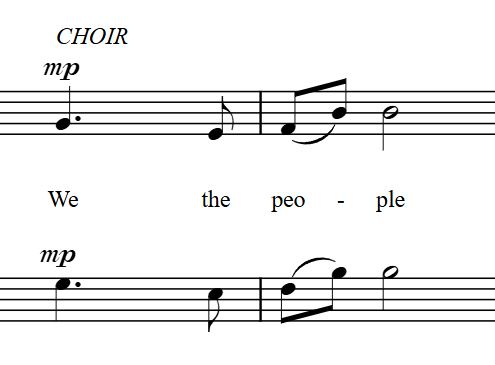
A snippet from a music sheet for "The Preamble" by Schoolhouse Rock. It includes the notes and words for "We the people."

Resist.

Four Doctor Who moments for the Now

Art can reduce tragedy down to a form we can look at without losing our ability to cope. To see — not to look away — but to retain the ability to act. To see terror and retain courage.

Consider the Dalek — a genocidal killing machine. Fascism in its purest form. We bake Dalek cookies and eat them; we crochet them for use as potholders and ornaments; or, in my case, put them in dollhouses. It’s a way of controlling our fear. We defuse it with silliness and domesticity.

A Dalek stands in the kitchen of my dollhouse, wearing an apron and holding a jar of yogurt. Ants cover the floor and are climbing up its apron to get at the yogurt.

Art also teaches us to recognize historical patterns. A nazi or fascist might not sieg-hail or use the amateurish German accent we recognize from TV, but we can still learn to notice a violent authoritarian regime that must be resisted.

Here, then, are four moments in Doctor Who that speak to us in the United States, today, right now.

1. “It’s happening again!”

    In the episode “Turn Left,” Donna Noble and her grandfather Wilf say goodbye to their host Rococco, an Eastern European man who had welcomed them with open arms into his apartment when they were displaced by war. Donna is confused about why he has to leave in the back of an army truck.

    “Oh, but why do you have to go?” she asks.

    Rococco replies cheerily. “It’s the new law. England for the English, et cetera. They can’t send us home. The oceans are closed! They build labour camps.”

    “I know,” asks Donna, “but labor doing what? There aren’t any jobs.”

    She still hasn’t clued in, but Wilf’s heart is breaking. His lips tremble. He salutes Rocco and mutters,

    “Labour camps. That’s what they called them last time.”

    “What do you mean?” asks Donna.

    “It’s happening again,” says Wilf.

    That’s when she figures it out. She runs after the truck, but it’s already too late.

    2. I’m not lowering my bubble

    In “Dot and Bubble,” a young woman named Lindy is chatting with friends through her Bubble, wearable social media that nobody ever takes off. She and her lily-white peers are the children of the elite, and for some reason they have been abandoned by their parents and left to their own devices in the guarded town of Fineville. Nothing can get in or out, so they’re safe. Clearly.

    Oblivious, she walks past a body being dragged away and toward her office, where she and her friends do their two hours of work. The Doctor has hacked into her feed and tries to get her attention, but she gives a micro-expression of disgust and swipes him away. In the town of Fineville, racism won. The Doctor’s white companion, Ruby Sunday, appears instead and asks her to lower her Bubble just long enough to look at the real world.

    “I promise I will leave you alone if you could just look at the four desks in front of you,” says Ruby.

    “I am not…lowering… my Bubble,” says Lindy.

    “Okay. Can you stay inside and look beyond it? Can you do that?”

    Bit by bit, Ruby coaxes Lindy and her peers to look outside their Bubbles just long enough to run away from the monsters who are eating everyone in alphabetical order. To be safe, they just need to trust the Doctor.

    Will they?

    3. The Beast Below

    The Doctor and his new companion, Amy Pond, have landed on the far-future Starship U.K. He begins by falsely pretending he follows a Prime Directive: “We are observers only. That’s the one rule I’ve always stuck to in all my travels. I never get involved in the affairs of other peoples or planets.”

    Then they see a young girl sitting on a bench, crying all alone while adults hurry by without looking. Amy turns to the Doctor to ask him a question, only to discover that he is already outside of the TARDIS sitting on a bench and talking to her. He gestures to Amy to join him, and then he asks her to look at this world and tell her what’s wrong with it.

    “Is it the bicycles?” she asks. “Bit unusual on a starship, bicycles.”

    It isn’t the bicycles.

    “Life on a giant starship,” he says. Back to basics. Bicycles, washing lines, wind-up street lamps. But look closer. Secrets and shadows, lives led in fear. Society bent out of shape, on the brink of collapse. A police state.”

    He gives her a moment, then asks, “Do you see it yet?” 

    “Where?” she asks.

    He points to the young girl. “There.”

    4. Get some perspective, woman!

    In “Aliens in London,” the world is in crisis, and all the Very Important People are rushing around the British Parliament Building trying to figure out how to respond. Acting Prime Minister Joseph Green is entirely out of patience with this annoying minor official, Harriet Jones, who has arrived with a proposal for preserving cottage hospitals.

      Green barks out, “By all the saints, get some perspective, woman! I’m busy.” Then he rushes off, super-competently leaving her alone in the Cabinet Room with a file of Emergency Protocols.

      A bit irresponsible? Well, aliens have just landed in the middle of London, and most of the British Government is missing. It is an emergency, after all. As it turns out, though, this is an emergency of his own making. He is actually an alien, wearing a human skin, intent on making quick cash by destroying Earth. And farting. A lot of farting.

      Authoritarianism pairs well with farting, don’t you think?

      Thoughts on Horizontalism, ed. Marina Sitrin

      Some years ago, I read the collection Horizontalism: Voices of Popular Power in Argentina by Marina Sitrin. Sitrin collected firsthand accounts of people active in the social movements in Argentina that came after sudden economic devastation in 2001. Sitrin writes:

      “The precipitating incident was the government’s freezing of peoples’ bank accounts, and converting their money, once pegged to the U.S. dollar, into a financial asset that would be held by banks and used to secure payment to foreign investors, but that could not be accessed by the depositors. . . . This was the spark dropped on a long smoldering fire. The government of Argentina had taken out huge loans with the IMF in the 1990s, and in the late 90s began to pay these loans back through privatization and severe austerity measures. Thousands of people were laid off, wages and pensions were cut, and social services degraded. . . [B]y 2001 industrial production had fallen by over 25 percent. The official poverty level grew to 44 percent, with the unofficial level substantially higher.” (pp 8-9)

      Let’s go back a minute to the word “austerity.” Here is a short definition from an article published in 2022 on the Oxfam International web site: “85% of the world’s population will live in the grip of stringent austerity measures by next year.”

      “Austerity measures include scaling down social protection programs for women, children, the elderly and other vulnerable people, leaving only a small safety net for a fraction of the poorest.  They also include cutting or capping the wages and number of teachers and healthcare workers, eliminating subsidies, privatizing or commercializing public services such as energy, water and public transportation, and reducing pensions and workers’ rights.”

       In the past, “austerity” is something that mostly happened to other countries, so those of us in the United States might not have heard of it. (It has been happening here slowly, for quite some time, but that’s a topic for another post.) Well, we’d better learn fast, because it’s going full throttle. In other words, we can defeat “America First” if we realize that we are not the only country in the universe. (For that matter, we’re not even “America.” That’s a continent. It has other countries in it.)

      From the global South, those of us in the global North can learn both what might happen and how people might respond.

      I’ll try to write more later, but for now I’ll just say, “Go read the book.”

      Previous posts about this book:

      Have our brains been hacked?

      I have been thinking about “collective consciousness” for some time now, as a corollary to the Jungian idea of the collective unconscious. My 2018 blog posts “Musings on collective cognition” and “Could collective cognition be manipulated?” touched on ideas around social media, emergent consciousness, and deliberate rewiring of group thought. What do I mean by “collective consciousness”? It’s a fun thought experiment to imagine that the consciousness of humanity could be an organic entity of itself, self-aware and capable of acting in its self-interest. But there’s no need to get that abstract and esoteric.

      Let’s think of collective consciousness as a form of thought that goes beyond a single brain. We make it when we talk to each other, or write, or sing, or paint. When someone carved a poem on cuneiform, and I read a translation of it thousands of years later, that is like a message passed from one neuron to another.

      Who is allowed to pass such thoughts into my brain? People, books, music . . . but that’s so twentieth century, man! TikTok, the social media formerly known as Twitter, Facebook . . . I just let those types of social media right in, past all my defenses. I catch myself “knowing” something but not remembering where I learned it. Now humanity is sharing this space with bots and AI designed by humans in order to gain political and economic power. This is a little scary.

      More scary: the people who own social media, like Elon Musk, have an outsized impact on how we think.

      It should be pretty well known by now that Russia has been influencing U.S. politics using social media bots. If not, here’s the news from the mouth of the Justice Department, in its September 4, 2024 press release

      Justice Department Disrupts Covert Russian Government-Sponsored Foreign Malign Influence Operation Targeting Audiences in the United States and Elsewhere

      “The Justice Department today announced the ongoing seizure of 32 internet domains used in Russian government-directed foreign malign influence campaigns colloquially referred to as “Doppelganger,” in violation of U.S. money laundering and criminal trademark laws. As alleged in an unsealed affidavit, the Russian companies Social Design Agency (SDA), Structura National Technology (Structura), and ANO Dialog, operating under the direction and control of the Russian Presidential Administration, and in particular First Deputy Chief of Staff of the Presidential Executive Office Sergei Vladilenovich Kiriyenko, used these domains, among others, to covertly spread Russian government propaganda with the aim of reducing international support for Ukraine, bolstering pro-Russian policies and interests, and influencing voters in U.S. and foreign elections, including the U.S. 2024 Presidential Election. “

      This is not a new phenomenon. A recent article from the SAIS Review of International Affairs, “Social Media, Disinformation, and AI: Transforming the Landscape of the 2024 U.S. Presidential Political Campaigns” talks about some of the ways that bots are shaping public dialogue, and it cites studies going back as far as 2011.

      “During the 2016 US presidential election, Howard and Kollanyi (2016) proposed that political bots played an increasingly important role in the globalized political system in the form of botnets, fake news, and algorithmic manipulation, which was also known as “computational propaganda,” that referred to “assemblage of social media platforms, autonomous agents, and big data tasked with the manipulation of public opinion” (p. 4). In short, political bots—a subset of social bots—can be leveraged to influence public sentiment and intervene in the opinion climate, commonly known as “social media astroturf” (Ratkiewicz et al., 2011). Moreover, political bots would intensify the polarization of attitudes, amplify negative emotions, and subtly endanger democracy (Robles et al., 2022).”

      So there’s something I read on social media but can’t find now. (Ironic, yes?) It had to do with Russian psy-ops bots weighing in on U.S. “culture wars” by either creating or amplifying memes such as “Karen” and “O.K. Boomer.” Maybe they did, maybe they didn’t. But that’s the kind of thing bots can do: find two opposing parties, learn their point of disagreement, and fuel the flames by amplifying it. This manipulation feels more personal and disturbing than simply political bots.

      I titled this blog post, “Have our brains been hacked?” and my answer is “Yes, obviously.”

      Where does it stop? How far will it go? Billionaire “tech bros” now have access to a vast storehouse of public dialogue, AI tools to analyze and utilize it, and an economic interest in keeping people compliant.

      And what can we do? My answer is largely metaphorical. We need antivirus software for our brains, and also for our collective mind/minds. What? How? Dunno. I’ll just fling that question out into the world and hope somebody smart catches it.

      But I guess more urgently, we should be aware that if we are doing The Resistance on social media, then The Resistance has also been hacked.

      What does handwriting have to do with democracy?

      It wasn’t until high school that I first learned to type. Before that, handwriting was the only game for communication, and I wrote voraciously, with words and pictures. Today, I use a mix. Typing is much faster, but a pen and paper is always available.

      The generation graduating high school, voting, and entering the workforce has had a much different experience. Because of widespread focus on standardized tests, administered by computer, schools were forced to teach typing in the early elementary grades. With no additional instructional hours, what got cut? Snail mail letters, cursive, and art.

      Flash forward to the present day, and typing on computers is being replaced by typing on phones, usually in short, quick bursts. The faster the better, and if you pass along someone else’s words, well that’s even faster! We pass on links before we have thought about whether they are credible. Checking sources is quick and easy, but with only one screen in front of us at a time, it’s a bit of a hassle and often skipped. Who has the time? We have to get to the next thing to read and pass on. We are metaphorically putting other people’s words, verbatim, into our mouths.

      I have certainly done my share of “doomscrolling” lately. But it isn’t the only way I interact with the universe. I also spend time with a sheet of paper and a pen writing down ideas. These are my ideas, and my words. I can come back to them later to question or remember. I can link ideas together graphically, whether it be in outline form or whatever “bubble” form might be popular. At that point, I type them up. I’ve put more thought and more feelings into them, I’ve considered the past and future, and I’ve left time and space for them to breathe. It’s like kneading dough, knocking it down, letting it rest, and letting it rise.

      What happens to a generation without this skill? What is being taught to our elementary school kids today? Who and what will they vote for in 2035?

      -Kristin

      Asking the wrong questions, getting the wrong answers

      Normally I find the Guardian to be a good news source, but this article frustrated me: “How America’s Identity Politics Went from Inclusion to Division.” The author, Amy Chua, is taking the position of “expert” on a topic for which she’s missing essential context. As are the editors of the Guardian, and probably most of the readership. So people who are quite rightly annoyed by a certain ideological narrowness in the politics of the Left today will go on sharing it on social media and various fights will break out. But this is a time when collectively, our lives depend on knowing what’s wrong and what to do about it.

      Here’s the narrative Chua gives:

      Perhaps in reaction to Reaganism, and a growing awareness that “colorblindness” was being used by conservatives to oppose policies intended to redress racial inequities, a new movement began to unfold on the left in the 1980s and 1990s – a movement emphasizing group consciousness, group identity, and group claims.

      Perhaps she was unaware of the influence that third-wave feminism had on “the left” or the fact that “the left” is not monolithic. How, one wonders, could the she have missed that? Well, who is the author? Amy Chua is a law professor, with expertise in the areas of international business transactions, development, ethnic conflict, and globalization. The view of the world looks vastly different from where she’s standing.

      Me, I’ve spent two or three decades grappling with the miscellaneous neuroses of activist groups. I agree with Chua on many points, such as insularity, exclusion, and so forth. But I disagree that these are problems of “identity politics,” and say rather that they stem from a misunderstanding of the original context of “identity politics,” which was a truly revolutionary and inclusive movement by Black feminists that existed back in 1978 and is ongoing today. And people who really want to put an end to narrow-mindedness would do well to understand who has been already doing that work and why, rather than to sweep everything remotely reeking of “identity politics” under the rug.


      Why would somebody focus politics on their identity, anyway? Is it “tribalism,” as Chua suggests, or is there a different goal? There’s no answering this question without delving deeply into the Combahee River Statement.  Here’s what the collective has to say about identity politics:

      This focusing upon our own oppression is embodied in the concept of identity politics. We believe that the most profound and potentially most radical politics come directly out of our own identity, as opposed to working to end somebody else’s oppression.

      They go on to explain that as Black lesbian feminists they face oppression on many fronts, including race, gender, and class, and because of their identity they cannot agree with any single-issue politics, because it leaves out too much and too many people:

      As we have already stated, we reject the stance of Lesbian separatism because it is not a viable political analysis or strategy for us. It leaves out far too much and far too many people, particularly Black men, women, and children.

      Because they experience multilayered oppressions, they feel the need to fight them all:

      The major source of difficulty in our political work is that we are not just trying to fight oppression on one front or even two, but instead to address a whole range of oppressions. We do not have racial, sexual, heterosexual, or class privilege to rely upon, nor do we have even the minimal access to resources and power that groups who possess anyone of these types of privilege have.

      For their own work, they chose to prioritize issues at the intersection of a number of oppressions but also noted:

      During our time together we have identified and worked on many issues of particular relevance to Black women. The inclusiveness of our politics makes us concerned with any situation that impinges upon the lives of women, Third World and working people.

      This is not tribalism. This work includes anyone who faces any type of oppression. And in fact, it tangibly benefits a much broader group than themselves, right down to working class white men.

      And this is ultimately their goal:

      As feminists we do not want to mess over people in the name of politics. We believe in collective process and a nonhierarchical distribution of power within our own group and in our vision of a revolutionary society.

      I mention the Combahee River Statement because I find it particularly inspiring, but it is only the tip of the iceberg when it comes to feminist thought by women of color. In fact, it was written in 1978 and theorizing has gone farther than this. Right now I’m rereading the book This Bridge Called My Back, Writings by Radical Women of Color, written in 1981, with works by 29 women. I’m taking it slow, because there’s a lot here, all of it potent.

      Bridge-Called-My-Back-Writings-Radical-Women-Color

      So for anybody talking about narrowness of politics and calling it “identity politics,” for heaven’s sake, get up to speed on conversations that have been ongoing since at least 1978. Racism and a suspicion of feminism have kept these dialogues out of mainstream awareness . . . it’s long past time for that to end.


      When free speech is expensive

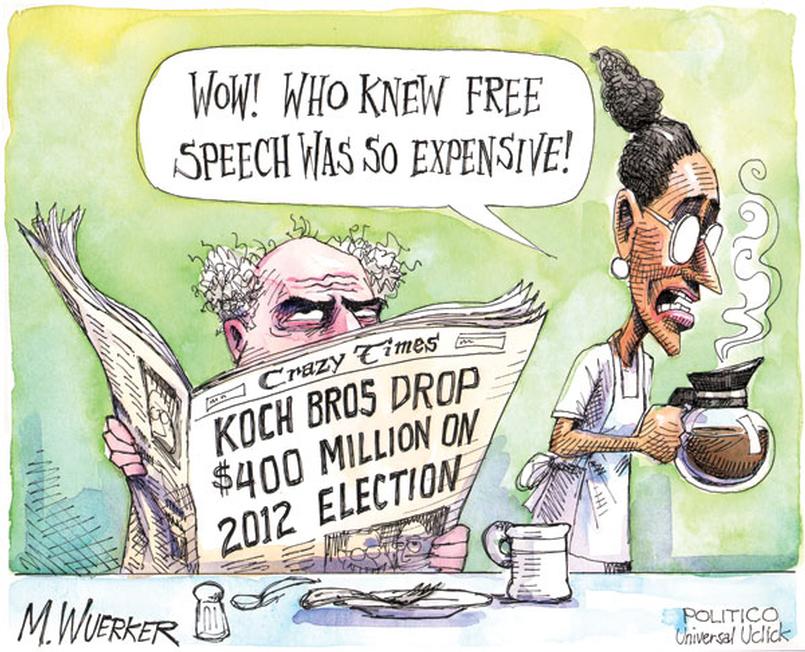
      This Saturday, the University of Washington College Republicans are bringing in a speaker from a right-wing group called Patriot Prayer, amidst protests by campus groups. The president of the university has warned people to stay away from the area for the entire day because the university has information that people are coming with the explicit purpose of instigating violence. Now, it also turns out, according to an article in the University of Washington’s Daily newspaper, that the College of Republicans is also suing because the University is imposing a fee of $17,000 to provide security. That is some expensive free speech!

      Last year, on January 20th, when a protester was shot (by somebody who came to the university, with a gun, with the intent to use it, at an event sponsored by the College Republicans) he and his family and community paid dearly for medical costs. He almost died. This was free speech for the wealthy and powerful speaker, who wasn’t even a UW student, but expensive on many levels for everyone else.

      In a free society, who should bear these costs?

      Let’s suppose the College Republicans has to pay the $17,000 for security. I assume they could. But most student groups couldn’t, which in practice means they wouldn’t be allowed the same free speech rights as the College Republicans.

      Something’s wrong here, not only with the situation, but also the way we’re all thinking about free speech. I have this to say to antifa activists regarding the “No Platform” strategy:  right now, it is the wrong tool for the job. More powerful and constitutionally defensible tools exist. For instance: what if every campus group demanded $17,000 for the combined costs of bringing out a speaker and paying for security? A call for “Equal Platform” — now, that would be free speech.

      Above all else though . . . folks, be safe out there on Saturday.

      120604_cartoon_6001_905

      Could collective cognition be manipulated?

      After my last post I wondered if the term “collective cognition” is already in use, and a quick Google search shows me the answer is yes. The next question: could it be manipulated? Also yes. Here are a few “teaser” sites for further exploration. But I’m going to resist the temptation to follow my curiosity because I have a backlog of writing projects . . . including novel revisions.

      Since at least 2001, corporate strategists have been studying the manipulation of collective cognition. For example, here is the abstract to an article by John Mezias in the journal Long Range Planning, “Changing Collective Cognition: A Process Model for Strategic Change.”

      Firms face increasing pressures to modify their strategies and adjust to rapidly changing environmental threats and opportunities. Yet strategic reorientations are difficult to achieve, especially as most methods fail to recognize the cognitive aspects of change. While some methods such as facilitated workshops have become increasingly popular to help top management teams better facilitate strategic change, these have largely evolved on the basis of successful experience rather than on an understanding of cognitive processes. This paper seeks to fill this gap, by drawing both upon theoretical literature and experience with successful change facilitation practices from Europe and the US. Its focus is on the cognitive aspects of strategic orientation and provides a practical guide to those who use this process.

      In other words, when corporate leadership wants to make a change to strategic organization, this article is recommending also changing collective thought processes.

      Here’s an outline of topics covered:

      1.  Introduction
      2.  From theory to practice
      3.  From the individual to the collective
      4. Changing collective cognition
      5. Problems with recognizing a need for change
      6. Problems with mobilizing change forces
      7. Problems with overcoming change barriers
      8. Unlearning, learning and cognitive reorientation
      9. The facilitated Change Workshop
      10. Summary and conclusion

      But why stop with changing collective cognition within a single corporation, when the world is full of potential customers and policymakers? That’s definitely happening within the field of education. Corporately funded think tanks are pushing messages, for instance, that public schools are failing, and encouraging people to become “change agents.”

      And what do you know, the manipulation of social media is indeed being studied. This from “Mnemonic convergence in social networks: the emergent properties of cognition at a collective level” by Coman, Alin, et al, published 2016 in the journal Proceedings of the National Academy of Sciences of the United States.

       Here we report results on the formation of collective memories in laboratory-created communities. We manipulated conversational network structure in a series of real-time, computer-mediated interactions in fourteen 10-member communities. . . . The social-interactionist approach proposed herein points to optimal strategies for spreading information in social networks and provides a framework for measuring and forging collective memories in communities of individuals.

      Apparently they built collective memories out of nothing? Well, if that capability is available, somebody’s going to use it.

      And that’s quite enough dystopia for one day. I am an optimistic person, though, and I do believe there are utopian solutions that involve intentional, democratic, and compassionate attention to collective cognition.


      -Kristin

      (Picture is from Doctor Who: “The Lie of the Land,” featuring aliens who had the power to manipulate collective memory provided one person gave consent.)

      doctor who lie of the land

      From Doctor Who “The Lie of the Land”

      Musings on collective cognition

      Something I’ve been thinking about for a while is Carl Jung’s concept of a collective unconscious and the omission of a complementary term, collective consciousness. The emerging fields of AI and of rapid transmission of thoughts by social media is making the idea more and more interesting all the time.

      Many people in different fields are working on the question of defining things like cognition, sentience, consciousness, and so forth, and in different fields. I haven’t studied anything deeply but I get bits and pieces now and again, like the concept that human consciousness/identity/”I” is simply an illusion made up by a vastly more complex brain. If that’s the case, then perhaps a single voice could pipe up, such as an artificial intelligence, call itself the mind of the world, and convince others that only it has the power of speech. And maybe that would be a collective consciousness.

      So I think about weird things like that.

      Or perhaps humanity has always had not one but many collective consciousnesses, with some dominating the conversation and others forced to remain silent. The ones on top would be, for instance, news outlets, celebrities, and respected authors.

      In that case, what effect is social media having? Is another collective consciousness rising to the surface, as when people use hashtags such as #metoo and #blacklivesmatter, quickly followed by #notme and #bluelivesmatter. If so, it’s based in humanity but it’s also inhuman. It’s an emergent consciousness.

      Depending on how you define consciousness (cognitive scientists disagree), this is an overreach. But maybe collective cognition is a safer and less new-age concept.

      Here’s Wikipedia’s current definition of cognition: “the mental action or process of acquiring knowledge and understanding through thought, experience, and the senses”. This definition leaves out the question of “who or what is doing the thinking,” because we’ve always assumed it to be a human or other animal. Maybe it’s time to question that.

      Back to the idea that maybe social media and artificial intelligence could give rise to collective consciousness, we had better be damn sure that what we are building, accidentally at the moment, serves the interests of humanity and the Earth.

      Then connecting that concept to the idea “the medium is the message” — that is, if you communicated the same idea over the TV, radio, or speech, the media you used would make a much larger difference than the idea you were expressing — our social media platforms impact our collective cognition.

      Connecting that idea to Facebook in particular, it just changed its algorithms for what kinds of posts get higher in our news feeds. It’s a good idea to do something, since social media encouraged fake news, which helped swing a presidential election, but there will inevitably be unexpected side effects. We need to watch them.

      Now, taking that idea and putting it into a crystal ball, what is likely to happen in the near future? What kinds of positive change are likely and which impossible? Well, in the absence of a catastrophic failure of technology (could happen), there’s no going back. Social media is with us to stay.

      The one thing we can  impact is who owns it.

      So that’s it, a tour of my musings. Like the image I’m featuring, they turn the ways we typically view the world on its side. Hope you enjoyed the ride.

      -Kristin

      (Image features a sideways view of the globe.)

      600px-atcan_globe-webm

      Daniel R. Strebe, March 27, 2015, from Wikimedia Commons

      Poisoning the well of public debate

      Following up on my previous post about talking points for the #MeToo backlash, I did a google search for the phrase “meet the women worried about metoo” and found two articles of interest, one rebutting talking points and another, earlier article, that was propagating them for somebody’s profit. Exploring these articles and the connections between them can lead us to insights about how propaganda happens in the twenty-first century and some potential solutions.

      Poison and its rebuttal

      Since it’s more pleasant reading, I’ll start with the rebuttal: “People Still Have No Idea What The #MeToo Movement Is Actually About” by Callie Byrnes, January 11th 2018.

      It appeared on a site called thoughtcatalog.com, which I hadn’t heard on, so my first step was to wonder, “Okay, who’s funding this?” If I’m going to do true critical thinking I can’t simply criticize sources that challenge my own world view but must also suspect those that confirm them. To my pleasant surprise, their funding appears to come from the sale of products (such as books) rather than the pockets of the ultra-rich.

      Byrne summarizes her main points here:

      It’s as if people have taken the #MeToo movement and twisted it backwards and sideways and so many directions that it’s stopping them from focusing on what it really is: a movement against sexual harassment and assault. It’s not anti-men. It’s not anti-sex. It’s not Victorian or puritanic. It’s not meant to create victims on either side. It’s about stopping a problem we’ve always had but have always overlooked — and the only reason it seems like a “revolution” is because people are finally paying attention.

      Nicely argued, and if I were debating #MeToo on social media, I’d do well to start with these points. But there’s another question: Why do we have to bother? Why can’t we just get on with our work rather than continually answering irrelevant questions?

      I’d suggest the answer is right there in her quote, with a few tweaks (in bold and strikeout). It’s exactly as if somebody has taken #MeToo twisted it backwards and sideways and so many directions in order to focus attention away from it’s central message.

      Then who is that somebody? Yesterday I pointed to the “Meet the women . . .” article, published in Spiked Online, December 19, 2017. That article was pushing the talking points anti-sex (“Real feminists don’t think sex is dirty”), Victorian victims (“Women as victims/fainting flowers”), Puritanic (“Witch hunt”), and victims on both sides (“innocent people destroyed”).

      But that’s only one among many of well-funded think tank pieces, so today I’ll pick on an article published in The Federalist, “The #MeToo Movement Is DestroyingTrust Between Men And Women” by D.C. McAllister.

      First, what is the Federalist and who funds it? It’s an online magazine with a tag line “Be lovers of freedom and anxious for the fray” (meaning: get involved in social media fights). It’s free and with limited advertising, which suggests funding from another source. Well, what does that mean? It’s operating under capitalism. There is a buyer, a seller, and a product. FDRLST Media is the seller, the buyer is unknown, and the product is manipulation of public opinion.

      The product of this article is talking points, specifically Glittering Generalities, Destroying Trust, Demonizing Men or Masculinity, Naive Touch/ Innocent Kiss, Destroying the Rule of Law, Propagation of Fear, Totalitarianism, Policing of Sex and Love. Here are the examples:

      • Glittering Generalities (all of which are theoretically threatened): “Freedom and community flourish in a culture of trust,” “free, civil society,” “free society,” “we must have faith,” “free and happy,” “relationship freedom”
      • Destroying Trust: “breakdown of trust between the sexes,” “distrust is generated,” “environment of suspicion”
      • Demonizing Men or Masculinity: “cannot be labeled toxic, brutal, or evil,” “all men with their masculine sexuality intact are dangerous,” “become eunuchs,” “abandoning their natural sexuality”
      • Naive Touch/Innocent Kiss: “When anything from a naive touch during a photo shoot to an innocent attempt at a kiss is compared to rape”
      • Destroying the Rule of Law: “men never know when they will be presented at the court of injustice as a “sexual abuser”
      • Propagation of Fear: “when fear of the other sex becomes generalized, society simply can’t thrive,” “women assume a man’s sexuality is a threat,” “fear is generated on both sides,” “live in fear of a woman’s accusation”
      • Totalitarianism: “as was done in the past by certain totalitarian religions regarding feminine sexuality,” “political freedom breaks down,” “silenced through threats and intimidation,” “totalitarian regimes incite fear to maintain power,” “totalitarianism thrives on distrust,” “court of injustice”
      • Policing of Sex and Love: “harmless flirting is stifled,” “love is eradicated,” “sex being policed as a result of the sexual harassment with-hunt,” “in [1984], sex was severely regulated and loving relationships between men and women forbidden,” “robbing ourselves of mutual affection,” “one day we will wake up and feel the hollowness within, find that we’re alone”

      These talking points are manipulating peoples’ basic values, deep insecurities, and genuine need for love. So they’re powerful and they get replicated. Like a cold virus. Replicated how much? Well, according to the traffic analysis website SimilarWeb, the Federalist gets five million visits every six months. So it’s replicated a lot.

      (Replicated . . . for free. I already said there’s a buyer, a seller, and a product. There’s also unpaid, volunteer labor. All those folks who read the magazine and recycle its talking points are doing it on their own time.)

      So that’s why authors like Byrne end up having to rebut such manipulative talking points: because the points come at us so hard and so fast and in such great numbers. Like a swarm of angry hornets or a cloud of mosquitoes. Or spam in our email inboxes.

      Even worse: they’re coming at us from our friends and family members. People we trust. Even people who are on our side of whichever issue.

      Is there an antidote?

      On an individual level, the solution is to turn off social media and walk away. I know a few people who have done that. But let’s be realistic: social media is here to stay. And we need a collective solution for the problem.

      What would it look like? Let’s use spam as an analogy. In the early days of the Internet, a few enterprising people learned you could make money by emailing huge numbers of people. At first the emails came in a trickle, and people read them carefully and emailed back saying “I don’t want your emails!” Eventually somebody got annoyed enough to name them, spam, after a Monty Python song. Eventually people built tools to automate it.

      I don’t know if people can build tools to automate propaganda detection (it’s all about the context, the motivation of the entity spreading the phrase, etcetera) and in any case that sounds like a hazardous experiment in deliberate centralized censorship.

      But we could name it, catalog it, learn to recognize it, and develop a quick and easy response. I have some ideas, which are just for starters.

      On naming it: I’ve been using the term “think tank talking point” or “propaganda” but neither really work for that short, seductive, manipulative nugget of language that causes so much trouble. Maybe there is a word and I just don’t know it? Is there a linguist in the house?

      On cataloging it: Somehow, seeing all the points in one list robs them of their power and makes them easy to recognize in casual use.

      On developing a quick and easy response: A good response doesn’t shoot the messenger. If my friend says, “Oh, sure I support #metoo, but I don’t support policing kisses,” I could call my friend all sorts of names, or I could cuss at the Federalist and either ignore the statement or ask my friend to kindly put it in their own words.

      -Kristin
      ouat3-20kansas