Category Archives: that’s political

I’m always pondering how to build a better world. Or how to survive this one. I read, think, dream, act. It’s all here: utopias, dystopias, the hidden workings of power, resistance, organizing, and action.

Gift economies large and small

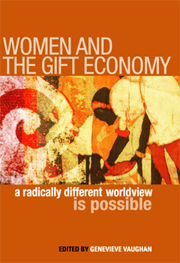
Gift economies have been with us throughout history. The book Women and the Gift Economy, ed. Genevieve Vaughan, has examples from South Africa, Big Mountain Black Mesa in Arizona, the Carribean, El Salvador,  and elsewhere.

On a smaller scale, and here in the U.S., gift economy projects are all around us. Here are just a few:

  • Little free libraries
  • Open source software
  • Creative Commons
  • Wikipedia
  • Kickstarter
  • Freecycle

There’s also a facebook phenomenon of “Buy Nothing Groups,” local groups where members give away items for free or ask for items. Its organizers had been inspired by the gift economies practiced in villages in Nepal.

And there are “free shops” or “give-away shops” and “The Really, Really Free Market,” which people organize in parks to give away goods.

 #

Here’s my question: is this phenomenon going to change society? Do these new gift economies offer an alternative to capitalism? Or are they a complement to capitalism, the same way shadow work is a complement to wage work?

I’m not saying this to be a downer. I really do hope people will find viable alternatives to capitalism, because capitalism is not working. I am saying it because we need to look critically at the solutions we hope will work, rather than glorifying them just because they are “alternative.” Maybe some gift economies do a better job of resisting exploitation than others. And maybe there are safeguards that can be put in place.

#

I don’t think the answers to my questions will be found in the U.S. and Europe, the so-called “first world.” I think the so-called “third world” is far ahead of us in social innovation. So let’s take a quick visit to Argentina, based on what I learned in the book Horizontalism, ed. Marina Sitrin (2006).

In 2001, Argentina suffered an economic meltdown, caused by the policies of the IMF. Banks froze their accounts and used depositors’ money to pay off foreign debt. Corporations fled. Factories shut down. In other words, capitalism broke itself. How could people survive? A movement was born, called horizontalidad. Or a collection of movements, including occupations of factories and workplaces, unemployed worker movements, new barter systems, direct democracy, neighborhood assemblies, and much more.

When Sitrin edited the book, many of these new movements were being co-opted or were changing in other ways. What has happened since then?

I don’t know the whole story. But fast forward in time to 2010, and a new phenomenon sprung up in Argentina: the gratiferia, meaning the market where everything is free. It has since spread to many other countries.

The grateferia in Argentina is maybe different than, for example, the Buy Nothing Facebook group that I participate in, because it’s maybe informed by a different kind of social consciousness, called politica afectiva (a politics of social relationships). Or just because the people of Argentina know, the way people in the United States do not, what happens when money suddenly disappears, and again, what happens when it comes back.

That’s all for now.

-Kristin


Related Links

Women and the Gift Economy, ed. Genevieve Vaughan

Really, really free market

Beginnings of the Buy Nothing Facebook groups

Horizontalism, ed. Marina Sitrin

Gratiferias

Other gift economies

horizontalism


Shadow work and the gift economy

In earlier posts I’ve discussed shadow work — the unpaid labor that complements wage work in a market economy. This includes everything from childcare and housekeeping (which together make up ten hours of my unpaid day) to commuting to shopping — basically any efforts that make it possible for a worker to sell their labor. I’ve also discussed subsistence work — the unpaid labor that provides for basic human needs — and the ways in which subsistence work can also function as shadow work, by making a wage laborer cheaper to maintain. Finally, I looked at work from a market economy perspective and a household economy perspective.

So there’s another kind of economy that is worth looking at: the gift economy. In a gift economy, basic needs are met through gifts rather than barter or market exchange. As it turns out, some peoples have historically run on the basis of a gift economy, and all peoples have incorporated gift economy principles and practices to some extent.

There’s a helpful discussion of gift and market economies in the article “The Khoekhoe Free Economy: A Model for the Gift” by Yvette Abrahams, found in the anthology Women and the Gift Economy: A Radically Different World View is Possible, ed. Genevieve Vaughan.

The essay discusses the history of the indigenous people of South Africa, the Khoekhoe. Their gift-giving economy was lost after hundreds of years of colonialism, slavery, apartheid, and structural adjustment–but many aspects of it remain. For example, it is the tradition at mealtime for a family to keep a little in the pot, in case someone knocks on the door and needs it.

Women give huge amounts of free labor, and according to Abrahams (writing in 2003), women’s subsistence farming provides about 66% of the food that feeds the continent, but it is never included in economic figures because it is given away, not sold.

This would be a workable economic solution except that women’s ability to farm is limited. For one thing, whites own 85% of the land in South Africa. For another, women have access to it only if they have a husband or a son.

So today in South Africa, the gift economy is broken in some important ways. It’s not a free social exchange, for instance, if one person needs the gift in order not to starve. It’s also not possible to gift when you have nothing. Abrahams writes: “Today, I cannot give away my labour. I have to work in order to eat.”

Also, the free labor operates not only as subsistence but also as a free subsidy of the wealthy. Abrahams writes: “Women’s non-waged labour provides two-thirds of all the food that Africans eat each year. In a way, it leads to greater independence, but in another way, it is a huge subsidy of the globalized capitalist economy.”

In other words, the gift economy is being exploited by the market economy. And the free gift of subsistence labor that people provide each other, to meet human needs, is being transformed into shadow work.

Is there a way to turn that around? Could understanding the relationship between the market and gift economies help us build a radically different future?

If you start to think about the gift economy, it is everywhere. The land gives freely of itself, providing sustenance and water and asking nothing in return. And from the moment of a child’s birth, their parents are providing the free gifts of food, shelter, and love. Even in the Western world, people are constantly giving each other presents — for birthdays, holidays, housewarmings, baby showers, weddings — and holding potlucks, and giving to charities, and volunteering, and the list goes on. Gift-giving is a normal human activity. Perhaps it is the market economy (which we mistakenly imagine is the only one that exists) that is artificial.

But if we have a gift economy, right here and right now, it is a broken one. When the market economy takes the free gifts but provides nothing in return, the gift economy runs out of steam and fails. We need to fix it.

Next up, I’ll talk about some more gift economies, both familiar and new.

– Kristin

womanand_giftcover


My posts on shadow work

Over the past several weeks, I’ve been contemplating the unpaid labor of mothers. The caregiving we do, essential in its own right, is also an economic contribution that goes on mostly in secret. I do apologize in advance for being lazy in my terminology through some of my posts, using the terms “women” and “mothers” as if we are the only ones who take on primary caregiving roles. Here are links to all the posts I’ve made:

I started out thinking about women’s liberation, and how it did and did not happen. I wrote: “Our role as primary caregiver, combined with economic exploitation, means that a woman is left largely alone to take on the multi-year, 24-hour-a-day responsibility to bring up the child.” I pointed out that although women who have money, or a wage, or a spouse with money, can pay somebody to do childcare, but these are all essentially workarounds to the primary problem that in an economy that requires a wage for simple survival, we don’t get one for the work we do.

Next up, I talked about how the wider economy uses women as a free source of human capital. I noted that “The unpaid labor mothers do, when we are perceived to be “not working,” has economic value to somebody outside our family, and people in power have measured that value.”

Then I named the unpaid labor done by parents, for the economic benefit of someone else, using Ivan Illich’s term “shadow work.” First I introduce the problem, then I give a longer analysis of Illich’s work, and finally, I consider two kinds of unpaid labor, shadow and subsistence, and two kinds of economies: household and market.

Next, I discussed shadow labor and gift economies.

There’s work yet to be done, and I hope I will get to it. It’s likely I won’t, at least in the forseeable future.

I am really interested in talking about shadow work and the prison-industrial complex. Is prison labor shadow work? What happens to a household economy when a worker, whether it be a shadow worker or a wage worker, is taken away to do prison labor?

I’m interested in looking at fertile and infertile women as two gender categories. Infertile women operate in our economy much like men, while fertile women end up stuck with shadow work and all it entails. I’d also like to challenge feminism and ask whether it really liberated women, or whether it just created a new class of men (infertile women) who may or may not be destined to flip genders.

I’m also interested in doing an economic thought experiment. What if all caregivers got a wage for the work they did? If it happened by way of wage earners getting a bigger wage, to cover all the caregiving work done for their families, and you gave the wage earner and the caregiver equal wages, then wages would have to double infinitely, wouldn’t they?

Finally, what about unions and shadow work? If I’m doing work and not earning a wage, and there’s nobody to ask for a wage from, then what is a union to me?

Another time, I hope!

– Kristin

512px-Shadow_2752

By Nevit Dilmen (Own work) [GFDL (http://www.gnu.org/copyleft/fdl.html) or CC-BY-SA-3.0 (http://creativecommons.org/licenses/by-sa/3.0/)%5D, via Wikimedia Commons

Shadow or subsistence?

In yesterday’s post I talked about the difference between two forms of unpaid labor: shadow labor and subsistence labor.

Subsistence labor is the work that provides for basic human needs, and shadow labor is the unpaid complement to wage labor. It makes it possible for a worker to enter the market economy.

I made the observation that there’s a relationship between shadow and subsistence labor, using the example of backyard gardening. It would be subsistence work, because it provides for basic human needs, but also shadow work, because it makes a wage laborer easier to feed. So the same activity qualifies for both. How do you make sense of that?

I’d say it depends on which economy you’re looking at: the household economy or the market economy. We hardly ever look at the household as an economy, but it is.

In understanding the world around us, we need to look closely at shadow labor and subsistence labor, understanding them separately, in connection to each other, in connection to the household economy, and in connection to the market economy.

When you start to do that, you see some things that were hidden. The household economy includes both wage labor and shadow labor. This is true whether it is an economy of one person or an economy of ten. The market economy skims a little off the top of the household economy, both in the form of wage labor and in the form of money spent on consumer goods and services.

Curiously, this holds true for communism as well as capitalism. The theory behind communism was “from each according to ability, to each according to need.” In practice, though, some people ended up getting more than others. Skimmed off the top.

Overall, state-run communism was a failure. But curiously, even in a market economy, a household economy can be run in communist fashion. That’s how ours is. All the money earned by the wage laborer is deposited in a joint account, and we decide democratically how it is spent. On the level of the household economy, I feel proud of myself and an equal to my spouse.

But the underlying communism of our household economy does nothing whatsoever to stop capitalism. There’s a little skimmed off the top, or a lot. And on the level of the market economy, I am seen as nothing.

The underlying communism of our household economy also does nothing whatsoever to challenge the inequality between households. Our household makes enough money to meet our basic needs and then some. Other households struggle to make ends meet, even though the people within it work just as hard. As for ours, if we lost the wage labor, we’d be right there struggling to make ends meet.

In theory, though, could the values of a household economy be used to transform the wider economy? It’s worth a look.

– Kristin

https://www.flickr.com/photos/lorettastephenson/7902147342

Cat Question Mark by Retta Stephensen


Shadow Work by Ivan Illich

In my previous post, “Mothering in the Shadow,” I introduced some concepts from the book Shadow Work by Ivan Illich, published in 1981 and available in full online. Overall, the book is a mixed bag, but it introduces groundbreaking concepts that have serious potential for feminist, environmental, and anti-capitalist movements. So I’ll give a short introduction to Illich and his ideas, briefly touch on their flaws, and then move on to a discussion of how the ideas could be used.

About Ivan Illich

Among other things, Illich is a medieval historian. It gives him a unique perspective on modern life: much we take for granted about the world around us is socially constructed. Although he has a tendency to glamorize past societies, he can see economic systems in ways others don’t.

How he defines work

Most basically, what he’s saying is that wage labor created another kind of labor: unpaid activities that make wage labor possible in the first place, or shadow work. There is also a third kind of labor, subsistence work, which competes with wage labor.

Shadow work includes all kinds of unpaid labor: transportation to and from a job, the maintenance of automobiles, the work of purchasing commodities, the housework and other supporting activities a wife does to enable a husband to do wage labor, and childrearing, which supplies future wage labor.

Subsistence work would be playing a guitar instead of buying a record, growing a backyard garden instead of going to the supermarket, and feeding a baby at the breast instead of from a bottle.

How he defines economies

He sees economies as having three dimensions. The first is a continuum between left and right — communism and capitalism. To him, they’re flawed in the same way. Both do what he calls “welfare” – though meaning something different than our current welfare system. To him, “welfare” means distributing industrialized products that are ultimately inferior to their subsistence counterparts, but which then take the place of those counterparts.

The second is a continuum between hard and soft — that is, most technologically advanced to least. Again, he doesn’t necessarily see a difference in value between the two.

The third is from consumption to production — that is, from market economies to subsistence economies. This one is very important to him. Illich believes people are better off “when a community chooses a subsistence-oriented way of life. There, the inversion of development, the replacement of consumer goods by personal action, of industrial tools by convivial tools is the goal. There, both wage labor and shadow work will decline . . .” (p. 14)

The flaws in his ideas

Don’t take me as an expert on Illich, because I’ve only read one of his books, and only one time through. But as far as I can tell, he’s much too taken by subsistence economies. In his body of work, he disparages modern medicine and universal education in such a way as to throw out the baby with the bathwater.

He is also naively unaware of how power operates. Any attempt to convert a market-based economy to one based on subsistence is going to be opposed by the ruling class, which has military and propaganda on its side. Wage labor and shadow work won’t decline on their own.

Next up, although he says he doesn’t see much difference between capitalism and communism (“the capitalist and the commisar”), most of the book deals with the market economy and wage labor.

Finally, as much as I love his separation of shadow work and subsistence, there’s a relationship between them that he hasn’t parsed. If shadow work is everything that supports a wage laborer, subsistence work like backyard gardening would also support a wage laborer, by making the person cheaper to feed.

The takeaway for feminism

So yes, Illich’s analysis has flaws. At the same time, it was groundbreaking to observe that there is a whole category of work that our economy ignores.

Feminists have been talking about this for a long time but with a slightly different focus. Feminists have complained that men work for pay and women do housework and childcare without pay. But that leads to an easy mistake: the idea that making men and women equal will somehow make this unpaid labor go away. But we’ve found that it doesn’t. Women have entered the workforce and men have stayed at home, and the unpaid labor is still a problem. Because women bear children and are their first caregivers, no matter how much we work toward gender equality, we are still saddled with work without pay.

So what happens if we take a good, hard look at all the shadow work that gets done? Not only childrearing and housework but transportation, volunteer jobs — everything? People of every gender should be outraged at all the free labor we’ve been snookered into doing for the benefit of the one percent, without getting even our basic needs done in return.

The takeaway for anticapitalist work

I’ve spent a lot of time with people who want to abolish capitalism but don’t have the least idea how to go about it. They’ve put a lot of work toward that end, but they’ve still been stuck with myths about how our economy works. Without a clear understanding, how can they know whether what they’re doing is actual resistance, or just shadow work under a new guise?

Meanwhile, the unchecked growth of the economy is continuing to lead toward environmental devastation and the fulfillment of a prophecy made in the 1970s that sometime within the next hundred years we will suffer a collapse of our economy and our population. Capitalism might well abolish itself, in which case we need to be ready to replace it with a workable replacement. And subsistence has to be part of it.

Failures of capitalism to provide for the common good of countries are already happening, of course. What happens then? Does a subsistence economy step in? For example, in 2001 the economy collapsed in Argentina and communities found new ways of coping–the book Horizontalism, ed. Marina Sitrin, tells that story. Where else has the economy failed, and what have communities done to make ends meet? We can look at history all we like, but we won’t understand the answer until we know how subsistence work plays a part.


Worth the read

All in all, this book is well worth the read. Absorb it with a grain of salt, or maybe a teaspoon. And a glossary. (He makes up words, or takes words from contemporary thinkers, and uses them without properly defining them first. He also takes words with commonly accepted meanings and assigns them new meanings, also usually without defining them. )

In keeping with his opposition to the commodification of labor, he doesn’t appear to have copyrighted it, and it is available for free download here.

Picture of a shadow on the floor

from tardis.wikia.com

Mothering in the Shadow

My last post “The Economics of Parenting” touched on the unpaid and unacknowledged labor of parents. Feminism has long seen it as a problem but has entirely failed to produce workable solutions. An early demand of “wages for housework” went nowhere because, under capitalism, there is no answer to the question of who should pay. Meanwhile, Marxist feminists in academia did a good job of defining the problem but otherwise mostly left it alone.

The labor movement also hasn’t been much help. Collective bargaining only makes sense if there is an outside entity invested in whether or not the work gets done, and when it comes to our children, that’s mostly not the case. Other peoples’ kids are usually regarded as “other peoples’ problems” and that’s that. Strikes make no sense, either. What are you going to do, not take care of your kid?

There’s a name for this job: “shadow work.”Australian historian and philosopher Ivan Illich coined the term  in the 1981 book Shadow Work. I’ve only just started the book, but it’s fascinating. Here’s an excerpt.

In a commodity-intensive society, basic needs are met through the products of wage labor – housing no less than education, traffic no less than the delivery of infants. The work ethic which drives such a society legitimates employment for salary or wages and degrades independent coping. But the spread of wage labor accomplishes more – it divides unpaid work into two opposite types of activities. While the loss of unpaid work through the encroachment of wage labor has often been described, the creation of a new kind of work has been consistently ignored: the unpaid complement of industrial labor and services.

That’s parenting and housework right there. They complement wage work because they free somebody else to spend more hours in the workplace.

Feminists have been talking about the concept for some time, but this is the first time I’ve ever seen it so tangibly expressed. It’s also part of a coherent theory that directly addresses a question that feminism gave up on: How do you change the system?

I’ll save that enormous question for another blog post, but believe me, I will get to it. In the meantime I’ll just touch on why I personally am in love with the term shadow work.

It’s all about respect, baby. Time and again, as I was staying at home with young children, people asked me “Are you working?” Of course, they meant wage labor. Usually I let it pass. Sometimes I said “Yes, I’m working in the home” and sometimes I said, “No.” What can I say? I was seriously sleep-deprived. My best answer was to the question “I mean, are you working outside the home?” when I said, “No way! I don’t want two jobs.”

But now I can say. “Definitely. I’m performing shadow labor.”

The term fights back against the disrespect I feel whenever I hear I’m “not working” or “not in the real world.” That disrespect gets at the core of me, whenever I perform housework or similar jobs.

Also, the term is beautifully consistent with Jungian philosophy.  The shadow, in Jungian terms, is everything that is a true part of our nature but that we repress, hide, push away, deny, negate. At the same time, the more we repress it, the stronger it gets. There is power in shadow.

I have to end this post now. My shadow labor workday began around seven a.m. and will end at nine p.m. Things to do. People to see. Boats to float.


The Economics of Parenting

Economists study things and make theories, and based on what they say, lawmakers set policy. That’s just one of the things that makes the world go round, and we don’t think about it too terribly much, or at least I didn’t, until I started seeing the phrase “human capital,” but now that I have, I pay attention. And I come up onto statements like this:

While such policies may increase the size of the next generation, their impact on the generation’s total human capital are unclear, since per person human capital may change as well. . . . This paper explores a potential national policy tradeoff, embodied in motherhood timing, between the quantity and quality of children.

This excerpt is from the article “Motherhood Delay and the Human Capital of the Next Generation” by Amalia R. Miller, American Economic Review, 2009. It looks at whether standardized test scores, an indicator of the future economic value of children (a.k.a. “human capital”), are affected by whether or not mothers delay childbearing. The answer to this question is intended to help countries decide whether or not to set “pro-natalist policies” — that is, policies that encourage women to have lots and lots of babies.

(A quick note on human capital, if you’ve never heard the term: it is the set of skills, education, and expertise of a worker or a labor force. Sometimes the term is used to refer to something the worker owns, and other times it means an asset a company owns, or a nation.)

I should mention I’m pretty creeped out by now. First off, I thought my kids were, well, children, not wealth. Next up, it’s disturbing that legislation surrounding childbearing should be affected by the wealth a nation is expected to reap from the children’s future labor. It means that human capital considerations could affect anything from anti-abortion legislation, if a nation is perceived to be running out of human capital, to forced sterilization, if the cost of raising a child is perceived to be higher than the human capital reaped.

But there’s one more thing that stands out when I look at articles regarding mothering and human capital. The unpaid labor mothers do, when we are perceived to be “not working,” has economic value to somebody outside our family, and people in power have measured that value. That’s interesting.

The United Nations is conducting a study called the “Inclusive Wealth Project.” There’s a 2012 report and a 2014 report. It is about the development of a new measure of the wealth of nations, on par with the gross development product (GDP) and human development index (HDI). The new “Inclusive Wealth Index” includes natural resources, produced resources, and human capital.

Here’s a taste of the math, from page 30 of the 2012 report:

Wealth = Pmc * Manufactured Capital (MC) + Phc * Human Capital (HC) + Pnc * Natural Capital (NC)

(Don’t ask me about the Pmc, Phc, and Pnc, because I have no clue. Nor do I have any desire to have a clue.)

The math for calculating human capital is laid out also on page 30 of the 2012 report and is too long to include in this post, but here’s a taste of it:

. . . measuring the population’s educational attainment and the additional compensation over time of this training, which is assumed to be equivalent to the interest rate (8.5 percent in this case) . . .

and

The shadow price per unit of human capital is obtained by computing the present value of the labor compensation received by workers over an entire working life.

and

. . . for each nation we computed these shadow prices for every year within the 1990–2008 time period, and then used the average of this rental price of one unit of human capital over time as the representative weight . . .

It must be strange to be an economist. The people who made this report are focused on “social value” — attempting to make capitalism work for the health and well-being of our people and planet, by reducing said health and well-being to dollars and cents. I’m skeptical, but I’m glad at least that somebody is trying to account for the rapid depletion of our natural resources.

Anyway, back to what I said about somebody measuring the economic value of the unpaid work of mothering. That’s not exactly what they’re doing. They’re measuring the value of educating. Here’s a widely-used graph, from a Science Magazine article “Skill Formation and the Economics of Investing in Disadvantaged Children” by James D. Heckman (2006).
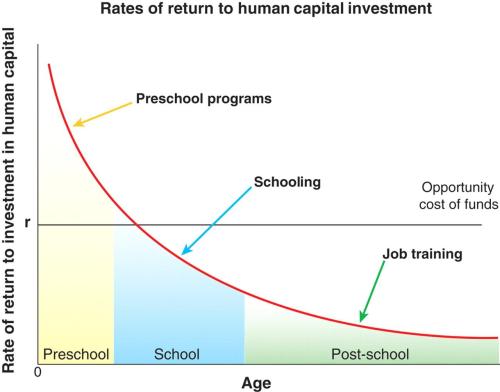
Graph showing that investing in preschool has great benefit to future earnings. Source: http://jenni.uchicago.edu/papers/Heckman_Science_v312_2006.pdf

Source: Science Magazine


The article has a curious blind spot when it comes to the job of the earliest education, the contribution of the parents. A lot of studies focus on “disadvantaged children” and “children in developing countries.” Here’s a quote:

Research has documented the early (by ages 4 to 6) emergence and persistence of gaps in cognitive and noncognitive skills (3, 4). Environments that do not stimulate the young and fail to cultivate these skills at early ages place children at an early disadvantage. Disadvantage arises more from lack of cognitive and noncognitive stimulation given to young children than simply from the lack of financial resources.

The assumption here is that a normal environment, which somehow appears naturally and out of the blue, provides adequate stimulation to cultivate skills needed later in life. Actually, no. Somebody made it happen. A parent.

And it was a hell of a lot of work.

Here’s an estimate of the unpaid labor value of a mother’s work:

If paid, Stay at Home Moms would earn $134,121 annually (up from 2005’s salary of $131,471). Working Moms would earn $85,876 annually for the “mom job” portion of their work, in addition to their actual “work job” salary.

(From “What is Mom’s Job Worth,” by Salary.com.)

(Note: there’s a serious omission here. According to the Pew Research Center, the percentage of stay-at-home parents who are dads is up to 16%. I don’t know if anybody’s ever run the numbers for dads.)

Never mind the costs of raising a child. According to a recent report from the U.S. Department of Agriculture, which says that “a middle-income family with a child born in 2013 can expect to spend about $245,340 ($304,480 adjusted for projected inflation*) for food, housing, childcare and education, and other child-rearing expenses up to age 18. Costs associated with pregnancy or expenses occurred after age 18, such as higher education, are not included.”

By “middle-income family, they mean “the middle third of the income distribution for a two-parent family with children.” This is the “normal environment” referred to in Science Magazine, although the number of single-parent households in the U.S. has jumped from 19.5% to 29.5%.

And the annual income at the federal minimum wage of $7.25 per hour is only $15,080.

On a family level, the economics of parenting just makes no sense. Wages are far too low to raise children.

It makes no sense on a societal level either. What happens, I wonder, if you take the cost of raising a child, plus the cost of a formal education, plus the unpaid labor of the parents, and compare it to that person’s “human capital” over a lifetime? You could calculate it. But honestly, I’m afraid to even try.

The problem here isn’t with the children. And it isn’t with the parents. It’s with the way we understand (or don’t) understand our own economy.

-END-

305410323_effd579e8f_b

Lego People by Joe Shlabotnik from http://www.flickr.com


Women’s Liberation

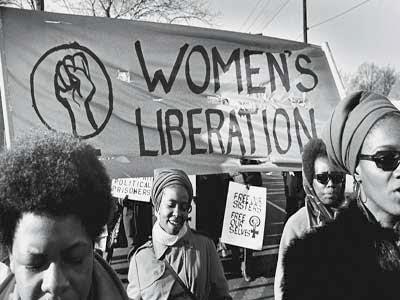
I’m having a lengthy and deep conversation on feminism with a friend on another blog (will share the link when we’re further along) and found to my surprise that I had used the term “women’s liberation.” I haven’t really heard that since the 1980s. Honestly, I thought feminism was past it. Aren’t we in the fourth wave or something like that?

Women, as a group, have not yet liberated ourselves, and that has much to do with childbearing and childrearing. Start with the very beginning: conception. Our technology gave women the ability to postpone or prevent it – birth control. That was huge. It changed gender. It gave women of childbearing age the ability to function socially, economically, and culturally like men. But from the beginning, legislators passed laws prohibiting this new technology from being used. (See the Comstock Laws.) Women are still fighting for the right to access birth control and this means that some women are prevented from choosing whether or not to have babies. The phenomenon of rape makes this even more true.

So even if we didn’t choose to give birth, we find ourselves suddenly presented with the all-consuming and unpaid job of caring for a baby.

We can give our children up for adoption, but to suddenly lose a human being that has been a part of your body for nine months, not knowing whether that human being will flourish, is a hard choice.  A woman who does this is at risk from suffering long-term physical, psychological, and social repercussions. (Here’s a 1999 review of the research, mostly from the era of closed adoptions. Apparently more recent research, including open adoptions, is scarce.)

For those of us who keep our babies, we are presumed by our current Western patriarchal culture to have primary responsibility for caregiving. Feminism has changed that, to some extent. Men can and do share caregiving responsibilities. Did you know that even men can nurse, by the way? All men can nurse for comfort, and some can lactate. A man can mother every bit as well as a woman. But we don’t call men “mothers,” and why? The overall cultural assumption is that only women can mother.

Meanwhile, feminism didn’t change a more fundamental problem: in an economy that depends on the exchange of labor for a wage, and requires money to carry out normal life activities, the job of caregiving of children doesn’t come with a wage. This set mothers up for economic dependence, or, in other words, a lack of liberation.

The phenomenon of men as primary caregivers doesn’t change this fundamental reality. It only extends this economic dependence to a new group of people. The only way we could really be liberated from caregiving-specific economic exploitation is if the entire community took on the responsibility of bringing up our children. But the U.S. has really gone backward in this area–cutting funding for education, using “stranger danger” to restrict children to the home, and prolonging adolescence. Where are all the kids you used to see playing in the streets?  (There’s a whole movement in opposition to this, BTW.)

Our role as primary caregiver, combined with economic exploitation, means that a woman is left largely alone to take on the multi-year, 24-hour-a-day responsibility to bring up the child. If we have money, we can pay somebody to do it part of the time. But that just means we can use economic privilege as a workaround, to avoid some of the consequences of our exploitation. If we are living in a relationship with equals, our partner can help care for the child. Since one or both partners end up needing to be in the paid workforce, though, that just spreads the exploitation to two people. And for the many women who are still following the model in which the wife obeys the husband, we’re just back to women being economically dependent on men.

All in all, there are plenty of women without access to money or social supports, and for these women, having a baby puts them in a position where all their options are bad. Marry someone who might be abusive and controlling? Give up the baby, abandoning it to who knows what fate? Keep the baby, but work long hours in addition to the 24-hour-a-day job of caring for a baby? Many women will put up with slavery-like conditions to make sure our children are O.K. We are not liberated.

If women require money to be liberated, and not all women have money, women as a group are not liberated. Women’s liberation is an ongoing struggle.

(Don’t get me wrong, by the way–I am not saying women’s liberation is the only struggle. See my post on collective liberation.)

What about women who are not mothers? Let’s divide them into two groups: fertile and infertile. The phenomenon of rape, combined with legislation that prevents women from accessing contraception or abortion, means that a man can convert a fertile woman into a mother without her consent. Any fertile woman at any time, could potentially lose her liberty through no action of her own. In such a case, can any fertile woman be considered free? Our liberation is provisional. Many women can solidify this provisional liberation into real liberation, but again, in society as we have currently set it up, that requires economic privilege.

What about women who are infertile? (Girls, women on reliable birth control, post-menopausal women, male-bodied women, and so forth?) Are they liberated now that women can hold jobs, vote, and generally participate in what used to be considered a man’s domain?  Or does a lack of liberation for fertile women bleed over and affect infertile women too? After all, there’s no clear visible difference between women who are fertile and women who are not. The decreased social status conferred on one group will indeed spill over to another. Social oppression goes hand-in-hand with economic exploitation.

Women’s liberation has yet to be achieved.

So what should we do? Keep on keepin’ on.

womens liberation

image found on libcom.org


We Didn’t Outlaw Slavery

You hear the terms “schools-to-prison pipeline” and “prison-industrial complex” and they’re really complicated and maybe they sound like this weird thing that came out of academia’s radical left and maybe you want to dismiss them.

Let me say it more simply: the United States Constitution didn’t end slavery. Our job is not done.

Here’s the exact text of the Thirteenth Amendment:

Neither slavery nor involuntary servitude, except as a punishment for crime whereof the party shall have been duly convicted, shall exist within the United States, or any place subject to their jurisdiction.

That’s one hell of a loophole. And in fact, it was exploited from the beginning of Reconstruction, with “Black Codes” that criminalized normal human activities for supposedly free blacks.

It’s still being exploited. That’s what the “War on Drugs” was all about — adding a crime for which someone could be duly convicted and enslaved, simply for possessing banned property. Somebody benefits from that. Actually, a whole lot of corporations benefit from it. Private prisons, for instance, get money from the government plus the nearly free labor of the inmates.

Where are we today? Check this out, from the article “Rooted in Slavery” by Jaron Browne.

It may surprise some people that as the number of people without jobs increases, the number of working people actually increases—they become prison laborers. Everyone inside has a job. There are currently over 70 factories in California’s 33 prisons alone. Prisoners do everything from textile work and construction, to manufacturing and service work.

That’s what “prison-industrial complex” means. Such a fancy word for such an unconscionable institution!

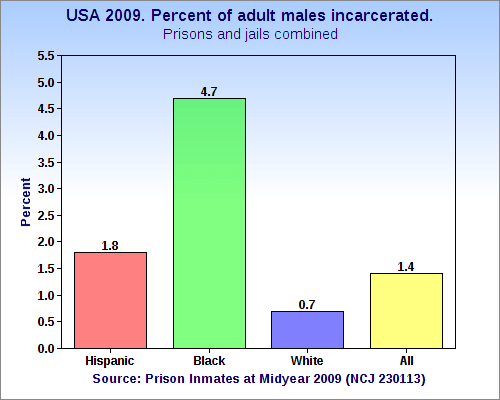
The mass incarceration we see today has huge racial disparities. One in six black men are in prison, for example. Hispanics are imprisoned at high rates as well. Here are the disparities in full color, courtesy of Wikipedia.

USA_2009._Percent_of_adult_males_incarcerated_by_race_and_ethnicity

There are a couple of important things to look at here. First: the obvious racial disparities. Second: the huge percentage of black men who are missing from their families. If 4.7 of my own male family members were missing, I would be pissed! And hurting. Children whose parents were torn away. Third, and something not usually explored, is that despite the disparities, our prison system has also extended this system of enslavement to white people.  That’s why the statement “No one is free until all people are free” is so very relevant.

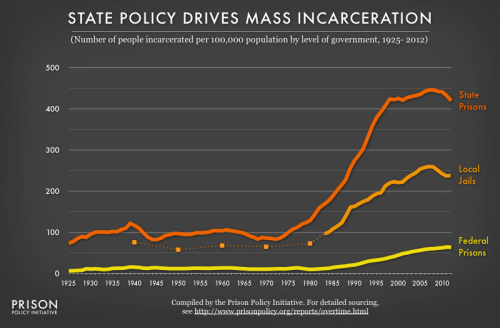
How far, exactly, are we planning to let this system continue to expand? Here’s the trend, up through 2012.


rise in prison population

Dear white people: Democrat and Republican alike, we let this happen. We let the “War on Drugs” go on. We let laws like “Three Strikes You’re Out” and mandatory sentencing laws get passed.

We allowed slavery to continue from the Civil War into the present day.

This is a hard truth and a bitter pill to swallow. It’s no wonder so many people are looking the other way. But understanding the problem is the first step toward reaching solutions.

The solutions are there.

I didn’t have to look very far to find all these statistics. We don’t have to look all that far to find solutions, either. Black feminist Angela Davis has written and spoken widely on this topic. A quick google search and here we go: “Bigger Than Incarceration: Angela Davis Talks Mass Criminalization, Mental Health and the War on Drugs.”

And then there’s this article, which traces abolitionist movements from the end of the Civil War to the present day. “Slavery and Prison – Understanding the Connections” by Kim Gilmore.

And there are movements of organized prisoners too: “Texas prisoners organize: threaten to strike on April 4th with IWW Prisoner Union.”

Dear white people: we don’t have to think up our own solutions. We just have to throw our support behind the people who are already hard at work!

Because Black Lives Matter.

Reflections on our Racial Equity Team

So our elementary school had a Racial Equity Team this year, with the goal of basically undoing racism. Every elementary school should have one. All the rest of the schools, too. But elementary school is such a key time in children’s development. If we don’t teach them about identifying and countering racism, they’re still going to learn about racism–but from all the wrong places, and without a framework to understand it.

Our group was a mixture of teachers and parents working collaboratively. I think this is rare in Seattle Public Schools, but it should be the goal. Teachers have a window on what really goes on at school, and parents have a window on how racism affects our own children. We have a deep incentive to get past the “all talk and no action” phenomenon that so often afflicts small groups.

What did we do? To make a long story short, we did some important work and we left some necessary work undone and we’re all emotionally drained.

The school district provided resources and support for our team. That’s appreciated but I would also definitely say it’s not enough. The work of undoing racism is hard in many ways–and most of us lack the required expertise. We should have had a dedicated and competent facilitator, outside the group, to help us through the rough patches.

That’s readily available, but expensive. K-12 education is not exactly rolling in the dough. In fact, as I’ve said many times on this blog, Washington State is failing in its constitutional mandate to fully fund education. Our legislature is in contempt of court for not doing it. It’s supposed to be fixed by 2018, but I’m not at all sure the Washington State Supreme Court has the guts to do what needs to be done to make it happen.

Our teachers are begging for pencils, folks.

So our schools are having a financial crisis, and we’re also having a racism crisis, and we need some outside help. Who? What? When? Where? How? I don’t know.

I do know we will keep on going, with whatever tools we have.

That’s all for now . . . stay tuned for more posts later.

Note: This post is part of a series, beginning with “Six Months on a Racial Equity Team.”