I am deeply excited about Nisi Shawl’s work in progress The Five Petals of Thought. It’s a philosophy that came fully formed from a dream, and worked its way into many of their stories. When I first saw it in the book Missing Links and Secret Histories, I immediately recognized it from my activist work. The concept of praxis involves theory, action, reflection, and new action. Similarly, the Five Petals are: Thought, Action, Observation, Integration, and New Action. I can’t wait to see it come to life as a self-help book. When a dream speaks, pay attention. Our unconscious is always telling us something that we need to know. This dream was like this, but not just for them — for all of us. If you want to help bring this work to fruition, you can! The gofundme is here: https://www.gofundme.com/f/help-nisi-shawl-write-the-book-of-her-dream
In 1961, Jung wrote a letter to a man named Bill W. You mighta heard of him. In it, he said:
“I am strongly convinced that the evil principle prevailing in this world, leads the unrecognized spiritual need into perdition, if it is not counteracted either by a real religious insight or by the protective wall of human community. An ordinary man, not protected by an action from above and isolated in society cannot resist the power of evil, which is called very aptly the Devil. But the use of such words arouse so many mistakes that one can only keep aloof from them as much as possible.”
In his writings, Jung constantly struggled to explain his religious beliefs. He knew for a certainty that God existed. But what is the nature of God? Is it a Christian God? Yes and no. Yes, because Christianity is the religion he was raised with. All the images and ideas from Christianity showed up in his own unconscious. And no, because he had been exposed to many religions and respected them all:
“As may be seen, I attribute a positive value to all religions. In their symbolism I recognize those figures which I have met with in the dreams and fantasies of my patients. In their moral teachings I see efforts that are the same as or similar to those made by my patients, when guided by their own insight or inspiration, they seek the right way of dealing with the forces of the inner life. Ceremonial, ritual, initiation rites and ascetic practices, in all their forms and variations, interest me profoundly as so many techniques for bringing about a proper relation to these forces.” (Modern Man in Search of a Soul, p. 119)
He believed in God, but not a particular God. Call it a “Higher Power,” if you will. And the Higher Power is the antidote to addiction. He used the phrase “spiritus contra spiritum,” meaning “spirit against spirit.” You see, Jung’s ideas had greatly influenced the birth of Alcoholics Anonymous, both from his book Modern Man in Search of a Soul and from a patient of Jung’s, Rowland H. Jung’s gift to Rowland H., after a year of psychoanalysis, was to admit that modern medicine could not cure him, but that religious experience had helped some sufferers. Rowland went to an evangelical organization, the Oxford Group, where he along with others were cured by an early version of the 12-step program. In 1961, Bill W. wrote to Jung with appreciation for his influence.
Wooden Staircase in South Korea. Basile Morin, CC BY-SA 4.0 via Wikimedia Commons
By himself, Carl Jung could not possibly have founded Alcoholics Anonymous. He centered the individual patient. But he understood that limitation and had the humility to tell a patient, “I’m not capable of treating you.” And so a community-based religious practice was birthed. Alcoholics Anonymous is a mutual aid organization based on interfaith. It came out of Christianity, but it didn’t stop and draw a line or count how many angels could fit on the head of a pin.
I said this post was about hope, and right now I do have hope that the resistance movement can embrace not only community but also divinity. Not from any specific deity, but from the religious experience and expression of every culture.
Even — or especially — the ones that Jung mistook for “primitive.” Nonwestern, indigenous, and diaspora religions all have wisdom to share if we will listen. To me, “listening” means looking inward, and also looking outward, and seeing the connections between the two. It means approaching other cultures with my imperfections, in a neighborly sense.
I feel comfortable here. I feel like I can breathe and dance. Could I have gotten here without Jung? Perhaps. He “discovered” the unconscious in the same way that Columbus “discovered” America. Other people had already found it and were living there. But he opened a door, and I went through.
May we all find our doors, and once we do, may we know where to go. Solidarity.
This is the end of my series on “Revisiting Carl Jung.” I have another post in mind, “Beyond Jung,” but first I will take a brain break and do some signal boosts on my blog. The full series is here:
Carl Jung lived through some terrible times: the First World War, the rise of fascism, the Second World War, the Holocaust. . . . By 1959 the world had entered the perilous age we still inhabit, a time when humanity can annihilate itself with the touch of a button. (Side note: let’s not.) He saw the world materially but also through dreams–his own and those of his patients. This is the year he published the book The Undiscovered Self. He asked:
“What will the future bring? From time immemorial this question has occupied men’s minds . . . Historically, it is chiefly in times of physical, political, economic and spiritual distress that men’s eyes turn with anxious hope to the future, and when anticipations, utopias and apocalyptic visions multiply. . . . Today, as the end of the second millenium draws near, we are again living in an age filled with apocalyptic images of universal destruction. What is the significance of that split, symbolized by the ‘Iron Curtain,’ which divides humanity into two halves? What will become of our civilization, or of man himself, if the hydrogen bombs begin to go off, or if the spiritual and moral darkness of State absolutism should spread over Europe?” (11-12)
Neither of those fears has come to pass, not yet. What happened instead was a flowering of collective liberation movements. Already, in 1956, Martin Luther King had spread the idea of a “Beloved Community.” This was seven years before his famous “I have a Dream” speech. A new age was beginning.
But what is the age we live in now? How have we been impacted by our increasing global connectedness, the Internet, A.I., climate change, and the increasing concentration of wealth and power into a few hands? What will the future bring? Carl Jung’s words speak also to our time. He proposes that our ideas, which come from our primordial psyche, are not quite up to the task.
“Human knowledge consists essentially in the constant adaptation of the primordial patterns of ideas that were given us a priori. These need certain modifications, because, in their original form, they are suited to an archaic mode of life but not to the demands of a specifically differentiated environment. If the flow of instinctive dynamism into our life is to be maintained, as is absolutely necessary for our existence, then it is imperative that we remold these archetypal forms into ideas which are adequate to the challenges of the present.
“Our ideas have, however, the unfortunate but inevitable tendency to lag behind the changes in the total situation. . . Only when conditions have altered so drastically that there is an unendurable rift between the outer situation and our ideas, now become antiquated, does the general problem of our Weltanschauung, our philosophy of life, arise, and with it the question of how the primordial images that maintain the flow of instinctive energy are to be reoriented or readapted.” (82-83)
What is our philosophy of life now, in the United States, in 2025? We don’t have one, we have many. We are and have always been multicultural. But two diametrically opposed philosophies have come to attention in the political realm: Christian nationalism, which worships the American Flag, and on the other hand a stubborn rationalism that worships Facts like climate change and vaccine effectiveness and expects the other side to do the same. Neither of those will save us.
Facts are great if you can find them. Most people, though, are wandering around the wilderness of the human psyche without a guide. Listen: what are facts? Look around you. You’re in a room. What can you see? What can you hear? I see a computer monitor, a stack of papers, a green curtain blowing. I don’t see a shelf full of books. That’s behind me, and so it exists only in my imagination. If I turn around I will find a book of poetry, Sound and Sense, right where I expect to find it, because I found it there the last time. Yep, there it is. One shelf lower than what I expected, but close enough. Physical reality matched my expectations. I found my Fact.
Let’s go over this again. Everything outside our direct sensory experience, even memory, we perceive through our imagination.
Today, the day I’m beginning this post, is October 6, 2025. Federal troops have been deployed to the city of Portland because the U.S. President was shown a video of protests from 2020. The Fact of the matter is that before the deployment, Portland was just as peaceful as any other city, with people walking to work and coffee shops and bookstores. But any image of Portland is a “psychic event,” which to the mind is just as real as any Fact.
*
We interrupt this regularly scheduled October 6th post with a note from the future. By October 17th, ICE agents have been confronted with protestors wearing inflatable frog suits. Wait, what? Stay tuned.
*
In the age of social media, of virtual reality, of TikTok, of AI, humanity has become alarmingly disconnected from both the material world. I suspect this will get worse before it gets better.
Humanity is also disconnected from its inner life, as Carl Jung notes, and cannot see its collective shadow. It therefore takes its own evil and projects it onto “the other.” Here’s a zinger:
“The horror which the dictator States have of late brought upon mankind is nothing less than the culmination of all those atrocities of which our ancestors made themselves guilty in the not so distant past. Quite apart from the barbarities and blood baths perpetrated by the Christian nations among themselves throughout European history, the European has also to answer for all the crimes he has committed against the dark-skinned people during the process of colonization.” (107)
I want to say, “Yeah, that’s not me. I’m nice. I’m one of the good guys!” Jung has a response to that, however:
“Since it is universally believed that man is merely what consciousness believes of itself, he regards himself as harmless and so adds stupidity to iniquity. He does not deny that terrible things have happened and go on happening, but it is always ‘the others’ who do them.” (107-108)
In other words, people project our own inclination to evil, our shadow, onto others. And then hurt them. It’s a terrible vicious cycle that can only be stopped if it is understood. “[O]nly the fool can permanently neglect the conditions of his own nature. In fact, this negligence is the best means of making him an instrument of evil.” (109)
When we project our shadow onto others, that disrupts our ability to create these bonds. But on the other hand, self-knowledge, the knowledge of our imperfections, forms the basis of human relationships.
“Recognition of the shadow, on the other hand, leads to the modesty we need in order to acknowledge imperfection. And it is just this conscious recognition and consideration that are needed wherever a human relationship is to be established. (116)
From there, he leads into a vision that corresponds to Martin Luther King’s Beloved Community: “[T]he free society needs a bond of an affective nature, a principle of a kind like caritas, the Christian love of your neighbor.” (117)
I found the end of the book unsatisfying, however. Jung counters the threat of totalitarianism with self-knowledge of the individual:
“I hope, therefore, that a psychiatrist, who in the course of a long life has devoted himself to the causes and consequences of psychic disorders, may be permitted to express his opinion, in all the modesty enjoined upon him as an individual, about the question raised by the world today. I am neither spurred on by excessive optimism nor in love with high ideals, but am merely concerned with the fate of the individual human being–that infinitesimal unit on whom a world depends, and in whom, if we read the meaning of the Christian message aright, even God seeks his goal.” (125)
I can’t be satisfied with curing my own psychic disorders–today’s problems require a strong community. I will move on next to a community that Jung’s work helped inspire and shape. But not yet. What’s up with the inflatable frog?
Stay tuned.
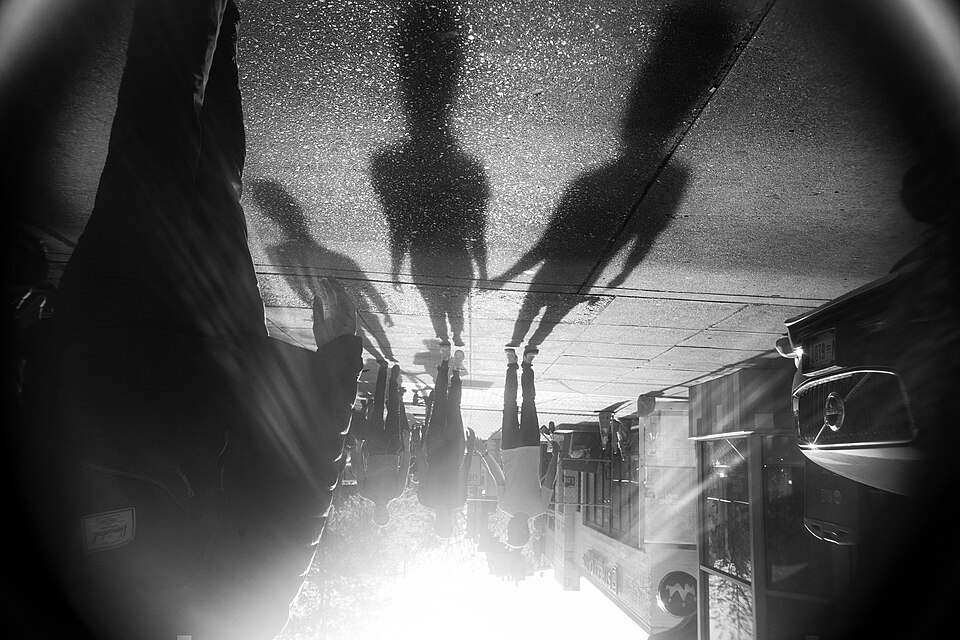
“The Shadow Knows,” Mike Maguire, CC BY 2.0, via Wikimedia Commons
Work Cited
The Undiscovered Self. Jung, Carl. Little, Brown & Company, Inc. 1959.
In the first three posts in this series, I talked about works by Carl Jung that have shaped my understanding of the unconscious. In this post, I will share my understanding of the term collective unconscious as he presented it, along with my own questions and reflections.
Jung’s “collective unconscious” is “the unconscious psyche.” For any given person, it includes anything and everything that we know or have known but is not immediately obvious to the conscious mind. It includes ideas that came to us before we were even born, and “archetypes,” or the myths and symbols that recur time and again. It includes the “anima,” or the woman’s spirit in the man, as well as the “animus,” or the man’s spirit in the woman. It includes the “shadow,” which represents the parts of our psyche we try to repress. It can be observed with science and perceived through art and dream, but is more than those parts. For a person to become whole, they must approach it.
But here is my first question: is the collective unconscious simply a pattern of thought that each person is born with, or does it also connect us together? People build community. We share art and story. Do our unconscious thoughts mingle? That’s not even taking into account the animals, plants, and rocks. Do we share the dreams of a cat?
And my second question: is the collective unconscious an unchanging inheritance? Or is it malleable? Do we change it when we dream, and write stories, and make art? Is there a two-way relationship between our conscious and unconscious minds?
And my third question, as a lover of time travel: does the collective unconscious move forward and backward in time?
These are not questions to be answered by science. They live in the imagination, art, stories, music, religion, poetry, street protest, random acts of violence, random acts of kindness, and of course, dreams.
My own answers to the three questions I posed are yes, yes, and THAT WOULD BE SO COOL. In my imaginings, just as we are interconnected in the material world, so too are we connected in the world of the unconscious, the wellspring of creativity. We learn from it, but we speak to it also. In this sense, our art has a power that requires respect, awareness, and love. (As to the third question, heck yeah there’s gotta be a TARDIS spinning along, and a Doctor whose hope is to fix everything.)
We have to pay attention. The collective unconscious matters. It matters a lot, and especially now, when computer networking and artificial intelligence have changed the way our conscious minds encounter reality. We speak faster than we feel. We spit out memes as though the words came from us. This is an ignorance that is already exacting a high price.
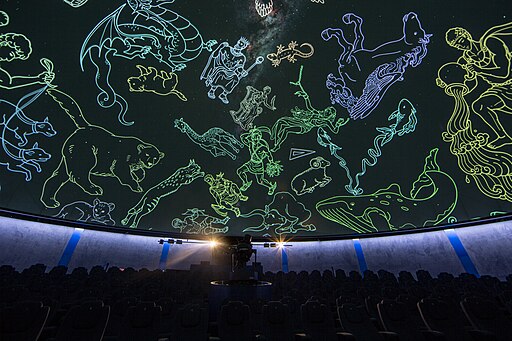
The featured image from this post comes from a planetarium.
I choseto begin my discussion of Jung with Modern Man in Search of a Soul for two reasons. First, it has moments where he explains his terms and ideas clearly and simply. Jung’s texts are often esoteric, and his language is slippery, so it’s hard to get at the ideas behind them. In this text, he has moments where he manages to make the irrational comprehensible.
Second, this was published in 1933. He was living in Switzerland, smack in the middle of France and Germany, with nazism and antisemitism on the rise. A scary and dangerous time, like now. Beyond the political and economic events raged a spiritual war. Are we any better prepared now than we were then? Then, as now, I think we need his ideas.
Let me stop a minute and correct myself. I said “his ideas.” In the chapter “Freud and Jung–Contrasts” he makes the point that ideas don’t belong to anyone:
“Impressive ideas which are hailed as truths have something peculiar to themselves. Although they come into being at a definite time, they are and have always been timeless; they arise from that realm of procreative psychic life out of which the ephemeral mind of the single human being grows like a plant that blossoms, bears fruit and seed, and then withers and dies. Ideas spring from a source that is not contained within one man’s personal life. We do not create them; they create us.” (115)
Bob Peterson from North Palm Beach, Florida, Planet Earth!, CC BY-SA 2.0 , via Wikimedia Commons
This quote also leads us nicely into the first word I’d like to explore: psyche. Take a minute and consider how you would define it. Just off the top of your head. What is the human psyche? The human mind–that would be my first answer. The words psychic and psychotic also spring to mind: both magic and madness.
Jung’s brief definition of the human psyche is “a whole that embraces consciousness, and is the mother of consciousness.” (123)
Is the psyche constrained to a single human body? Jung doesn’t answer the question–or even ank it– in any text I’ve found. As I said, he’s slippery. Usually I’ve seen the term referring to the primordial patterns of thought we are all born with. In the quote about ideas, though, “psychic life” does have an expanded and very organic meaning. It’s larger than, and mothers, one human mind.
Can the psyche be reduced to biology alone? Freud thought so, and Jung disagreed. “We moderns are faced with the necessity of rediscovering the life of the spirit; we must experience it anew for ourselves. It is the only way in which we can break the spell that binds us to the cycle of biological events.” Because of this position, Jung says, “I am accused of mysticism. I do not, however, hold myself responsible for the fact that man has, everywhere and always, spontaneously developed religious forms of expression, and that the human psyche from from time immemorial has been shot through with religious feelings and ideas.” (122) In other words, spirituality is a key component of the psyche.
Jung’s thoughts on spirituality come from direct observation:
“As may be seen, I attribute a positive value to all religions. In their symbolism I recognize those figures which I have met with in the dreams and fantasies of my patients. In their moral teachings I see efforts that are the same as or similar to those made by my patients, when guided by their own insight or inspiration, they seek the right way of dealing with the forces of the inner life. Ceremonial, ritual, initiation rites and ascetic practices, in all their forms and variations, interest me profoundly as so many techniques for bringing about a proper relation to these forces.” (119)
However, he also gives biology its due:
“I likewise attribute a positive value to biology, and to the empiricism of natural science in general, in which I see a herculean approach to understand the human psyche by approaching it from the outer world. I regard the gnostic religions as an equally prodigious undertaking in the opposite direction: as an attempt to draw knowledge of the cosmos from within. In my picture of the world there is a vast outer realm and an equally vast inner realm. . .” (119-120)
To put these ideas in my own words, the psyche is a vast unknown something composed of both matter and spirit. And spirit is also an unknown something.
Now, as in 1933, the life of the spirit, the soul, the psyche, the something, has great power over our collective thought and action, and all the more so if we pretend it doesn’t exist. We owe it to ourselves to pay attention.
The next term I’d like to grapple with is “the unconscious.” For that, in my next post I’ll move to the chapter “Analytical Psychology.”




 Kristin Ann King