
I learned about the Greek and Roman gods and goddesses as a child. But the Sumerian ones? Only recently. Here are a few tantalizing details about Inanna (goddess of writing, civilization, war, love, sex changes, and much more) and Nanshe (goddess of social justice).
Inanna

She’s a major god in the Sumerian pantheon, a direct descendant of Nannu, the primeval mother of heaven and earth. She was worshipped for thousands of years and bears a strong resemblance to other lands’ goddesses, such as Ishtar, Aprhodite, and Venus. Sumerians sang many hymns and told many stories about her.
Enheduanna, the first person ever to sign her name to a work of writing, prayed to Inanna as her personal god.
Inanna is the one who first brought civilization to the people. Sumerians tell of the divine me’s — no translation is possible because they’re laws, events, and qualities; for instance: irrigation, the flood, suffering, joy. Once upon a time, Enki had all the me’s, and Inanna, his daughter, journeyed to visit him. They drank a lot, and then he gave her all the me’s. He later regretted it and sent minions after her to retrieve them, but too late!
In another story, Inanna journeys to the underworld, just because she can. Her sister, who rules the underworld, has her stripped naked and killed, but she gets out again with the help of her faithful assistant. But the underworld demanded somebody in her place, and that somebody turned out to be her faithless husband Dumuzi.
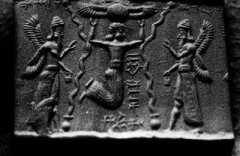
Nanshe
Nanshe is the goddess who looks out for widows, orphans, beggars, the debt-slave — the socially disenfranchised. She’s in charge of making sure that weights and measures are fair and accurate. And boy, does she run her temple like a tight ship. For instance, her temple hymns say:
“If the grain does not suffice for these rites and the vessels are empty and do not pour water, the person in charge of the regular offerings does not receive extra.”
I should think not!
The hymns also specify that priests can be fired or denied rations if they step out of line. People who ate and say they didn’t are also in trouble, as are mothers who deny food to their children.
She’s a powerful goddess, Nanshe, who “cares for all the countries,” who delivers the powerful to the powerless, who “sees into the heart of the Land as if it were a split reed.”
If You Had to Choose
Sumerians worshipped the entire pantheon, but they had one god in particular as their personal god. If you had to choose between these two, which would you serve? This question has special significance to me right now, because with everything going on in Libya, in Wisconsin, etc., it seems like right now is the time for some good social justice action — but what my soul craves is a long bath in the sea of story. I haven’t been writing stories in a year or more, and the lack is painful. Can I do both?
More Goddessy Goodness
For the authentic best-guess translations of Sumerian texts, check out the Electronic Text Corpus of Sumerian Literature. That’s where I snagged the quotes about Nanshe (A hymn to Nanshe: translation).
Nanshe, along with Inanna, also appears in Enheduanna’s temple hymns. There’s a lovely PDF of some of the hymns here.
I first met Enheduanna in the book Humming the Blues: Inspired by Nin-Me-Sar-Ra, Enheduanna’s Song to Inanna by Cass Dalglish.
The best place for a retelling of Inanna’s stories is the book Inanna by Kim Echlin and Linda Wofsgruber. It made me want to cry for poor Dumuzi, and for Inanna, who apparently regretted banishing him to the underworld. The somewhat stilted language of the “authentic” translation is made more accessible in this retelling, and the poetic spareness lets the beauty of the story shine through.
Previous Post: Enheduanna and Gilgamesh


 Kristin Ann King
