Tag Archives: books

Inanna and Nanshe

I learned about the Greek and Roman gods and goddesses as a child. But the Sumerian ones? Only recently. Here are a few tantalizing details about Inanna (goddess of writing, civilization, war, love, sex changes, and much more) and Nanshe (goddess of social justice).

Inanna

She’s a major god in the Sumerian pantheon, a direct descendant of Nannu, the primeval mother of heaven and earth. She was worshipped for thousands of years and bears a strong resemblance to other lands’ goddesses, such as Ishtar, Aprhodite, and Venus. Sumerians sang many hymns and told many stories about her.

Enheduanna, the first person ever to sign her name to a work of writing, prayed to Inanna as her personal god.

Inanna is the one who first brought civilization to the people. Sumerians tell of the divine me’s — no translation is possible because they’re laws, events, and qualities; for instance: irrigation, the flood, suffering, joy. Once upon a time, Enki had all the me’s, and Inanna, his daughter, journeyed to visit him. They drank a lot, and then he gave her all the me’s. He later regretted it and sent minions after her to retrieve them, but too late!

In another story, Inanna journeys to the underworld, just because she can. Her sister, who rules the underworld, has her stripped naked and killed, but she gets out again with the help of her faithful assistant. But the underworld demanded somebody in her place, and that somebody turned out to be her faithless husband Dumuzi.
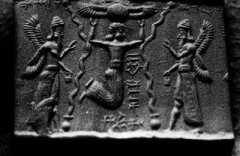
Nanshe
Nanshe is the goddess who looks out for widows, orphans, beggars, the debt-slave — the socially disenfranchised. She’s in charge of making sure that weights and measures are fair and accurate. And boy, does she run her temple like a tight ship. For instance, her temple hymns say:

“If the grain does not suffice for these rites and the vessels are empty and do not pour water, the person in charge of the regular offerings does not receive extra.”

I should think not!

The hymns also specify that priests can be fired or denied rations if they step out of line. People who ate and say they didn’t are also in trouble, as are mothers who deny food to their children.

She’s a powerful goddess, Nanshe, who “cares for all the countries,” who delivers the powerful to the powerless, who “sees into the heart of the Land as if it were a split reed.”

If You Had to Choose
Sumerians worshipped the entire pantheon, but they had one god in particular as their personal god. If you had to choose between these two, which would you serve? This question has special significance to me right now, because with everything going on in Libya, in Wisconsin, etc., it seems like right now is the time for some good social justice action — but what my soul craves is a long bath in the sea of story. I haven’t been writing stories in a year or more, and the lack is painful. Can I do both?

More Goddessy Goodness

For the authentic best-guess translations of Sumerian texts, check out the Electronic Text Corpus of Sumerian Literature. That’s where I snagged the quotes about Nanshe (A hymn to Nanshe: translation).

Nanshe, along with Inanna, also appears in Enheduanna’s temple hymns. There’s a lovely PDF of some of the hymns here.

I first met Enheduanna in the book Humming the Blues: Inspired by Nin-Me-Sar-Ra, Enheduanna’s Song to Inanna by Cass Dalglish.

The best place for a retelling of Inanna’s stories is the book Inanna by Kim Echlin and Linda Wofsgruber. It made me want to cry for poor Dumuzi, and for Inanna, who apparently regretted banishing him to the underworld. The somewhat stilted language of the “authentic” translation is made more accessible in this retelling, and the poetic spareness lets the beauty of the story shine through.

Previous Post: Enheduanna and Gilgamesh

Enheduanna and Gilgamesh

I’ve been fascinated by Mesopotamia ever since my tenth grade history class, when my outstanding teacher, Mr. Felt, taught me about the birthplace of writing. (Although I’ve since learned that it writing was developed in other places at around the same time, give or take a thousand years.) I’ve also been in love with the epic of Gilgamesh ever since I read the novelization Gilgamesh the King by Robert Silverberg.

But I had absolutely no idea of how much Sumerian literature survives, nor the extent to which goddesses figured in Sumerian story, myth, and poem. And I also did not know that the first person ever to sign her name to a text was a woman.

Her name was Enheduanna. Her father, Sargon, came to Sumer from the nearby country of Akkadia, and conquered the city-states that had previously been warring. He appointed Enheduanna as high priestess. She collected all the temple hymns from all the city-states in one place. At the end of it, she wrote:

“The compiler of the tablets was En-edu-ana. My king, something has been created that no one has created before.”

I get chills when I read that.

I first learned about Enheduanna a year or so back I went to a reading by Cass Dalglish, who wrote Humming the Blues: Inspired by Nin-Me-Sar-Ra, Enheduanna’s Song to Inanna.. It’s a “jazz translation” rather than a literal one, which makes the text come alive with passion and music. Dalglish points out that most translations of the cuneiform fix a single meaning to the words, but multiple readings are possible. So for each line, she took all the possible readings and then wrote a verse of poetry.

Having read Humming the Blues, I couldn’t help but wonder: what does the more traditional translation look like? I wanted the “authentic,” “authoritative” reading of the text. But I wanted the impossible. Sumer vanished with the birth of the Babylonian empire, and what’s left of their culture comes to us in stories passed on to other peoples and fragments of broken clay tablets.

I also couldn’t help but wonder: when did Enheduanna live, relative to the epic of Gilgamesh?

And so I began a journey into the heart of Sumer.

In the next post, I’ll write about Inanna and Nanshe — the goddess of writing and the goddess of social justice.

Book group dilemma

My book group has shrunk in size, and I’m now facing a dilemma. Grow it or leave it? One of the members recently expressed dissatisfaction at the lack of seriousness – people showing up without having read the book, and showing up not ready for a good discussion. I realized I’ve been batting fifty/fifty for a little while now. Last year I read ’em all, but this year there’s a higher proportion of books that I don’t like. And really, if I don’t like a book, there’s no way I’m going to finish it.

Our most recent book group meeting was pretty unfortunate. I actually read the book – in fact, I spent weeks struggling through it. But my kid vomited that morning, my spouse was working overtime, and on top of that, we were expecting house guests. So I didn’t go, and neither did one of the other four – which left two people, one who had read the book and one who had only gotten part of the way through.

The two things we need, if book group is to keep going, is: 1) more serious members; and 2) one or more people to enforce our rules. I don’t want to be a rule-enforcer. Too burned out by life generally.

Am I really a book group person? I’m not sure. I wouldn’t be in book group if the selection of books, generally speaking, wasn’t so fabulous. I get exposed to books I would never otherwise read, like The Brief Wondrous Life of Oscar Wao, Affinity, and What is the What?

Here’s our list for the past three years:

2010-2011
> 1. other voices, other rooms – truman capote (august 3)
> 2. south of broad – pat conroy
> 3. affinity – sarah waters
> 4. tam lin – pamela dean
> 5. the housekeeper & the professor – yoko ogawa
> 6. logicomix: epic search for truth – apostolos doxiadis
> 7. the forgotten garden – kate morton
> 8. brick lane – monica ali

2009-2010
Marjane Satrapi, Persepolis
Jamie Ford, Hotel at the Corner of Bitter and Sweet
Gwyneth Jones, Life: a novel
Junot Diaz, The Brief Wondrous Life of Oscar Wao
Marge Piercy, Woman on the Edge of Time
May Sarton, A House By the Sea

List 2008-2009
June 17, 2008
Animal, vegetable, miracle : a year of food life
Kingsolver, Barbara

July 29, 2008
What is the what : the autobiography of Valentino Achak Deng : a novel
Eggers, Dave

September 9, 2008
The beautiful things that heaven bears
Mengestu, Dinaw

October 21, 2008
Moral disorder : stories
Atwood, Margaret Eleanor

December 2, 2008
Let the Northern Lights erase your name : a novel
Vida, Vendela

January 13, 2009
If on a winter’s night a traveler
Calvino, Italo

February 24, 2009
Cat’s Cradle
Vonnegut, Kurt

April 7, 2009
Oh pure and radiant heart
Millet, Lydia

The Pleasures of Reading, Viewing, and Listening in 2010

The editor of Aqueduct press asked me to submit an essay as part of a series called “The Pleasures of Reading, Viewing, and Listening in 2010.” It’s a good time to reflect on some of my favorites. I haven’t read everybody else’s yet, but I’m looking forward to that.

My essay up on the Aqueduct Press Web site:

http://aqueductpress.blogspot.com/2010/12/pleasures-of-reading-viewing-and_18.html

I talked about:

  • The Brief Wondrous Life of Oscar Wao
  • The Hearts of Horses
  • The Tao Te Ching
  • Cheek by Jowl
  • The Man Who Lost His Shadow and Nine Other German Fairy Tales
  • Pippi Longstocking
  • Logicomix
  • Catching the Moon
  • The Polymath
  • Doctor Who
  • The Fishtrap winter gathering

The Polymath – Samuel Delany

I have been watching the documentary The Polymath about the life of Samuel Delany – a great American novelist that few people have heard of because a) he writes in SF and b) he is black. I first heard of him when his book was the Book of Honor at a Potlatch convention, and somebody read some of his work out loud. It was incredible, a multisensory experience, rich in so many dimensions. The documentary – even more so.

What would Pippi do on test day?

Under the superintendent’s SERVE proposal, there would be a whole lotta computerized testing. What would Pippi Longstocking do on test day? Just to give you an idea, here’s what she did on her first and only school day. (Don’t worry, she and the teacher parted on good terms.)

Excerpt from Chapter 4: Pippi Goes to School

“Indeed?” said the teacher. “Well, then we shall call you Pippi too. But now,” she continued, “suppose we test you a little and see what you know. You are a big girl and no doubt know a great deal already. Let us begin with arithmetic. Pippi, can you tell me what seven and five are?”

Pippi, astonished and dismayed, looked at her and said, “Well, if you don’t know that yourself, you needn’t think I’m going to tell you.”

All the children stared in horror at Pippi, and the teacher explained that one couldn’t answer that way at school.

“I’m sorry,” said Pippi contritely. “I didn’t know that. I won’t do it again.”

“No, let us hope not,” said the teacher. “And now I will tell you that seven and five are twelve.”

“See that!” said Pippi. “You knew it yourself. Why are you asking then?”

The teacher decided to act as if nothing unusual were happening and went on with her examination.

“Well now, Pippi, how much do you think eight and four are?”

“Oh, about sixty-seven,” hazarded Pippi.

“Of course not,” said the teacher. “Eight and four are twelve.”

“Well now, really, my dear little woman,” said Pippi, “that is carrying things too far. You just said that seven and five are twelve. There should be some rhyme and reason to things even in school. Furthermore, if you are so childishly interested in that foolishness, why don’t you sit down in a corner by yourself and do arithmetic and leave us alone so we can play tag?”

Superman Was Born Jewish

Right now I’m interested in the superhero story, where it came from, how it has evolved, what makes heroes “good” or “bad” in our minds, why we like antiheroes, and what we need from our superheroes. So I picked up a book on the history of superheroes,  Disguised as Clark Kent: Jews, Comics, and the Creation of the Superhero by Danny Fingeroth. I was amazed at the extent to which the Jewish experience shaped Superman – and, by extension, America’s national mythology.

In the book, Fingeroth talks about the original creators of the Superman comic, two Jewish boys named Jerry Siegal and Joe Shuster. Superman came out of a mix of their personal history, their cultural heritage, the immigrant experience, world events, and ideology surrounding them. I’m convinced Superman was born Jewish. But what fascinates me is how he was born Jewish. How did his story come to be, and what messages did it have for Americans? Looking at the past can help us see the present. Where have our superhero stories come from, and what are they telling us?

The Jews at the time were immigrating to America because of pogroms and the rise of fascism in Europe. They had come in fear for their lives. They had to maintain a double identity: their homeland identity and their assimilated, mainstream identity. Fingeroth writes, “When your history tells you that you can be murdered because of who your parents happened to be, the freedom provided by being able to blend into the mainstream culture is essential to survival.” Thus, Superman’s double identity was born. Just as the Jews had to disguise themselves as WASPs, so did Clark Kent.

The rise of fascism also brought a desperate need to the Jewish people – a need that cried out for a messianic figure. The creators of Superman, therefore, sent out subconscious messages to the American people. Fingeroth lists a few:

•    Look out for the Nazis!
•    Have some compassion for their victims!
•    Don’t you understand we are just like you?
•    You have to help!
•    Here is how you can use your gifts, America – to help those in need and distress! (p. 18)

Another historical influence was the Russian Revolution and the rise of Stalinism. Superman’s individualist ideology opposed the communist ideology. Fingeroth writes: “As expressed through Superman, the self was not to be subsumed to the collective. The self could best serve the whole by being allowed to flourish and thrive and express itself. This was the same celebration of the individual that had pervaded American popular culture from the solitary cowboy heroes of Owen Wister even onto the baseball fields . . . ” (42)

Yet another was the concept that science and reason could transcend human flaws, expressed in early science fiction.

One final influence was the Great Depression. Fingeroth quotes a 1975 press release from Siegal that shows how poverty added to the mix:

What led me into creating Superman in the early thirties?

Listening to President Roosevelt’s “fireside chats” . . . being unemployed and worried during the depression and knowing homelessness and fear. Hearing and reading of the oppression and slaughter of helpless, oppressed Jews in Nazi Germany . . . seeing movies depicting the horrors of privation suffered by the downtrodden . . . I had the great urge to help . . . help the downtrodden masses, somehow.
How could I help them when I could barely help myself? Superman was the answer.(41)

So that’s Superman. Born out of dire need, giving inspiration and hope to so many. What impact did he have back then? Did he inspire Americans to have compassion? Did he contribute to getting us involved in World War II?

It is ironic that the same qualities we needed from a superhero back then are getting us in trouble now: the individualist ideology, the idea that a hero can swoop down and save us (so we don’t have to do it ourselves). Our time is different. We beat Hitler and then became him, creating our own occupation camps of Japanese and ultimately dropping a weapon of mass destruction on two Japanese cities. State communism fell. An individualist ideology that went too far has contributed to the dismantling of our social safety net.

What do we need from our superheroes now? What are we telling them? What are they telling us?

Tune in next time. Same bat-time! Same bat-channel!

Works Cited
Fingeroth, Danny. Disguised as Clark Kent: Jews, Comics, and the Creation of the Superhero. Continuum: London and New York. 2007.