I choseto begin my discussion of Jung with Modern Man in Search of a Soul for two reasons. First, it has moments where he explains his terms and ideas clearly and simply. Jung’s texts are often esoteric, and his language is slippery, so it’s hard to get at the ideas behind them. In this text, he has moments where he manages to make the irrational comprehensible.
Second, this was published in 1933. He was living in Switzerland, smack in the middle of France and Germany, with nazism and antisemitism on the rise. A scary and dangerous time, like now. Beyond the political and economic events raged a spiritual war. Are we any better prepared now than we were then? Then, as now, I think we need his ideas.
Let me stop a minute and correct myself. I said “his ideas.” In the chapter “Freud and Jung–Contrasts” he makes the point that ideas don’t belong to anyone:
“Impressive ideas which are hailed as truths have something peculiar to themselves. Although they come into being at a definite time, they are and have always been timeless; they arise from that realm of procreative psychic life out of which the ephemeral mind of the single human being grows like a plant that blossoms, bears fruit and seed, and then withers and dies. Ideas spring from a source that is not contained within one man’s personal life. We do not create them; they create us.” (115)
Bob Peterson from North Palm Beach, Florida, Planet Earth!, CC BY-SA 2.0 , via Wikimedia Commons
This quote also leads us nicely into the first word I’d like to explore: psyche. Take a minute and consider how you would define it. Just off the top of your head. What is the human psyche? The human mind–that would be my first answer. The words psychic and psychotic also spring to mind: both magic and madness.
Jung’s brief definition of the human psyche is “a whole that embraces consciousness, and is the mother of consciousness.” (123)
Is the psyche constrained to a single human body? Jung doesn’t answer the question–or even ank it– in any text I’ve found. As I said, he’s slippery. Usually I’ve seen the term referring to the primordial patterns of thought we are all born with. In the quote about ideas, though, “psychic life” does have an expanded and very organic meaning. It’s larger than, and mothers, one human mind.
Can the psyche be reduced to biology alone? Freud thought so, and Jung disagreed. “We moderns are faced with the necessity of rediscovering the life of the spirit; we must experience it anew for ourselves. It is the only way in which we can break the spell that binds us to the cycle of biological events.” Because of this position, Jung says, “I am accused of mysticism. I do not, however, hold myself responsible for the fact that man has, everywhere and always, spontaneously developed religious forms of expression, and that the human psyche from from time immemorial has been shot through with religious feelings and ideas.” (122) In other words, spirituality is a key component of the psyche.
Jung’s thoughts on spirituality come from direct observation:
“As may be seen, I attribute a positive value to all religions. In their symbolism I recognize those figures which I have met with in the dreams and fantasies of my patients. In their moral teachings I see efforts that are the same as or similar to those made by my patients, when guided by their own insight or inspiration, they seek the right way of dealing with the forces of the inner life. Ceremonial, ritual, initiation rites and ascetic practices, in all their forms and variations, interest me profoundly as so many techniques for bringing about a proper relation to these forces.” (119)
However, he also gives biology its due:
“I likewise attribute a positive value to biology, and to the empiricism of natural science in general, in which I see a herculean approach to understand the human psyche by approaching it from the outer world. I regard the gnostic religions as an equally prodigious undertaking in the opposite direction: as an attempt to draw knowledge of the cosmos from within. In my picture of the world there is a vast outer realm and an equally vast inner realm. . .” (119-120)
To put these ideas in my own words, the psyche is a vast unknown something composed of both matter and spirit. And spirit is also an unknown something.
Now, as in 1933, the life of the spirit, the soul, the psyche, the something, has great power over our collective thought and action, and all the more so if we pretend it doesn’t exist. We owe it to ourselves to pay attention.
The next term I’d like to grapple with is “the unconscious.” For that, in my next post I’ll move to the chapter “Analytical Psychology.”
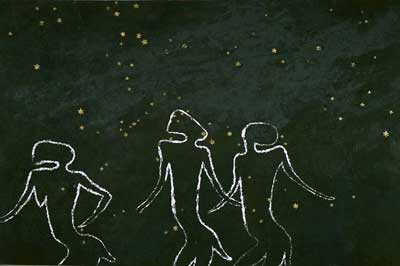
My featured image comes from the National Museum of African Art, collection 96-23-1, by artist Gavin Jantjes. I chose it for this post because my heart said, “Yes, that’s it, exactly.” Well, I say “heart,” but I could also say “imagination” or “spirit” or “soul” or “unconscious.” It’s easy to get all tangled up in words. My conscious mind asks: “What do you mean? What is it about this particular image?” It’s the empty space. Three outlined figures dancing against (in front of, amid. . .) a backdrop of stars. It’s telling me something I need to know. Some images are like that. They say, “A-ha!” even though I don’t know what or why. I listen quietly.
I studied Carl Jung in my early college years, not as a college course but as part of a local group that my father and stepmother belonged to. I learned and practiced a method of dream analysis, to the great benefit of my self-understanding and creativity. I also read and sometimes outlined a couple of books:
Modern Man in Search of a Soul, first English printing 1933
The Undiscovered Self, copyright 1957
Man and His Symbols, copyright 1964
These titles point to a few key frustrations I have with his work. Humanity is all he/him. Man is broken into “modern man” and “primitive man.” The world is broken into the Western world and the “other.” All those cultural biases from those times.
All the same, they were foundational to the way I understand the landscape of our collective mind. Spirituality, art, stories, philosophy, science — everything. I have something I would like to say, but I realized that to express my thoughts, I would need to dip back into these books. I was surprised at what I had underlined, highlighted, and marked with highlighter pen.
In this series of posts, I will examine Carl Jung’s ideas as a way of retracing my steps back from the beginning to the way I now think about the psyche. The full series is:



 Kristin Ann King