Tag Archives: history

Lucy Parsons, Emancipator

In honor of Juneteenth, I have a few remarks about Lucy Parsons — anarchist, revolutionary, orator, essayist, mother, seamstress. She became famous as a widow of a “Haymarket martyr,” anarchist Albert Parsons, and later for her own speeches and orations. The Chicago police called her “more dangerous than a thousand rioters” and, after her death, they disappeared all of the books and papers they could find.

Why was her speech so dangerous? She sought to liberate the downtrodden–or rather, she spent her life urging them to take direct action in liberating themselves.

In one of her more famous essays, “To Tramps,” she spoke to the 35,000 unemployed Chicago workers, who had been dying by starvation and exposure, and by throwing themselves into the river in despair.

stroll you down the avenues of the rich and look through the magnificent plate windows into their voluptuous homes, and here you will discover the very identical robbers who have despoiled you and yours. . .

Another of her better-known essays, “The Factory Child,” uses moving Victorian prose to decry the horrors of child labor.

O factory child! What can be said of thee, thou wee, wan thing? ‘Tis thy teardrop which flashes from the jeweled hand of the factory lord. ‘Tis thy blood which colors the rubies worn in his gorgeous drawing room. . . .

Some day . . . brave hearts and strong arms will annihilate the accursed system which binds you down to drudgery and death. Only then will the factory door to gender childhood be forever closed, and the schoolhouse be flung open, and all the avenues of art and learning be opened up to children of the producing many.

Another, less well-known essay is surprisingly relevant today. Her essay “Wage-Slaves vs. Corporations: What are You Going to Do About It?” takes aim at the funds spent by a life insurance company to influence elections. She writes:

Oh, I think I hear you say, “Why, I am going to use the ballot, the freeman’s weapon, and elect good men to office, who will seize the boa constrictor-like trusts and control them. Are we not free-born American citizens?”

Oh, are you though? Not too much assurance, please.

After explaining the political corruption, she asks:

What are you going to do about it?

Before Juneteenth, Lucy and her family had been enslaved by a doctor named Talliafero, who had moved the family to Texas in an effort to keep them enslaved. After the Civil War ended, Lucy’s family moved to Waco, Texas, where she secured her formal education in the first school for Black children.

Freedom after the Civil War was precarious. The countryside was full of white vigilante violence, Ku Klux Klan atrocities, kidnappings, and efforts to press freed Blacks into involuntary apprenticeships. At the same time, though, freedom must have seemed just over the horizon. Black people got the vote, and in places they were the majority, elected Black politicians. Globally, too, 1867-1871 was the time of Marx’s Capital and the Paris Commune. Lucy met Albert Parsons, a white man and former Confederate soldier, and they got married.

Then the door slammed shut for the couple. Neo-confederates came into power in Texas and outlawed interracial marriage. In 1873, Lucy and Albert fled to Chicago, where they became socialists, anarchists, and communists. Lucy worked as a seamstress and began publishing her work.

In 1877, the same year Reconstruction ended, railroad workers across the United States struck over a series of wage cuts that stole half their income and left them starving and desperate. Police, business owners, deputized militias, and the federal government banded together to break the strike. Rutherford Hayes, the Republican president, called in the National Guard for the first time the U.S. military had been deployed against strikers. Business owners and newspapers called for strikers to be poisoned, hanged, and shot. Dozens of Chicago workers were killed. Lucy’s husband responded with incendiary speeches of his own, and the local police advised him to leave town, on threat of murder.

All these experiences built into Lucy Parsons’ political analysis. Along with many other socialists of the time, she saw commonalities between chattel slavery and wage slavery, and between slaveowners and industrialists. She had seen the emancipation of enslaved people by military might, and then she had seen the failure of the ballot box to preserve liberty. She had seen extreme violence used to repress freedpeople and strikers.

And so began her lifelong project of emancipation.

Read more:

Lucy Parsons, An American Revolutionary by Carolyn Ashbough

Lucy Parsons Freedom Equality & Solidarity Writings & Speeches, 1878-1937, ed. Gale Ahrens

Goddess of Anarchy by Jacqueline Jones
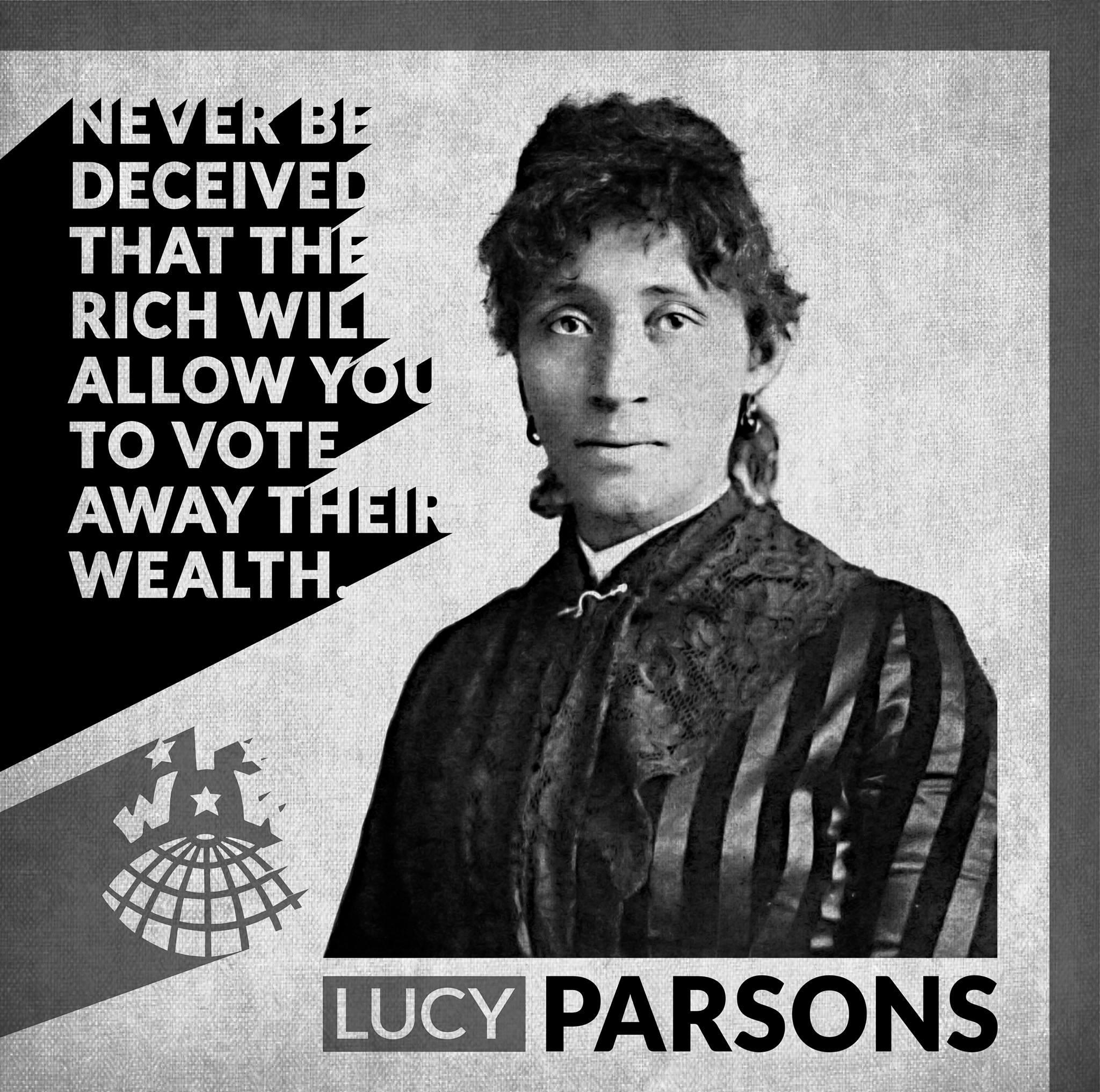
Portrait of Lucy Parsons, with the quote "Never be deceived that the rich will allow you to vote away their wealth"

Learning the actual history of the U.S. colonies

I’ve been interested in genealogy and family history for a while now. I like to learn more than the names and dates — I like their stories, and the “why” of where they moved, what religion they were, etc. And there is a LOT of information online. I can trace some branches of the family back to the 1600s. (One problem with that is there are “non-parental events” — that is, kids who have been assigned by history to the wrong parents, whether by adultery or adoption or who knows what all. Errors are bound to multiply as you go back in time. All the same, I feel attached to these ancestors.)

Anyway, about a month ago I got interested in some of the names in my family tree. In one set of great-great-great grandparents and their ancestors, I saw names like Zenos or Zenas, Electa, Hannibal, Sylvanus, Israel, Abraham, Sarah, Tryphena . . . there are Hebrew names, Greek names, New Testament names, names of emporers, and even full names of two U.S. Presidents. How on earth did these names get in my family tree?

I was able to trace some of those families back by their paternal lines to arrival in the early U.S. colonies. Then I looked up the history of their churches and the towns they lived in, and ultimately the history of Protestant sects from 1630 to 1840.

Found out some fascinating tidbits! I’ll list a couple of them here, with the caveat that I learned all this from surfing the Web, which is notoriously unreliable. Most of this came from Wikipedia and the rest from random places.

1. The first two Puritan colonies were very different. The Mayflower Pilgrims were separatists — they wanted to break completely with the Church of England. The Massachusetts Bay Colony wanted to reform it instead. Both established theocracies, which survived at first only because there was a civil war distracting the King of England. Power and influence of these two colonies waned as England settled its civil war and took a greater role in colony governance, more Europeans moved to the U.S. (giving people a chance to flee the Puritan colonies), and  ultimately England revoked the charter of one or the other or both.

2. Puritans had Hebrew names and modeled their theocracies after laws in the Hebrew Bible. They identified strongly with the persecution of the Jews, since they had been persecuted as well.

3. Puritans were from the beginning very invested in democracy — that is, of the male members of the church.

4. By the 1690s, the influence of the Puritans had waned, but a lot of the beliefs and traditions carried on in other religions until at least the 1840s. This is where it gets super interesting, though — there were no less than three revival movements, called “Great Awakenings,” where everything got turned on its head. They took place in approximately the 1730s, the 1790s, and the 1820s (give or take a couple of decades).

With that context in mind, here are a couple family stories.

John Mathew Noah came to the U.S. in colonial times as an indentured servant and eventually worked his way up to being fairly wealthy. He left Massachusetts for Ohio in the early 1800s, where he participated in the founding of a church called Bethesda.

Like Puritan churches, it had covenants to enforce church attendance and personal behavior. A decade or so later, the church was rocked by the Third Great Awakening and a schism developed. Some members wanted to keep the covenants, and some, including John Noah, wanted to throw them out entirely.

The notes of church meetings were kept, so I got to read an account of the schism, which was fascinating! There were a series of votes that kept getting overturned, and eventually, John Noah and ten to seventeen others were excluded from the church. He went on to help found a second church in another town. Meanwhile . . .

. . . his daughter, Margaret Haynes Noah, and her husband joined the Mormon Church, along with several other members of the Bethesda church. Her husband was . . .

. . .  Charles Hulet, a descendent of Puritans, including the Hathorne family, and a distant relation of the leader of the Salem Witch Trials and of Nathaniel Hawthorne. His father, Sylvanus Hulet, had fought in the Revolutionary War, then disappeared from historical records for seven years and emerged married to . . .

. . .  Mary Ann Lewis, whose parentage has not been traced, aside from a family story that her grandmother was a Native American named Running Deer and her grandfather was a white man referred to as Charles Sq**man (that’s a derogatory term that was used for whites who married Native Americans). This history, connected to the fact that the LDS church had a focus on converting Native Americans, adds up to something, but I can’t for the life of me tell what!

Here are the names that Charles Hulet and Margaret Ann Noah, my great-great-great-great grandparents (if I counted right!) gave their children: Anna Maria, Melvina, Catherine, Electa Fidelia, Sylvanus Cyrus, Elizabeth, Jane, Sarah, Dorcus, Tabitha, and Warren.

I see so many recurring patterns. Idealism, the desire to throw out all the old rules, restlessness, the willingness to pick up and move your entire family for the sake of religion, and interest in new forms of government. The desire for theocracy and the desire for its opposite.

That’s just one small segment of my family. This is the family of my great-great-great grandparent and beyond, and she (Catherine Hulet) is only one of thirty-two great-great-great grandparents. (If I counted right!) It contains so much drama and so many different kinds of people!

Folks, the history of the U.S. is so much stranger and more complicated than we could ever imagine.