
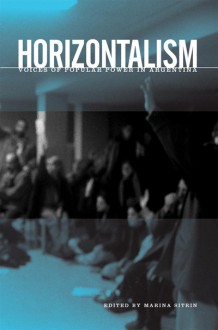
Some years ago, I read the collection Horizontalism: Voices of Popular Power in Argentina by Marina Sitrin. Sitrin collected firsthand accounts of people active in the social movements in Argentina that came after sudden economic devastation in 2001. Sitrin writes:
“The precipitating incident was the government’s freezing of peoples’ bank accounts, and converting their money, once pegged to the U.S. dollar, into a financial asset that would be held by banks and used to secure payment to foreign investors, but that could not be accessed by the depositors. . . . This was the spark dropped on a long smoldering fire. The government of Argentina had taken out huge loans with the IMF in the 1990s, and in the late 90s began to pay these loans back through privatization and severe austerity measures. Thousands of people were laid off, wages and pensions were cut, and social services degraded. . . [B]y 2001 industrial production had fallen by over 25 percent. The official poverty level grew to 44 percent, with the unofficial level substantially higher.” (pp 8-9)
Let’s go back a minute to the word “austerity.” Here is a short definition from an article published in 2022 on the Oxfam International web site: “85% of the world’s population will live in the grip of stringent austerity measures by next year.”
“Austerity measures include scaling down social protection programs for women, children, the elderly and other vulnerable people, leaving only a small safety net for a fraction of the poorest. They also include cutting or capping the wages and number of teachers and healthcare workers, eliminating subsidies, privatizing or commercializing public services such as energy, water and public transportation, and reducing pensions and workers’ rights.”
In the past, “austerity” is something that mostly happened to other countries, so those of us in the United States might not have heard of it. (It has been happening here slowly, for quite some time, but that’s a topic for another post.) Well, we’d better learn fast, because it’s going full throttle. In other words, we can defeat “America First” if we realize that we are not the only country in the universe. (For that matter, we’re not even “America.” That’s a continent. It has other countries in it.)
From the global South, those of us in the global North can learn both what might happen and how people might respond.
I’ll try to write more later, but for now I’ll just say, “Go read the book.”
Previous posts about this book:

 Kristin Ann King