
Every so often somebody asks me, “Who’s your favorite author?” That question is unanswerable. There have been so many favorites over the years! Ten years ago it would have been a toss-up between Ursula K. Le Guin and Octavia Butler, with Ursula winning by a hair. Today? Must I have one? Why? And what about my favorite book? My shelves are filled with contenders.
But if I’m pressed, I’m likely to reach for someone tried and true, someone other people may know. Some literary star, I suppose? We have those, but maybe we shouldn’t.
The idea of a “Star System” apparently comes from Hollywood. Take one actor and promote them to godhood, and hey, your movies will sell. Works for books too. I came to the term through a different route, though: Jo Freeman’s essay Tyranny of Structurelessness, a critique of power dynamics in the feminist movement of the 1970s. Here is an excerpt:
“While it has consciously not chosen spokespeople, the movement has thrown up many women who have caught the public eye for varying reasons. These women represent no particular group or established opinion; they know this and usually say so. But because there are no official spokespeople nor any decision-making body that the press can query when it wants to know the movement’s position on a subject, these women are perceived as the spokespeople. Thus, whether they want to or not, whether the movement likes it or not, women of public note are put in the role of spokespeople by default. . . This has several negative consequences for both the movement and the women labeled “stars.” First, because the movement didn’t put them in the role of spokesperson, the movement cannot remove them. The press put them there and only the press can choose not to listen.”
Within activist organizing, I’ve seen many people cast into the roles of unelected, unaccountable “stars.” They step up to speak, and because they are confident, everyone listens to them. They can do no wrong (except they do).
As you may have guessed from the title, I’m circling around the literary star Neil Gaiman and the assaults he committed. (In case you want me to use the word alleged, forget it. Even if all the other grotesque details were made up, he admitted to intercourse with a much younger employee. That’s all I need to know.) He was never my favorite author, but I have enjoyed and admired his fiction greatly. His short story “The Problem of Susan” is an excellent analysis of misogyny in Narnia, and the Doctor Who episode he scripted, “The Doctor’s Wife,” will always be one of my favorites. Fans have been grappling with this question of liking the art even when the artist is a shitty, shitty person.
I’m more disturbed by the question: how did we end up making him a literary star? A feminist one, even. Why did we want a literary star?
Part of this is timing–at the beginning of the tenure of the United States’ most depraved president to date. And yet, he’s a star in the eyes of thousands upon thousands of people. Is there just something wrong with us as a species, that we seek out people to put on pedestals? The hypothesis in Octavia Butler’s Xenogenesis series is often on my mind: is the combination of intelligence and hierarchy in a species simply an evolutionary dead end?
Maybe, maybe not. I guess somebody will find out sometime.
Meanwhile, I went in search of Tanith Lee’s Flat Earth series, in order to form my own opinion on another allegation against Gaiman: it’s been said that Sandman borrowed heavily from that series, and that whether or not the borrowing amounted to plagiarism, it was shitty of him to leave her uncredited. In case you think this is a new speculation, read the article “Tanith Lee: Gone But Not Forgotten” by Deuce Richardson.
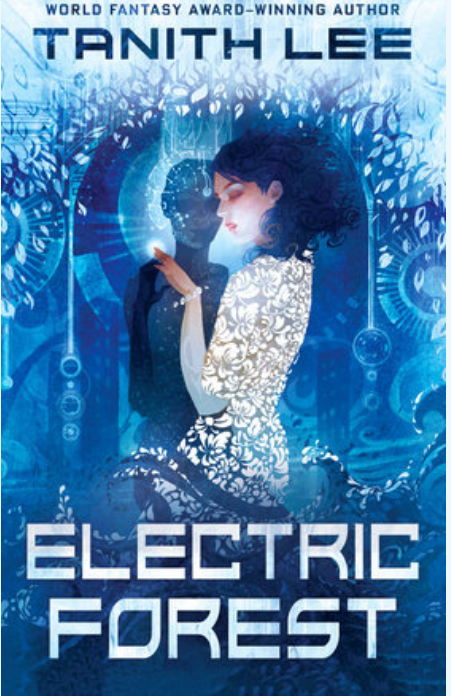
My quest led me outside of the house, to a used bookstore and then to a library. In the bookstore I found a “Best Of” science fiction anthology, and at the library I found Electric Forest. Here is an excerpt from the cover blurb:
“Because of her natural-born features, Magdala is an outcast in society–abandoned at birth, abused in the orphanage she grew up in, and branded with the cruel name ‘Ugly.’ But Magdala’s world turns upside down when she’s approached by Claudio Loro, a wealthy scientist who has created a beautiful artificial body. When he offers to transfer Magdala’s consciousness into the body, she cannot refuse the priceless opportunity for a new, beautiful life.”
That’s all I’ll share, because the cover blurb gave away the plot. I know where the story is heading. But the journey! Tanith Lee is a marvel of creativity, and even though I’ve read many, many books, this one is so fresh. It hits hard but in a luscious way.
I haven’t found the Flat Earth series yet. When I do, I expect it to be full of captivating characters and dripping with story.
That brings me to one of the books I read years ago and think about often: Haroun and the Sea of Stories by Salman Rushdie. I can’t remember most of the details . . . a princess with her lips sewn shut, so she cannot speak. A heroic journey. The question: “what’s the use of stories that aren’t even true?” Most importantly, a sea full of stories. I carry that metaphor. And when I ask myself the question, “If Gaiman is such a noxious person, why do I like them so much? Why were his stories so wildly inventive?”
It makes me feel better to think that the stories originated from outside him, that he tapped into this magical endless source of story. But, why? Shouldn’t such a power be reserved for people who are kind?
(Insert Moral Here)
I thought perhaps this blog post, which has wandered all around the world of books, circling some deep and important questions, was leading to a brilliant conclusion. No such luck. What is a reader to do?
Fortunately, I have more chapters of Electric Forest yet to read.

 Kristin Ann King