
Art can reduce tragedy down to a form we can look at without losing our ability to cope. To see — not to look away — but to retain the ability to act. To see terror and retain courage.
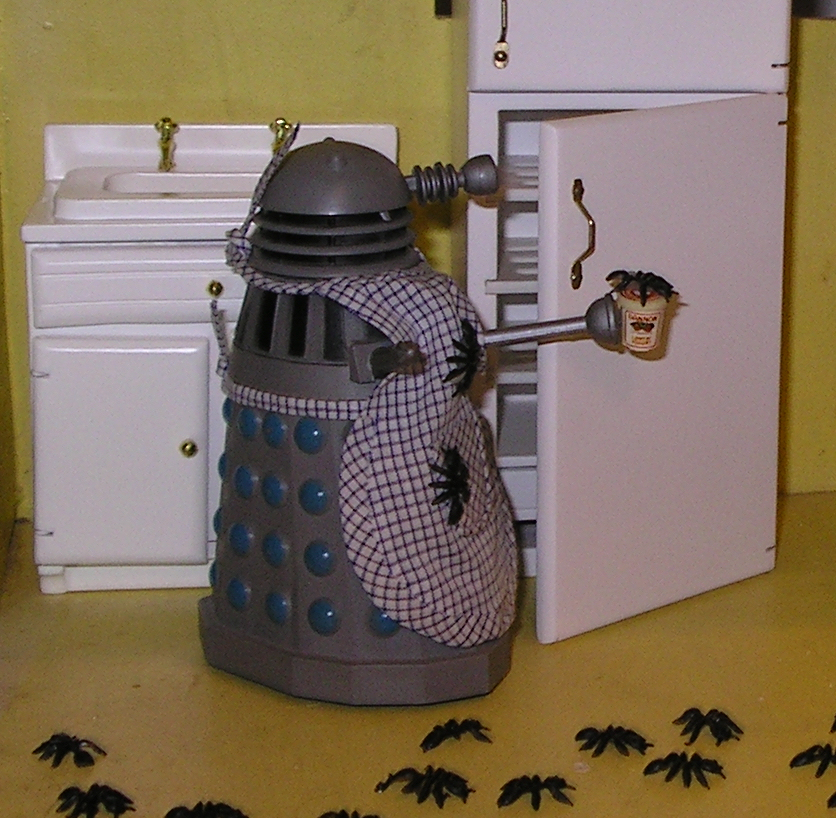
Consider the Dalek — a genocidal killing machine. Fascism in its purest form. We bake Dalek cookies and eat them; we crochet them for use as potholders and ornaments; or, in my case, put them in dollhouses. It’s a way of controlling our fear. We defuse it with silliness and domesticity.
Art also teaches us to recognize historical patterns. A nazi or fascist might not sieg-hail or use the amateurish German accent we recognize from TV, but we can still learn to notice a violent authoritarian regime that must be resisted.
Here, then, are four moments in Doctor Who that speak to us in the United States, today, right now.
1. “It’s happening again!”
In the episode “Turn Left,” Donna Noble and her grandfather Wilf say goodbye to their host Rococco, an Eastern European man who had welcomed them with open arms into his apartment when they were displaced by war. Donna is confused about why he has to leave in the back of an army truck.
“Oh, but why do you have to go?” she asks.
Rococco replies cheerily. “It’s the new law. England for the English, et cetera. They can’t send us home. The oceans are closed! They build labour camps.”
“I know,” asks Donna, “but labor doing what? There aren’t any jobs.”
She still hasn’t clued in, but Wilf’s heart is breaking. His lips tremble. He salutes Rocco and mutters,
“Labour camps. That’s what they called them last time.”
“What do you mean?” asks Donna.
“It’s happening again,” says Wilf.
That’s when she figures it out. She runs after the truck, but it’s already too late.
2. I’m not lowering my bubble
In “Dot and Bubble,” a young woman named Lindy is chatting with friends through her Bubble, wearable social media that nobody ever takes off. She and her lily-white peers are the children of the elite, and for some reason they have been abandoned by their parents and left to their own devices in the guarded town of Fineville. Nothing can get in or out, so they’re safe. Clearly.
Oblivious, she walks past a body being dragged away and toward her office, where she and her friends do their two hours of work. The Doctor has hacked into her feed and tries to get her attention, but she gives a micro-expression of disgust and swipes him away. In the town of Fineville, racism won. The Doctor’s white companion, Ruby Sunday, appears instead and asks her to lower her Bubble just long enough to look at the real world.
“I promise I will leave you alone if you could just look at the four desks in front of you,” says Ruby.
“I am not…lowering… my Bubble,” says Lindy.
“Okay. Can you stay inside and look beyond it? Can you do that?”
Bit by bit, Ruby coaxes Lindy and her peers to look outside their Bubbles just long enough to run away from the monsters who are eating everyone in alphabetical order. To be safe, they just need to trust the Doctor.
Will they?
3. The Beast Below
The Doctor and his new companion, Amy Pond, have landed on the far-future Starship U.K. He begins by falsely pretending he follows a Prime Directive: “We are observers only. That’s the one rule I’ve always stuck to in all my travels. I never get involved in the affairs of other peoples or planets.”
Then they see a young girl sitting on a bench, crying all alone while adults hurry by without looking. Amy turns to the Doctor to ask him a question, only to discover that he is already outside of the TARDIS sitting on a bench and talking to her. He gestures to Amy to join him, and then he asks her to look at this world and tell her what’s wrong with it.
“Is it the bicycles?” she asks. “Bit unusual on a starship, bicycles.”
It isn’t the bicycles.
“Life on a giant starship,” he says. Back to basics. Bicycles, washing lines, wind-up street lamps. But look closer. Secrets and shadows, lives led in fear. Society bent out of shape, on the brink of collapse. A police state.”
He gives her a moment, then asks, “Do you see it yet?”
“Where?” she asks.
He points to the young girl. “There.”
4. Get some perspective, woman!
In “Aliens in London,” the world is in crisis, and all the Very Important People are rushing around the British Parliament Building trying to figure out how to respond. Acting Prime Minister Joseph Green is entirely out of patience with this annoying minor official, Harriet Jones, who has arrived with a proposal for preserving cottage hospitals.
Green barks out, “By all the saints, get some perspective, woman! I’m busy.” Then he rushes off, super-competently leaving her alone in the Cabinet Room with a file of Emergency Protocols.
A bit irresponsible? Well, aliens have just landed in the middle of London, and most of the British Government is missing. It is an emergency, after all. As it turns out, though, this is an emergency of his own making. He is actually an alien, wearing a human skin, intent on making quick cash by destroying Earth. And farting. A lot of farting.
Authoritarianism pairs well with farting, don’t you think?

 Kristin Ann King