Lucy Parsons, Emancipator

In honor of Juneteenth, I have a few remarks about Lucy Parsons — anarchist, revolutionary, orator, essayist, mother, seamstress. She became famous as a widow of a “Haymarket martyr,” anarchist Albert Parsons, and later for her own speeches and orations. The Chicago police called her “more dangerous than a thousand rioters” and, after her death, they disappeared all of the books and papers they could find.

Why was her speech so dangerous? She sought to liberate the downtrodden–or rather, she spent her life urging them to take direct action in liberating themselves.

In one of her more famous essays, “To Tramps,” she spoke to the 35,000 unemployed Chicago workers, who had been dying by starvation and exposure, and by throwing themselves into the river in despair.

stroll you down the avenues of the rich and look through the magnificent plate windows into their voluptuous homes, and here you will discover the very identical robbers who have despoiled you and yours. . .

Another of her better-known essays, “The Factory Child,” uses moving Victorian prose to decry the horrors of child labor.

O factory child! What can be said of thee, thou wee, wan thing? ‘Tis thy teardrop which flashes from the jeweled hand of the factory lord. ‘Tis thy blood which colors the rubies worn in his gorgeous drawing room. . . .

Some day . . . brave hearts and strong arms will annihilate the accursed system which binds you down to drudgery and death. Only then will the factory door to gender childhood be forever closed, and the schoolhouse be flung open, and all the avenues of art and learning be opened up to children of the producing many.

Another, less well-known essay is surprisingly relevant today. Her essay “Wage-Slaves vs. Corporations: What are You Going to Do About It?” takes aim at the funds spent by a life insurance company to influence elections. She writes:

Oh, I think I hear you say, “Why, I am going to use the ballot, the freeman’s weapon, and elect good men to office, who will seize the boa constrictor-like trusts and control them. Are we not free-born American citizens?”

Oh, are you though? Not too much assurance, please.

After explaining the political corruption, she asks:

What are you going to do about it?

Before Juneteenth, Lucy and her family had been enslaved by a doctor named Talliafero, who had moved the family to Texas in an effort to keep them enslaved. After the Civil War ended, Lucy’s family moved to Waco, Texas, where she secured her formal education in the first school for Black children.

Freedom after the Civil War was precarious. The countryside was full of white vigilante violence, Ku Klux Klan atrocities, kidnappings, and efforts to press freed Blacks into involuntary apprenticeships. At the same time, though, freedom must have seemed just over the horizon. Black people got the vote, and in places they were the majority, elected Black politicians. Globally, too, 1867-1871 was the time of Marx’s Capital and the Paris Commune. Lucy met Albert Parsons, a white man and former Confederate soldier, and they got married.

Then the door slammed shut for the couple. Neo-confederates came into power in Texas and outlawed interracial marriage. In 1873, Lucy and Albert fled to Chicago, where they became socialists, anarchists, and communists. Lucy worked as a seamstress and began publishing her work.

In 1877, the same year Reconstruction ended, railroad workers across the United States struck over a series of wage cuts that stole half their income and left them starving and desperate. Police, business owners, deputized militias, and the federal government banded together to break the strike. Rutherford Hayes, the Republican president, called in the National Guard for the first time the U.S. military had been deployed against strikers. Business owners and newspapers called for strikers to be poisoned, hanged, and shot. Dozens of Chicago workers were killed. Lucy’s husband responded with incendiary speeches of his own, and the local police advised him to leave town, on threat of murder.

All these experiences built into Lucy Parsons’ political analysis. Along with many other socialists of the time, she saw commonalities between chattel slavery and wage slavery, and between slaveowners and industrialists. She had seen the emancipation of enslaved people by military might, and then she had seen the failure of the ballot box to preserve liberty. She had seen extreme violence used to repress freedpeople and strikers.

And so began her lifelong project of emancipation.

Read more:

Lucy Parsons, An American Revolutionary by Carolyn Ashbough

Lucy Parsons Freedom Equality & Solidarity Writings & Speeches, 1878-1937, ed. Gale Ahrens

Goddess of Anarchy by Jacqueline Jones
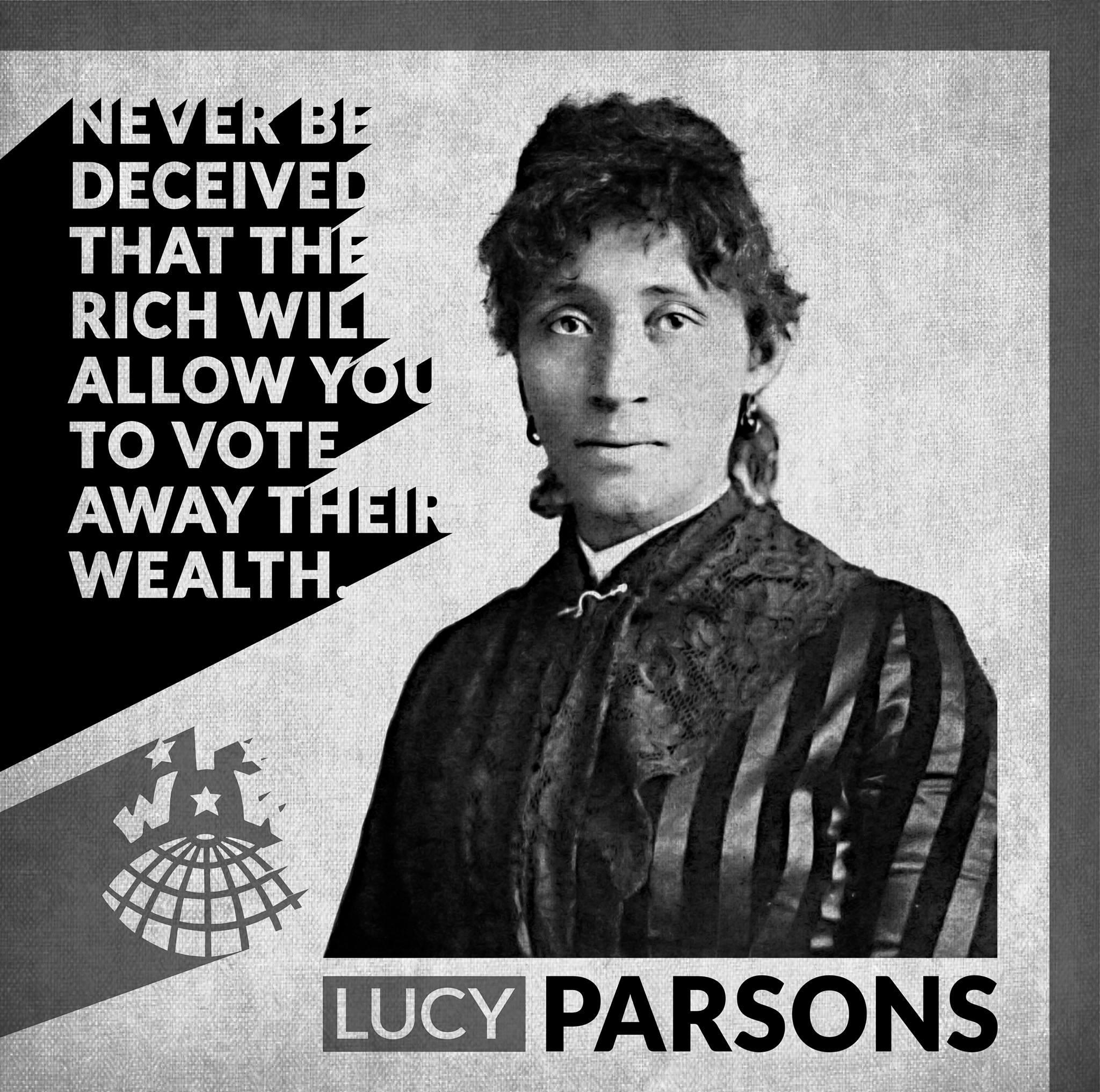
Portrait of Lucy Parsons, with the quote "Never be deceived that the rich will allow you to vote away their wealth"

Four Doctor Who moments for the Now

Art can reduce tragedy down to a form we can look at without losing our ability to cope. To see — not to look away — but to retain the ability to act. To see terror and retain courage.

Consider the Dalek — a genocidal killing machine. Fascism in its purest form. We bake Dalek cookies and eat them; we crochet them for use as potholders and ornaments; or, in my case, put them in dollhouses. It’s a way of controlling our fear. We defuse it with silliness and domesticity.

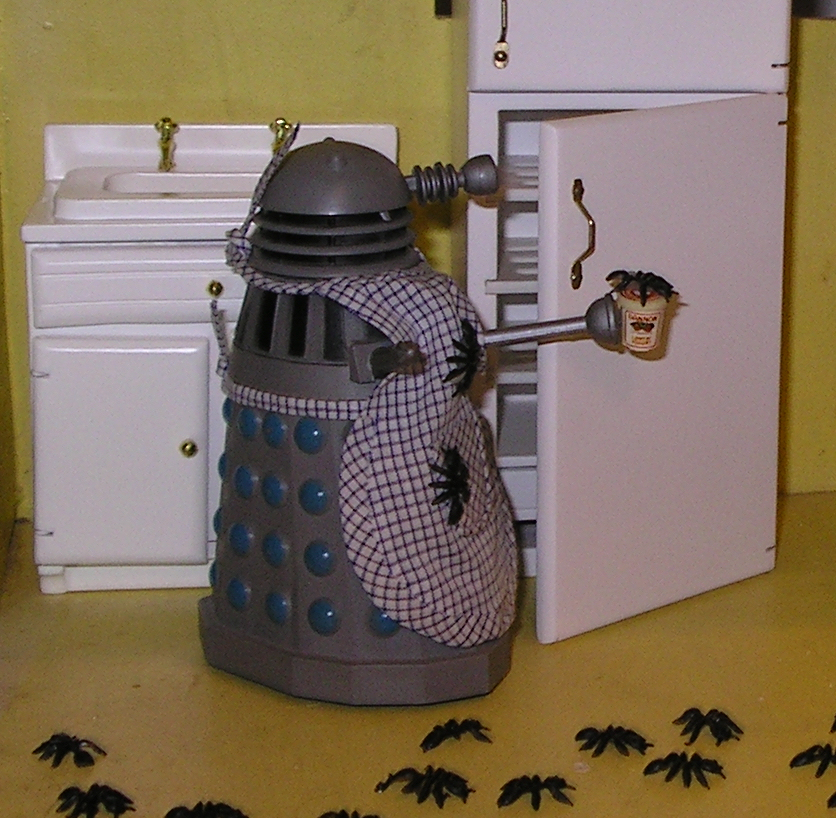
A Dalek stands in the kitchen of my dollhouse, wearing an apron and holding a jar of yogurt. Ants cover the floor and are climbing up its apron to get at the yogurt.

Art also teaches us to recognize historical patterns. A nazi or fascist might not sieg-hail or use the amateurish German accent we recognize from TV, but we can still learn to notice a violent authoritarian regime that must be resisted.

Here, then, are four moments in Doctor Who that speak to us in the United States, today, right now.

1. “It’s happening again!”

    In the episode “Turn Left,” Donna Noble and her grandfather Wilf say goodbye to their host Rococco, an Eastern European man who had welcomed them with open arms into his apartment when they were displaced by war. Donna is confused about why he has to leave in the back of an army truck.

    “Oh, but why do you have to go?” she asks.

    Rococco replies cheerily. “It’s the new law. England for the English, et cetera. They can’t send us home. The oceans are closed! They build labour camps.”

    “I know,” asks Donna, “but labor doing what? There aren’t any jobs.”

    She still hasn’t clued in, but Wilf’s heart is breaking. His lips tremble. He salutes Rocco and mutters,

    “Labour camps. That’s what they called them last time.”

    “What do you mean?” asks Donna.

    “It’s happening again,” says Wilf.

    That’s when she figures it out. She runs after the truck, but it’s already too late.

    2. I’m not lowering my bubble

    In “Dot and Bubble,” a young woman named Lindy is chatting with friends through her Bubble, wearable social media that nobody ever takes off. She and her lily-white peers are the children of the elite, and for some reason they have been abandoned by their parents and left to their own devices in the guarded town of Fineville. Nothing can get in or out, so they’re safe. Clearly.

    Oblivious, she walks past a body being dragged away and toward her office, where she and her friends do their two hours of work. The Doctor has hacked into her feed and tries to get her attention, but she gives a micro-expression of disgust and swipes him away. In the town of Fineville, racism won. The Doctor’s white companion, Ruby Sunday, appears instead and asks her to lower her Bubble just long enough to look at the real world.

    “I promise I will leave you alone if you could just look at the four desks in front of you,” says Ruby.

    “I am not…lowering… my Bubble,” says Lindy.

    “Okay. Can you stay inside and look beyond it? Can you do that?”

    Bit by bit, Ruby coaxes Lindy and her peers to look outside their Bubbles just long enough to run away from the monsters who are eating everyone in alphabetical order. To be safe, they just need to trust the Doctor.

    Will they?

    3. The Beast Below

    The Doctor and his new companion, Amy Pond, have landed on the far-future Starship U.K. He begins by falsely pretending he follows a Prime Directive: “We are observers only. That’s the one rule I’ve always stuck to in all my travels. I never get involved in the affairs of other peoples or planets.”

    Then they see a young girl sitting on a bench, crying all alone while adults hurry by without looking. Amy turns to the Doctor to ask him a question, only to discover that he is already outside of the TARDIS sitting on a bench and talking to her. He gestures to Amy to join him, and then he asks her to look at this world and tell her what’s wrong with it.

    “Is it the bicycles?” she asks. “Bit unusual on a starship, bicycles.”

    It isn’t the bicycles.

    “Life on a giant starship,” he says. Back to basics. Bicycles, washing lines, wind-up street lamps. But look closer. Secrets and shadows, lives led in fear. Society bent out of shape, on the brink of collapse. A police state.”

    He gives her a moment, then asks, “Do you see it yet?” 

    “Where?” she asks.

    He points to the young girl. “There.”

    4. Get some perspective, woman!

    In “Aliens in London,” the world is in crisis, and all the Very Important People are rushing around the British Parliament Building trying to figure out how to respond. Acting Prime Minister Joseph Green is entirely out of patience with this annoying minor official, Harriet Jones, who has arrived with a proposal for preserving cottage hospitals.

      Green barks out, “By all the saints, get some perspective, woman! I’m busy.” Then he rushes off, super-competently leaving her alone in the Cabinet Room with a file of Emergency Protocols.

      A bit irresponsible? Well, aliens have just landed in the middle of London, and most of the British Government is missing. It is an emergency, after all. As it turns out, though, this is an emergency of his own making. He is actually an alien, wearing a human skin, intent on making quick cash by destroying Earth. And farting. A lot of farting.

      Authoritarianism pairs well with farting, don’t you think?

      Cats, Milk, and Español

      Last summer I got a start on learning Spanish from my friend, teacher, and poet Gabriella Gutiérrez y Muhs. (The image for this post is her wonderful and recently published picture book.) Why did I want to learn Spanish? The story begins when I was three or four years old, learning in a Salt Lake City Montessori school called La Casa. I still remember my teachers. They were beautiful women. From then I learned that the world is safe and people are kind. These days, sadly, people wouldn’t be so kind to them. I hope, though, that they are still around somewhere, surrounded by loved ones. They have my gratitude. I learned some Spanish words, too.

      Our family moved to Seattle and the Spanish dropped away. I learned un poco, a little bit, during an enrichment class in my first grade. (First grade was very boring, as I had already learned the material. Remember that I started learning when I was three or four.) In first grade, I learned how to say “The cat drinks milk.” El gato bebe leche. And that’s all I remember from that time.

      In middle school, I had the choice to learn Spanish or French. Which was the right choice? My neighbors spoke French, so I chose that language. I loved learning French! However, I was too shy to ever speak it with my neighbors.

      My aunt and cousins knew Spanish, but my family was estranged from them for reasons I didn’t truly understand at the time. I only knew any of my cousins when my family threw us together, which seemed generally out of my control. This was my loss. I grew up, got busy with my life, had kids, got breastfeeding support from La Leche League, gave my children piñatas to break – all those words and customs that have come into U.S. culture from the Spanish-speaking world.

      What’s happening now at the border between the U.S. and Mexico, really between the U.S. and every other country in the world, is a misunderstanding of the nature of humanity. Our lives are inextricably woven together. No matter how many walls and guns there are, we are family.  

      To make a long story short, I’ve been wanting to learn Spanish for quite some time, and last summer, with lots of help from my teacher. I got started. I have a solid foundation, and now what I need to do is practice. Keep it up. Be a world citizen.

      Estudio español.

      Thoughts on Horizontalism, ed. Marina Sitrin

      Some years ago, I read the collection Horizontalism: Voices of Popular Power in Argentina by Marina Sitrin. Sitrin collected firsthand accounts of people active in the social movements in Argentina that came after sudden economic devastation in 2001. Sitrin writes:

      “The precipitating incident was the government’s freezing of peoples’ bank accounts, and converting their money, once pegged to the U.S. dollar, into a financial asset that would be held by banks and used to secure payment to foreign investors, but that could not be accessed by the depositors. . . . This was the spark dropped on a long smoldering fire. The government of Argentina had taken out huge loans with the IMF in the 1990s, and in the late 90s began to pay these loans back through privatization and severe austerity measures. Thousands of people were laid off, wages and pensions were cut, and social services degraded. . . [B]y 2001 industrial production had fallen by over 25 percent. The official poverty level grew to 44 percent, with the unofficial level substantially higher.” (pp 8-9)

      Let’s go back a minute to the word “austerity.” Here is a short definition from an article published in 2022 on the Oxfam International web site: “85% of the world’s population will live in the grip of stringent austerity measures by next year.”

      “Austerity measures include scaling down social protection programs for women, children, the elderly and other vulnerable people, leaving only a small safety net for a fraction of the poorest.  They also include cutting or capping the wages and number of teachers and healthcare workers, eliminating subsidies, privatizing or commercializing public services such as energy, water and public transportation, and reducing pensions and workers’ rights.”

       In the past, “austerity” is something that mostly happened to other countries, so those of us in the United States might not have heard of it. (It has been happening here slowly, for quite some time, but that’s a topic for another post.) Well, we’d better learn fast, because it’s going full throttle. In other words, we can defeat “America First” if we realize that we are not the only country in the universe. (For that matter, we’re not even “America.” That’s a continent. It has other countries in it.)

      From the global South, those of us in the global North can learn both what might happen and how people might respond.

      I’ll try to write more later, but for now I’ll just say, “Go read the book.”

      Previous posts about this book:

      Have our brains been hacked?

      I have been thinking about “collective consciousness” for some time now, as a corollary to the Jungian idea of the collective unconscious. My 2018 blog posts “Musings on collective cognition” and “Could collective cognition be manipulated?” touched on ideas around social media, emergent consciousness, and deliberate rewiring of group thought. What do I mean by “collective consciousness”? It’s a fun thought experiment to imagine that the consciousness of humanity could be an organic entity of itself, self-aware and capable of acting in its self-interest. But there’s no need to get that abstract and esoteric.

      Let’s think of collective consciousness as a form of thought that goes beyond a single brain. We make it when we talk to each other, or write, or sing, or paint. When someone carved a poem on cuneiform, and I read a translation of it thousands of years later, that is like a message passed from one neuron to another.

      Who is allowed to pass such thoughts into my brain? People, books, music . . . but that’s so twentieth century, man! TikTok, the social media formerly known as Twitter, Facebook . . . I just let those types of social media right in, past all my defenses. I catch myself “knowing” something but not remembering where I learned it. Now humanity is sharing this space with bots and AI designed by humans in order to gain political and economic power. This is a little scary.

      More scary: the people who own social media, like Elon Musk, have an outsized impact on how we think.

      It should be pretty well known by now that Russia has been influencing U.S. politics using social media bots. If not, here’s the news from the mouth of the Justice Department, in its September 4, 2024 press release

      Justice Department Disrupts Covert Russian Government-Sponsored Foreign Malign Influence Operation Targeting Audiences in the United States and Elsewhere

      “The Justice Department today announced the ongoing seizure of 32 internet domains used in Russian government-directed foreign malign influence campaigns colloquially referred to as “Doppelganger,” in violation of U.S. money laundering and criminal trademark laws. As alleged in an unsealed affidavit, the Russian companies Social Design Agency (SDA), Structura National Technology (Structura), and ANO Dialog, operating under the direction and control of the Russian Presidential Administration, and in particular First Deputy Chief of Staff of the Presidential Executive Office Sergei Vladilenovich Kiriyenko, used these domains, among others, to covertly spread Russian government propaganda with the aim of reducing international support for Ukraine, bolstering pro-Russian policies and interests, and influencing voters in U.S. and foreign elections, including the U.S. 2024 Presidential Election. “

      This is not a new phenomenon. A recent article from the SAIS Review of International Affairs, “Social Media, Disinformation, and AI: Transforming the Landscape of the 2024 U.S. Presidential Political Campaigns” talks about some of the ways that bots are shaping public dialogue, and it cites studies going back as far as 2011.

      “During the 2016 US presidential election, Howard and Kollanyi (2016) proposed that political bots played an increasingly important role in the globalized political system in the form of botnets, fake news, and algorithmic manipulation, which was also known as “computational propaganda,” that referred to “assemblage of social media platforms, autonomous agents, and big data tasked with the manipulation of public opinion” (p. 4). In short, political bots—a subset of social bots—can be leveraged to influence public sentiment and intervene in the opinion climate, commonly known as “social media astroturf” (Ratkiewicz et al., 2011). Moreover, political bots would intensify the polarization of attitudes, amplify negative emotions, and subtly endanger democracy (Robles et al., 2022).”

      So there’s something I read on social media but can’t find now. (Ironic, yes?) It had to do with Russian psy-ops bots weighing in on U.S. “culture wars” by either creating or amplifying memes such as “Karen” and “O.K. Boomer.” Maybe they did, maybe they didn’t. But that’s the kind of thing bots can do: find two opposing parties, learn their point of disagreement, and fuel the flames by amplifying it. This manipulation feels more personal and disturbing than simply political bots.

      I titled this blog post, “Have our brains been hacked?” and my answer is “Yes, obviously.”

      Where does it stop? How far will it go? Billionaire “tech bros” now have access to a vast storehouse of public dialogue, AI tools to analyze and utilize it, and an economic interest in keeping people compliant.

      And what can we do? My answer is largely metaphorical. We need antivirus software for our brains, and also for our collective mind/minds. What? How? Dunno. I’ll just fling that question out into the world and hope somebody smart catches it.

      But I guess more urgently, we should be aware that if we are doing The Resistance on social media, then The Resistance has also been hacked.

      What does handwriting have to do with democracy?

      It wasn’t until high school that I first learned to type. Before that, handwriting was the only game for communication, and I wrote voraciously, with words and pictures. Today, I use a mix. Typing is much faster, but a pen and paper is always available.

      The generation graduating high school, voting, and entering the workforce has had a much different experience. Because of widespread focus on standardized tests, administered by computer, schools were forced to teach typing in the early elementary grades. With no additional instructional hours, what got cut? Snail mail letters, cursive, and art.

      Flash forward to the present day, and typing on computers is being replaced by typing on phones, usually in short, quick bursts. The faster the better, and if you pass along someone else’s words, well that’s even faster! We pass on links before we have thought about whether they are credible. Checking sources is quick and easy, but with only one screen in front of us at a time, it’s a bit of a hassle and often skipped. Who has the time? We have to get to the next thing to read and pass on. We are metaphorically putting other people’s words, verbatim, into our mouths.

      I have certainly done my share of “doomscrolling” lately. But it isn’t the only way I interact with the universe. I also spend time with a sheet of paper and a pen writing down ideas. These are my ideas, and my words. I can come back to them later to question or remember. I can link ideas together graphically, whether it be in outline form or whatever “bubble” form might be popular. At that point, I type them up. I’ve put more thought and more feelings into them, I’ve considered the past and future, and I’ve left time and space for them to breathe. It’s like kneading dough, knocking it down, letting it rest, and letting it rise.

      What happens to a generation without this skill? What is being taught to our elementary school kids today? Who and what will they vote for in 2035?

      -Kristin

      The “Star System,” Gaiman, and Tanith Lee

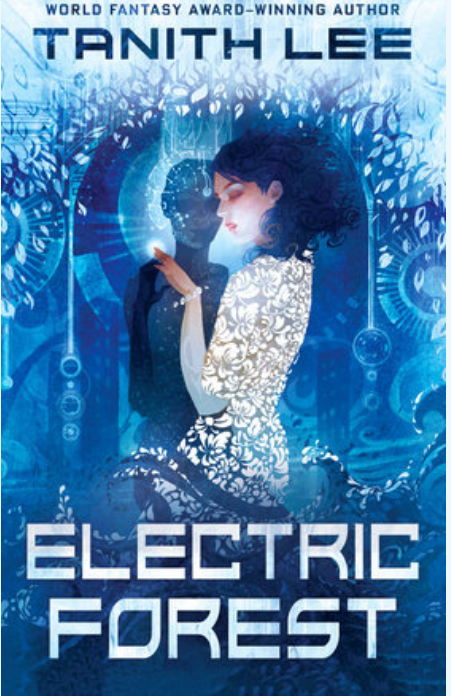
      Cover of Electric Forest by Tanith Lee, downloaded from AstraPublishingHouse.com

      Every so often somebody asks me, “Who’s your favorite author?” That question is unanswerable. There have been so many favorites over the years! Ten years ago it would have been a toss-up between Ursula K. Le Guin and Octavia Butler, with Ursula winning by a hair. Today? Must I have one? Why? And what about my favorite book? My shelves are filled with contenders.

      But if I’m pressed, I’m likely to reach for someone tried and true, someone other people may know. Some literary star, I suppose? We have those, but maybe we shouldn’t.

      The idea of a “Star System” apparently comes from Hollywood. Take one actor and promote them to godhood, and hey, your movies will sell. Works for books too. I came to the term through a different route, though: Jo Freeman’s essay Tyranny of Structurelessness, a critique of power dynamics in the feminist movement of the 1970s. Here is an excerpt:

      “While it has consciously not chosen spokespeople, the movement has thrown up many women who have caught the public eye for varying reasons. These women represent no particular group or established opinion; they know this and usually say so. But because there are no official spokespeople nor any decision-making body that the press can query when it wants to know the movement’s position on a subject, these women are perceived as the spokespeople. Thus, whether they want to or not, whether the movement likes it or not, women of public note are put in the role of spokespeople by default. . . This has several negative consequences for both the movement and the women labeled “stars.” First, because the movement didn’t put them in the role of spokesperson, the movement cannot remove them. The press put them there and only the press can choose not to listen.”

      Within activist organizing, I’ve seen many people cast into the roles of unelected, unaccountable “stars.” They step up to speak, and because they are confident, everyone listens to them. They can do no wrong (except they do).

      As you may have guessed from the title, I’m circling around the literary star Neil Gaiman and the assaults he committed. (In case you want me to use the word alleged, forget it. Even if all the other grotesque details were made up, he admitted to intercourse with a much younger employee. That’s all I need to know.) He was never my favorite author, but I have enjoyed and admired his fiction greatly. His short story “The Problem of Susan” is an excellent analysis of misogyny in Narnia, and the Doctor Who episode he scripted, “The Doctor’s Wife,” will always be one of my favorites. Fans have been grappling with this question of liking the art even when the artist is a shitty, shitty person.

      I’m more disturbed by the question: how did we end up making him a literary star? A feminist one, even. Why did we want a literary star?

      Part of this is timing–at the beginning of the tenure of the United States’ most depraved president to date. And yet, he’s a star in the eyes of thousands upon thousands of people. Is there just something wrong with us as a species, that we seek out people to put on pedestals? The hypothesis in Octavia Butler’s Xenogenesis series is often on my mind: is the combination of intelligence and hierarchy in a species simply an evolutionary dead end?

      Maybe, maybe not. I guess somebody will find out sometime.

      Meanwhile, I went in search of Tanith Lee’s Flat Earth series, in order to form my own opinion on another allegation against Gaiman: it’s been said that Sandman borrowed heavily from that series, and that whether or not the borrowing amounted to plagiarism, it was shitty of him to leave her uncredited. In case you think this is a new speculation, read the article “Tanith Lee: Gone But Not Forgotten” by Deuce Richardson.

      My quest led me outside of the house, to a used bookstore and then to a library. In the bookstore I found a “Best Of” science fiction anthology, and at the library I found Electric Forest. Here is an excerpt from the cover blurb:

      “Because of her natural-born features, Magdala is an outcast in society–abandoned at birth, abused in the orphanage she grew up in, and branded with the cruel name ‘Ugly.’ But Magdala’s world turns upside down when she’s approached by Claudio Loro, a wealthy scientist who has created a beautiful artificial body. When he offers to transfer Magdala’s consciousness into the body, she cannot refuse the priceless opportunity for a new, beautiful life.”

      That’s all I’ll share, because the cover blurb gave away the plot. I know where the story is heading. But the journey! Tanith Lee is a marvel of creativity, and even though I’ve read many, many books, this one is so fresh. It hits hard but in a luscious way.

      I haven’t found the Flat Earth series yet. When I do, I expect it to be full of captivating characters and dripping with story.

      That brings me to one of the books I read years ago and think about often: Haroun and the Sea of Stories by Salman Rushdie. I can’t remember most of the details . . . a princess with her lips sewn shut, so she cannot speak. A heroic journey. The question: “what’s the use of stories that aren’t even true?” Most importantly, a sea full of stories. I carry that metaphor. And when I ask myself the question, “If Gaiman is such a noxious person, why do I like them so much? Why were his stories so wildly inventive?”

      It makes me feel better to think that the stories originated from outside him, that he tapped into this magical endless source of story. But, why? Shouldn’t such a power be reserved for people who are kind?

      (Insert Moral Here)

      I thought perhaps this blog post, which has wandered all around the world of books, circling some deep and important questions, was leading to a brilliant conclusion. No such luck. What is a reader to do?

      Fortunately, I have more chapters of Electric Forest yet to read.

      Time to blog again?

      https://www.flickr.com/photos/lorettastephenson/7902147342
      Cat Question Mark by Retta Stephensen

      I started keeping a handwritten diary when I was about ten. Once blogging became a thing, I posted on LiveJournal instead, more or less abandoning the handwritten diary format in favor of publicly viewable text. Of course, what I could say changed dramatically, and after I had kids, it became much more limited. Still, I had plenty to say. When it came time to ditch LiveJournal, I came here to WordPress.

      The pandemic interrupted a lot of my activities, including my posting on WordPress, and I spent more time on Facebook, writing brief entries and reading updates on the lives of friends, family, and strangers. It’s getting toward time to ditch Facebook now, and so I am on bluesky, but I wonder: will it be one more thing I’ll have to ditch? (Kristin52, by the way.)

      Tomorrow, 1/20/2025, is going to suck. Hard. Mass deportations, I guess. People I know have left Facebook already in protest. Some people are staying, and I’ll stay for them.

      But I like the blog form better. I like being able to have deeper conversations with people.

      I have a lot more to say, but I’ve reached the end of my allotted hour. Later!

      Reading:

      The Day and Night Books of Mardou Fox, by Nisi Shawl

      Bloggy shout out to:

      Laura “Tegan” Gjovaag at https://wandering.shop/@realtegan

      Goodbye, Origins (2016-2022)

      A group of youtubers has been making Minecraft roleplays since 2016, and yesterday they officially closed it down. Shortly after I became invested in it, of course! Minecraft roleplays, a form of collaborative storytelling that takes place with Minecraft characters and settings, have piqued my interest for a few different reasons. I like the idea of stories told collaboratively, I love that Minecraft handles the mechanics of animations, and I am fascinated by artists for whom character creation comes easy. (To me, it’s the most terrifying part of writing stories.) On top of all that, I got invested in the voice actors and the plots in the #OriginsMCRP universe.

      Yesterday, at the #OriginsIsOverParty on twitter, on youtube, and on Twitch, various content creators gave their perspective on what went well and what was difficult, and I learned a lot from their retrospectives, not just about the experience of making Minecraft roleplays but also the particular challenges of making art on youtube and of building a community.

      Minecraft roleplays are not as popular as they were two years ago. Roleplays got a huge boost at the start of the pandemic when people were stuck at home and afraid for the future. Serial episodes came out several times a week, from a variety of perspectives. A fan community grew up, made fan art and fanfiction, and shipped characters. Some of the youtubers — not all — started making a livable income from their roleplays.

      Some Origins creators found that content creation caused serious mental health issues. The pressure to always be bigger and better, combined with a general drop in viewership that was completely outside their control, must have been intensely difficult. Other forms of content creation, like playing video games, got more viewers for less work. Some of the Origins folks started leaving the group for jobs or Twitch or mental health breaks. Because it is a collaborative story form, people leaving messed up the storylines that other creators were actively working on, raising the pressure. Meanwhile, some who stayed behind worked hard on “cinematics.” These look amazing but are hand-animated, so they take a lot of time and effort. Sometimes the cinematics delayed the release of episodes, and youtube is not at all forgiving. The dreaded “youtube algorithm,” which ranks and recommends videos, penalizes breaks.

      Let me take a moment here to rant about the youtube algorithm. This impersonal and ever-changing set of automated rules has a direct impact on folks’ livelihoods and also often on their perception of whether they are crafting good or bad content. They have to constantly watch the analytics to see how they are doing.

      That’s deadly to art.

      I’m impressed with what these folks managed to create even despite those hurdles, and I hope they will keep making roleplays or some other form of collaborative storytelling, and I hope they will end up being compensated for their work.

      Shout outs to @CrazyMtch42, @Captain_Froggie, @FourOhFourEnt, @nayaVT, @plulesser, and all the rest. Keep telling stories.

      Fairy Tail Origins: cookies were thrown

      The Fairy Tail Origins series of Minecraft roleplays is a response to the Fairy Tail anime and manga. Its first three seasons had some story content but mostly consisted of gameplay on a Minecraft server. (I find it deathly boring and do not watch them.) In the fourth and fifth seasons, storytelling took over.

      Season 5 might be the high point of the Origins series in terms of youtuber participation, with twenty-eight youtubers who posted online and twenty-seven other players all coming together to form intersecting storylines. It gets really confusing when three or more characters are on screen at the same time, because it’s often unclear which Minecraft figure is attached to which voice, and the characters speak in different volumes. But those moments when multiple players interact are amazing feats of coordination: players have to get together across multiple time zones and juggle their schedules around their work, school, or family responsibilities.

      My introduction to the Origins series was Fairy Tail Origins Season 5, with Kay’s perspective. Kay, a shapeshifting wolf, is friendly to everyone she meets, throwing dozens of cookies at them whether they want cookies or not. She considers her guild leader, a cat, to be her pet — “pet” defined not as someone you own, but someone you take care of. Hence the throwing of cookies. She is oblivious to rudeness and befriends the character Viper, who keeps insulting her guild leader and friends.

      My introduction to the Origins series was Fairy Tail Origins Season 5, with Kay’s perspective. Kay, a shapeshifting wolf, is friendly to everyone she meets, throwing dozens of cookies at them whether they want cookies or not. She considers her guild leader, a cat, to be her pet — “pet” defined not as someone you own, but someone you take care of. Hence the throwing of cookies. She is oblivious to rudeness and befriends the character Viper, who keeps insulting her guild leader and friends.

      Viper arrives in season 5 as a tormented and grouchy character, trying to pay off a debt he incurred in season 4 as a villain. He is kind to Kay by order of both his guild leader and his seeing-eye snake, and she immediately falls in love. Many cookies are thrown. Their growing relationship is one part comedic, one part angst-ridden, and one part sweet.

      By the time she wins him over, unfortunately for the both of them, he’s dragged into somebody else’s storyline and stuck in a world without magic for a while.

      These things happen.