Readers are like cats

I like being a reader and I like being an author and I think the relationship between the two is a little strange.

Readers, like cats, are an ungrateful bunch. We lap up books like a dish of milk, which we fully expect to appear every day. Then we lick our fur self-righteously, as if we have done a good deed by lapping up that milk. We wander off. If we found the milk a bit sour, we wander off in a huff. Occasionally we purr as a note of thanks, but we know it isn’t expected. We pick and choose as we wish.

Authors, meanwhile, put out the milk. We watch the cats and enjoy cuddling up to them, petting them, and hearing them purr. We expect things from our cats, even though we know we won’t get it unless they want to give it.

Cats wander off when they get bored. And so I will wander off from this blog post. Look for a book. I might like it.

Image

Codeswitching vs. Coat-switching

Last night I went to a reading of Mixed Blessings by Rhoda Berlin MS Lmft, and Harriet Cannon M. C. Lmft Lmhc. It’s a guidebook written by marriage and family therapists. Here’s a quick description:

Mixed Blessings explores the impact of migration, appearance, social class, spiritual/religious and cultural practices on individual, couple and family identity. It is practical and nourishing, an inclusive resource for modern times. The book is intended for those living mixed blessings and for helping professionals who help them navigate these challenges.
It was a lovely reading, mixed with music — the Beatles “All You Need is Love” and “Let’s Call the Whole Thing Off” sung by Ella Fitzgerald and Louis Armstrong. They even got the audience to sing along a little bit, and I am ALWAYS ready to sing along.
Lot of good information about how socio-cultural differences affect relationships and some eye-openers from me, including some differences between “individualist culture” and “collectivist culture” in plain-speaking terms instead of academia-terms.
They talked a little about “coat-switching,” and I thought, “Yes indeed, I have done that. I have switched coats as I moved from one culture to another.”
Later, glancing through the book, I saw that they were not in fact talking about “coat-switching,” but instead about “code-switching.” Code-switching means shifting the way you talk and act based on the culture you’re in at the moment. We all do it.
But it’s a big word. I like the term “coat-switching” quite a bit and might just use it instead. It’s an approachable and friendly term.
Just like the reading was! Thank you, authors, for an enjoyable evening.
Aside

Walk into a bookstore and pick up a highly acclaimed book. Look at the cover. Some of them have accolades like “National Book Award Winner” or “Pulitzer Prize winner.” That’s a mark of favor by the literary establishment, which includes authors, critics, literary agents, and publishers. It’s a signal that aspiring writers would do well to write like these authors. That the book magically met some Platonic ideal, separate from culture and politics.

That’s the lie. It isn’t separate from politics at all. The feminist movement has known that for a very long time, that “the personal is political.”

We just didn’t know, until last week,  that the anti-political stance, and the unwritten politics in work favored by the literary establishment was intentionally influenced by the CIA.

And not just the CIA. The CIA and other governmental funding is the sensational, headline-grabbing aspect — ooooh, Big Brother, scary government — but all the other funding, the funding from the Rockefeller Foundation and other private entities, probably left a much greater mark.

(If you’re wondering why, then the book The Revolution Will Not Be Funded is for you.)

I’ve spent a lot of time researching the ways foundation funding are warping public education. Here’s a little primer on that: The Lines of Influence in Education Reform by Dora Taylor and Sue Peters. That’s why it came as a surprise, but shouldn’t have, that the same thing would be going on with creative writing.

I’m quite sure somebody could do the same kind of analysis with literary fiction that Dora and Sue did with public education. They could look at how foundation funding encouraged some kinds of outstanding authors and not others. At how some writing programs, given foundation funding, were able to draw in literary agents to help some authors, and not others, get published. At how some authors, and not others, got teaching posts and inspired second and third generations of outstanding authors. It would be a fascinating read.

I’ll close with a quote from The New Yorker, one of the three or four flagship literary magazines, about the Iowa Writers Workshop, which received so much cash in the 1960s to promote its brand of writing.

And this, from the New Yorker: “Show or Tell: Should Creative Writing Be Taught” by Louis Menand

The University of Iowa Writers’ Workshop is the most renowned creative-writing program in the world. Sixteen Pulitzer Prize winners and three recent Poet Laureates are graduates of the program. But the school’s official position is that the school had nothing to do with it. “The fact that the Workshop can claim as alumni nationally and internationally prominent poets, novelists, and short story writers is, we believe, more the result of what they brought here than of what they gained from us,” the Iowa Web site explains. Iowa merely admits people who are really good at writing; it puts them up for two years; and then, like the Wizard of Oz, it gives them a diploma. “We continue to look for the most promising talent in the country,” the school says, “in our conviction that writing cannot be taught but that writers can be encouraged.”

That’s right: writers can be encouraged. And those who have the money can influence which ones will be encouraged and where they will go to school.

It’s time to drop the platonic ideal and realize that our views on art, like everything else in capitalism, are touched by cold, hard cash.

Image

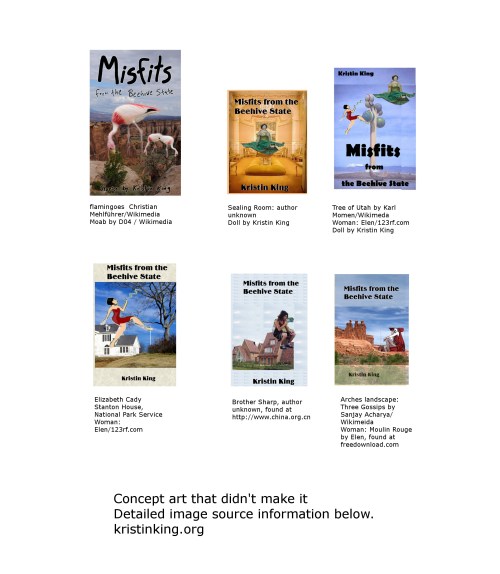
Concept art that didn’t make it, presented for your viewing amusement

Concept art that didn't make it, presented for your viewing amusement

Here is the concept art that ultimately didn’t make it onto my book cover. They were all fun to make, but none of them had the right personality. (One day, though, I hope to write a story that will live up to the flamingo cover.)

I learned a lot along the process. First, don’t use copyrighted works even for private concept art, because you might fall in love with something you can’t ultimately use. Second, it’s not easy, but you can search wikimedia commons for art that falls under “CC-BY-3.0” a common license that can be used for book covers. Third, there are a lot of stock photography sites that charge a small fee for the kind of print runs an indy author would have. Fourth, it’s way easier to have a graphic designer do your cover than to do it yourself. Fifth, I learned how to use the free image manipulation program GIMP. WIN!

Here is some more detailed information about the art in this picture. I did my best, but if this is your art and I’ve attributed it incorrectly please let me know.

Flamingo cover
Moab by DR04, found at http://commons.wikimedia.org/wiki/File:05242008_Moab50.JPG
Flamingoes by Christian Mehlführ, found at http://commons.wikimedia.org/wiki/File:James_Flamingos_MC.jpg

Floating doll cover
Sealing Room: author unknown, found at http://thetrumpetstone.blogspot.com/2011/02/unique-sealing-rooms.html
Doll by Kristin King, photographed from antique at Lagoon amusement park

Tree of Utah cover
Tree of Utah by Karl Momen, found at http://en.wikipedia.org/wiki/Metaphor:_The_Tree_of_Utah
Doll by Kristin King, photographed from antique at Lagoon amusement park
Smoking woman by Nuria Garay Del Barrio, found at 123rf.com

White house cover
Elizabeth Cady Stanton House, found at http://www.nps.gov/ner/photosmultimedia/photogallery.htm?id=1B0E50FF-155D-451F-678AB4570B671E4D
Smoking woman by Nuria Garay Del Barrio, found at 123rf.com

Man on roof cover
Steep Roof, author unknown, found at http://www.wienerberger.com/brands-products/koramic-clay-roof-tiles/projects-and-references/steep-roofs-on-scattered-buildings-make-modern-village.html?lpi=1120659566515
Brother Sharp, found at http://www.china.org.cn/photos/2010-03/03/content_19511630_8.htm

Arches National Park cover
Three Gossips by Sanjay Acharya/ Wikimedia Commons, found at

Woman smoking – Moulin Rouge, by Elen Moulin Rouge(?), found at http://all-free-download.com/free-vector/vector-people/moulin_rouge_40997.html

more on the Iowa Writer’s Workshop

In my post “Creative writing programs and the CIA fan club,” I talk about Eric Bennet’s essay on how Iowa Writer’s Workshop director Engle (1941-1966) procured lots and lots of money from govermental and private organizations for the explicit purpose of anti-communist propaganda. Fifty years ago, so that’s ancient history, right? Nope.

Here’s just one example of how its influence passed through various people to me. John Gardner, 1958 Iowa Writers Workshop graduate, wrote The Art of Fiction, championed by one of my professors as the authoritative volume on how to write. It’s really good in many ways. I love his concept of fiction being a “vivid and continuous dream.” But there are certain Rulez in the book that limit the types of stories that can be told.

John Gardner inspired Raymond Carver, another student of the Iowa Writers Workshop (1963-1964), and Raymond Carver was a leader in “minimalist” writing, which was in favor during my undergraduate years. He’s a great writer. My favorite: his story “A Small, Good Thing.” But minimalism leaves out a lot of things — language, intrusions by the narrator, and commie politics. How much of that was influenced by the Iowa Writers Workshop of the 1960s?

It would be an overstatement to say that Gardner and Carver took anti-communist propaganda whole cloth and passed it on. (We’ll leave that to John Irving, graduate of the late 1960s, who according to Wikipedia wrote, “This is Marxism. It’s leveling everything by decimating what works … It’s that vindictive ‘We’ve suffered, and now we’re going to take money from your kid and watch you squirm’… There’s a minority which is an open target in this country which no one protects, and that’s rich people”)

No, this is only influence, and one influence among many. But it passes on from writer to writer, from institution to institution, and its ripples will be felt for years to come.

Why am I self-publishing?

I own a license plate frame that says, “A Woman’s Place Is My Bookstore.” Come to think of it, I ought to put it on my car. It’s not just a lovely sentiment — it’s also advertising for a bookstore that used to exist in the early 1990s, before chains like Barnes and Noble put a lot of independent bookstores out of business. A Woman’s Place. That bookstore supported me as a fledgling writer. I gave a reading there, and I took a workshop with Pam Houston there that led to a wonderful writing group. But now it’s gone, as is the Red and Black Bookstore in Seattle — quite a loss.

At the same time as bookstores were consolidating, publishing houses were also consolidating. It became harder and harder to publish midlist books (books that make money but aren’t bestsellers). And books that were published went quickly to the remainder table, because they were profitable, but not profitable enough.

At the same time, the growth of MFA programs put out more and more and more accomplished writers, all of whom were submitting stories to literary magazines and book publishers.

What did all this mean? As my writing became better and better, the likelihood of publishing a collection of short stories with a traditional publisher moved farther and farther away. The rules had changed. And my strategy for getting published ought also have changed.

Here was the strategy in the early 1990s: you submit stories to literary magazines. Once you have enough, you seek out an agent or an editor and attempt to get your collection published. But by the beginning of this century, when I finally had a publishable-quality collection of short stories, that strategy was ultimately doomed.

So to me, the question is not, “Should I self-publish?” The question is now, “Why did I wait so frickin long?”

I re-evaluated everything when I sent my collection to an agent and she said, “Yes, it’s good enough to publish. But I can’t sell it until you’ve sold a story to either the New Yorker, Harpers, or the Atlantic Quarterly.” And then I sent a story to the New Yorker, and I got a note back saying that despite its evident merit, it wasn’t the kind of thing they published. Earlier in my writing career, I would have been ecstatic, because a handwritten rejection note from the New Yorker meant that you were getting somewhere! But I realized then that I simply wouldn’t get anywhere with the kind of writing I did.

And then the publishing industry changed again. Publishing houses started paying authors less and less, and Amazon made it possible for people to make money self-publishing, and now, many respected authors are self-publishing on Amazon. So I went for it.

Thank you, Ariel Gore and your book How to Be a Famous Writer Before You’re Dead!!!!

I realized a couple important things when I made the decision to self-publish. I changed my book title, my “pitch,” and even the kind of stories that were in the collection. I was no longer trying to please a publisher; I was trying to please a reader. And I know what a reader is like — after all, I am one! All I had to do was make a book that someone like me would be interested in reading.

What if nobody likes it? What if nobody buys it? That’s where my friend Brandon came in. “I want to read it,” he said. “I’ll buy it.”

One reader. Just one reader. It’s worth doing.

Image

Misfits from the Beehive State

Misfits from the Beehive State

Coming up! The publication of “Misfits from the Beehive State” ran into a bit of a hitch with the cover, but it’s finally done. I’ll get a proof copy on Wednesday, make changes, get another proof copy, and then good to go!

Creative writing programs and the CIA fan club

This week, author Eric Bennett dropped a rather enormous bombshell on the literary world. The CIA, as it turns out, helped spread propaganda through creative writing programs all across the United States.

What? How?

Through the Iowa Writer’s Workshop, the most prestigious and influential creative writing program in a U.S. university. To make a long story short, in 1960 Paul Engle, the head of the program, wrote to the Rockefeller Foundation explaining exactly how his program could help fight communism (by bringing foreign writers to Iowa to indoctrinate them). He got the money, and later money from the CIA and the State Department, and used it to implement his plan. In essence, the Iowa Writer’s Workshop under Engel became the CIA Fan Club. The money, and the director who sought it out, left an enduring mark on creative writing programs all over the country.

You can read more about this from Bennet and a rebuttal from a University of Iowa Professor Loren Glass.

All this money brought prestige and influence to the Iowa Writer’s Workshop, which in turn influenced the creative writing programs that came after. Bennett writes, “The Iowa Writers’ Workshop emerged in the 1930s and powerfully influenced the creative-writing programs that followed. More than half of the second-wave programs, about 50 of which appeared by 1970, were founded by Iowa graduates. Third- and fourth- and fifth-wave programs, also Iowa scions, have kept coming ever since.”

With this influence, the Iowa Writers Workshop exported its long-held values – “middlebrow realism,” as explained by Glass in his rebuttal. And it exported Cold War propaganda.

Having gone through an MFA program and a creative writing undergraduate program, I have to say that this explains a whole lot. I’ve been busy re-evaluating my experiences in view of the larger picture. I wasn’t just learning writing, I was learning what the rich and powerful wanted me to learn.

The most obvious example took place in graduate school. Many writing professors will tell you that political writing is bad writing. (Of course, that’s a complete misunderstanding of politics. Everything is political. If you don’t see it, that’s just because it reflects the politics of the dominant culture.) At the time Paul Engle headed the program, that would have meant commie writing is bad writing, but today it means more than that. So on time my professor asked us to hand in some story ideas. I had an idea about something that happened to the anarchist Emma Goldman. I wasn’t sure I could pull it off – it would involve doing historical research and somehow transforming that moment into fiction. He returned it with a note explaining that stories starting from politics turn out badly. So I chose a different idea, having to do with a husband and a wife and some turtles. The Emma Goldman incident never made it into story form, although I did write an essay about it for the Aqueduct Press blog.

I would have been more skeptical of the concept if I had thought it came from the CIA. But no, it came from a trusted professor. And who taught him? Not any particular person, I imagine. It was just in the air.

That’s the obvious example. But the influence of the CIA Fan Club also spread to the seemingly apolitical – to general questions of content, style, and narrative structure. Good writing met the expectations of the “middlebrow” white male with his wife and children and white picket fence. Bad writing didn’t.

Those seemingly apolitical questions played a huge part in my writing development in my very first university courses. Creative writing programs at the university are deeply influential in a writer’s aesthetic. Writers, and especially beginning writers, have the disadvantage that they really don’t know which stories are good and which aren’t. We write what’s in our heads, and it may or may not please the reader. We don’t know until someone has read it and given us feedback.

I first studied creative writing in the early 1990s at the University of Utah under writers such as Jan Nystrom and François Camoin. They taught both the “traditional” writing that the Iowa Writers Workshop favored and “experimental” writing, a kind of writing that plays with narrative structure and style and today would be called postmodern. I felt the pull of both.

One of the wonderful things that Jan Nystrom and François Camoin did for me as a writer was to expose me to all kinds of interesting “experimental” writers. This was important, because the writing I was already doing coming into the creative writing program differed from the expected norms. I felt very much at home with Leonard Michaels’ lyrical prose, especially a story about a hotel maid who kept cleaning the same room over and over and finding more and more disturbing things. That was a story that went straight to the imagination and the spirit. I also felt at home with Grace Paley’s stories, which didn’t use quotation marks for the dialogue. This gave the dialogue an internal feel.

These stories became part of what I saw as possible in literature. Another couple of things that stood out –

  • Jan Nystrom wrote a story about women who fly around and leave shoes on roofs. There wasn’t any (rather Freudian) climax, but I loved it, and along with the work of Leonard Michaels and Grace Paley it became part of the inspiration for my Pushcart Prize-winning story “The Wings.”
  • Sophia Kartsonis’ first story was very lyrical and poetic. Somebody questioned whether it was too poetic to be a good story. To me, the poetry enhanced the appeal. I raised my hand and said so. As for me, my first story to be workshopped had comma splices for most of the sentences. This was entirely intentional and was part of the rhythm of the story. One of the classmates saw that as a big flaw and said so, but Camoin stuck up for me. In a different workshop, I might have been squashed by both the classmate and the teacher.

Also on the plus side, Camoin told us which literary magazines would accept experimental writing. It was only a small fraction, but it saved me a lot of trouble and got me published.

On the minus side, even though there was a lot of freedom and flexibility in the curriculum, there was also a lot of emphasis on “minimalist” writing, which is basically “show, don’t tell” taken to an extreme. The author’s thoughts, feelings, and opinions are theoretically omitted, as are explicit politics. This is one of the three favored forms of writing by the Iowa Writers Workshop, according to Bennett. (Bennett called it “cold” writing, but the kind of minimalist writing we looked at had dazzling language. Dazzling, but not gorgeous in the way something like Virginia Woolf’s work is gorgeous. More like a stained glass window than a river.) Just from a craft side, I learned a lot of bad habits there, which I had to unlearn in graduate school and beyond. Thing is, you can only skip telling if your reader is coming at you from a common cultural context, which is rarely the case.

Also on the minus side, this freedom of narrative structure came at the expense of the ability to publish some of my stories. I have written a couple of stories that just weren’t suited to go anywhere. They’re not bad stories; they just didn’t meet a particular literary aesthetic.

And so the years went by and a lot of things happened with my writing that I’ll also write about if I have time. I’ve abandoned a fair number of stories that didn’t meet expectations for narrative structure and I’ve edited out various experimental aspects of stories. And I’ve always wondered: Is something wrong with my story, or is there something wrong with the writing aesthetic? I still don’t know. Writers can judge their own work, but only to a point.

But you know what? Every time I did something unusual, whether it succeeded or whether it failed, I was fighting Cold War propaganda.

I’m pleased.

My daughter, the guinea pig

We’re a very mathy family. We all learned math the way human beings learn things — that is, by making it a fun part of our everyday activities. But this year, my daughter is a guinea pig for the new national experiment that is called the Common Core standards. Her class is using a new curriculum designed specifically for the Common Core, “My Math,” and she hates it. I’m hearing her say, “I don’t like math,” and I’m concerned. She still likes math, really, but only when we mess around with it as a family. Her homework is procrastination and resentment and sometimes tears.

The Common Core standards came to us by a fairly strange route. Sixty people wrote them without public input, and only one of them was a teacher. And there’s a lot of controversy surrounding the Common Core, particularly the assessments designed for them.

I’m trying to keep an open mind. As one of my kids’ teachers told me, they’re simply one more set of standards. I do like one thing about these new standards: they tell us what our kids are supposed to be learning.

But what exactly are they supposed to be learning? Mathematical reasoning, the boring way. What makes it boring is the frequent testing to make sure kids have learned each individual concept, which appears to mean that each individual concept takes priority over a holistic understanding. Even worse: there is national pressure to base teachers’ job evaluations on kids’ mastery of these standards.

Also, it looks a lot like math fact fluency is being pushed aside. I’ve looked at the standards many times, and they do say what kind of fluency kids are supposed to have, but as one standard among many. And I’m not seeing it in the curriculum. My kids, and other kids whose parents I’ve talked to, are not getting the five minutes of math fact practice per day that they need to learn the facts.

Here are the standards, if you want to know more.

And here are some examples of math lessons that teach to these standards. The National Education Association (NEA) teamed up with some company or other to bring together lots of teachers to share the curriculum that they use in classrooms. So this curriculum is free online for browsing, which makes it a godsend for parents who want to understand what their kids are learning in class. I keep looking and looking for math fact fluency exercises, but I’m not seeing them.

I do realize that there are lots of things I don’t understand about the standards, the way they’re being implemented in curriculum, and the way my kids’ teachers are handling them in class.

But I sure am sorry my daughter has to be the guinea pig. 

Desegregation, Segregation, Integration

Corrected 4/30/218 – see comments

NPR just did a story on desegregation in Little Rock. (I can’t remember which day, so I’m not sure which one.) I only caught snippets of it, but from what I heard there was some good stuff and some parts that completely missed the boat, in the same way that adults have been missing the boat for a while.

Good stuff first: they made the distinction between desegregation and integration. A school is desegregated if it includes white kids and black kids. But it’s not integrated unless those kids actually hang out together. I went to a desegregated middle school in the 1980s. Kids in the advanced learning program, mostly white, were bused to a school that was mostly black. Today’s name for that would be “magnet school.” Good intentions . . . but most of the classrooms were still segregated, because so many of the kids in the advanced learning program were white. It was kinda half a solution.

Thirty years later, we’re still doing the same thing. The NPR program talked about the way the kids had separate classrooms and sat apart from each other in the lunchroom, and it included some student voices talking about how they could take responsibility for the problem. That’s good.

But what it did wrong, its blind spot, is that it placed the blame for the segregation on the high school kids and not on the adults who set up the classroom situation in the first place. If the classrooms are segregated, is it any wonder the lunchroom would be too? I know it’s a tricky and difficult situation, and the adults are taking steps to change this. But we can’t just let the kids shoulder all the responsibility and blame.

Now, I just heard a snippet. It could well be that NPR covered that ground later in the program. Regardless, this is a huge blind spot that we have. The adults need to be doing our part to make sure that we break down as many barriers as we can to integration.

Instead, sometimes we’re putting more barriers in the way, like when Seattle Public Schools shut down a successfully integrated K-8 program called Summit. Or when it closed down a schools race and justice curriculum last year.

We’ve got to get this right.

And we also need to be explaining to our kids that the work of desegregation is not yet done. Our school is celebrating Martin Luther King right now, and talking about the civil rights movement and the ending of segregation. This is misleading. Our school is 61 percent Caucasian and 7 percent African-American. If my kids grow up thinking segregation is over, they’ll also grow up thinking that our country is populated by 61 percent white people and 7 percent black people. Not true! In our school district, whites are a minority, at 43%. (Full detail: American Indian 1%, Black 19%, Hispanic 12%, Asian/Pacific-Islander 19%, White 43%, Multiracial 6%)

At the same time, while I need to explain that we still have plenty of troubles, I can’t be filling my kids’ heads with doom and gloom. Kids need to know the hard truths, but they also need to have hope.

Enter Ruby Bridges! She was the first black child to attend an all-white elementary school. Last year, my daughter got a book about her from the school library, The Story of Ruby Bridges. So this year, when she was assigned a Great American Leader biography project, she chose Ruby Bridges. Martin Luther King is an inspirational role model, and so is Rosa Parks. Big, important people. But Ruby Bridges is a child. My daughter can identify.

I wasn’t so sure that Ruby Bridges would fit the bill of a Great American Leader, though. It’s not like she had a choice to attend that all-white school. Her parents made that decision, and she had to live with it. It was a long, hard road for a lot of those first kids who attended all-white schools, and nobody came out of it unscathed. (It’s STILL a long, hard road.) So I had to find out what happened to her later in life. Here it is:

http://www.cbsnews.com/news/ruby-bridges-rockwell-muse-goes-back-to-school/

To summarize the video . . .

When Ruby Bridges first walked into the school, she was surrounded by an angry mob. Fortunately for her, she didn’t understand at first. “I actually thought it was Mardi Gras. . . . They were throwing things and shouting, and that sort of goes on in New Orleans at Mardi Gras.” White parents pulled their kids out, and all the teachers but one left the school. Ruby was all by herself at that school, except for another white student, five-year-old Pam Foreman Testroet, whose parents refused to go along with the boycott.

Fast-forward past the consequences Ruby’s family faced for their heroic efforts, and whatever hard and scary things Ruby had to endure, because my daughter is not ready for this yet. Now, as an adult, Ruby is continuing the important work that she began.

She visited her old school, the one she helped desegregate, and was reunited with her schoolmate Pam. It was a time of celebration, but Ruby also pointed out that the school is now all black. The work of desegregation is not done.

It’s a grand, epic tale about a Great American Leader. But what really touched my daughter? The reunion with her classmate Pam.

That’s where integration happens: in our hearts and in our children’s hearts. If we let it. Image