Genderfail Sucker Punch!

Couple caveats: #1 I don’t know the whole story so I’m sure I left out important bits; and #2 that I don’t blame any individual people for this. It’s societal.

A sucker punch is “an unexpected blow” but to me holds the additional connotation that “you should’ve expected it, sucker!” When I think of a sucker punch, I think of Charlie Brown still trying to kick that football Lucy is holding.

Genderfail is Internet slang for some sort of failure to appropriately address issues of gender. To my mind it’s a sister term to “racefail,” which can be absolutely epic. For an example of racefail: “RaceFail ’09 is one of the names given to a large and tangled snarl of racism, misunderstanding, culture clash, poor behavior, and hurt which consumed several interconnected corners of fandom in early 2009.” (This is from http://fanlore.org/wiki/RaceFail_%2709)

So now I can explain how I’m using these terms in this blog post: a snarl of feminism, misunderstanding, culture clash, poor behavior, and hurt — that came as a surprise blow to me even though I really should have known better.

My suspicion is that any political organization comprising both men and women is going to have a genderfail at some point. I mean, how do you avoid it, really?

So anyway, there was a political organization. I joined it because although it was male-dominated, it had a core of feminists, and I thought that would be enough to bring real change. Then some things happened, and I went inactive. This part wasn’t genderfail, it was just your basic organizational dysfunction. (Note to self: if it takes an organization more than six months to make a new member packet, it’s time to run.) So I was on the listserv but mostly not paying attention.

Another woman went inactive after having a baby.

Meanwhile, the organization kept on doing what it was doing. Let me make a metaphor here. Let’s suppose that you have built a house, and some people have moved in. Then some more people have moved in, and it is determined that the house needs an add-on, which will take about three to six months. People get out of the way to accomodate the add-on. Maybe a couple people take temporary housing (that would be me) whereas others just move out and move on. Suddenly you don’t need the add-on, but you keep going. And it takes a year and a half, by which time other people have left. Meanwhile, next door, there is a high-rise condo going up. It is determined that the community who lives in the house will take part in the building of the high-rise condo, and about half the people go off and do that.

I guess I was waiting for the high-rise condo to be finished so I could move back into the house.

But meanwhile, back at the house, there was some bickering. Which wouldn’t have been so bad, except then the mansplaining set in, and then the resulting concerns were put down to interpersonal conflict, which was true enough, but not nearly as true as that there was a genderfail in the making.

The sucker punch is this: there were four women who could have stepped in to help, but instead, one bore the brunt of it alone.

Here’s the other reason it was a sucker punch: This house was a rebound relationship for me. The last house I was in had more women than men. It still had genderfail, and it still had racefail too.

And here’s why it was a sucker punch for the activist community as a whole: back then, when I related the genderfail to an activist from the 1980s, she nodded her head and said “Of course!”

We’ve come a long way, baby!

(Or not.)

Best writing teacher ever

Now that I’ve spent the week complaining about writing curriculum in schools, it’s time to give a shout-out to my best writing teacher ever. It could well be my ability to write with confidence came from him.

Now what’s funny is that he wasn’t a writing teacher. He was my seventh grade social studies teacher. But here’s what he did: he started off every class period with a ten-minute freewrite. It was graded — by quantity, not by content. He came around and looked at our journal entries and gave us a check, check-minus, or a check-plus. But he made a special point that he didn’t read what we had written, which meant we could write whatever we wanted.

I loved it. I wrote snippets of stories, complaints about being tired or hungry, and who knows what all.

Now, that didn’t turn me into a writer. I’ve always loved to write stories, from early elementary school to now, and I would have done it even without that teacher’s help. But would I have written as freely?

I don’t even remember that teacher’s name, but he sure did me a favor. Thank you, teacher.

Finished a draft of a story

Whew. I finished a draft of a story today. It was exceptionally difficult to finish. It’s a fanfiction, for one thing, and I feel pretty embarrassed about that. What’s weird is that I have been writing fanfictions, and feeling embarrassed about it, since I was in seventh grade. Back then my fanfictions were based on Enid Blyton’s Famous Five series. I felt bad because I couldn’t seem to think up my own characters, and I also felt bad because my writing wasn’t as good as Enid Blyton’s. I started a ton of stories but didn’t finish any of them. If I could go back to that seventh grader I would just tell her to go for it, for heaven’s sake! I would tell her not to worry about quality because it’s the writing practice that matters. Stick with it and sooner or later, you are bound to come up with something fabulous.

I struggled again when I finished college. I was reading novelizations of the Doctor Who series and had learned that fans could write them and send them in for possible publication. In hindsight, that was an essentially impossible goal. But I had to set the goal so I wouldn’t feel like I was writing something with no purpose.

I didn’t finish the novelization – not even close. I went on to writing stories that people around me would respect. One day I would like to finish it properly and make it into a story.

This particular fanfiction that I just finished is something I started around 2008 or so. When the character River Song first showed up in the Doctor Who TV series, I was hugely impressed. She knew him, but being a time traveler, he hadn’t met her. So I wrote an adventure in which he knows her but she doesn’t know him. I had the whole thing planned out and laid out and it just sat there, half-finished. Now it’s a draft.

What will I do with it? Two possible options: post it on whofic.com or de-Doctor-Who-ize it, changing the character names and so forth, and try to get it published that way.

Either way, though, it was a huge accomplishment for me to finish a fanfiction. Thirty years after I first tried! Time to go celebrate.

Top 10 Ways to Mis-Make Espresso

I’ve done them all. More than once.


10. Forget to plug the espresso maker in, then turn it on and wait.

9. Plug in my cell phone instead. Turn on the espresso maker and wait.

8. Plug in the espresso maker but forget to turn it on. Wait for coffee.

7. Turn it to “steam” instead of “brew.”

6. Forget to put espresso in the filter. 

5. Put espresso in the filter. Forget I have done it and dump out the filter into the compost.

4. Forget to screw the pressure lid on. (Loud.)

3. Forget to put water in. 

2. Put water in the carafe but not the espresso maker. Turn it on.

1. Put water in the espresso maker. Forget I have done it and put it in again. (Big mess!)

Image

Scored by Lauren McLaughlin: Some Thoughts

Note: This is an expansion of a book I reviewed on the blog post “Pleasures of Reading, Viewing, and Listening in 2012” on aqueductpress.blogspot.com.

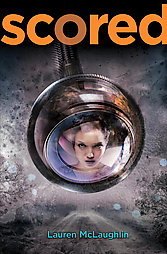
Scored by Lauren McLaughlin
(http://www.powells.com/biblio/62-9780375867910-0)

This YA novel is the dystopia for our time. What happens when you put together No Child Left Behind high-stakes standardized testing with surveillance measures like spy-cams and GPS monitoring of cell phones, and then introduce a company whose product is a single score for every child, which colleges and corporations will then use to sort people?

That is the reality for Imani LeMonde, a high school student whose scores put her on track for a college scholarship — something that is otherwise out of reach for all but the very rich. The scores are supposed to establish a meritocracy to replace our system of inequalities, but something else is going on. Scores update minute-to-minute, and they depend not only on school performance but also day-to-day activities and peer group associations.

Imani’s troubles begin when her score drops precipitously because her friend Cady is kicked out of her house and moves in with a boy. This takes her off the college track, and if her scores drop farther, her only options will be welfare or the military. She has a choice to make — but it’s not the simple moral dilemma of whether or not to denounce Cady to regain her score, because that option is not open to her. Instead, she has to look deeply into the scoring system to understand how it works — and what matters to her.

The society pictured here is not far off the mark. Our teens and children will be subject to more surveillance than we ever imagined. Case in point: school records are kept in “longitudinal databases” where they can be tracked over long periods of time and across school district and state lines. And by school records I mean test scores, tardies, absences, ethnicity, dental records – you name it. (For a sneak peek of the hundreds of items that can be collected, visit http://nces.sifinfo.org/datamodel/eiebrowser/techview.aspx?instance=studentElementarySecondary.)

This information is being provided to the private sector without public comment or scrutiny. For example, the Seattle Public School district signed a Memorandum of Understanding with an organization called the Community Center for Education Results, indicating that the district would be sharing its database of student information with CCER. This database excludes “personally identifiable” information about the students according to the federal FERPA law, but because it is so specific, it is potentially identifiable information, particularly if you are nonwhite, use special education services, and so forth. Also, private sector organizations could easily combine this information with other databases.

(Thanks to the mirmac1 for her comment on Feb 21, 2013 on the blog saveseattleschools.blogspot.com.)

Just as one example among many, yesterday I went to the Pacific Science Center and visited an exhibit called “Professor Wellbody’s Academy of Health and Wellness.” This is a grant and foundation-funded exhibit. As part of the exhibit, children can join the “Academy” by entering information about themselves – first name, school attended, and health habits such as diet and sleep. So now there’s a database about kids per school, and a certain lack of clarity about who will get that information.

Ten years from now, could a prospective employer check the database for these types of information about my children? I bet. Could they get a score? I bet.

“The Feminine Mistake”

My spouse and I have been watching Laverne and Shirley. It’s a great show – accomplished actors, who can also sing and dance and take pratfalls like nobody’s business, with a feminist agenda snuck in so cleverly I completely missed it when I first watched it. I’m seeing it now, and what’s more, I’m seeing how much today’s television hasn’t got it. It has something else that today’s television is also missing: at their core, the characters are respectful of each other.

Last night we watched “The Feminine Mistake.” The title is a reference to Betty Friedan’s The Feminine Mystique, instrumental in sparking the U.S. feminist movement of the 1960s and 1970s. In it, Laverne, who is the more butch of the two, is having a great time playing baseball and fishing with her love interest (played by Jay Leno). She expects him to ask her to a dance. Unfortunately for her, he thinks of her as “just a guy” and tells her that no guy would ever want to go out with her. So she enlists Shirley’s help in being feminine. Together, they devise a frou-frou persona for Laverne. Like the rest of their escapades, it’s hilarious.

So does it work? Does he take her to the dance? Watch the episode.

Another good stealth-feminist episode was “The Bully Show.” In it, Laverne is nearly raped. The word “rape” is never used and the danger she’s in is portrayed slapstick-style, but nonetheless, it deals with the topic seriously. Best of all, instead of blaming the victim or focusing narrowly on the scary rapist, it goes straight to the heart of “rape culture” and confronts the people and attitudes who set the stage for the rape being considered acceptable.

Persuasive Writing for Activists

This was a first attempt to introduce this topic, but I’ve done it better elsewhere. Check out https://kristinking.wordpress.com/2013/04/11/persuasive-writing-for-activists-intro/. I’ll be adding content about once a week. — 4/11/2013.

If you know me, you know that to say I have progressive politics is an understatement. If I see a progressive make an argument I agree with, half of me says, “Right ON!”

And the other half is saying, “Seriously? You expect that to persuade anybody? Preaching to the converted, folks.”

As much as I disagree with the conservative point of view, I have to give conservatives props for effective persuasive writing. And honestly, they get empathy points for at least knowing their audience.

There’s a reason for that. The corporate world teaches persuasive writing. And they teach it well.

How do I know? Back at the beginning of the millenium, I taught business writing at a university. That’s where I learned to do persuasive writing. I keep thinking I should create a document “Persuasive Writing for Activists” or make a Power Point and teach a course. That’s one on my list of several hundred things I wish I had time to do.

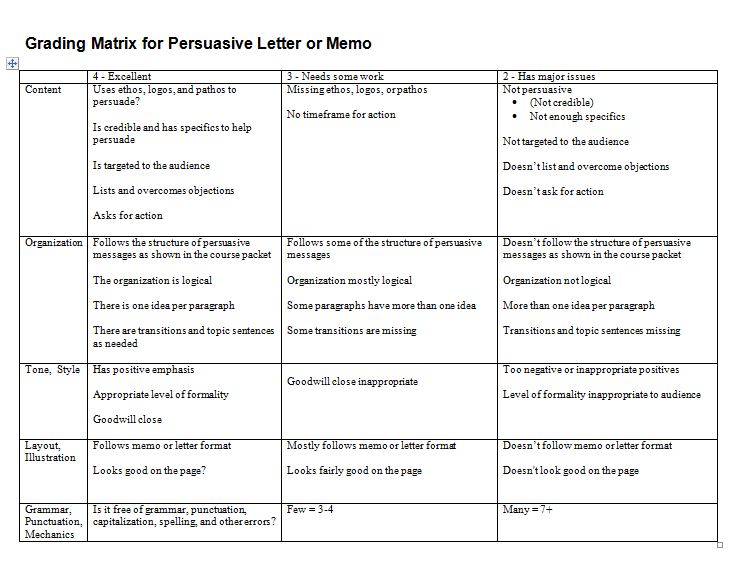
But until I get around to it, here’s a teaser: the grading matrix I used for the business writing course. (This was back in 2002, when some people still used memos.)

With an offer of free advice! Progressive activists: if you would like, I will grade your persuasive writing. Post a comment with your writing, or include a link to it. Then tell me who your intended audience is. I’ll tell you where it went wrong and where it went right.

(P.S. I would grade this blog post as follows: Content – 2; Organization – N/A; Tone and style – 2; Layout – 3; Mechanics – ?. We’re not always at our best, are we?)

Image

Is the MAP test “really about the children?”

Confirmation from Seattle Times that parents are in solidarity with teachers and students:

On Tuesday, only 97 of the roughly 400 ninth-graders who were supposed to take the MAP reading test did so, said Garfield Principal Ted Howard. The other 300, he said, had their parents’ permission to be excused.

Something else from this article bears serious consideration.

Banda said many teachers and parents have told him the MAP is a useful tool.

“Regardless of whether we think testing is good or bad, it’s really about the children and making sure we are able to identify any potential gaps in their learning,” he said.

Superintendent Banda didn’t mean to, but he got at the heart of the problem with the MAP test. It is a useful tool for some, that’s true. But is it “really about the children”?

For some, yes. But for policy-makers, no. On a district-wide and state-wide level, it’s being misused:

  • Test scores are being used as part of teacher evaluations – in some states, it makes up as much as half the teacher’s evaluation. This despite there is no evidence that student standardized test scores measure a teacher’s performance and plenty of evidence that such use is arbitrary.
  • Test scores are being used to classify students into “normal learners,” “advanced learners,” and “kids who need special services.” It could be a useful tool if a human being had authority over how to interpret and use the results, but policies are in place that withhold that authority.
  • Test scores are being used to bar students from graduation.
  • Test scores are being used to grade schools with letter grades, as if such a thing made any sense.
  • And test scores are being collected and stored in a national database, along with various other information about the students – race, ethnicity, income level, dental records, you name it. It’s being kept for long-term use. Can you give me a guarantee that when my kids reach the workforce, that data won’t be in the hands of prospective employers? Hmm???

It’s not about the children. It’s about top-down control of our schools, teachers, and students.

Make the test about the children, Mr. Banda, and I’ll let you give it to my kids.

Till then, I’m opting out.

Garfield High has made history

Garfield High students, teachers, and parents, you have made history. People will be talking about you for generations to come. The first U.S. school in a testing revolt that has been too long in coming. A school where students, teachers, and parents have all banded together to support each other.

This is going down in history whether Garfield High wins or loses. I hope Garfield wins, because it will embolden those of us who want our education to be child-driven rather than results-driven. But no matter what happens, the actions at Garfield are sparking other actions nationwide. It didn’t create the movement against high-stakes standardized testing, but it is a focal point for struggle.

And what is that? Well, yesterday the superintendent demanded that the test be administered. The teachers are still boycotting the test, but apparently administration is giving it. However, a whole bunch of students are refusing to take it. And a whole bunch of parents are supporting them by submitting opt-out forms. With that kind of solidarity, the district cannot win. It can only save face. Sort of.

My condolences, Superintendent Banda, to have the misfortune of being in a conflict you cannot win. I can kind of get where you might be coming from. If I were you, I would be reluctant to side with students and teachers for fear of being smeared by the corporate types who want results-driven education. All I can say is, try not to be on the wrong side of history.

Potlatch/Foolscap – the Book of Honor

Well, I introduced my weekend at Potlatch/Foolscap in yesterday’s post. Today I’ll say a little bit about the Potlatch Book of Honor. (Potlatch has a tradition of having a Book of Honor rather than a Guest of Honor. Everyone reads the same book and discusses it throughout the con.)

This year the Book of Honor was Among Others by Jo Walton. That deserves its own post, but in brief it is a coming-of-age story of a person with a disability who is also a fan of 1970s SF/F. Mori, the main character, is sent away to a boarding school and has to deal with otherness surrounding both her disability and her love of classic sci-fi. Along the way she encounters fairies that come straight out of . . . not The Lord of the Rings, but from the actual mythology that inspired Tolkien. The book is thought-provoking and heartwarming, won a Hugo award, and is well worth the read!

One of the more interesting aspects of the book is the concept of a “karass.” The term comes from Kurt Vonnegut’s novel Cat’s Cradle, and it mean — very satirically — a “group of people who, often unknowingly, are working together to do God’s will.” It means something different in Among Others. There it means something like “a group of people who don’t fit in with regular people due to fannishness, and who might have the good fortune to find each other and, for the first time in their lives, fit in.” There’s a sense of community, and also a sense of having a similar world view because of having read the same books.

Potlatch is quite a bit like that. Many of the people who have kept it going all these years grew up on science fiction / fantasy from a similar era. For some, it’s the 1970s, and for some, it’s even earlier. There are people who got to know each other by passing around fanzines through the mail. (This was pre-Internet.) These are often thoughtful and beautifully done. There is a tradition of an active participation by fans in the writing of SF/F — readers would write into SF/F magazines asking for more stories from a particular author, or praise or criticize something an author had said or done, and there would end up being two-way communication. Somewhere along the way a local writer’s workshop developed, Clarion West, and many of the people involved with Potlatch are also involved with Clarion West. That means the local fans have built a community that supports the authors of tomorrow, which is awesome.

You can find out more about Walton and her book by reading this interview with Jo Walton.