Thoughts on the MAP boycott

For whoever hasn’t been following this bit of news – it’s been in the national media – teachers in Seattle are boycotting a standardized test called Measures of Academic Progress, or MAP. The boycott was initiated by teachers at Garfield High School. Students there are on serious testing overload! There are a bazillion tests required for graduation, which is a problem in and of itself. And on top of that, there’s the MAP. This test is not required for graduation and students are not taking it seriously. At the same time, teachers evaluations are strongly affected by the student’s test results.

All these issues – testing overload, tests being used inappropriately – are a national problem. Some consider excessive testing to be child abuse. Testing is pushing out time for learning. Many people agree that basing teacher evaluations on student test scores is highly arbitrary. Parents are frustrated when standardized tests are used for student placement in lieu of the human judgment by teachers.

Something else is going on, too. Our schools are facing many different kinds of privatization, from privatization of schools (such as charter schools and vouchers) to privatization in schools (transforming schools in the model of the private sector, including dehumanized, centralized control). This is misleadingly called “education reform.” That’s where the push toward high-stakes testing is coming from. That’s why a lot of states have passed laws mandating that student test scores make up one-half of a teacher’s evaluation. And that’s why there’s a call for “multiple measures” of student achievement – that is, multiple tests. Test overload.

There’s pushback from the community affected. Students, parents, and teachers alike. At Garfield, all three have come together – the teachers are boycotting, the PTSA supports it, and the associated student body supports it. All over the city and nationally, people are supporting the boycott. By coming together, I think we could kill the MAP. It’ll be a major win not just for Garfield and not just for Seattle: it will provide inspiration nationwide.

But then what? This brings me to the rather inconvenient fact that most of us fighting this standardized testing overload seriously need to grapple with. Some parents, some teachers, and some students like the MAP. Some oppose it, some support it.

And to be honest, they do it for some good reasons. Kids fall through the cracks. They really do. Without testing, some struggling students are not identified and end up graduating high school without being able to read. Without testing, some advanced learners are not identified. The MAP test catches some of those. And in some cases, the MAP is the only tool that’s useful for that purpose.

But then on the other hand, the Seattle Public School District is using it to bar students from the advanced learning program. Kids who demonstrate the ability to work well above grade level, but who don’t meet a score cutoff on the MAP test, are denied access.

Parents do have a recourse, but it has the word “Privilege” smeared all over it. You can appeal. For an appeal to be successful, in many cases, that means private testing. Two groups of people can get that: the group of parents who can afford the $300 per child that you would need to slap down; and the group of parents whose kids qualify for free-or-reduced lunch AND who have the wherewithal to jump through all the hoops needed to locate and arrange private testing, get their child there on time and prepared, and appropriately fill out the forms. Plenty of kids are going to fall through the cracks.

Is it worth it? Is identifying some children’s education needs worth the price of barring others from programs they need?

And is it worth jeopardizing teachers’ jobs over an arbitrary measure?

And is it worth spending so much learning time and money and so many instructional resources (library space, tutor time, you name it)?

I don’t mean the answer is “no.” I mean that these are questions we need to be asking and answering as a community of students, teachers, and parents.

Also, we need to be asking these questions separately from and independent of the private sector individuals and organizations who are interested in privatizing schools. They want to know, “How can we transform education so it looks good to us?” But we want to know, “What’s the best way to bring up and educate our kids?”

We also need to be asking questions like, “How much testing is too much?” and “What kind of testing is appropriate for our kids and at what grade?” and “What is this test measuring?” and “What are the limitations of this test?”

(That last is a biggie. To understand what the limitations are, people need to understand some basic statistics concepts. Measurement error, confidence level, standard deviation. Almost nobody does. We’re using these numbers without understanding them. We’re worshipping the numbers.)

We need to be asking these questions.

Because even if the MAP goes away, it’s going to be replaced by something else. There will be a whole slew of new tests to measure mastery of the new Common Core Standards. (By the way, one organization that will be sitting pretty is Pearson, the company that makes tests and curriculum and as such, has a vested interest in promoting high-stakes testing and testing overload.) States will continue to pass laws mandating that student test results play a role in teacher evaluations. Communities will continue to resist.

So tell me, what do you think? How are these tests helpful? How are they harmful? Is there a way to use them without getting burned? Is there a way to stop using them without leaving some students’ needs unmet? Let me know what you think.
A Weekend at Potlatch/Foolscap

I spent the weekend at a “reader’s spa.” Chocolate fondue, rest time, reading time, conversation, coffee, brunch, board games, even a masseuse at the ready.

Actually, it’s not called a spa.You could call it a weekend-long book group meeting, with food.

But it’s not called a book group either. It’s called a con, short for convention. But it’s unlike any other con I know about. I’m not altogether sure how to explain it. First off, it was a hybrid between two different cons — Potlatch and Foolscap. I’ve never been to a Foolscap, but I’ve been going to Potlatch for years. It is all about science fiction/fantasy book fandom, and beyond that it means different things to different people. There’s a hospitality suite with free food (and a donation kitty, of course) and hardworking volunteers. There’s a “book of honor” rather than a “guest of honor”, and the book provides a focal point for conversations that take place. As for the conversations, there are two kinds of programming: panels and microprogramming. The panels are decided in advance and involve lots and lots of audience participation. Usually the audience talks more than the panelists. The microprogramming are events that get decided on the spur of the moment. People write them up and then people attend them.

(Now when I said there was a book of honor rather than a guest of honor, that only applied to the Potlatch side of things. Foolscap has a guest of honor – in fact, two. Nancy Pearl, celebrity librarian, and Michel Gagné, artist and cartoonist. And they were responsible for the chocolate fondue.)

Potlatch is extremely well suited for introverted readers and writers. We just plain have difficulty with conversation. Not only that, but we do conversation differently. Actually, what I mean is that *I* do conversation differently. I hear something, and it sets something off in my mind, and then I take a long time to mull it over. Or I read something in a book, and although I might like to talk to somebody about it, maybe nobody around me has read the same book and then before long I forget whatever it was I wanted to say. So in general, in my daily life, I simply don’t talk about what matters most to me.

Put another way, cocktail party conversation is hell for me.

At Potlatch, on the other hand, I might attend a panel with something pre-prepared to say. Or I might spark off some idea somebody else had. Or I might derive some casual conversation to share with somebody later in the elevator. Or I might just remain silent and then go home and write about it later.

That would be now.

Doctor Who Carousel Ride

Three Doctors hitch a ride on a carousel with Ace and Santa. But when a Dalek appears to spoil the fun, who will save them? Raggedy Man to the rescue.

My animated gif here:

http://kristinking.livejournal.com/22747.html


Teachers, take heart!

What am I thankful for on this Thanksgiving holiday? A lot of things, but specifically . . .

. . . TEACHERS.

My teachers, my kids’ teachers, my friends who are teachers. Where would we be without them?

Why do I feel the need to call it out right now? Because from what I can tell, a lot of K-12 teachers are feeling discouraged and disrespected. They’re facing some specific challenges that a lot of people aren’t aware of, such as increased job insecurity, overly controlling administrations, age discrimination, and increased pressure to “teach to the test.”

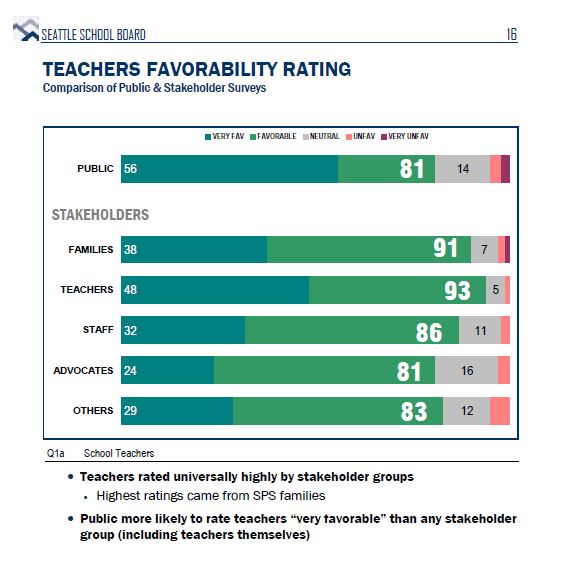
And why do I think that? Because the vast majority of parents like their children’s teachers. The Seattle School District recently surveyed parents and community members, and a whopping 91% of parents felt “very favorable” or “favorable” about teachers. Here’s the bar graph.

This is an overwhelming supermajority of support. It means that whenever teachers are under attack, parents are potential allies. I say “potential” because it doesn’t always work that way. If parents don’t know about the challenges teachers are facing, they’ll stay on the sidelines. And if they can be convinced that the needs of teachers are in conflict with the needs of children, they’ll take the side of whoever claims to represent children.

But when teachers reach out to parents and tell their side of the story, it makes a huge difference. And when teachers ask for help we come through. Tacoma is a case in point. Dring the Tacoma teacher’s strike, parents backed teachers on the picket line, “walking with them and bringing coffee and snacks.” Not only that, but parents got organized and formed a group to support public education, “Parents and Friends of Tacoma Public Schools.

So take heart, teachers. You have friends.

Washington State, you let us down

As a parent of a child in Seattle Public Schools, I am bitterly disappointed in the results of the 2012 elections. Not the charter school vote – I oppose it, but I don’t see it as the most important issue this election season. The votes on taxation.

Our state and our schools have seen cut after cut and we are having trouble with basic health and safety, with school supplies, and with finding seats for all our kids. The Washington State Supreme Court reaffirmed – once again – that our state is failing in its constitutional mandate to fully fund education. We’re short by about 3-4 billion dollars per year. Social services have been hit hard too, with 40% of children living in families that struggle to meet basic needs for food, housing, and healthcare.

We need money, but where is it going to come from? It is easy and popular to blame the legislature. But guess what? Washington voters just tied their hands. In every single county, voters said that the legislature would need a 2/3 majority to pass any new taxes. That includes the closing of corporate tax loopholes.

Not only that, but in an “advisory vote,” Washington voters also told the legislature that the two tax increases it managed to pass last year, which closed some corporate tax loopholes, would be repealed. All but two or three counties went for this.

We can blame the legislature if we like, we can blame Tim Eyeman (the guy who keeps putting this 2/3 requirement on the ballot), and we can blame the big money that heavily promoted these ballot measures. That’s all fine and dandy if it makes us feel better.

But the people who voted for these measures are our friends, neighbors, and family. In my opinion, they let our kids down.

If we really want our schools to be fully funded, as mandated by our state constitution, if we really want our kids to have a great education and a secure future, that’s who we need to convince.

In the meantime, parents and teachers, brace for a storm. We’re not getting relief any time soon.

By which I mean:

Shall I go on? Are those cuts enough? How many more cuts is it going to take before we turn around as a state and say we value our kids?

People burnout!

Apparently I have a severe case of “people burnout.” A few days ago I posted about a lack of free time, and that’s been a problem, but a similar problem is a lack of “alone time.” I’ve gone without it for most of the summer, including evenings and weekends, and on Sunday something snapped.

Or dripped might be the right word. Our family was camping, and that’s always fun but a whole ton of work before and after, and on top of that there was a lot of socializing, and I had gone back to the tent for some alone time, to nap and work on a story in progress. And then my husband came up and said, “Kristin,” and I said “Go away,” and he said, “It’s raining, we have to take the tent down.” Which we did. Because otherwise, we would have had to pack up a wet tent and take it home, and somehow dry it, and it would have been a huge hassle.

Basically, all week I’ve felt like my brain has had the flu – mental exhaustion, emotional exhaustion, and immense feelings of resentment. It’s hard to think, hard to do work, hard to talk to people. So I’ve been busy taking my precious free moments to read books, play Katamari, and take walks. It’s helping. This morning for the first time I’ve been inspired and energized to come downstairs and write. Hope I can keep it up!

Long story short, dear beloved people in my life – if it looks like I’m avoiding you, don’t take it personally.

Scene from the video game "Katamari Forever"

Getting there . . .

This week was a difficult one for getting a story submitted (my goal for the Clarion West write-a-thon). I have a story that doesn’t need a lot of revision but carries a lot of emotional weight for me. I was gonna do it, really I was, but then a “heat wave” hit. Don’t laugh at me, but we call 75-80 degrees a heat wave here in Seattle. At least in my house we do.

I decided that it would be easier to take a different story and do a pretty much complete rewrite and turn it from 2500 words down to a 1000-word “flash fiction” story. It was easier. Now that’s done and I just have to submit it.


Censorship on overdrive

What is censorship? A central committee allowing publication and distribution of approved items only? 

What’s the role of a public library? Historically they’ve taken a stand against book-banning.

What is censorship in the digital age?

What is the role of a public library in the digital age?

All these questions and others have been churning around in my mind ever since reading this post:

http://aqueductpress.blogspot.com/2012/03/what-most-people-dont-know-about-e.html

Overdrive, the (for-profit) provider of ebooks for public libraries, holds a monopoly on providing ebooks, probably for purely pragmatic reasons (they’re the first to come up with a system the library could actually use), which would be one thing if they allowed for downloading of ALL books, but they don’t. Only approved books–that is to say, only books put out by major publishers–that is to say, only books with the information that the corporate interests who control the publishing industry want us to have.

I’m wondering about intellectual freedom for my children, brave new pioneers of the “screen-time generation.”

Submission #3 is in

Just submitted story #3. 3 more to go! Today’s was more complicated than others . . . it involved going online and getting my printer manual; going through boxes for high quality paper; and so forth. In the end I submitted it to an online market anyway.

That’s an honest lullaby . . .

Cleaning out my files, I came across an old lullaby I composed while angry, frustrated, and tired – all those normal mom feelings the usually don’t appear in lullabies. This is to the tune of “Too Ra Loo Ta Loo Ral.”

Pretty little baby,

I’m feeling mad right now

I’ve fed you and I’ve napped you,

So why do you cry so loud?


After your nap in the morning

And in the afternoon

Why do you wake up crying,

When I’m so tired I could swoon?


It’s time to do the laundry

A million things to do

But now I’ll sit here rocking

Cause you’re sad and I love you.