Election fraud

There’s a debate within the U.S. about whether or not “voter fraud” happened. Did millions of people vote illegally, or is that just another lie? This is the wrong question to ask. It’s taking a big-picture problem and framing one small issue, in order to divide and mislead voters.

It also hides the fact that voters broadly agree on one thing: we want fair elections. The president is calling for a massive investigation of elections but such an investigation will likely exclude:

  • voter suppression — denying eligible citizens the right to vote
  • gerrymandering — dividing up districts in ways favorable to incumbents, and
  • election machines that can be hacked

There’s a lot at stake here. People are pinning their hopes on the 2018 midterm elections, but if we don’t keep a close eye on these three issues, those midterm elections won’t be free or fair. In fact, at the same time as Tromp is stealing center stage on the news, a House committee voted to eliminate the independent election commission because it is “fluff.” (Here’s a link to an article in the Guardian about it.)

So what do we do?

Step one: Pay close attention to language used by the media. If our news sources are talking about “voter fraud,” call them on it. Use a different term, like “election fraud” — one that won’t narrow the issue.

Step two: Get informed and talk to our friends and neighbors. And by the way, if we’re sharing news, let’s look for the most neutral sources possible. A conservative neighbor is no more likely to believe The Nation, for example, than I am to believe Breitbart.

Step three: pick our news sources deliberately rather than waiting to see what new and sensational terror comes through our social media. We should control our viewing of news, not the other way around.

Further Reading

Here are a few quick sources for further reading about ways elections can be compromised:

A Bloomburg Businessweek article on voter suppression, published before the election. These are the words of a senior official in the Tromp campaign:

Instead of expanding the electorate, Bannon and his team are trying to shrink it. “We have three major voter suppression operations under way,” says a senior official. They’re aimed at three groups Clinton needs to win overwhelmingly: idealistic white liberals, young women, and African Americans.

A New York Times article that discusses the background of partisan gerrymandering:

A panel of three federal judges said on Monday that the Wisconsin Legislature’s 2011 redrawing of State Assembly districts to favor Republicans was an unconstitutional partisan gerrymander, the first such ruling in three decades of pitched legal battles over the issue.

Federal courts have struck down gerrymanders on racial grounds, but not on grounds that they unfairly give advantage to a political party — the more common form of gerrymandering. The case could now go directly to the Supreme Court, where its fate may rest with a single justice, Anthony M. Kennedy, who has expressed a willingness to strike down partisan gerrymanders but has yet to accept a rationale for it.

That particular case focused on gerrymandering that unfairly favored Republicans, but the article asks us to rethink whether it’s a good idea to let incumbents of either party should have control of redistricting.

CBS article on whether election machines can be hacked:

Roughly 70 percent of states in the U.S. use some form of electronic voting. Hackers told CBS News that problems with electronic voting machines have been around for years. The machines and the software are old and antiquated. But now with millions heading to the polls in three months, security experts are sounding the alarm, reports CBS News correspondent Mireya Villarreal.

As a counterpoint, the federal Election Assistance Commission says it certifies voting systems:

The Election Assistance Commission told CBS News that it ensures all voting systems are vigorously tested against security standards and that systems certified by the EAC are not connected to the Internet.

But guess what? That’s the exact same Election Assistance Commission the House Republicans committee just voted to eliminate.

No voter, from either side of the aisle, should support that!
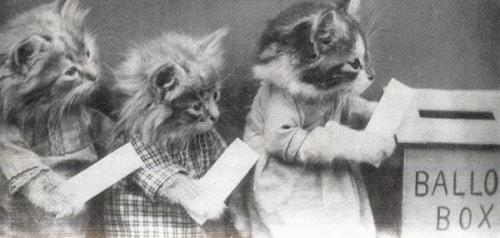
cats voting


– Kristin

My path to getting woke, part two

At the end of Monday’s post on getting woke, I promised to write about Professor Colleen McElroy and what she taught me while I was in the creative writing graduate program at the University of Washington. I regret to say I am skipping over my entire undergraduate education, largely for lack of time.

She was an amazing professor with a vast quantity of fascinating stories, which she always told with a conspiratorial twinkle in her eye. For a small taste of her life and her personality, here is an article by Bethany Reid on HistoryLink and an interview by Elizabeth Hoover in the magazine Sampsonia Way. I enjoyed her classes a lot but was fairly silent in her classes, partly because I was shy then and partly because of the awkwardness that comes from systemic racism. Now if you’re a person of color reading what I’m about to say, you might be surprised, and if you’re white you might think, “Oh yes, I know what you mean,” but anyhow, for the longest time, for many years, or rather several decades, I had the mistaken assumption that the internalized racial prejudice that I held — that everyone holds, to one extent or another — would be revealed to all the world if I spoke up and said the wrong thing. This has stopped me from speaking up about race, many times, when I should have.

Where I was most mistaken was in thinking that my internal racial prejudice was unique to me, or that most other white people would care about it one way or another. But even more so was my naive assumption that because the civil rights movement had happened, segregation theoretically ended, and so forth, that if a person held back from making some racist comment it was because they were ashamed of it, like I was. It’s clear now, from the enormous backlash against “political correctness,” that a whole lot of white people were silent only because of social conventions.

In other words, I cared a lot more about racism than a lot of other white people, but I was less likely to speak up. I’m still in recovery on that one. I find it much easier to write about racism than to speak about it, even with close friends.

Colleen McElroy exposed me to a wide swath of voices I would never have heard otherwise. To name a few: bell hooks, Gloria Anzaldua, Isabel Allende, and Carolyn Forché. These voices framed my understanding of concepts such as the politics of art, race, and immigration; and they also provided a launching off point for learning more and more and more.

One of the books she taught was:

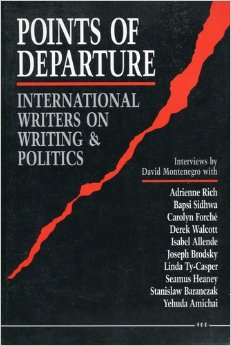
Points of Departure: International Writers on Writing & Politics, David Montenegro, University of Michigan Press, 1991

points-of-departure-book

From the cover blurb:

In these times of political transformation and turmoil around the globe, Points of Departure offers incisive and passionate reflections on literature and politics by ten of the world’s leading writers. David Montenegro’s interviews with these novelists and poets, some living in exile, focus on the relationship of the writer’s work to political violence and oppression and examine the troubling tensions between art and social responsibility.

There’s an ongoing debate about “whether or not art should be political” and I have to say, after reading this book, I look at people who believe you can separate the two and wonder: What world are you living in?

The texts here put me on the path to getting “woke” not exclusively about racism but also about the lived experiences of people who have endured imperialism, colonialism, and so forth. And the understanding that many terrible realities have been too often whitewashed in our history and our news. This is of course still going on.

Below are quotations from two texts that provided a-ha moments for me, one by Isabel Allende and one by Carolyn Forché. I will leave them as is without discussion or interpretation.

From David Montenegro’s interview of Isabel Allende about the day of the military coup in Chile, in which her uncle, Senator Allende, was deposed and killed, here are some snippets.


Well, I was a journalist at that time, and that day I got up very early in the morning, as I usually do. I prepared my children for school, like any day, and went to my office. I didn’t realize there was a coup. . . .

By two o’clock, more or less, I learned that Allende was dead and that many of my friends were in hiding; others were killed; others were in prison. But at that moment it was very difficult to realize exactly what was happening. It was a time of great confusion. And rumors. On television we only had military marches and Walt Disney movies. It was so surrealistic, so strange. . . .

[T]he very day of the coup, soldiers would cut the pants of women in the streets with scissors because they wanted ladies to wear skirts, which was proper. . . .

(pp 110-115)

And here is a bit from Carolyn Forché prose poem “The Colonel,” which details a poet’s interview with a colonel. It begins in mundane domesticity, with the wife bringing coffee and sugar and the daughter filing her nails. Midway through the interview:

The colonel returned with a sack used to bring groceries home. He spilled many human ears on the table. They were like dried peach halves. There is no other way to say this. . . .

(pp 75-76)

So then.

Opening my eyes to the world in this way was not the most pleasant gift I have ever received, but is certainly one of the most important. Thank you, Professor Colleen McElroy.

colleenjmcelroy3

image from awritersalchemy. wordpress.com

– Kristin

My path to getting woke

In Seattle, people of color – in particular, indigenous people – LED the march. That’s the way to do it. One of my eye-openers was the bell hooks book From Margin to Center which laid out very clearly and practically why folks on the margins understand the world in ways folks in the center don’t. It’s a matter not only of justice but of practicality that we center the voices of women and color right now.

I posted that comment on a friend’s facebook page and followed it up with another post to mine:

Only a fraction of the people who attended Seattle’s Womxn’s March yesterday would have heard this–the mike only carried so far–but in the opening remarks the speaker gave respect for Judkins Park being on Coast Salish land, and that indigenous people would be leading the march. A HUGE cheer went up at this news. Later, two bald eagles graced the march. I take all this as a sign that the new womxns movement is heading in the right direction.

Until recently, it wouldn’t have even occurred to me that putting women of color first in a march might be a good idea, or that anybody would even understand if I said it. That’s the ignorance of white privilege. But to my surprise and pleasure, a huge number of friends clicked “like.” So I think I am along the path to getting woke, and doing so in community.

I expect some of you readers are looking at me right now like I’m a weirdo.  But if you have some patience, feel free to follow along and see how I got to where I am.

What does “getting woke” mean? Roughly, becoming aware of racial justice issues. There’s an article about it on dailykos, just as a starting point. If you haven’t heard the concept, take a minute to read that before reading the rest of this post.

Okay, done?

So. My steps toward getting woke. Some of it’s reading books, talking to people, listening to speakers, and some of it’s from making mistakes. Altogether it’s a long and ongoing process but I have gratitude to everyone along the way.

The first people who helped me “get woke” were my liberal parents, the conversations we had, the book they got me. And then middle school: the substitute teacher who told us stories of times there were two water fountains, one for “white” and one for “colored” and since he was biracial, he never knew which to use. I remember his kindness to us and the frustration he felt as he spoke, because of the difficulty in communicating what those times were truly like.

There was a sharp division in middle school, which took me a long time to understand. I attended Washington Middle School in Seattle, an almost entirely black school that had implemented busing for desegregation, by which I mean they bused white kids from the north end from the advanced learning program, meaning that the district was less segregated, but the school was more.

By high school my family was living in Salt Lake City, and there was my high school teacher who said Martin Luther King was a “troublemaker.” This woke me to understand not everybody was like my liberal parents, and that history didn’t proceed from race hatred to everybody singing kumbaya.

One time for journalism I distributed a survey asking people two questions: did they think white and black people were equal, and is mixed marriage okay. If I recall correctly, everybody who responded believed in equality, but only half in mixed marriage.

Then there was the time my mom dated a black man, and we lived in a house where the front door was stuck so we only ever used the back door, and my mom’s date explaining to me that he was always afraid a cop would see him sneaking in our back door and arrest him.

That gets me through high school, in bits and pieces. I had no black friends in high school. In fact, my entire high school had no black kids. That’s how it was.  I’ll just go ahead and skip undergraduate school, although some learning took place there, and move forward to graduate school. Because there’s a professor I need to express gratitude to, and that’s Colleen McElroy, who exposed me to some amazing poets and writers of color. I’ll talk about her in my next post.

More concerning than Tromp

Suppose for a moment that our president-elect is not the main threat to our freedom but a buffoon whose primary purpose is to be so outrageous as to distract everyone from worse things happening. And suppose for a moment that everything U.S. citizens have taken for granted is no longer a certainty. As someone who reads dystopic science fiction and has paid attention to happenings in Latin American countries, and as someone with children who will inherit tomorrow, I think about these things.

It’s easy to get frightened here, but let’s not. Let’s start with the assumption that the worst we could imagine is preventable. In this case, the first step is to predict it. If you’re somebody who hasn’t paid a lot of attention to what’s happened in other countries, now’s the time. So, here’s a link to an interview with author Isabel Allende explaining what happened the day of the military coup in Chile, when democracy was suddenly abolished.  And here’s a link to some excerpts from the novel Horizontalism by Marina Sitrin, which talks about the day that Argentina froze bank accounts and used the money to pay off an IMF loan, leaving people without their savings for months. Anyway, those were my starting points for understanding the world around me a little better.

Right now it’s clear that the New Deal and civil rights legislation, both hard-won in the twentieth century, are under attack by our current Congress. And people are already worried that loss of the Affordable Care Act will cost lives, and asking whether Medicare and Social Security might be next.

What other damage could Congress do? I can think of a lot of things — defund the EPA, repeal worker protections, and more.

But what aren’t we thinking about? How about a substantial revision to the Constitution, dramatically limiting the federal government’s ability to raise taxes and pass laws?

That’s impossible, right? No. According to the article “Corporate America is Inching Even Closer to a Constitutional Convention” on the web site In These Times, apparently, the U.S. close to having something that hasn’t taken place in the entire history of our country: a constitutional convention.

According to Article V of the U.S. Constitution, the states can convene a constitutional convention without the federal government’s go-ahead if two-thirds (34) of them pass a resolution in favor. Right-wing organizations—and their billionaire funders—have been working feverishly for decades to get state legislatures to call for such a convention, with the explicit aim of limiting the powers of the federal government.

According to the Constitution, such a convention would only have the power to propose amendments, which would then be ratified only upon approval by three fourths of the states.

What’s concerning here is that model legislation has been written by the American Legislative Exchange Council (ALEC), and if you don’t know what that is, now’s the time to find out! I like to think of them as a fourth branch of our government–the corporate branch. Unelected, secret, unaccountable. And there has been a dry run of a constitutional convention using ALEC’s model legislation.

That warrants close scrutiny. In a Tromp era, with more and more people angry at the federal government, efforts to limit it will be popular among both the right and the left. But here’s the rub: curtailing federal rights can make states more tyrannical. As the article points out:

But ALEC doesn’t just fight for states’ rights over the federal government. It fights for states’ rights over everything else, including local governments. After focusing on state legislatures for decades, they now hold decisive control in states across the country, which they have used to stalemate state budgets, and push an avalanche of “state preemption” laws to entrench state control over local towns, villages, cities and counties.

It’s also worth noting that the recent federal election, which put in place a conservative president, Congress, and governors were affected by voter suppression, including voter ID laws proposed by ALEC. The issue of voter suppression, detailed in an article in The Nation, is one of the most under-reported stories about the recent election, but also one of the scariest.

What else aren’t we thinking about?

How about the bizarre goings-on within the U.S. intelligence community–the CIA, the FBI, and whatever Homeland Security is doing? Hacking, Russian blackmail, and who knows what else. It’s like there’s some turf war going on with unknown stakes. Yesterday Anonymous came forward with a threat to release damaging material on our president-elect — after having made but not followed through on a similar threat before the election. That’s surprising enough on its own, but an even bigger surprise to me is that when I checked the news, the top hit announcing this threat was not for any traditional media but rather rt dot com.

Anybody know what that is? Leftists have been forwarding lots of articles from it. Really, anything damaging to the president-elect appears legit to us. We’ve gotten lazy.

But remember: the enemy of our enemy is not necessarily our friend.

That website, which jumped to the very top of my news feed, is Russia Today — the Russian state-owned media. Why did it jump to the top? Is it because it’s that popular, or because my news feed has been personalized? It’s concerning either way. Because whoever can manipulate the news can manipulate the nation. And to what end? What does Putin want? Would destabilizing the U.S. help him achieve his goals?

Our representative government is a big stinking mess right now. People have lost faith in it, for good reason, and with every new Tromp scandal our faith grows weaker.

But there are no other democratic proposals out there on the table. Our constitution and our system of elected officials is, at the moment, the best thing we have. Let’s not throw them out the window.

To make a long story short, what’s more concerning than Tromp? The possible loss of our democratic institutions. That’s what. Let’s keep a sharp eye and all our wits about us in the days and weeks to come. Watch the news, but also watch behind the news.

Onward.

– Kristin King

Categorizable

Took some time today to categorize my posts. Every time I share my URL with anybody, I always say, “It’s a bit of a mishmash!” Everyday stuff, book reviews, Doctor Who, and lots of radical politics. But maybe somebody comes here just for the Who. Or just the feminism. So now, you’re in luck. Here are my categories, and I’ve added them to some of my posts, going back at least a year or so.

books, movies, tv, music
A book, a movie, a show, a song. Was it amazing? Fun? Did I hate it? Am I now thinking deep thoughts about it? Come along for the ride.

doctor who
What is that certifiably insane time traveler up to THIS TIME?

dreaming politics
I’m always pondering how to build a better world. Or how to survive this one. I read, think, dream, act. It’s all here.

everything else
These are all the posts that don’t involve my job, my writing, my interests, or politics. In other words, anything. So either this category is empty, or else my post has ventured into the Twilight Zone.

my writing
What have I published? Struggled with? Where can you go to read my latest work?

on the job
As a parent and a writer, most of what I do is unpaid. But it’s still a job. Here’s what it’s like.

By Balu Ertl (Own work) [CC BY-SA 4.0 (http://creativecommons.org/licenses/by-sa/4.0)], via Wikimedia Commons

By Balu Ertl (Own work) [CC BY-SA 4.0 (http://creativecommons.org/licenses/by-sa/4.0)%5D, via Wikimedia Commons

Learning from Women

In 2014, I attended a weekend workshop in Oregon, called the Fishtrap Winter Gathering. The theme was “Learning from Women,” and it was a weekend of talks, readings, and workshops by Molly Gloss, Ursula Le Guin, and Tony Vogt. It was a marvelous experience that changed my thinking in many ways, and I have never described it to my satisfaction. I did make one post to the Aqueduct Press blog, “Report from the Fishtrap Winter Workshop.”

First up was a discussion of the definition of women. Throughout the workshop, it was awkward to talk about “women” as a whole, because of gender essentialism. We did it anyway. There was an acknowledgment that the definition is shaky and incomplete, and a general invitation to men to take on the honorary name of “women” for the duration of the workshop, but that by and large, across cultures, women have been socialized to take on certain roles and certain ways of being.

There is a cultural division, and in it, the role of “men” is privileged. Ways of thinking, being, doing. An assumption that women will be liberated when we take on those roles. But why not the other way around?

At the moment I’m thinking about all these things in the context of the left. The group I’ve been working with got an influx of new members (hooray!) that is mostly men, and thinking, “Oh, this again” with a certain sense of exhaustion. It’s not the big things but the little things, like do you put smiley faces in your emails or not, when you should ask nicely or express gratitude. In mostly women’s spaces, we do all these things, and we do them to build community. In mixed or mostly men’s spaces, it comes across looking like weakness.

How does a group handle interruptions? Men often interrupt more and get more air time. If you want to change it, do you ask women to interrupt more, or men to interrupt less? Is there a social benefit to taking turns?

Just the little things.

More later.

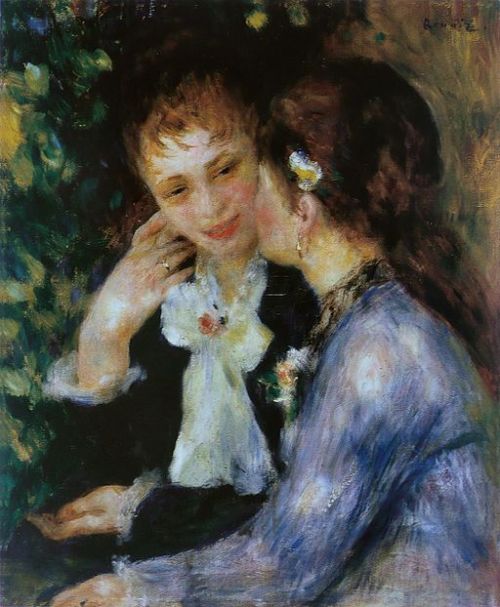
512px-Pierre-Auguste_Renoir_-_Confidences

Pierre-Auguste Renoir – Confidences


Neo-fascism trounced in sci fi, 2016

Last year I posted an essay about neo-fascist goings-on in the science fiction community. To make a long story short, a racist, misogynist troll who calls himself “Voice of God” and owns a publishing house in Finland used Gamergate tactics to hijack the ballot for science fiction’s prestigious Hugo Awards.

At the time, I was shocked and alarmed by the blatant neo-fascist rhetoric used by the troll and the normalization that had taken place in the science fiction community. (He had run for president of Science Fiction Writers of America even after using an outrageous racial slur against N.K. Jemisin, and a stunning ten percent of people had voted for him.)

In hindsight, I see that the racist far right has made inroads everywhere. Because about a fourth of the U.S. electorate voted in someone who is looking to be an actual fascist.

But here’s the good news: the science fiction community organized and the science fiction community won. Whatever else happened in 2016 that sucked, a bright spot is that he was roundly defeated. You can read more about that in the IO9 blog article “Hugo Awards Celebrate Women in Sci-Fi, Send Rabid Puppies to Doghouse” by Beth Elderkin.

Science fiction represents the dreams of our community. And dreams are powerful. If science fiction fans can come together to defeat neo-fascism with their own community, then everyday people in the U.S. can defeat white supremacy, actual fascism, and all the rest of that garbage.

We can win.

I’ll finish up by a quote from N.K. Jemisin:

. . . all this anger and discussion reflects a struggle for the soul of the organization, which is in turn reflective of a greater struggle for the soul of the genre, and that overall struggle taking place globally. . . .

Diverse voices are here to stay.

Spaceship_Kawaii

Yes, we can win

Recent events have been a shock, the next four years are going to be a nightmare, and too many of the people I know are discouraged. But we can win. How do I know this? Because of the mass movements that have won, across history and across the globe.

But there are obstacles, including some that are not at all obvious. The two I’ll touch on today are:

  • social anxiety
  • ignorance about our own history

This morning while I was in my children’s school the intercom came on and I heard the story of Rosa Parks changing the world with her one refusal to sit in the back of the bus. It’s meant to be inspirational: look what one person can do!

But the vast majority of people who hear the story think, “I could never do that!” Not even for fear of being arrested. Social anxiety is enough to stop most of us.

Once I stepped far outside my comfort zone and freaked out the entire leadership of a big nonprofit. (It’s a long story but I’ll tell it one of these days.) It took me weeks to recuperate. I could not possibly have done it without social support and collective planning ahead of time. So we need to do scary stuff, but we all need help.

To do that, we need to organize. In person. Face to face. With actual people.

We also need to know our history. Rosa Parks was a great leader, but there are also thousands of unsung heroes who contributed in many different ways. Their stories are buried but not lost.

Here’s the book that tells that story. It has the who, what, where, when, how, and why of a mass movement that won. Go read it. Then tell me something: if you could be any civil rights hero from this book, which one would you be?

I’ve Got the Light of Freedom by Charles M. Payne

light-of-freedom


– Kristin Ann King

Missing voices

I went to my local PTSA today to talk about starting a parent group focused on racial equity. There were some good conversations about how the school was moving forward . . . baby steps, though. One woman said something that has stuck with me, about remembering the voices of the people who were not in the room. Because it was all pretty darn white.

There’s no exact right thing to do when voices are missing from a table. All the things are wrong to some extent. I learned this lesson last year, working on a racial equity team at another school, when I had been listening to the voice of someone who couldn’t make the meetings and advocating one course of action, while meanwhile someone else was advocating an opposite course. My speaking up “for” somebody not present was both right and wrong.

Sometimes you just have to choose the least wrong thing and let it go at that.

It would be better, though, to have all the voices in the room.

To Pin or Not To Pin

To Pin or Not To Pin . . . that is not the question.

Some context: a couple days ago, a friend of color, also queer and disabled and a member of a much-maligned ethnic group, altogether a visible target for white supremacists, put out a request that her friends wear a safety pin. So I did. It is one small things, along with other small things, that I am doing to try to build a better, kinder world in the face of hate. Also, I adore my friend.

Few days later, I come across a blog entry on Huffington Post saying “Dear White People, Your Safety Pins are Embarrassing.” (Link below.) It’s by a white man, shaming white people into not wearing the pin. His tone is condescending. It’s the worst kind of identity politics imaginable. Between him and my friend? I’m going with my friend.

I started a facebook conversation on my wall, and it’s gone all over the map, with people of many colors and genders putting forward various opinions. (And there’s actually a pretty compelling reason not to wear a pin – apparently it’s being co-opted by white supremacists – so I’ll provide a link at the bottom.) Probably this conversation is happening all over the Internet and the dust will settle, one way or another. I’ll wear the pin or not wear the pin. If I don’t wear the pin, I will wear something different, to show solidarity.

But I sure am pissed off with that guy. His assumption that the only reason a white person would wear a pin is to feel better about themself? Arrogant. His failure to notice that queer people, disabled people, and women are all justifiably afraid right now? Oops. His choosing sides between different people of color, without noticing — well, actually, that’s an easy mistake to make. I’ve done it. But there’s more than that.

When I was first confronted with the job of raising a baby, there were a lot of decisions to make. They were the kind of choices you make at one a.m. when you’re at the end of your rope. Do I let my baby cry themself to sleep right now, or not? As kids get older, there are questions of discipline. People saying “Don’t do this, don’t do that.” My takeaway was:

If you’re going to tell people not to use a tool, you damn well better have an equal tool to offer them.

The author of this post didn’t. He suggested that people wear “Black Lives Matter”  instead. But what he apparently didn’t realize is that the safety pin does some things that a “Black Lives Matter” pin wouldn’t.

See, some people are ready to wear “Black Lives Matter” and some are not. Others aren’t ready, but who would wear a safety pin. Now what’s going to happen when you tell them not to wear the pin? They’re going to take off the safety pin and wear nothing. (It’s easy to say, oh, well, we don’t need allies like that. But I disagree. I feel like I need all the allies I can get.) And then vulnerable people will be looking around and thinking, “Oh, I guess nobody cares about me.”

In other words, there’s a need for a visible symbol that everyone can wear to show solidarity. And somebody thought up the idea for one and started spreading it around, and then somebody said no. And now instead of moving forward, people are arguing about whether to wear it or not.

Right now, we need everybody to stretch a little. The actual do’s and don’ts and hows and wherefores don’t matter as much to me, but two general principles, which I learned as a young mother, need to be remembered.

  1. Don’t tell someone not to use a tool unless you’re prepared to offer an equivalent one that works for the same purpose.
  2. For every no, offer two yeses.

For context, here are a couple of links about the safety pin:

“Here’s the Heartwarming Reason Safety Pins are a Trend Now”

“Dear White People, Your Safety Pins are Embarrassing”

“NeoNazis are trying to co-opt the Safety Pin” (trigger warning: NeoNazi symbols)

Okay, off my soapbox and on to more productive organizing work.

-Kristin