In the first three posts in this series, I talked about works by Carl Jung that have shaped my understanding of the unconscious. In this post, I will share my understanding of the term collective unconscious as he presented it, along with my own questions and reflections.
Jung’s “collective unconscious” is “the unconscious psyche.” For any given person, it includes anything and everything that we know or have known but is not immediately obvious to the conscious mind. It includes ideas that came to us before we were even born, and “archetypes,” or the myths and symbols that recur time and again. It includes the “anima,” or the woman’s spirit in the man, as well as the “animus,” or the man’s spirit in the woman. It includes the “shadow,” which represents the parts of our psyche we try to repress. It can be observed with science and perceived through art and dream, but is more than those parts. For a person to become whole, they must approach it.
But here is my first question: is the collective unconscious simply a pattern of thought that each person is born with, or does it also connect us together? People build community. We share art and story. Do our unconscious thoughts mingle? That’s not even taking into account the animals, plants, and rocks. Do we share the dreams of a cat?
And my second question: is the collective unconscious an unchanging inheritance? Or is it malleable? Do we change it when we dream, and write stories, and make art? Is there a two-way relationship between our conscious and unconscious minds?
And my third question, as a lover of time travel: does the collective unconscious move forward and backward in time?
These are not questions to be answered by science. They live in the imagination, art, stories, music, religion, poetry, street protest, random acts of violence, random acts of kindness, and of course, dreams.
My own answers to the three questions I posed are yes, yes, and THAT WOULD BE SO COOL. In my imaginings, just as we are interconnected in the material world, so too are we connected in the world of the unconscious, the wellspring of creativity. We learn from it, but we speak to it also. In this sense, our art has a power that requires respect, awareness, and love. (As to the third question, heck yeah there’s gotta be a TARDIS spinning along, and a Doctor whose hope is to fix everything.)
We have to pay attention. The collective unconscious matters. It matters a lot, and especially now, when computer networking and artificial intelligence have changed the way our conscious minds encounter reality. We speak faster than we feel. We spit out memes as though the words came from us. This is an ignorance that is already exacting a high price.
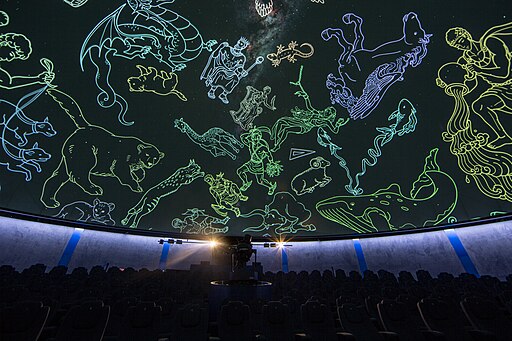
The featured image from this post comes from a planetarium.
In this post, I’ll start looking at Jung’s conception of the “unconscious.” It relates to the phrase “psyche” in the chapter “Freud and Jung–Contrasts.” There, he called it the “mother of consciousness.” Here, also, he explains it as a noncorporeal phenomenon with an existence beyond the conscious mind, but he does so in terms that someone steeped in Western rationalism can understand. Having been steeped in Western rationalism, I find this approach helpful. Jung says:
“It would all be so much simpler if we could only deny the existence of the psyche. But here we are with our immediate experiences of something that is–something that has taken root in the midst of our measurable, ponderable, three-dimensional reality, that differs bafflingly from this in every respect and in all its parts, and yet reflects it. . . . If it occupies no space, it has no body. Bodies die, but can something invisible and incorporeal disappear? What is more, life and psyche existed for me before I could say “I,” and when this “I” disappears, as in sleep or unconsciousness, life and psyche still go on. . .” (184)
He shifts from calling this phenomenon the psyche to the unconscious psyche and sometimes the unconscious. Does he consider them the same? Or does he suppose there is a conscious psyche? I can’t tell. Either way, he’s still firmly within Western rationalism when he talks about the functions of the unconscious psyche with a comparison to instinct that operates in the animal world.
“A high regard for the unconscious psyche as a source of knowledge is by no means such a delusion as our Western rationalism likes to suppose. We are inclined to assume that, in the last resort, all knowledge comes from without. Yet today we know for certain that the unconscious contains contents which would mean a immeasurable increase in knowledge if they could only be made conscious. Modern investigation of animal instinct, as for example in insects, has brought together a rich fund of empirical findings which show that if man acted as certain insects do he would possess a higher intelligence than at present. It cannot, of course, be proved that insects possess conscious knowledge, but common-sense cannot doubt that their unconscious action-patterns are psychic functions.” (185)
I don’t know exactly which “certain insects” were studied pre-1933 and found to have high intelligence, but today I would think about the difference between the ant and the anthill. The anthill possesses its own form of intelligence. An ant, if it thinks anything, if it has a conscious mind, could think it is acting of its own accord. It might be dimly aware of the system that organizes it, or it might not.
Jung then moves from animal instinct to human instinct:
“Man’s unconscious likewise contains all the patterns of life and behavior inherited from his ancestors, so that every human child, prior to consciousness, is possessed of a potential system of adapted psychic functioning. In the conscious life of the adult, as well, this unconscious, instinctive functioning is always present and active. In this activity all the functions of the conscious mind are prepared for.” (185)
So far, his comments are strictly in line with the science in Jung’s time. Like other animals, we are born knowing a lot about how to get along in the world. But he is about to take a big leap away from rationalism with a bold claim:
“The unconscious perceives, has purposes and intuitions, feels and thinks as does the conscious mind.”
The unconscious mind has purposes? Goals? Does it? What would that mean? If I return to the concept of an anthill, then yes, you could say it has purposes and intentions. But does it feel? Does it “think”? That is a considerable stretch. Speaking as a science fiction writer and reader, though, it sets my imagination on fire.
He goes on to compare and contrast the conscious and unconscious psyche in terms of memory:
“While consciousness is intensive and concentrated, it is transient and is directed upon the immediate present and the immediate field of attention. . . A wider range of “memory” is artificially acquired and consists mainly of printed paper.” (186)
Jung contrasts this with the unconscious, which contains “an immense fund of accumulated inheritance-factors left by one generation of men after another. . . ” (186)
That’s on scientifically conventional ground. But next he makes another big leap and imagines the unconscious psyche as its own personage, even suggesting this entity is called God. Please note that Jung’s God is intersex.
“If it were permissable to personify the unconscious, we might call it a collective human being combining the characteristics of both sexes, transcending youth and age, birth and death, and from having at his command a human experience of one or two million years, almost immortal….Unfortunately-or rather let us say fortunately-this being dreams. At least it seems to us as if the collective unconscious, which appears to us in dreams, had no consciousness of its own contents-though of course we cannot be sure of this, any more than we are in the case of insects.” (187)
Now he’s back in the world of rational analysis. Just as the ant doesn’t know what, or if, the anthill is thinking, people can’t fathom the intelligence behind the collective unconscious.
He goes on to talk about how people in “past ages” would have characterized the collective unconscious. People of past ages “held the individual soul to be dependent upon a world-system of the spirit. They could not fail to do so, because they were aware of the untold treasure of experience lying hidden beneath the transient consciousness of the individual. These ages not only formed a hypothesis about the world system of the spirit, but they assumed without question that this system was a being with a will and consciousness-was even a person-and they called this being God, the quintessence of reality. He was for them the most real of beings, the first cause, through whom alone the soul could be understood.” (187-188)
That’s a view of the collective unconsciousness as God. Is this true? Is it real? There’s no way for us to know. Jung has gone beyond science into philosophy and metaphysics. As a psychologist he’s in trouble here, and he is honest enough to say so:
“In the foregoing I have shown where the problems lie for a psychology that does not explain everything upon physical grounds, but appeals to a world of the spirit whose active principle is neither matter and its qualities nor any state of energy, but God.” (188)
He begins to ground the question in the context of psychoanalysis, where there is a patient’s life at stake: “we are not free to set up theories which do not concern our patients or may even injure them. Here we come to a question which is often attended by mortal danger–the question whether we base our explanations upon matter or upon spirit.” (188)
Neither the physical world nor the spiritual world is sufficient to explain our experience, he says, but the “modern” psychologist unfortunately ends up believing two contradictory ideas–the physical and the spiritual–and this leads to opportunism. I’m not sure which practitioners or practices he might have been referring to, but I can see the risk in a medical authority claiming to understand the spiritual world behind a patient’s mental illness.
Jung has a solution to this apparent contradiction, and it is surprisingly elegant. By the time he gets to the end of his reasoning, he has proven a ghost is just as real as a fire.
“The conflict of nature and mind is itself a reflection of the paradox contained in the psychic being of man. This reveals a material and a spiritual aspect which appear a contradiction as long as we fail to understand the nature of psychic life. Whenever, with our human understanding, we must pronounce upon something that we have not grasped or cannot grasp, then–if we are honest–we must be willing to contradict ourselves, and we must pull this something into it antithetical parts in order to deal with it all. The conflict of the material and spiritual aspects of life only shows that the psychic is in the last resort an incomprehensible something. Without a doubt psychic happenings constitute our only, immediate experience. All that I experience is psychic. Even physical pain is a psychic event that belongs to my experience. My sense-impressions. . . are psychic images, and these alone are my immediate experience. . .. Here there is a reality to which the psychologist can appeal–namely psychic reality.” (189-190)
So here is his solution to the contradiction:
“If I change my concept of reality in such a way as to admit that all psychic happenings are real–and no other use of the concept is valid–this puts an end to the conflict of matter and mind as contradictory explanatory principles.” (190)
To illustrate his point, Jung compares the pain caused by being burned by fire to the fear of a ghost. “[J]ust as the fire is the psychic image of a physical process whose nature is unknown so my fear of the ghost is a psychic image from a mental source; it is just as real as the fire, for my fear is as real as the pain caused by the fire.” (190)
To recap and expand on this point, from a psychoanalyst’s point of view, the material fire and immaterial ghost both cause “psychic events” and there is no need to speculate on whether the ghost has any existence outside the patient’s mind, because the treatment is the same.
I gave my children fits because they knew me to be honest, and once they were old enough to question Santa Claus, I swore up and down that Santa Claus was real. “Are the cookies eaten? Are your stockings filled? Do presents arrive? Is it the same for children all over?”
The world of the imagination is real. This concept actually terrifies me, because humanity is capable of both great good and great evil. All the things we can imagine, we can make real. I think about this when I see one group of people demonizing another, as maga is doing to migrants and immigrants. They are afraid of their own shadows, and so they create demons, and violence follows. And if I am afraid of maga, what is in my imagination? God help us all. Speaking of God. . .
In my next post I will explore Jung’s idea of God, the collective unconscious, and religion.
Today’s featured image is a picture of “Sfera Grande,” a sculpture by Arnaldo Pomodoro. What do you see in it? A world, a mind, a broken thing? Light and shadow? I think I see typewriter keys.
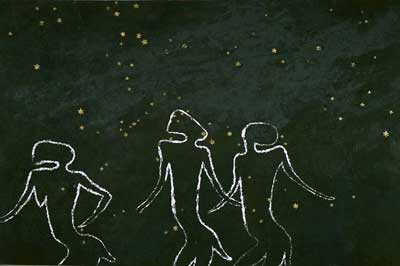
My featured image comes from the National Museum of African Art, collection 96-23-1, by artist Gavin Jantjes. I chose it for this post because my heart said, “Yes, that’s it, exactly.” Well, I say “heart,” but I could also say “imagination” or “spirit” or “soul” or “unconscious.” It’s easy to get all tangled up in words. My conscious mind asks: “What do you mean? What is it about this particular image?” It’s the empty space. Three outlined figures dancing against (in front of, amid. . .) a backdrop of stars. It’s telling me something I need to know. Some images are like that. They say, “A-ha!” even though I don’t know what or why. I listen quietly.
I studied Carl Jung in my early college years, not as a college course but as part of a local group that my father and stepmother belonged to. I learned and practiced a method of dream analysis, to the great benefit of my self-understanding and creativity. I also read and sometimes outlined a couple of books:
Modern Man in Search of a Soul, first English printing 1933
The Undiscovered Self, copyright 1957
Man and His Symbols, copyright 1964
These titles point to a few key frustrations I have with his work. Humanity is all he/him. Man is broken into “modern man” and “primitive man.” The world is broken into the Western world and the “other.” All those cultural biases from those times.
All the same, they were foundational to the way I understand the landscape of our collective mind. Spirituality, art, stories, philosophy, science — everything. I have something I would like to say, but I realized that to express my thoughts, I would need to dip back into these books. I was surprised at what I had underlined, highlighted, and marked with highlighter pen.
In this series of posts, I will examine Carl Jung’s ideas as a way of retracing my steps back from the beginning to the way I now think about the psyche. The full series is:
Art can reduce tragedy down to a form we can look at without losing our ability to cope. To see — not to look away — but to retain the ability to act. To see terror and retain courage.
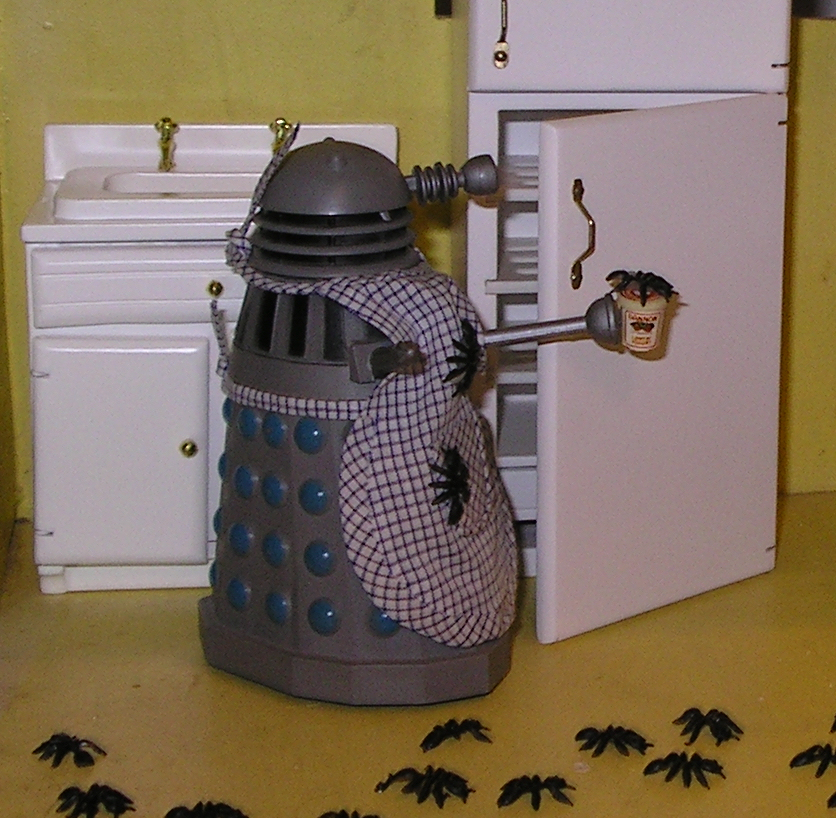
Consider the Dalek — a genocidal killing machine. Fascism in its purest form. We bake Dalek cookies and eat them; we crochet them for use as potholders and ornaments; or, in my case, put them in dollhouses. It’s a way of controlling our fear. We defuse it with silliness and domesticity.
Art also teaches us to recognize historical patterns. A nazi or fascist might not sieg-hail or use the amateurish German accent we recognize from TV, but we can still learn to notice a violent authoritarian regime that must be resisted.
Here, then, are four moments in Doctor Who that speak to us in the United States, today, right now.
1. “It’s happening again!”
In the episode “Turn Left,” Donna Noble and her grandfather Wilf say goodbye to their host Rococco, an Eastern European man who had welcomed them with open arms into his apartment when they were displaced by war. Donna is confused about why he has to leave in the back of an army truck.
“Oh, but why do you have to go?” she asks.
Rococco replies cheerily. “It’s the new law. England for the English, et cetera. They can’t send us home. The oceans are closed! They build labour camps.”
“I know,” asks Donna, “but labor doing what? There aren’t any jobs.”
She still hasn’t clued in, but Wilf’s heart is breaking. His lips tremble. He salutes Rocco and mutters,
“Labour camps. That’s what they called them last time.”
“What do you mean?” asks Donna.
“It’s happening again,” says Wilf.
That’s when she figures it out. She runs after the truck, but it’s already too late.
2. I’m not lowering my bubble
In “Dot and Bubble,” a young woman named Lindy is chatting with friends through her Bubble, wearable social media that nobody ever takes off. She and her lily-white peers are the children of the elite, and for some reason they have been abandoned by their parents and left to their own devices in the guarded town of Fineville. Nothing can get in or out, so they’re safe. Clearly.
Oblivious, she walks past a body being dragged away and toward her office, where she and her friends do their two hours of work. The Doctor has hacked into her feed and tries to get her attention, but she gives a micro-expression of disgust and swipes him away. In the town of Fineville, racism won. The Doctor’s white companion, Ruby Sunday, appears instead and asks her to lower her Bubble just long enough to look at the real world.
“I promise I will leave you alone if you could just look at the four desks in front of you,” says Ruby.
“I am not…lowering… my Bubble,” says Lindy.
“Okay. Can you stay inside and look beyond it? Can you do that?”
Bit by bit, Ruby coaxes Lindy and her peers to look outside their Bubbles just long enough to run away from the monsters who are eating everyone in alphabetical order. To be safe, they just need to trust the Doctor.
Will they?
3. The Beast Below
The Doctor and his new companion, Amy Pond, have landed on the far-future Starship U.K. He begins by falsely pretending he follows a Prime Directive: “We are observers only. That’s the one rule I’ve always stuck to in all my travels. I never get involved in the affairs of other peoples or planets.”
Then they see a young girl sitting on a bench, crying all alone while adults hurry by without looking. Amy turns to the Doctor to ask him a question, only to discover that he is already outside of the TARDIS sitting on a bench and talking to her. He gestures to Amy to join him, and then he asks her to look at this world and tell her what’s wrong with it.
“Is it the bicycles?” she asks. “Bit unusual on a starship, bicycles.”
It isn’t the bicycles.
“Life on a giant starship,” he says. Back to basics. Bicycles, washing lines, wind-up street lamps. But look closer. Secrets and shadows, lives led in fear. Society bent out of shape, on the brink of collapse. A police state.”
He gives her a moment, then asks, “Do you see it yet?”
“Where?” she asks.
He points to the young girl. “There.”
4. Get some perspective, woman!
In “Aliens in London,” the world is in crisis, and all the Very Important People are rushing around the British Parliament Building trying to figure out how to respond. Acting Prime Minister Joseph Green is entirely out of patience with this annoying minor official, Harriet Jones, who has arrived with a proposal for preserving cottage hospitals.
Green barks out, “By all the saints, get some perspective, woman! I’m busy.” Then he rushes off, super-competently leaving her alone in the Cabinet Room with a file of Emergency Protocols.
A bit irresponsible? Well, aliens have just landed in the middle of London, and most of the British Government is missing. It is an emergency, after all. As it turns out, though, this is an emergency of his own making. He is actually an alien, wearing a human skin, intent on making quick cash by destroying Earth. And farting. A lot of farting.
Authoritarianism pairs well with farting, don’t you think?
Last summer I got a start on learning Spanish from my friend, teacher, and poet Gabriella Gutiérrez y Muhs. (The image for this post is her wonderful and recently published picture book.) Why did I want to learn Spanish? The story begins when I was three or four years old, learning in a Salt Lake City Montessori school called La Casa. I still remember my teachers. They were beautiful women. From then I learned that the world is safe and people are kind. These days, sadly, people wouldn’t be so kind to them. I hope, though, that they are still around somewhere, surrounded by loved ones. They have my gratitude. I learned some Spanish words, too.
Our family moved to Seattle and the Spanish dropped away. I learned un poco, a little bit, during an enrichment class in my first grade. (First grade was very boring, as I had already learned the material. Remember that I started learning when I was three or four.) In first grade, I learned how to say “The cat drinks milk.” El gato bebe leche. And that’s all I remember from that time.
In middle school, I had the choice to learn Spanish or French. Which was the right choice? My neighbors spoke French, so I chose that language. I loved learning French! However, I was too shy to ever speak it with my neighbors.
My aunt and cousins knew Spanish, but my family was estranged from them for reasons I didn’t truly understand at the time. I only knew any of my cousins when my family threw us together, which seemed generally out of my control. This was my loss. I grew up, got busy with my life, had kids, got breastfeeding support from La Leche League, gave my children piñatas to break – all those words and customs that have come into U.S. culture from the Spanish-speaking world.
What’s happening now at the border between the U.S. and Mexico, really between the U.S. and every other country in the world, is a misunderstanding of the nature of humanity. Our lives are inextricably woven together. No matter how many walls and guns there are, we are family.
To make a long story short, I’ve been wanting to learn Spanish for quite some time, and last summer, with lots of help from my teacher. I got started. I have a solid foundation, and now what I need to do is practice. Keep it up. Be a world citizen.
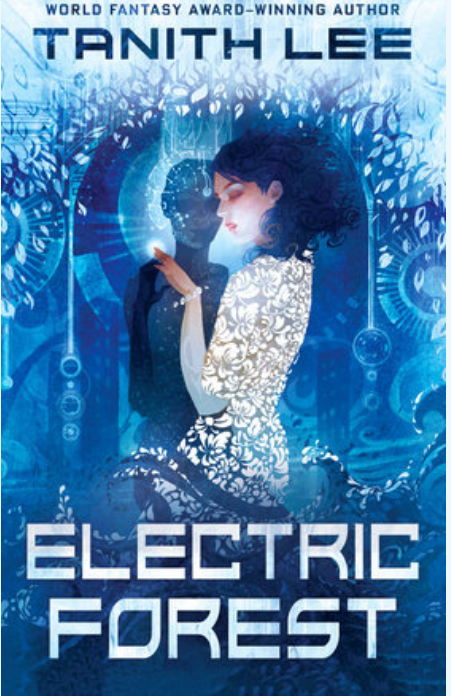
Cover of Electric Forest by Tanith Lee, downloaded from AstraPublishingHouse.com
Every so often somebody asks me, “Who’s your favorite author?” That question is unanswerable. There have been so many favorites over the years! Ten years ago it would have been a toss-up between Ursula K. Le Guin and Octavia Butler, with Ursula winning by a hair. Today? Must I have one? Why? And what about my favorite book? My shelves are filled with contenders.
But if I’m pressed, I’m likely to reach for someone tried and true, someone other people may know. Some literary star, I suppose? We have those, but maybe we shouldn’t.
The idea of a “Star System” apparently comes from Hollywood. Take one actor and promote them to godhood, and hey, your movies will sell. Works for books too. I came to the term through a different route, though: Jo Freeman’s essay Tyranny of Structurelessness, a critique of power dynamics in the feminist movement of the 1970s. Here is an excerpt:
“While it has consciously not chosen spokespeople, the movement has thrown up many women who have caught the public eye for varying reasons. These women represent no particular group or established opinion; they know this and usually say so. But because there are no official spokespeople nor any decision-making body that the press can query when it wants to know the movement’s position on a subject, these women are perceived as the spokespeople. Thus, whether they want to or not, whether the movement likes it or not, women of public note are put in the role of spokespeople by default. . . This has several negative consequences for both the movement and the women labeled “stars.” First, because the movement didn’t put them in the role of spokesperson, the movement cannot remove them. The press put them there and only the press can choose not to listen.”
Within activist organizing, I’ve seen many people cast into the roles of unelected, unaccountable “stars.” They step up to speak, and because they are confident, everyone listens to them. They can do no wrong (except they do).
As you may have guessed from the title, I’m circling around the literary star Neil Gaiman and the assaults he committed. (In case you want me to use the word alleged, forget it. Even if all the other grotesque details were made up, he admitted to intercourse with a much younger employee. That’s all I need to know.) He was never my favorite author, but I have enjoyed and admired his fiction greatly. His short story “The Problem of Susan” is an excellent analysis of misogyny in Narnia, and the Doctor Who episode he scripted, “The Doctor’s Wife,” will always be one of my favorites. Fans have been grappling with this question of liking the art even when the artist is a shitty, shitty person.
I’m more disturbed by the question: how did we end up making him a literary star? A feminist one, even. Why did we want a literary star?
Part of this is timing–at the beginning of the tenure of the United States’ most depraved president to date. And yet, he’s a star in the eyes of thousands upon thousands of people. Is there just something wrong with us as a species, that we seek out people to put on pedestals? The hypothesis in Octavia Butler’s Xenogenesis series is often on my mind: is the combination of intelligence and hierarchy in a species simply an evolutionary dead end?
Maybe, maybe not. I guess somebody will find out sometime.
Meanwhile, I went in search of Tanith Lee’s Flat Earth series, in order to form my own opinion on another allegation against Gaiman: it’s been said that Sandman borrowed heavily from that series, and that whether or not the borrowing amounted to plagiarism, it was shitty of him to leave her uncredited. In case you think this is a new speculation, read the article “Tanith Lee: Gone But Not Forgotten” by Deuce Richardson.
My quest led me outside of the house, to a used bookstore and then to a library. In the bookstore I found a “Best Of” science fiction anthology, and at the library I found Electric Forest. Here is an excerpt from the cover blurb:
“Because of her natural-born features, Magdala is an outcast in society–abandoned at birth, abused in the orphanage she grew up in, and branded with the cruel name ‘Ugly.’ But Magdala’s world turns upside down when she’s approached by Claudio Loro, a wealthy scientist who has created a beautiful artificial body. When he offers to transfer Magdala’s consciousness into the body, she cannot refuse the priceless opportunity for a new, beautiful life.”
That’s all I’ll share, because the cover blurb gave away the plot. I know where the story is heading. But the journey! Tanith Lee is a marvel of creativity, and even though I’ve read many, many books, this one is so fresh. It hits hard but in a luscious way.
I haven’t found the Flat Earth series yet. When I do, I expect it to be full of captivating characters and dripping with story.
That brings me to one of the books I read years ago and think about often: Haroun and the Sea of Stories by Salman Rushdie. I can’t remember most of the details . . . a princess with her lips sewn shut, so she cannot speak. A heroic journey. The question: “what’s the use of stories that aren’t even true?” Most importantly, a sea full of stories. I carry that metaphor. And when I ask myself the question, “If Gaiman is such a noxious person, why do I like them so much? Why were his stories so wildly inventive?”
It makes me feel better to think that the stories originated from outside him, that he tapped into this magical endless source of story. But, why? Shouldn’t such a power be reserved for people who are kind?
(Insert Moral Here)
I thought perhaps this blog post, which has wandered all around the world of books, circling some deep and important questions, was leading to a brilliant conclusion. No such luck. What is a reader to do?
Fortunately, I have more chapters of Electric Forest yet to read.
A group of youtubers has been making Minecraft roleplays since 2016, and yesterday they officially closed it down. Shortly after I became invested in it, of course! Minecraft roleplays, a form of collaborative storytelling that takes place with Minecraft characters and settings, have piqued my interest for a few different reasons. I like the idea of stories told collaboratively, I love that Minecraft handles the mechanics of animations, and I am fascinated by artists for whom character creation comes easy. (To me, it’s the most terrifying part of writing stories.) On top of all that, I got invested in the voice actors and the plots in the #OriginsMCRP universe.
Yesterday, at the #OriginsIsOverParty on twitter, on youtube, and on Twitch, various content creators gave their perspective on what went well and what was difficult, and I learned a lot from their retrospectives, not just about the experience of making Minecraft roleplays but also the particular challenges of making art on youtube and of building a community.
Minecraft roleplays are not as popular as they were two years ago. Roleplays got a huge boost at the start of the pandemic when people were stuck at home and afraid for the future. Serial episodes came out several times a week, from a variety of perspectives. A fan community grew up, made fan art and fanfiction, and shipped characters. Some of the youtubers — not all — started making a livable income from their roleplays.
Some Origins creators found that content creation caused serious mental health issues. The pressure to always be bigger and better, combined with a general drop in viewership that was completely outside their control, must have been intensely difficult. Other forms of content creation, like playing video games, got more viewers for less work. Some of the Origins folks started leaving the group for jobs or Twitch or mental health breaks. Because it is a collaborative story form, people leaving messed up the storylines that other creators were actively working on, raising the pressure. Meanwhile, some who stayed behind worked hard on “cinematics.” These look amazing but are hand-animated, so they take a lot of time and effort. Sometimes the cinematics delayed the release of episodes, and youtube is not at all forgiving. The dreaded “youtube algorithm,” which ranks and recommends videos, penalizes breaks.
Let me take a moment here to rant about the youtube algorithm. This impersonal and ever-changing set of automated rules has a direct impact on folks’ livelihoods and also often on their perception of whether they are crafting good or bad content. They have to constantly watch the analytics to see how they are doing.
That’s deadly to art.
I’m impressed with what these folks managed to create even despite those hurdles, and I hope they will keep making roleplays or some other form of collaborative storytelling, and I hope they will end up being compensated for their work.
Shout outs to @CrazyMtch42, @Captain_Froggie, @FourOhFourEnt, @nayaVT, @plulesser, and all the rest. Keep telling stories.
The Fairy Tail Origins series of Minecraft roleplays is a response to the Fairy Tail anime and manga. Its first three seasons had some story content but mostly consisted of gameplay on a Minecraft server. (I find it deathly boring and do not watch them.) In the fourth and fifth seasons, storytelling took over.
Season 5 might be the high point of the Origins series in terms of youtuber participation, with twenty-eight youtubers who posted online and twenty-seven other players all coming together to form intersecting storylines. It gets really confusing when three or more characters are on screen at the same time, because it’s often unclear which Minecraft figure is attached to which voice, and the characters speak in different volumes. But those moments when multiple players interact are amazing feats of coordination: players have to get together across multiple time zones and juggle their schedules around their work, school, or family responsibilities.
My introduction to the Origins series was Fairy Tail Origins Season 5, with Kay’s perspective. Kay, a shapeshifting wolf, is friendly to everyone she meets, throwing dozens of cookies at them whether they want cookies or not. She considers her guild leader, a cat, to be her pet — “pet” defined not as someone you own, but someone you take care of. Hence the throwing of cookies. She is oblivious to rudeness and befriends the character Viper, who keeps insulting her guild leader and friends.
My introduction to the Origins series was Fairy Tail Origins Season 5, with Kay’s perspective. Kay, a shapeshifting wolf, is friendly to everyone she meets, throwing dozens of cookies at them whether they want cookies or not. She considers her guild leader, a cat, to be her pet — “pet” defined not as someone you own, but someone you take care of. Hence the throwing of cookies. She is oblivious to rudeness and befriends the character Viper, who keeps insulting her guild leader and friends.
Viper arrives in season 5 as a tormented and grouchy character, trying to pay off a debt he incurred in season 4 as a villain. He is kind to Kay by order of both his guild leader and his seeing-eye snake, and she immediately falls in love. Many cookies are thrown. Their growing relationship is one part comedic, one part angst-ridden, and one part sweet.
By the time she wins him over, unfortunately for the both of them, he’s dragged into somebody else’s storyline and stuck in a world without magic for a while.
“I woke up and I felt words in my mouth, like soup.”
The Origins MCRP character of Plant, played by Plu, began with access to only one word: Plant. They were accepted all the same, adopted and included in conversations, and later taught to talk, haltingly. And then, all of a sudden, in a one-episode visit to the world of Pixelmon Origins, Plant was fluent.
I could say more about this, but all those words, I don’t know where they are.
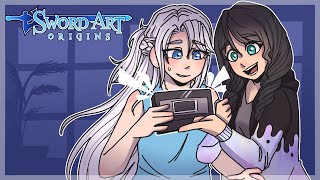
Image caption: The Town of Beginnings! – Sword Art Origins #1 (Minecraft Sword Art Online Roleplay. Uploaded to youtube by: Hayden Blake, Mar 18, 2022
Lately I’ve been interested in Minecraft roleplays, specifically the Origins series. I’m not their target audience: they’re mostly made by gamers in their teens and twenties, whereas I’m a book reader and author in my . . . well, let’s just say “middle age.”
Minecraft roleplays are a form of collaborative, animated storytelling, using Minecraft worlds as the theater. They’re tough to watch if you don’t play Minecraft. Compared to a TV show, their production quality is terrible–but that’s part of their appeal for me, because it means a low barrier to entry for creators who don’t have tons of money or access to television executives and whatnot, so I get to see raw creativity. Sometimes, what comes out of it is amazing.
Here’s how it works: a group of people will have a shared world and some general idea of a shared plot that goes on for a season. Some are there to play, while others have youtube channels where they post their final, edited videos. One of the biggest Origins series, My Hero Origins, had 30 youtubers and 32 other players. Their fans, which number in the hundreds of thousands, are constantly commenting and participating in the shared world with fanfics and fan art.
The full list of series is on the OriginsMCRP Wiki, but my personal favorites are Fairy Tail Origins Seasons 4 and 5, Origins of Olympus Seasons 2 and 3, and My Hero Origins. I’m hoping to have some time to point out some of my favorite characters and moments.
Sword Art Origins is in the Isekai genre and is a fan response to the manga and anime Sword Art Online. All the characters joined a virtual game, some serious gamers and some just to try it out, and were trapped by “the godfather” in a game world, where they must clear 100 levels to escape. I’m not a fan of that plotline, but the series is more polished and more consciously crafted than previous Origins series. It also represents a turning point because a wave of players have departed the Origins group, including @ItsRichieW (the original creator of the group), @ReinBloo, @TheFamousFilms, and @_HaydenBlake. Hayden Blake’s departure is a mystery to fans and colleagues alike: she just made a Twitter announcement that her YouTube channel, with its 50,000 subscribers, was for sale. Her character’s story arc in Sword Art Origins, like many others, will stay unfinished.
My favorite episode in this series is “Found in Minecraft SAO,” which aired May 18, 2022. Previous episodes took place before the first-floor boss, which not all the characters would necessarily survive. This one skips forward in time, bypassing the boss fight, and treats us to a rendition of Scarborough Fair by the characters Crocus, Enzo, Sierra and Venom. After that, they wander about home a bit in domestic bliss, eating peanut butter and banana sandwiches, and then they chase each other off into the sunset.



 Kristin Ann King