Category Archives: doctor who

What is that certifiably insane time traveler up to THIS TIME?

Four Doctor Who moments for the Now

Art can reduce tragedy down to a form we can look at without losing our ability to cope. To see — not to look away — but to retain the ability to act. To see terror and retain courage.

Consider the Dalek — a genocidal killing machine. Fascism in its purest form. We bake Dalek cookies and eat them; we crochet them for use as potholders and ornaments; or, in my case, put them in dollhouses. It’s a way of controlling our fear. We defuse it with silliness and domesticity.
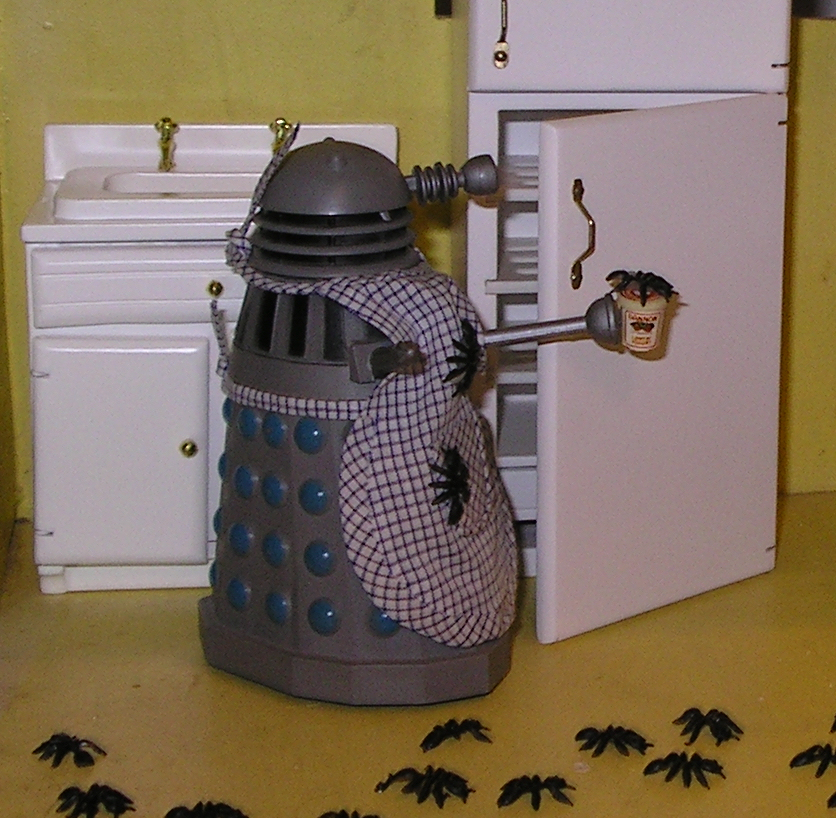
A Dalek stands in the kitchen of my dollhouse, wearing an apron and holding a jar of yogurt. Ants cover the floor and are climbing up its apron to get at the yogurt.

Art also teaches us to recognize historical patterns. A nazi or fascist might not sieg-hail or use the amateurish German accent we recognize from TV, but we can still learn to notice a violent authoritarian regime that must be resisted.

Here, then, are four moments in Doctor Who that speak to us in the United States, today, right now.

1. “It’s happening again!”

    In the episode “Turn Left,” Donna Noble and her grandfather Wilf say goodbye to their host Rococco, an Eastern European man who had welcomed them with open arms into his apartment when they were displaced by war. Donna is confused about why he has to leave in the back of an army truck.

    “Oh, but why do you have to go?” she asks.

    Rococco replies cheerily. “It’s the new law. England for the English, et cetera. They can’t send us home. The oceans are closed! They build labour camps.”

    “I know,” asks Donna, “but labor doing what? There aren’t any jobs.”

    She still hasn’t clued in, but Wilf’s heart is breaking. His lips tremble. He salutes Rocco and mutters,

    “Labour camps. That’s what they called them last time.”

    “What do you mean?” asks Donna.

    “It’s happening again,” says Wilf.

    That’s when she figures it out. She runs after the truck, but it’s already too late.

    2. I’m not lowering my bubble

    In “Dot and Bubble,” a young woman named Lindy is chatting with friends through her Bubble, wearable social media that nobody ever takes off. She and her lily-white peers are the children of the elite, and for some reason they have been abandoned by their parents and left to their own devices in the guarded town of Fineville. Nothing can get in or out, so they’re safe. Clearly.

    Oblivious, she walks past a body being dragged away and toward her office, where she and her friends do their two hours of work. The Doctor has hacked into her feed and tries to get her attention, but she gives a micro-expression of disgust and swipes him away. In the town of Fineville, racism won. The Doctor’s white companion, Ruby Sunday, appears instead and asks her to lower her Bubble just long enough to look at the real world.

    “I promise I will leave you alone if you could just look at the four desks in front of you,” says Ruby.

    “I am not…lowering… my Bubble,” says Lindy.

    “Okay. Can you stay inside and look beyond it? Can you do that?”

    Bit by bit, Ruby coaxes Lindy and her peers to look outside their Bubbles just long enough to run away from the monsters who are eating everyone in alphabetical order. To be safe, they just need to trust the Doctor.

    Will they?

    3. The Beast Below

    The Doctor and his new companion, Amy Pond, have landed on the far-future Starship U.K. He begins by falsely pretending he follows a Prime Directive: “We are observers only. That’s the one rule I’ve always stuck to in all my travels. I never get involved in the affairs of other peoples or planets.”

    Then they see a young girl sitting on a bench, crying all alone while adults hurry by without looking. Amy turns to the Doctor to ask him a question, only to discover that he is already outside of the TARDIS sitting on a bench and talking to her. He gestures to Amy to join him, and then he asks her to look at this world and tell her what’s wrong with it.

    “Is it the bicycles?” she asks. “Bit unusual on a starship, bicycles.”

    It isn’t the bicycles.

    “Life on a giant starship,” he says. Back to basics. Bicycles, washing lines, wind-up street lamps. But look closer. Secrets and shadows, lives led in fear. Society bent out of shape, on the brink of collapse. A police state.”

    He gives her a moment, then asks, “Do you see it yet?” 

    “Where?” she asks.

    He points to the young girl. “There.”

    4. Get some perspective, woman!

    In “Aliens in London,” the world is in crisis, and all the Very Important People are rushing around the British Parliament Building trying to figure out how to respond. Acting Prime Minister Joseph Green is entirely out of patience with this annoying minor official, Harriet Jones, who has arrived with a proposal for preserving cottage hospitals.

      Green barks out, “By all the saints, get some perspective, woman! I’m busy.” Then he rushes off, super-competently leaving her alone in the Cabinet Room with a file of Emergency Protocols.

      A bit irresponsible? Well, aliens have just landed in the middle of London, and most of the British Government is missing. It is an emergency, after all. As it turns out, though, this is an emergency of his own making. He is actually an alien, wearing a human skin, intent on making quick cash by destroying Earth. And farting. A lot of farting.

      Authoritarianism pairs well with farting, don’t you think?
      Memory and Identity in “Twice Upon a Time”

      Identity and Memory in “Twice Upon a Time”

      by Kristin King

      One time, the Star Trek crew cheated death with the transporter. Our hero dissolved in atoms, presumably dead, but luckily, the transporter still had his pattern. After I saw that, I began questioning every single use of the transporter. Did it move somebody from place to place or did it destroy one body and create a clone, with all the same memories? Does consciousness continue or cease?

      From there it’s not hard to wonder: is the person who wakes up in the morning the same as the one who went to sleep at night? My consciousness ceased, for a time, as my unconscious mind pruned memories and integrated what remained into the semblance of a whole?

      What remains the same, sleeping to waking? What makes a person themself? Is it memory? Or is it something else?

      Doctor Who turns out to be the perfect show for pondering this question, and showrunner Stephen Moffat took full advantage of this opportunity during his tenure, culminating with a deeply philosophical regeneration episode, “Twice Upon a Time.”

      Who emerges from regeneration? Outgoing showrunner Russell T. Davies gave this problem to Stephen Moffat when the Tenth Doctor said, “Even if I change it still feels like dying. Everything I am dies. Some new man goes sauntering away… and I’m dead.”

      The Eleventh Doctor had a new perspective in his final episode, with this tearjerker:  “It all just disappears, doesn’t it? Everything you are, gone in a moment. Like breath on a mirror.”

      But he followed up optimistically:

      “We all change, when you think about it. We’re all different all through our lives. And that’s okay, that’s good. You’ve got to keep moving. As long as you remember all the people that you used to be.”

      That need to remember plays a huge role in many of the character arcs during Moffat’s tenure. Amy Pond loses family members to a crack in time but regains them once she remembers — and she saves Rory as well, and finally the Doctor. Next, Clara’s theme from the beginning is “Run, you clever boy, and remember me,” but the Doctor ends up making mistakes (including the mistake the Tenth Doctor had made in erasing Donna’s memories), and he must pay the price by forgetting Clara. And finally, Ashildr, becomes immortal but her human mind cannot possibly remember everyone she used to be, and she finally simplifies her identity to “Me.”

      The question of the Doctor’s memory also plays a crucial role in the episode “Heaven Sent,” in which he must repeatedly undergo the horrific procedure of fleeing from a monster until mortally injured, then annihilate his own body to create himself anew — by throwing a switch that looks uncannily like the TARDIS takeoff control. And yet, although his body is destroyed, some part of him remembers.

      “Twice Upon a Time” concludes Stephen Moffat’s exploration of memory and identity with a mysterious entity, Testimony, that manipulates both memory and forgetting. Testimony removes people from time just before their death to copy and thus preserve their memories, and then makes them forget the event and returns them to the moment of death. But the First and Twelfth Doctors accidentally interrupt the proceedings and end up trapped in a frozen landscape in which nothing can change. Not even a snowflake can move: when the Doctor tries, it simply returns to its place of origin.

      And then Bill appears. But is it Bill? Or is it a copy of Bill, trapped by Testimony in glass just as surely as the snowflake is trapped in midair? The answer, for her, is yes to both. Testimony-Bill asserts that she has all Bill’s memories, and she is Bill’s memories, so she is Bill. Identity is memory.

      The Twelfth Doctor disagrees. At the same time, though, he has his own past self to make sense of. He enjoys meeting the First Doctor and remembering who he used to be. And at one point, when the First Doctor makes a keen observation, the Twelfth lays claim to having made it. (“I said that!” protests the First Doctor. The Twelfth dismisses it: “Same difference!”)

      In the end, of course, the question of identity has no answer. When the Twelfth Doctor is ready to regenerate, he gives explicit advice to the next Doctor. “I’ve got a few things to say to you,” he begins (in a Tom Baker voice). And then: “Basic stuff first. Never be cruel, never be cowardly. Never, ever eat pears. Remember: Hate is always foolish, and love is always wise. Always try to be nice, and never fail to be kind. . . . Laugh hard, run fast, be kind.”

      He finishes up with heroic grace: “Doctor, I let you go.” The statement gives us the emotional effect of resolution, but it’s also quite ambiguous. Who is the “I” that lets go of the Doctor? We could all ask that question. Who is “I”?

      And so the Doctor regenerates, going out in flame right along with his partner the TARDIS. And Stephen Moffat has cleared the worktable for the new showrunner and for the new Doctors, whoever they may be.

      Brilliant.

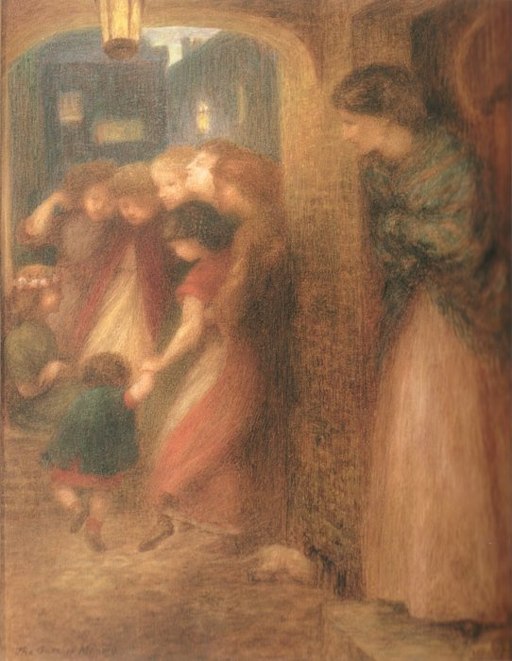
      Dante_Gabriel_Rossetti_-_The_Gate_of_Memory

      The Gate of Memory by Dante Gabriel Rossetti [Public domain], via Wikimedia Commons. That’s not a TARDIS in the background . . . is it?


      Anglicon 2017 “Should the Doctor Be a Woman”? Panel

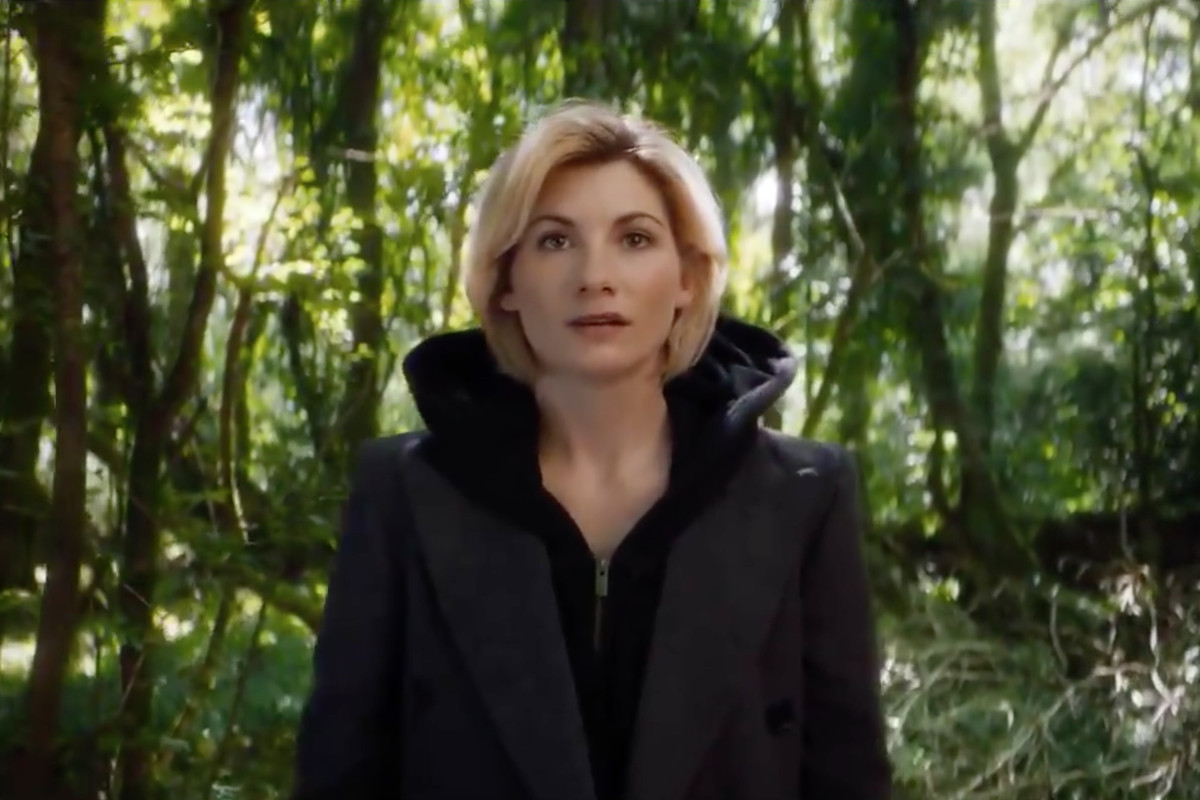
      This panel on the past and future of female Doctors may have been poorly named, considering that Jodie Whittaker has already been cast as the Thirteenth Doctor, but the conversations were great. Raven Oak moderated, and the panel consisted of Eric Gjovaag, Mark Dando, and Denise Nilsson.

      Eric Gjovaag got the conversation off to a productive start with a brief video showing fan appearances of female Doctors, starting with a clip featuring Barbara Benedetti. (More info on these films is available on director Ryan K. Johnson’s website.) That way, the panel and audience started out with a lot to chew on. The video also had a moment from The Curse of Fatal Death and some other works I can’t recall off the top of my head.

      The audience conversation was lively, energetic, and thoughtful. A sampling of some of the questions and comments:

      • There’s a generation gap in fan reaction. People who grew up with Classic Who may find this quite a departure. On the other hand, the younger generation seems ready.
      • Some of these videos continually referenced the fact that the Doctor was a woman. If the new show does that, it won’t turn out well.
      • Some of this came up when Missy appeared as the latest incarnation of the Master. While it’s true that the Master has always been a complete ham, there was some discomfort about having her gender and sexuality continually referenced.
      • Someone popped his head in and got the audience roaring with laughter by asking: “Will she get equal compensation?” GOOD QUESTION.
      • Someone proposed Idris Elba as the fourteenth Doctor. I agree.

      We finished up with a look at the publicity photo of Jodie Whittaker’s costume (below), described on a UK news site as “navy culottes with yellow braces.” Apparently that’s in fashion in Europe. Folks spent some time speculating on whether the rainbow ribbon on her shirt might have come from an earlier Doctor or companion, like Dodo (who was filmed during the black and white era). Panelist Mark Dando expressed dismay at the photo: “But what have they done to the police box?” (It’s darker blue and one panel looks black.)

      Denise Nilsson finished out the session by expressing optimism for the series, saying, “It’s still the TARDIS, still the Doctor.”

      doctor-who-costume-reveal-jodie-whittaker

      Anglicon 2017 Recap

      I went to Anglicon this year, along with my son, to revel in Classic Doctor Who fandom. Much fun! It’s nice to meet people who liked Doctor Who before it was trendy. Highlights:

      I lived the Classic Who tropes (not always on purpose):

      1. Losing track of companions: This began the moment I left home. I hopped in the car to pick up my spouse from the bus stop, but due to bad directions, I drove around aimlessly only to find he’d walked all the way home. It was a good omen.
      2. Wandering through corridors: The hotel room was a half mile from the convention area, along a twisty route. This would have been true to the show, except the walls didn’t wobble.
      3. Tea: I enjoyed a proper black tea in the Hospitality Suite.
      4. An unattended TARDIS: And as usual, someone had left the door open, and someone else had wandered in. (They fixed this by Saturday, though.)
      5. Losing track of companions (again): In the end, exhausted beyond belief, I kept trying to gather family members, and they kept wandering off.

      Fanstruck by Sylvester McCoy:

      I lined up early for a photo op with Sylvester McCoy so that I wouldn’t spend the entire con worrying about getting one. I needn’t have worried, since there was plenty of time for photo ops, but it was a delight to see him show up and perform crowd control.  Later, during his Q & A, he put on another stellar performance, getting down into the audience to answer questions with a quick wit and well-timed comedy. And finally, I hung out in the general vicinity as he wandered through the art show with his “handler,” admiring the art.

      And Peter Davison:

      He had so many stories to tell about his acting career. The audience questioned him about everything from his first time acting to his upcoming works. My second favorite: his account of directing The Five(ish) Doctors Reboot, including the moment when all the actors were in their spots, the cameras adjusted, the lights on, and he was waiting around to hear people shout “Action!” only to realize that was his job.  And my favorite: his account of filming All Creatures Great and Small, with . . . actual animals about to give birth.

      The game room:

      I got a chance to play my first Doctor Who role-playing game, run by a game master who kindly took into account my inexperience (and that of my son as well). Something I’ve wanted to do for a long time.

      The panel “Should the Doctor Be a Woman”?

      Poorly named (because the next Doctor is a woman) but great in-depth conversations about the past and future of a female Doctor. I’d like to spend an entire post on that, so I’ll skip it here.

      The film festival:

      I only had the chance to see two short films but liked them both. The first was a sci/fi zombie crossover, “Father’s Day”, that was at the same time gross and heartbreaking. The other film, “Renegades,” by Grant Pierce Liester, was riveting, with small moments gorgeously done.

      All the costumes:

      So many people put so much detail and care into dressing up. It’s a delight to watch.

      The Corgi parade:

      One of the guests of honor is a Corgi who starred in Dirk Gently, along with his sister. I missed most of the Corgi antics. But on Sunday as I walked down the hallway, I found everyone lined up for something, and it turned out to be a parade of dogs (many in costume), led by a Dalek. Boy, were those dogs pleased with the attention!

      And the conversations:

      I mostly kept to myself (introvert!) but the conversations I did have were fun.

      All in all:

      I don’t attend many cons, finding them exhausting, but this one was worth it. Thank you to everyone who worked so hard to put it on.

      anglicon-staff-2017

      Are Fans Ready for Jodie Whittaker?

      jodie whittaker doctor whoI never expected to see a woman play the official “Doctor Who,” but here we are, with Jodie Whittaker cast as the 13th Doctor. Are the fans ready? Not entirely. This weekend at Anglicon 2017 I had one telling experience, with one high-profile guest doubling down on previous comments opposing the casting. He had already been publicly criticized for those comments and had taken those comments as “getting in trouble” unjustly. This tells me that either nobody sat down with him and had a thoughtful conversation on the topic, or that somebody tried and he didn’t listen.  Either way, the communication failure is frustrating!

      I was most frustrated at having to listen to these comments without the ability to talk back, but well, since I am a writer . . . . I’ll just pull out my trusty soapbox. (It’s bigger on the inside than out, by the way.)

      What follows is my recollection of the comments, to the best of my ability, though memory is fallible, and my response.

      1. It’s unfortunate to see politics in Doctor Who

      Some of the best episodes of the show have been political satire, like “Aliens of London,” where the top figures of government are replaced by windbags, or “The Long Game,” where human civilization is controlled by aliens, through the media. So what do you mean by “politics”?


      2. Casting a woman as the Doctor is “political correctness”

      It’s the opposite. The simple truth is that for a long time casting a female Doctor was considered “politically incorrect” and even now, it’s a risky move. She will face criticism like you would not believe, from women and men both.

      3. All future Doctors will be women

      The logic of your comment seemed to be: Since we’ve had fifty years of male Doctors, to balance the ledgers we’ll have fifty years of women. Don’t worry! Misogyny is alive and well in Western culture, and men and women alike both judge powerful women harshly. How many fans liked Captain Janeway? How did Hilary Clinton lose the election? But even in the absence of misogyny, why bar men from the role. That makes as little sense as — well — barring women.

      For the record: I vote for Idris Elba as the fourteenth Doctor.

      4. Losing a role model for boys

      Okay, some people in the audience were offended by that, but I used my magical ability to create “head canon” (fandom’s phrase for “the show as we wish it was”) to convert it to “losing the Doctor as a male role model for boys,” and I’m actually sympathetic to that. There is a gender-utopia view that kids can be anything, do anything . . . and yet, many if not most still look to same-gender adults when shaping their identities and planning their future careers.

      And yes, the Doctor is unique as a male role model. He hates guns and uses intellect to solve problems instead. He has boundless compassion and is not afraid to cry. The truth is, we have precious few heroes like that.

      But.

      See #3. There will be plenty more male Doctors, I’m sure. A generation of boys will not lose that.

      And.

      Boys can take women as role models.

      And.

      By the way, I’m the reason my son is a Doctor Who fan.

      And.

      Since a gender-specific Doctor is so amazing for our sons . . . why would you want to deny that opportunity to our daughters?

      I grew up a Star Trek fan and gladly imagined myself in the role of Captain Kirk, and later the Doctor. That worked for me. It doesn’t work for my daughter.

      We’ve got a new generation coming to Doctor Who, and, in the words of Captain Jack Harkness, “The twenty-first century is when everything changes. And you’ve got to be ready.”

      Clara Oswald Series 9 – Moving On

      (Part of a series of “feminist takes” on Doctor Who companions. Spoilers for Doctor Who Series 8 and 9.)

      When I watch Doctor Who, I live vicariously with both the Doctor and the companions. The Doctor gets to have power and to talk smack to the ruling class. The companions, meanwhile, get to take a break from their regular lives and go on a thrilling extended vacation. That’s my expectation, anyway. And when it’s broken I get seriously pissed off.

      I like to see companions take a journey of personal growth and end up somewhere different-and better-than where they started. For me, the bar was set by Nyssa, who departed from the Tardis to hunt for a cure on a plague planet. (I’m deliberately not considering the possibility that the plague kills her.) Few companions have been treated that well, though. They’ve been killed, married off, suffered memory loss, simply been abandoned, or gotten stranded in time. And when I’m living vicariously through the companion, that’s disappointing.

      In Series 9, Clara Oswald departs. Does the show do her justice? I’d say yes. She continues on the trajectory established in the Series 8 episode “Flatline,” in which she temporarily takes on the Doctor’s name and token of power to act like him. But as Clara becomes more and more like the Doctor, she’s also punished for it. She’s seen as a danger junkie. And in “Face the Raven,” her actions kill her. Definitively. We watch her die. Many fans are sad. I’m not sad. I don’t get sad when companions have bad endings: I get furious.


      But two episodes later, in “Hell Bent,” we see her again. How is this possible? We’re in a time travel show. Clara is snatched out of time, just moments before her death, and in between one heartbeat and the next she has an infinity to explore. (She’s “in-between-finite,” a term I learned from you-tuber Vi Hart in an entertaining discussion of Pi.) She ends up with a Tardis and the ability to defer the moment of her death as long as she likes. In her last scene, she spins off in the Tardis to have adventures. She gets to fulfill her destiny as a wandering adventurer. Sweet.

      Even sweeter: fanfiction writers are taking the scenario and running with it. On sites like Archive of our Own, Fanfiction.Net, and A Teaspoon and an Open Mind, people are paring up Clara and her traveling companion Ashildr and writing stories like crazy.

      And so the story goes on.

      cc40e6e2cc8fb2a2f4ec2a7123cc8b5ff7540f0e_hq


      Feminist Take: Clara Oswald Series 8

      (Spoilers for Doctor Who Series 8)

      In Doctor Who Series 8, companion Clara Oswald came into her own. The actress, Jenna Coleman, simply shone. She was strong, brittle, funny, powerful, beautiful, unique. And she continued to maintain her life outside the Tardis. But the storyline itself betrayed her by pitting her accomplishments on board the Tardis against an otherwise compelling relationship with a richly characterized man. In so doing, it failed both Clara Oswald and Danny Pink.

      From the moment we meet Clara Oswald in Series 6, she is something more than human. She’s a human/Dalek hybrid who has resisted Dalek conversion better than anyone ever–so well that she takes over the Daleks’ telepathic world. She is plainly and simply human in the beginning of the first episode of Series 7, but in the middle of the show, she gets a brain upgrade of alien origin that makes her hyperintelligent. She’s off on a hero’s journey, and it’s amazing. Through it all, she never fails to maintain her connection to her “real life,” the life Human Clara had chosen for herself before becoming entangled with the Doctor.

      Then the end of Series 7 hits and Clara has another upgrade of alien origin, one that splinters her throughout time and space to live a thousand different lives, playing the hero in each of them. She also literally enters the Doctor’s essence, getting to know him arguably better than any other companion–so much so that in later episodes she starts to become the Doctor.

      So what is in store for her in Series 8? A smackdown. She starts a relationship with a man named Danny Pink, a former soldier with his own complicated past and his own heroic journey to undertake. Just as in Series 7, she attempts to keep her home life and Tardis life separate. But two people won’t let her: the Doctor and Danny Pink.

      The Doctor, upon regenerating, has become more unstable than usual, and gone farther into an ethical gray zone. Toward Clara, he acts as a toxic combination of jealous boyfriend, protective grandfather, and military commander. He interferes in Clara’s life in “The Caretaker,” where he first meets Danny Pink and first starts to denigrate him by calling him a P.E. teacher when he actually teaches math. (We’re never told whether this is racism–Danny is black–or jealousy or just because Danny was a soldier, but my money’s on racism.)

      Danny sees the abusive aspect of this relationship and names the Doctor, accurately, as a military commander. He predicts a moment when the Doctor will push Clara too far, and when that moment does come, he’s ready as a friend with a hug and some solid advice. But he oversteps himself and in so doing enters abusive-boyfriend territory.

      Here’s the conversation that takes place after “The Caretaker.”

      Danny says “I know men like him. I’ve served under them. They push you and make you stronger until you’re doing things you never thought you could. I saw you tonight. You did exactly what he told you, you weren’t even scared, and you should have been.”

      This is a lovely, chill-down-the-back moment. Danny’s right.

      Clara shrugs it off: “I trust him. He’s never let me down.”

      Danny replies. “Fine. If he ever pushes you too far, I want you to tell me because I know what that’s like. You’ll tell me if that happens, yeah?”

      Clara promises to tell him. So far, so good. Stop right here, and it’s a brilliant setup for the drama of the season.

      But then Danny says, “If you break that promise, Clara, we’re finished. . . because if you don’t tell me the truth I can’t help you, and I could never stand not being able to help you. We’re clear?”

      This is emotional manipulation. Instead of stopping at giving the her emotional support of a friend, an equal, he’s insisting on being her protector. And she never once calls him on it. She spends a fair bit of the season lying to him–going off with the Doctor and telling him she’s not–and I can only assume it’s because Danny has threatened to break off the relationship. This is not acceptable behavior.

      Worse, Danny never acknowledges that Clara has been doing anything of import in her adventures aboard the Tardis. And we never see him asking about her past. Apparently, he’s satisfied with the half of Clara that likes to teach and hang out with him. Meanwhile, Clara’s perfectly willing to give Danny the impression she’s something less than she is. That shows a lack of respect for him.

      While Clara and Danny are having their strange, dysfunctional relationship, Clara’s heroic journey is charging forward, full-steam ahead. In “Kill the Moon,” she confronts the Doctor to call him on his B.S. A few episodes later, in “Flatline, she literally takes on the role of the Doctor, complete with moniker, sonic screwdriver, and her own companion. She has a moment of epiphany when she asks herself, “What would the Doctor do?” and then corrects herself: “No. What would I do?” She has come fully into herself as a hero.

      Then what? Two episodes later, in “Deep Water,” she gets a smackdown. Danny has confronted her about lying and said (finally!) that he’s okay with her traveling in the Tardis, as long as she doesn’t lie to him. So she starts off ready to confess everything. There’s an opportunity for them to finally have it out, for Clara to lay claim to her personal growth and accomplishments . . . but before she can manage it, Danny is suddenly killed (fulfilling the “Black Man Dies First” trope, by the way.). Clara is devastated. She finishes out the season as an emotional wreck. Her heroic journey is cut short.

      There’s an age-old question this season appears to be playing out, badly. Can a woman be a good wife/mother/girlfriend and have her own life, too? Apparently not. We should just stay at home and let our men protect us.

      This treatment wasn’t fair to Danny, either. It sidelined his own heroic journey, which was actually one of the most moving if you look at it in isolation. As an ex-soldier who left the army after accidentally killing a young boy, he became the one man to defy orders and save the Earth from Cybermen, and then, given the chance to return to life, sent the young boy instead.

      I doubt the showrunner, writers, and editors meant to send the message they did. I think Danny’s sudden possessiveness, which destroyed Clara’s storyline for me, was just a slip-up. And that’s embarrassing. The show can and should do better.

      Looking forward, in Series 9, it does. Mostly. But that’s a topic for another time.

      Danny-Clara-Doctor


      Feminist Take on Doctor Who’s Companions

      I’ve been working off and on over the years to create little bits of feminist analysis on the Doctor Who companions and thought I’d share them here. There’s a demand for “strong female characters” in our popular media, and the show has responded to it. Has it succeeded or failed? Both, of course. If there is a Feminist Ideal, and could a character live up to that ideal without being overly perfect, or contradictory, or both? I found myself in the strange position of judging the female characters. (Are they strong? Do they get to be the protagonists? To what extent are they the equal of the Doctor? Which stereotypes do they fit into, and which do they resist?) How catty of me.

      So here are my links. None of them represent The Final Word on feminism, the companions, or anything else. They’re what I saw, as I saw it at the time.

      Zoe Heriot from the Patrick Troughton years, seasons 5 and 6. I fail to provide any criticisms whatsoever, because she was the first companion I ever saw and I simply adore her. She’s in black and white, she’s a screamer, and she’s the best.

      Amy Pond in “The Eleventh Hour.” The Doctor meets the little girl Amelia Pond, and this visit marks her for life and transforms her into his perfect traveling companion. He leaves in his TARDIS, promising to return in five minutes, but instead returns when she is a grown woman. Was this accidental, or deliberate? Whose purposes did it serve?

      River Song in “Silence in the Library” and “Forest of the Dead.”  Fan reaction has been mixed for this character, but I argue that she is powerful throughout. I might be reading more into this character than I should, but hey, it’s fun.

      River Song after “The Time of Angels” and “Flesh and Stone.” I waffle back and forth between saying she’s a stereotype and saying she isn’t, and between saying she’s powerful and saying she’s not.

      Clara Oswin Oswald after “Hide” and again after “Journey to the Centre of the TARDIS” and again after “The Crimson Horror.” Honestly, I don’t know what to think about her. Clara Who?

      Clara Oswin Oswald in Series 8, written immediately afterward and again upon more reflection. She’s both extremely powerful and strangely mired in a bad relationship that depends on her pretending to be something she’s not.

      And finally, Clara Oswin Oswald’s departure in Series 9.


      zoe at tardis console


      Fun this week

      Much too much heavy thinking on this blog lately. Mental health break! What’s been fun in my life?

      Last Tuesday’s Clarion West reading. Elizabeth Bear boggled my mind when she explained her writing schedule. Four hours of writing a day. Wow.

      Friday’s Clarion West party. I got to chat with cool people, eat ridiculously delicious desserts, and drink in a view. Anybody can get invited to these, at least for next year. How did I get invited? By supporting Clarion West financially last year. Support the writeathon this year, and you’ll get invites for next year.

      Visit from some family and a gorgeous, though way too long, hike through one of Seattle’s enormous parks.

      Lots and lots of Gilmore Girls. My spouse and I usually just watch SF/F shows: Buffy, Angel, Orphan Black, Supergirl, Battlestar Galactica, you name it. (I left off Doctor Who because that’s mostly my obsession.) Then somebody said that Gilmore Girls was this amazing feminist class struggle thing and we started watching it, and for a while we kept expecting vampires to jump out at us, except they didn’t. The show is all about relationships: the single mother and her daughter; the daughter and her mother; the daughter, mother, and wealthy grandparents; boyfriends and fathers; and an entire small town.

      Three great books, one of which ends on a cliffhanger. I won’t say which one, but the cliffhanger did not help my mental state one bit! I would ask the author to please, please, please write a follow-up.

      Dragonheart by Cecelia Holland. Vivid and primordial story of a castle by a sea, a dragon, and a cursed princess. The quote on the front of the book by Kim Stanley Robinson says the book takes these images and “plunges them right into your unconscious,” and he would not be wrong.

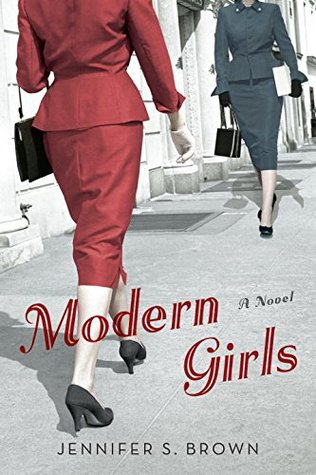
      Modern Girls by Jennifer S. Brown. Wow, wow, and wow! When the Jewish “modern girl” in 1935 New York gets accidentally knocked up, what’s she going to do? Especially since her 42-year-old mother is in the same situation. I feel like I got plopped down right in their little apartment and met all their friends and relatives. Everything about mothering felt genuine to me, too–all the ambivalence, the love, and the hard work. Overall, a remarkable read, fun without being candy, deep and thoughtful without being a downer. I want more.

      (As a side note, it also had an odd resonance with Gilmore Girls and with all the things I’ve been pondering about shadow work.)

      Doctor Who: Borrowed Time by Naomi A. Alderman. The Doctor and his companions Amy and Rory must save people who borrowed time and must pay it back . . . at compounding interest. A sharp and stinging critique of capitalism, also funny and with heart. It’s unfortunate that I skimmed this book before reading it–my son read it first, and I was helping him with his homework by looking for a character who changed in the course of the book. Enjoyable nonetheless!

      The Terrible Zodin – Doctor Who fanzine I’ve just barely started to read. Like it!

      – Kristin

      modern girls cover

      New Who to Try

      The question came up: “What’s the big deal about Doctor Who? I’ve watched a couple episodes and couldn’t get into it at all.” Tastes differ, and not everybody is going to like it. But if you’re one of the people who might like it and might not, here are some episodes worth trying.

      They’re not necessarily my favorite episodes, but they’re ones that might be good for a new viewer.

      I’ve only included episodes through the end of Series 8, leaving out Series 9. I would not recommend that series as a starter.

      Ninth Doctor – Christopher Eccleston

      Rose. This episode kicked off the first series of New Who, introducing the various characters. It’s fun and exciting and silly.

      Aliens of London / World War III. Smart political satire mixed in with fart jokes.

      Father’s Day. This is a good one for people who like sentimental stories and stories where time travel is explored in new and interesting ways.

      The Empty Child / The Doctor Dances. This two-parter won a well-deserved Hugo award.

      Tenth Doctor – David Tennant

      The Girl in the Fireplace. Adventure in which time travel lends emotional depth to the plot.

      The Runaway Bride. Comedy-horror. Actress Catherine Tate is magnificent.

      The Shakespeare Code. If you like Shakespeare, you’ll enjoy visiting the actual Globe theater. The monster plot is fun too.

      Blink. Seriously frightening monsters. Also, time travel done well.

      Partners in Crime. Comedy-espionage with monsters made of human fat.

      The Fires of Pompeii. Apocalypse story, as you visit Pompeii and see why it burned.

      The Unicorn and the Wasp. The Doctor and Donna meet Agatha Christie and together they solve the classic drawing-room mystery. Also, giant flying wasp.

      Midnight. This is a one-scene psychological drama.

      Eleventh Doctor – Matt Smith

      The Eleventh Hour. This episode features a new Doctor, new traveling companions, and a new storytelling style. It’s sweet and funny and a good place to start.

      Victory of the Daleks. Not a bad Dalek episode to start out with. It encapsulates the scariness and the silliness of the number one Doctor Who monster.

      The Hungry Earth / Cold Blood. Antiwar plot.

      Vincent and the Doctor. A visit with Vincent Van Gogh. Bittersweet, as the Doctor and his traveling companion both know his ultimate fate.

      The Lodger. It’s your classic romantic comedy, except for the scary something on the top floor.

      The Curse of the Black Spot. Pirate story!

      The Doctor’s Wife. Neil Gaiman wrote this one. The time machine finally gets to speak for herself, and she’s amazing.

      The Rebel Flesh / The Almost People. Good sci fi with dopplegangers.

      Night Terrors. Proper scary. Don’t show it to your kids.

      Dinosaurs on a Spaceship. Adventure. Dinosaurs. Spaceship. Fun.

      The Snowmen. Victorian thriller.

      Hide. Ghost story set in the 1980s.

      Journey to the Centre of the TARDIS. This is if you like your time travel hard core and don’t mind getting dizzy.

      The Crimson Horror. Lovely Victorian crime drama. Starring Diana Riggs as the villain.

      Twelfth Doctor – Peter Capaldi

      Deep Breath. This episode features a brand new Doctor, who is much more cantankerous than the last several.

      Time Heist. Your classic bank heist fun.

      Kill the Moon. This is a strange episode. It features the Doctor abandoning the fate of Earth to three generations of women.

      Flatline. Homage to Flatland.

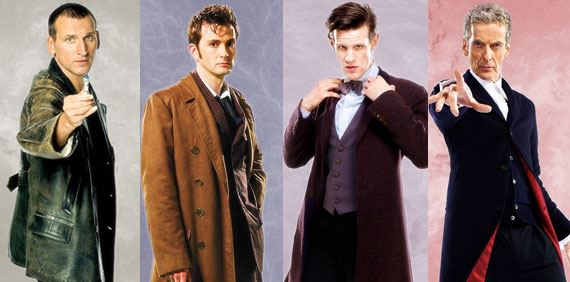
      From left to right: Christopher Eccleston, David Tennant, Matt Smith, Peter Capaldi. From http://www.doctorwhotv.co.uk/

      From left to right: Christopher Eccleston, David Tennant, Matt Smith, Peter Capaldi. From http://www.doctorwhotv.co.uk/


      a1963-dw_companions_498px

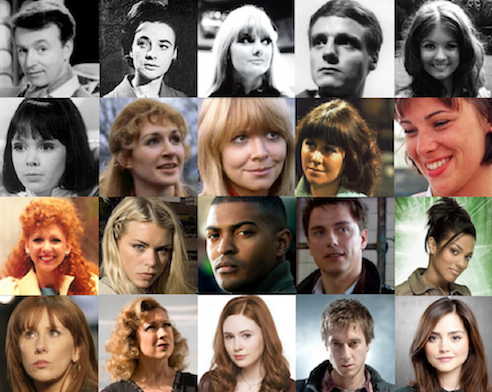
      Some of the Doctor Who companions, 1963 to present. From http://www.teenlibrariantoolbox.com/

      tardis2

      And, of course, the time machine.