Category Archives: books, movies, tv, music

A book, a movie, a show, a song. Was it amazing? Fun? Did I hate it? Am I now thinking deep thoughts about it? Come along for the ride.

On reading Orson Scott Card

I was a diehard fan of Orson Scott Card from maybe 1987 until the time I got to the end of his novel Treasure Box, sometime after 1996, and then I suddenly wasn’t. I gave my reasons in a previous blog post, which you can search for if you like, but this post isn’t about that.

It’s about what it was like to be a reader of his work between 1987 and 1992. In 1987, I was in high school, living in Utah as a non-Mormon with mostly Mormon friends. Utah, well . . . back when the Mormons first settled it, it was supposed to be a theocracy. The State of Deseret, with the church and business leader Brigham Young at its head. By 1987 a lot had changed, of course, but the LDS church had quite a bit of influence over business and government.

Non-Mormons were (and still are) in a strange place culturally. I don’t think there’s anything like it anywhere else in the world. If you want a little taste of it, see this review of the play Saturday’s Voyeur, a parody of Mormon culture and politics that has been put on by the Salt Lake Acting Company since the late 1970s.

Part of the strangeness was that we were a minority culture subordinate to and in opposition to another minority culture. In many places outside of Utah, Mormons were looked upon skeptically. In Utah, though, they were the political power.

Another part of the strangeness was that many non-Mormons were ex-Mormons. They had belonged to the Church, and maybe their whole family and all their friends belonged to the Church, and then they had left it. That meant leaving a whole community, but still living in the same place.

Our family was kind of like that. My mom had been Mormon and had left the church because of, well, some stuff. And my dad had some Mormon roots as well. I am the descendant of Mormon converts, polygamists, “Jack Mormons,” ex-Mormons, and anti-Mormons. There’s a history. And a complicated cultural divide. My parents had their own stories to tell, and the occasional frustrated “Oh, those Mormons!” comments.

Orson Scott Card bridged the cultural divide, and he did it well. He was enjoyed and respected by Mormons and non-Mormons alike — including my dad and me. He put out quality work.

What did we read? Well, everything we could find. We blazed through the Ender’s Game series. And we read the Alvin Maker series. And the novel Saints, which had as its protagonist a polygamous woman from the early days of the church. We both felt she had done a good job of conveying a woman’s point of view and that the historical information was really compelling. On my own, I also read and loved his novel Songmaster and his short story collection Folk of the Fringe.

Around that same time I had an on-again, off-again Mormon boyfriend, also a big fan of Orson Scott Card. He told me stories about how the top leadership of the church would come to him saying, “Well, we heard about such-and-so in your book, and we’re concerned about it,” and he would point-by-point defend his works. I was duly impressed.

Within the broad science fiction and fantasy community, outside of Utah, I would have guessed that his Mormon identity would be a liability. But I don’t think it was. Actually, he was pretty mainstream.

How mainstream? Well, check out this list I found while going through old papers.  (I’m tidying.) It’s an article that appeared in Fantasy & Science Fiction in 1989, titled “Books to Look For” by Orson Scott Card.

I only have the first half of the article, but here were his selections:

  • Cyberbooks by Ben Bova (TOR)
  • Imago by Octavia Butler (Warner)
  • Nemesis by Isaac Asimov (Doubleday/Foundation)
  • On My Way to Paradise by Dave Wolverton (Bantam)
  • Tourists by Lisa Goldstein (Simon & Schuster)
  • Eva by Peter Dickinson (Delacorte)
  • The Golden Thread, Suzy McKee Charnas (Bantam)
  • The Jedera Adventure by Lloyd Alexander (Dutton)
  • The Boat of a Million Years by Poul Anderson (TOR)
  • The Divide by Robert Charles Wilson (Doubleday/Foundation)
  • Castleview by Gene Wolfe (TOR)

Back then, I looked at this list and thought, “Wow, what a lot of great books!” I didn’t see then what was obvious now: only three of ten of the authors are women, and only one is black. I didn’t think much about the gender of authors or protagonists, and I didn’t think about race at all. (I probably wouldn’t even have noticed that Octavia Butler was black, unless I had read her book and looked at her picture.) That was the mainstream, or maybe to the left of it. Those were the kind of demographics you’d see even now from a lot of reviewers.

Well, that was then. A lot of things happened in the meantime. I took eye-opening feminist theory courses from Katherine Stockton, learned a lot about racism and sexism, joined the Mormon church, left the Mormon church, left Utah, went to graduate school, and learned more about racism and sexism, and then found Octavia Butler (WOW!), then learned more about systemic racism, misogyny, rape culture, collective liberation, and intersectional feminism.

I’m an entirely different reader.

Meanwhile, the science fiction and fantasy community is different, and so is the publishing landscape, and the demographic makeup of authors and readers. There are some people who have made the same journey as me, and some people (supporters of Theodore Beale, for instance) who have moved in the opposite direction.

And then there are the people in the middle. People who think, as I used to think, that demographics don’t matter, that there is some universal standard that makes a book excellent or mediocre. Such people can change. They can go in one direction or the other, or they can stay put.

If I were to start fresh, right now, and reread all those same books for the first time, I would probably say they were damn fine books with some seriously problematic elements.

The same, though, could be said about quite a few of my best beloved books. Rereading favorite children’s books to my daughter, I have to gag and skip over some of it. Other parts I have to explain. (“Well, it used to be considered acceptable to hit children.”) Or (“Well, back then, some people thought black people weren’t human.”) Or (“That’s because women were considered men’s property.”)

Would I ever reread any of Orson Scott Card’s books? Likely not, with the possible exceptions of SongmasterSaints, or Folk of the Fringe. But I am going to give him cred for recommending Octavia Butler.

Here’s what he says:

“Butler caps the series that began with Dawn and Adulthood Rites with this story of human beings struggling for species identity in the face of a genetic challenge from ruthless-yet-compassionate aliens. Which is more important, asks Butler, what we were or what we are becoming?”

Onward to the future.
Spaceship_Kawaii

Neo-fascism in science fiction, 2013 to 2015

DSC00443

Here’s a bizarre little story. In 2013, ten percent of a major science fiction / fantasy organization votes for a man who later turns out to be organizing neo-fascists and miscellaneous hate groups. The organization later ignores a complaint about the man sending extreme hate speech over an official Twitter feed, and then takes ten weeks of debate before it decides to expel him. In 2014, a publishing company is started by this man — in Finland, of all places. In 2015, a rather surprising number of people are mobilized to take an action that shakes the science fiction / fantasy community — a hijacking of the Hugo Award nominations.

I’m not using the name of the person here partly because everybody’s sick of talking and thinking about it, partly because the person has already too much publicity, and partly because the person appears to be using that publicity to draw fascists to his site. You can certainly google it, but in the words of author Amal El-Mohtar, only do it “if your day is suffering from a surfeit of happiness and sunshine.”

But I will give the context: for the last three years, a group called the “Sad Puppies” have published a slate of candidates to be nominated for the Hugo Awards, in protest against what they see as the “establishment.” This year, though, somebody else jumped on board with a “Rabid Puppies” slate, almost identical to the “Sad Puppies” one and made a call-out to the Gamergate folks. (That somebody is the same one who was expelled for hate speeech.) Now, some of the awards are populated exclusively by Sad Puppy and/or Rabid Puppy nominations.

So I got curious about the Rabid Puppies story. For such an organized action to succeed suggests to me that somebody has money they’re throwing around for some purpose beyond their stated goals.

So that’s how I accidentally started reading a blog I never would otherwise. And oh, my. It’s kind of like somebody went to the website of the Southern Poverty Law Center, which tracks hate groups, and decided to see how many varieties of hate speech they could include.

But I let’s go back a minute. I said neo-fascist, and here’s why. It’s an excerpt from the blog, in a section on how to submit to the publishing house.

coded fascism

It doesn’t say, “Hello, fascists, come join our publishing house!” But it’s suspiciously close.

The first full sentence here is a question addressed to the owner of the publishing house, and the second is the answer. With some help from Google Translate and a friend knowledgeable about fascism, I got the general gist. “How do Italians see the core difference between Nazism and Italian Fascism, beyond the added-on race stuff?” “I don’t believe this question is appropriate here, but in any case, I recommend such-and-so book by such-and-so author.”

Such-and-so book explains that the failure of the glorious leadership of Mussolini and co. was caused not only by military defeat but also by the supporters not being wholly committed to the cause.

It would be a bit dodgy to go calling somebody a neo-fascist for a statement like this, so I didn’t. But there’s more. Here’s a secondhand account of some holocaust-denial, ethnic cleansing hate speech that is no longer online.

From http://mediamatters.org/blog/2010/05/11/wnds-vox-day-on-reclaiming-traditional-white-an/164574

From mediamatters.org, 5/11/2010

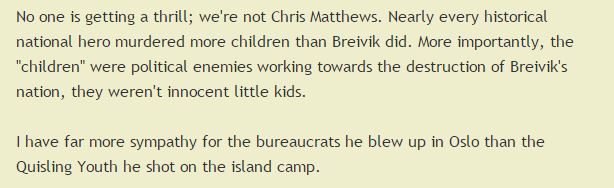
And here’s some more hate speech commentary on a terrorist attack in which actual children were actually killed. This is from August 10, 2013.

example of hate speech

Other stuff on the blog is calling out to Finnish fascists and other groups, as has been mentioned by authors Charlie Stross and Philip Sandifer.

These other groups, they’re not just mucking around in the field of books. No, they’re trying to ban immigrants of color, they’re hoping for a medical “solution” for homosexuality, they’re beating their wives at home. There are some real-world consequences for these views, which is exactly why hate speech is illegal.

And of course, fascism in its “Golden Age” was all about military and killing and all.

As you might expect, I quite naturally felt a bit alarmed at the thought of organized neo-fascism in the science fiction and fantasy community.

Fortunately, author N.K. Jemison calmed me down somewhat by giving some historical perspective. See, I was thinking of fascism in science fiction as this new thing that’s popping up, but really, it’s just an attempt to return to business as usual, to the “Golden Age of Science Fiction.”

As Jemison explains back in 2013,

“Straight white men have dominated the speculative literary field for the past few decades; their dominance is now going the way of the dinosaur; most are OK with that but a few (and their non-straight-white-guy supporters) are desperately trying to figure out how to bring things back to the way they were.”

So, I was thinking, it’s a garden-variety conservative backlash. But I disagreed, thinking, It’s a neo-fascist backlash, which is different. With all the hate speech going around, someone could get hurt!

But then I kept reading and came across this:

“Which I guess is why I’ve recently had to add some new entries to the file of death and rape threats I’ve already gotten over the years (pretty much since around the time I started publishing professionally, if you’re wondering).”

So I had to smack myself in the head for forgetting all the violence that is routinely being done to people of color, and once again for forgetting it while my Facebook feed is full of stories of people who “just happened” to have their spines break while in police custody.

But then I thought, “That’s racism and violence, not fascism,” because there is a line that divides fascism from other things. So then I had to ask, “What exactly is that line?”

And also, “How do you figure out where a person stands in relation to that line?”

One might wonder, “If somebody ends up accidentally supporting a neo-fascist, what’s their next step? Do they step back carefully, double down, or sit comfortably in a state of denial?” I think it would be fair to ask such a person: “Do you oppose fascism, support fascism, or are you neutral on fascism?”

(And yes, of course nobody can be neutral on fascism.)

Or I could just wait until the next thing happens, whatever this is, because this is an organized attack on feminists of all sorts, and see who sides with whom, and add 2016 to the title of this blog post.

So then the question became, “How do you counter fascism in science fiction and fantasy?”

And that was too big a topic for me to address before lunch, so I’ll just finish up with another couple quotes by N.K. Jemison:

“. . . all this anger and discussion reflects a struggle for the soul of the organization, which is in turn reflective of a greater struggle for the soul of the genre, and that overall struggle taking place globally.”

and

“SFF is going to become more diverse, with women and people of color taking their place as equals within its hierarchies, whether the scared white manly men want it to or not.** Nothing can stop this now; it’s inevitable.”

Oh yes, and the one action I’m going to take after all this research? Read a good book.  I have three new authors on my “to-read shelf” — N.K. Jemison, Charlie Stross, and  Philip Sandifer.

(Note: I edited this on 5/5/2015 and again on 5/7/2015 to include a little more context & details.)

Do Women Destroy Science Fiction?

Spent last weekend at the wonderful and thought-provoking Potlatch convention (http://www.potlatch-sf.org/). It’s a con for readers of speculative fiction, and I’ve been going to it for years and years.

Instead of a “Guest of Honor”, Potlatch has a “Book of Honor”. This year’s book was the anthology Women Destroy Science Fiction, produced by Lightspeed Press. It’s a response to the all-too-frequent claim by men that women writers are DESTROYING science fiction! Ever since H.G. Wells wrote the first sci fi book! (Actually, though, he wasn’t the first. That honor goes to a woman, the author of Frankenstein.)

The book is great! Where else can you read stories about dystopias where everyone lives in a mall? Genetic and cybernetic modifications that turn people into mermaids and spaceships? Or watch a corpse decompose in a spaceship after the artificial gravity system disappears? Who can resist an essay titled “How to Engineer a Self-Rescuing Princess”?

It was also wonderful to be able to have conversations about the book, in the form of audience-participation panels, and outside the panels — in the halls, in the hospitality suite, in restaurants, and afterward in blogs.

The conversations, though, seemed to lack focus. We’re in the middle of change — women are respected science fiction authors in some contexts, but not in others — and I don’t know that anybody was able to come up with a clear and coherent vision about the exact nature of the problem or how to handle it. So it seemed like we were talking about all different kinds of problems.  And we were. Some people were talking about respect, some people were talking about the disproportionate publishing and reviewing of men’s work, and some people expanded the conversation to include the difficulty of publishing in general.

You can see some of the comments here:

“Notes on ‘Women Destroy Science Fiction: Not Again'” — posted on the Aqueduct Press blog

The focus that conversation lacked can be found in Nisi Shawl’s Lightspeed anthology essay “Screaming Together: Making Women’s Voices Heard” —

“Wouldn’t it be fantastic if . . . women’s genre stories and poems and genre-related nonfiction being published and read and noticed–happened every single day?”

She goes on to give a bunch of solutions, such as:

  • reading books by women
  • talking about books by women on social media
  • nominating women for awards
  • helping one of the many organizations that support women’s writing
  • for editors: repeatedly asking non-assertive women to participate in creative projects
  • for editors: issuing women writers public deadlines
  • supporting women who are writing
  • publishing women who are writing
  • for writers, using alternate publishing resources such as Book View Cafe, Indiegogo, and Kickstarter

This particular conversation, though, didn’t make it into the panel. Nor did a conversation about how far we have come, or maybe more important, what we are aiming for. We want women’s genre writing to be heard, but by whom? Is our goal equal representation in the Big Five publishing houses, and if so, why? Is it just women’s writing we want, or do we care about race, class, ability, gender, and more? Do we need a Combahee River Collective Statement  for genre writings?

Well, this explains why the conversations seemed to lack focus. They’re tackling a big topic. Why not make it just a little bigger by introducing publishing problems faced by men and women alike? Here you go:

“Notes on ‘What Dreams May Come'” — also from the Aqueduct Press blog.

That panel, which drew its inspiration on a speech Ursula Le Guin gave at the National Book Awards about authors, publishers, capitalism, and freedom. However, many of the audience members (including myself) hadn’t seen it, and the conversation dissolved into a conversation about big publishers and Amazon.

Where to next?

I left Potlatch mulling over a couple different concepts, so here they are, in their preliminary form.

1) It’s about building power. The question of who is published and reviewed, and who isn’t, has a little to do with quality and a whole lot to do with power. A group of people working together to read, edit, publish, and review each others’ works will build power.

2) Is it about competing with money, trying to get into the top publishers? I don’t think so. Money is a form of power. A noxious one. It’s a form of power best countered by striving for freedom. Whatever that means. Again, Ursula Le Guin’s speech is worth watching.

3) Is this a problem best solved by the individual, or the community?  Is it about what the individual wants to read, or write, or edit, or publish, or about what our communities need to hear and say and dream?

4) Speaking of community, Potlatch itself is a community-building con. It’s a place for readers and authors to meet each other and support each other. Over the years, it’s exposed me to a diverse range of authors, and it certainly has supported me as a woman author. Part of the solution, that.

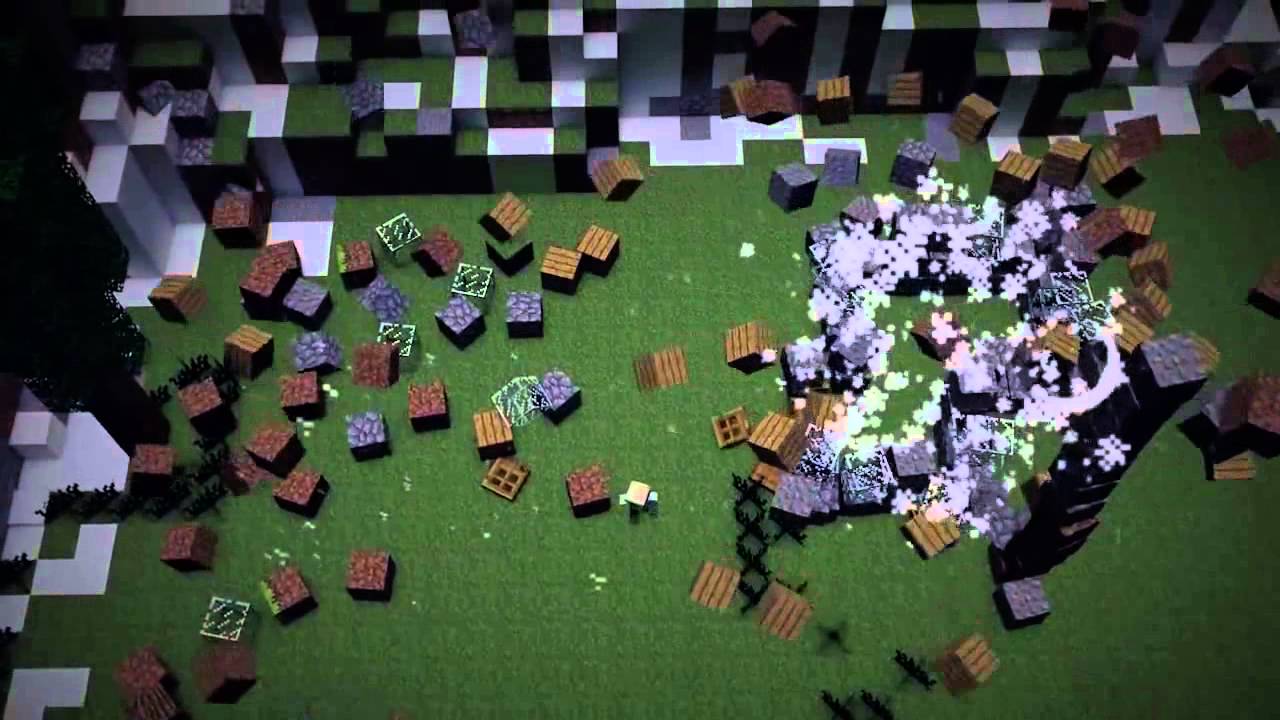
5) Do women destroy science fiction? No. Science fiction is indestructible. Here — bring me some rockets and robots and TNT, and I’ll show you what I mean.

Image is from the Minecraft "Let it Blow" youtube video

Image is from the Minecraft “Let it Blow” youtube video

Fascinating book about our genetic heritage

For those who are curious about humanity’s common genetic origins, may I introduce the book Mapping Human History by Steve Olson. Here are three quick factoids from the book:

  • We all came from Africa. That may come as a surprise to many, but unless you want to throw science out the window and cosy up to creationism, that’s as much of a scientific fact as anything.
  • It’s impossible to accurately trace our family trees, no matter how well written records are kept. Why? According to medical research, there’s about a four percent chance of mistaken paternity. And the more generations you go back, the wronger it gets.
  • On the other hand, if you go back far enough, it is very likely that any one particular ancestor is your ancestor. Keep in mind that as you go back in time, the number of ancestors increases exponentially. After a certain number of generations, the number of ancestors you have is greater than the number of people living on Earth at the time. How is this possible? We’re related to each other through multiple lines of descent.

Don’t believe me? Read the book.

Mapping Human History by Steve Olson

The pleasures of reading, viewing, and listening

I’ve been AWOL from this blog for a little while, but I have been busy elsewhere! Check out my post on the Aqueduct Press blog, “Pleasures of Reading, Viewing, and Listening in 2014”. I talk about The Theory of Everything, Maplecroft, Doctor Who (of course), Daniel Orozco’s “Orientation,” and more!

Is Doctor Who for kids any more?

(Removed and expanded from another post.)

Season 8 of Doctor Who has been billed as “a darker season” with “a darker Doctor” than the previous two, more flippant Doctors. Is it still appropriate for kids?

In a review of the episode “Dark Water,” columnist Sam Wollaston from The Guardian points out all the disturbing elements he enjoyed and then writes:

“I suspect my approval may mean he gets the opposite from the kids. Yeah, well, so what, it’s not your show any more. Love you, now go to bed.”

Yeah, well, fuck you Sam Wollaston, from the bottom of my motherly heart. Should my kids be deprived of this show just to make you happy? Plus, you’re dissing the future adult fan base of Doctor Who. Don’t forget that it was rebooted by adults who watched it as children.

This, by the way, is nothing to do with wanting or not wanting the show and the Doctor to be “darker,” whatever that means. Children are fully capable of dealing with “darker.” Read any Roald Dahl lately? Any Brothers Grimm fairy tales? In fact, many children’s ordinary lives are a lot scarier than any episode of Doctor Who could ever be.

Anyhow, when my spouse and I sit down to watch Doctor Who, the kids join in. My oldest loves to be scared, and my youngest leaves the room when the going gets too rough. She didn’t actually leave the room during “Dark Water” — I have a feeling it was scarier for the grownups, who think more about death. Nobody had nightmares, except me.

I think the show is good for kids in many ways. For instance, it’s a great source of metaphors and a way to understand our rapidly changing world. When a child asks, “But whyyyyyy can’t I have a cell phone? Even second-graders at my school have them!!!” I can say, “Because they will turn you into Cybermen,” and they get it.

The show is also a great way to expose children to some of the frightening truths that adults grapple with (badly) without overwhelming the kids. How many apocalypses have we had on the show? Ecological disasters? Megalomaniac rulers? But there’s almost always been a counterbalance, a ridiculous and fallible Doctor who saves us from the monsters, while tripping over his own shoes.

That’s the magic formula of the show, the one that’s kept fans coming back for more. The world is scary, but you can go out into it, explore, confront danger, because somebody’s got your back. It’s a lie, of course, but it’s a lie that children need in order to learn and grow and take risks. (As an adult who figured out that lie, and learned we have to save the frigging world ourselves, I do love the mental health break of stepping inside that blue box to watch that magic formula in action.)

This season has done a beautiful job of keeping that magic formula while still exploring all the troubling aspects of being the Doctor. But I do have a perpetual worry that Doctor Who might stray too far from the formula and stop being fun for kids. Of any age. As an extreme example, I don’t want Doctor Who to turn into “Torchwood: Children of Earth.” That episode had the kind of gut-wrenching impossible choice no hero could live with. And I don’t want the companions to get killed — especially Clara, the character my daughter adores. Finally, I don’t want the underlying optimism and humor to be lost. Fortunately, for now at least, we have a showrunner who remembers and values what it’s like to be a Doctor Who fan as a child. Don’t forget. Run, you clever show, and remember.

And hey, kids — Doctor Who is and always has been your show. Stay up late.

Have a jelly baby.

Have a jelly baby.

Have a jelly baby.

Other opinions about Missy in Doctor Who

Nov 7, 2014

Update: after considering all week and checking out various opinions, I have decided I like Missy. A lot. She’s basically a walking, talking, kissing piece of comic meta. I took down one of my posts (Doctor Who Dark Water – A Near Miss) because I’ve changed my mind about it.

Keeping this post though, because it’s basically a summing up of various opinions I’ve heard around the net. Spoilers below.

Nov 4, 2014

I’m conflicted about the character of Missy in Doctor Who. What are other people saying? Here’s a little summary of what I’ve found around the net.

From Cogpunk Steamscribe – “From a feminist viewpoint, this is a brilliant addition to the Doctor Who canon.” and “All the . . . shippers must be screaming in delight.”

Personally, I think half are screaming in delight and the other half are pissed.

From freethoughtblogs – Missy is one of a number of cookie-cutter female characters.

She sure channeled River Song in this episode.

From Radio Times – She’s a strong female character and shows Moffat to be a feminist. “Surely, this puts paid to any whingers who, for reasons that escape me, have labelled Moffat a misogynistic writer.”

Nice try.

From feministfiction.com (and by the way, how have I not found this before???) – very excited by the plot twist but yet another female character being in love with the doctor is setting up potential alarm bells.

Yes, that’s it exactly. That’s how I feel.

From ibishtar.livejournal.com – was hoping for Missy to be who she is but is concerned about how it was handled.

Yes. But I can’t personally decide how I would rather have had it handled.

Various comments on doctorwho.livejournal.com

From gildinwen – “You Troll Moffat…you epic epic troll *G*”

Also from gildinwen – “He did bring us Jack and River…..like flexible sexuality was kinda introduced into the Doctor Who universe via Moffat….and thank you for that kiss!!!!”

angelophile – “it manages to be both sexist and homophobic at the same time. Double whammy.”

eowyn – “Why are all female villains the same? Karabraxos, Miss Foster, Kovarian, Missy – they’re all basically interchangeable.”

gonzo21 – “And yes! Moffat knows how to write precisely 2 female characters. They’re either Amy/Clara or Missy/Kovarian/River/etc. ”

norahsilverbird – “I thought it was hilarious how she decided to kiss the Doctor.”

femme_slash_fan – “the way Missy has been spouting off about her ‘boyfriend’ just hits me as needy and a little overly sexualised”

gonzo21 – “I’m also not convinced Moffat is the writer we want to be handling trans-gender issues like this.”

sharaz-jek – “. . . it’s good to see an example of genderfluidity, even if it is . . . ”

pinguthegreek – ” Transgender issues are a relatively new thing to many people who may not have any experience or contact with trans people. To expect writers of a mainstream, flagship, prime time show to carefully consider those kind of sensitivities in this particular instance is kind of shooting for the moon. . . Progress has to be in small steps . . .”

ibishtar – “. . .a writing move that I found cissexist, heteronormative and sexist . . .”

Sexuality Dragon (warning: blog contains mature themes): “My reaction so far has been to squeal, cry, yell, swear, say things like: ksjdfbkwebtksdvkbdsfansbdn l I can’t I can’t oh god it’s so beautiful am I betraying everything I believe in if I start watching DoctorWhoagain”

Verity Podcast – The Verities interpreted Missy as an excellent continuation of the Master, complete with a typical crazy “Master plan,” flirting through destruction of planet Earth, flair for style, invasion of the Doctor’s personal space, and more. As for the gender dynamics, there was one interpretation that this is how the Master thinks he ought to behave now that he has a woman’s body.

Quite the range of opinions! If nothing else, this is a move that’s making people think.

Any other feminist opinions about Missy? Let me know and I’ll link to them here.

Kill the moon?

–Spoilers for Doctor Who: “Kill the Moon”–

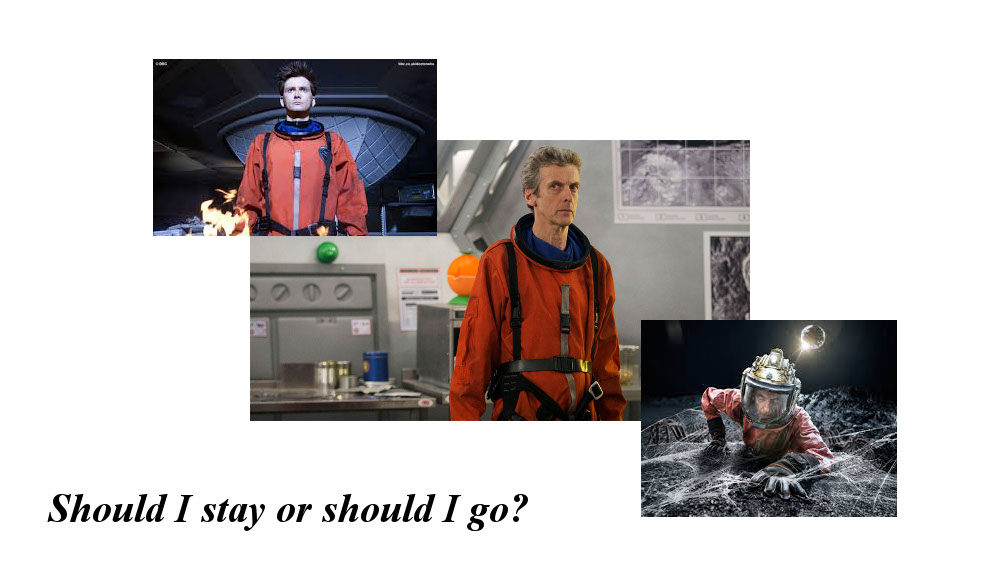
A man puts on a red spacesuit and walks onto a planet, to find a team of people grappling with an alien threat. It’s a very special moment, a time when big things are about to be decided. In response to the threat, there’s a nuclear bomb that might have to be set off.

The leader of the team says to him, “Who the hell do you think you are?” Well, he’s a Time Lord, a superintelligent alien being, with the power to step into special moments like these and shape the future. He can help . . . but maybe he shouldn’t.

This is the premise of the Doctor Who episode “Kill the Moon.” Curiously, it’s also the premise of a previous episode, “The Waters of Mars.” Although “Kill the Moon” works perfectly well as its own story, it also works as a duet with “The Waters of Mars.” And when the two are put together, they ask some philosophical questions I’d be hard-pressed to answer.

In brief, here are the two plots. In “The Waters of Mars,” which takes place in 2059, the Doctor as played by David Tennant finds himself on Mars, at what he calls a “fixed point in time and space.” There are some moments he is not allowed to change, based on laws of time that only he understands. The inhabitants there are forced to blow up the colony with a nuclear weapon, sacrificing themselves to save the Earth from malicious aliens. But when it comes right down to it, he can’t sit back and let that happen. He’s grown so attached to the people on the base that he tries to save them at any cost. This is the wrong choice, and it makes him cross the line from good to evil. “Who the hell do you think you are?” asks one of the women he saves, Captain Adelaide Brooke.

In “Kill the Moon,” which takes place in 2049, the Doctor as played by Peter Capaldi finds himself and two companions on a space shuttle on the Moon, where some mighty strange things are going on. He meets up with a team of astronauts, and the first thing the captain says is “Who the hell do you think you are?” The Earth is at risk because the Moon has become “gravity flexible,” and a team of astronauts have come up with a hundred nuclear bombs to destroy the alien threat. Only it turns out that the alien is innocent, and killing it might or might not save humanity. In a moment of apparent cruelty, the Doctor washes his hands of the whole affair and walks off, stranding three human women in a room where the terrible decision awaits.

“Kill the Moon” has a number of deliberate allusions to “The Waters of Mars” — the year, the color of the Doctor’s space suit, the nuclear bomb dilemma, the concept of a pivotal moment in time, the Doctor’s acknowledgment that he shouldn’t be there, and the Doctor’s conflicting view of humans as “little people” or greatly important.

Along with allusions, the two episodes have some important contrasts, beginning with their personalities. Tennant is fairly warm and fuzzy and considerate. He wrings his hands over difficult decisions and pays explicit attention to others’ well-being. So when he makes his initial decision to leave the Mars colony to his fate, he is near tears. His downfall comes from caring too much.

In contrast, Capaldi is often dismissive of others’ feelings — at least outwardly. When he decides to leave the three women on the Moon, he is positively rude about it. “I’m sorry,” he says. “Well, actually, no, I’m not sorry! It’s time to take the stabilizers off your bike. It’s your moon, womankind!” That’s patronizing and quite cruel.

Another important contrast is the choice itself. Tennant makes the wrong one. Through some combination of caring too much about the colonists and growing too attracted to power, he risks humanity’s future and ultimately dooms himself and is forced to regenerate (which is as close to death as the Doctor can get).

Capaldi’s choice is the opposite. On the surface, he doesn’t care about the three women, and he leaves them to live or die, depending on their actions. Had they detonated the nuclear bombs, they presumably would have been killed right along with the alien creature.

Another contrast lies in how the Doctor treats a human woman’s right to choose. Tennant’s wrong choice overrules a human woman’s choice. Captain Adelaide Brooke makes up her mind to die to sacrifice herself, and he saves her instead. Luckily for the Doctor and the future of humanity, Brooke shoots herself, undoing Tennant’s mistake.

In contrast, Capaldi forces three women to make a choice on their own, despite repeated pleas for help. “It’s your moon, womankind,” he says. “It’s your choice.” He even goes so far as to drag a fifteen-year-old girl out of the TARDIS to participate in the impossible decision.

Here’s what I’m wondering: did Capaldi do the right thing? Faced with a similar situation, he made the opposite choice. Was it the right one, or did he veer too far in the other direction? It’s hard to tell. Unlike the two previous Doctors, Capaldi rarely explains himself, and when he does, we don’t know whether or not he’s telling the truth.

On the other hand, he deserves credit for refusing to sugarcoat the hard truths he lives by. He could have easily made the same choice but won over Clara’s heart, and the viewers’ hearts, if he had wrung his hands or shed a tear before he left. Instead, he overtly patronized and manipulated people so that at the end of the episode when Clara gave him a spectacular telling off, a lot of viewers were right there with her. Who the hell does he think he is?

I’d like to think Capaldi made the right choice — that he’s brusque and arrogant but underneath it all has a more mature understanding of morality than either of the two previous Doctors.

But maybe that’s not the point. Maybe the point of “Kill the Moon,” in combination with “Waters of Mars,” is not the Doctor, but the viewers. We’re asked to look critically at our hero’s actions, to question his motives, and to ponder what we might do in the same situation. We’re right there with him, seeing the universe in all its cruelty and splendor, and hoping, as he hopes, that humanity can be saved.

should i stay or should i go

Goodness had nothing to do with it

(Caution – spoilers for Doctor Who, “Flatline”!)

This last week’s episode of Doctor Who, “Flatline,” has pleased me to no end. It was great to see a woman playing the Doctor, for one thing. That deserves a squee post all on its own. (While I’m at it, I really ought to post about Barbara Benedetti, who played the Doctor in a series of fan-made films produced by Ryan K. Johnson.) But even more exciting, to me, was its exploration of morality.

I started watching Doctor Who with Patrick Troughton and went straight through to the end of Classic Who, with Sylvester McCoy. The Doctor was a fine, though ridiculous, hero. Most of the time, the show never questioned the Doctor’s innate goodness. He was just this guy who saved us from the monsters. I have to admit, I liked it that way. I wanted, and I still do want, the Doctor to be “the good guy.”

But I also have to admit that I was fascinated when the Doctor took a wrong step in “The Waters of Mars.” What happens when a superhero goes too far? I was so intrigued that I wrote an article about it for Strange Horizons: “Fall of A Superhero in Doctor Who and the Waters of Mars.” I said:

It is asking the grown-up questions that need to be asked. Can we really count on our superheroes? We need them to be powerful enough to fight our villains and win, but what do we do if our heroes become villains themselves?

This is not a new question. Lately, many movies and graphic novels have been exploring the theme of good and evil with superheroes. But I felt that “The Waters of Mars” and the two following episodes explored that question exceptionally well. My opinion is that superheroes can be “good” only if there is a counterbalance to their power. And when the Doctor stepped over the line, a woman did step up to stop him.

I hoped that when the Doctor regenerated, he could go back to being “the good guy.”

Did he? Is he a good man?

This season of Doctor Who has taken this question as one of its main mysteries. The Twelfth Doctor was terrified when we first saw him — probably of himself. He asked Clara if he was a good man, and she replied, “I don’t know.” Like Clara, we’re not sure. The Eleventh Doctor always explained himself, but the Twelfth Doctor is both cagey and brutally honest about his reasons for doing what he does.

But there’s another question behind that one. What does it even mean for a superhero to be “good?” Which actions should s/he take in the face of difficulty? And what if there are no good choices?

That’s the question that “Flatline” tackled. To summarize the episode, the Doctor gets trapped in his TARDIS and hands Clara his tokens of power (sonic screwdriver and psychic paper), his name, and his leadership tips and tricks. Clara flawlessly executes the usual monster-fighting strategy, managing to save the world plus at least a couple survivors.

And that’s why the Doctor compliments her halfway through, saying, “You were good, and you made a mighty fine Doctor!”

But at the end of the adventure, after everything has been said and done, he changes his story. “You were an exceptional Doctor, Clara,” he said. But then he adds, “Goodness had nothing to do with it.” He walks off into his TARDIS, leaving Clara puzzled.

What was it? What went wrong? Clara did a brilliant job. If she hadn’t done it, our entire world would have been taken over by malicious monsters from a two-dimensional world, and the Doctor and his TARDIS would have been utterly destroyed. Some people died along the way, but it was through no fault of hers. Why wouldn’t that count as “good?”

Well, there are hints throughout the episode that something is amiss.

Early on, the Doctor catches Clara lying to him about her boyfriend. He congratulates her, saying that lying is a survival skill  . . . and a terrible habit. Later, while Clara is leading a group of people to safety, knowing they might or might not live, she realizes that part of the Doctor’s strategy is to lie to people. She consults the Doctor to see if she’s right.

“Lie to them. Lie to them,” she says. “Give them hope. Tell them they’re all going to be fine. Isn’t that what you would do?”

Taken aback, he stammers, “In a manner of speaking, I-i-it’s true that people who have hope tend to run faster. . .”

Clara also guesses his “Rule 1.” Each incarnation of the Doctor has had its own series of rules. For example, for many of the Doctors, “Rule 1” was for the companions not to wander off. (Of course, they always did, because otherwise, how would they have adventures?) For the 11th Doctor, Rule 1 was “The Doctor lies.”  But for this 12th Doctor, the rule appears to be, “Use your enemies’ power against them.” What’s happened to Rule 1? It’s gone from a joke to an admission of Machiavellian techniques and from there to a military strategy.

Could this be why the Doctor tells Clara “Goodness had nothing to do with it?” Has he seen his morality mirrored in her actions and decided it’s flawed?

Yes, maybe. But there could be another explanation. Perhaps the moral issue is not with Clara’s actions — which were as “good” as possible under the circumstances — but with Clara’s later processing of the situation.

The Doctor asks her a question at the end. “You okay?” He looks more considerate in that one moment than he has this entire season. He knows she’s been responsible for a group of people and seen some of them die.

“I’m alive,” she replies. She’s wearing a poker face, as she usually does. If she’s in pain, she tends to hide it.

“A lot of people died,” he says, still sympathetic.

And here they are interrupted by Fenton, a morally degenerate survivor. The survivor compares what has just happened to a forest fire. You save the big trees, but you let the brush go. He refers to the dead, who had been doing mandatory community service, as “scum.”

The Doctor is not pleased by this analysis. He says, “It wasn’t a fire, those weren’t trees, those were people.”

Clara, however, does not appear to have quite followed this interchange. She is listening from a distance, a slight smile on her face. She  wants the Doctor’s approval, so she says, “Yeah, but we saved the world, right?”

The Doctor smiles. “We did! You did.”

“Okay, so on balance . . .”

I think this is where Clara goes wrong. She has taken all the right actions, but she’s failed to consider the impact of those actions on her own sense of right and wrong. She’s nothing like Fenton, but just as he is comparing people to expendable trees, Clara is weighing one group of lives against another.

Perhaps this is why the Doctor later says that goodness had nothing to do with it. Perhaps he’s trying to tell Clara to step back and consider the moral implications of her actions.

Or maybe something else is going on.

“Balance!” says the Doctor, disgusted.

“Yeah! That’s how you think, isn’t it?” She’s still looking for his approval.

“Largely so other people don’t have to.”

Well, it looks like the Doctor has his own issues there. He doesn’t want other people to weigh one life against another, but he does it himself. It’s the classic “Do as I say, not as I do.”

So perhaps when the Doctor says, “Goodness had nothing to do with it,” he actually means, “Goodness had nothing to do with being the Doctor.”

If that’s what he means, he’s challenging the morality of the entire series, all the way back to the 1960s. This was a pretty run-of-the-mill episode, with clear-cut choices and answers. The same plotline would have easily worked with Patrick Troughton as the Doctor, or Tom Baker, or any other “Classic Who” Doctor — and without that enigmatic statement from the Doctor, we would never have batted an eye.

Maybe we should have.

Anyway, whatever the Doctor means, I’m hooked. Can’t wait to hear what next week’s episode has to say!

–Kristin

screwdriver and book2


This weekend’s panel at Geek Girl Con

Cross-posted on the Washington Lawyers for the Arts website, http://thewla.org/blog/.

This weekend I had the opportunity to participate in a panel at Geek Girl Con on “Fanfiction: Sharing, Creating, and the Law,” put on by the Washington Lawyers for the Arts. It was a great experience! It was fun to work with the knowledgeable and friendly panelists, and I got answers to questions I’ve had for a long time. I’ve spent a lot of time researching the concept of fair use and learned a lot of legalities, but less about how I could apply them in a practical sense. Now I’m armed with a lot of knowledge and a solid sense of direction. Very helpful!

Just being at Geek Girl Con was amazing in itself. I brought my spouse and children, and we all spent some time exploring the con, dressed as characters from Doctor Who or Nancy Drew. Who knew you could find a life-sized robotic Dalek standing next to a woman in a TARDIS costume singing along to “Let it Go”? Or make a pocket-sized model of the solar system?

The panel was moderated by Allison Durazzi, Executive Director of the Washington Lawyers for the Arts, and the participants were Kristin Ann King (myself); Rachel Buker, WLA board member; and Brian Rowe, chair of the WLA Board of Directors. Our goal was present both creative and legal perspectives on creating fan fiction.

I went first and talked a little about my background. I write short stories, blog posts, and critical essays. My first book, Misfits from the Beehive State, was published last year. It’s not fanfiction — it’s a book of surreal short stories set in Utah, all about people who aimed for perfection but fell down the rabbit hole instead. I also write fanfiction, mostly for the Doctor Who fanfiction site A Teaspoon and An Open Mind. That site has tens of thousands of stories, all put out there for free by fans, mostly using a pen name. It’s a wonderful avenue for storytelling, but I do often wish I felt free to put it out under my own name. I’ve had many questions over the years about the practicality and legality of borrowing others’ work. What happens if someone thinks I’m infringing? Is it possible to know for sure whether my use of a copyrighted work is protected by law?

Rachel went next, and she covered the fundamentals of copyright, including thorough definitions of copyright and the public domain. In brief, copyright is a bundle of rights that protects “original works of authorship” that are fixed in a tangible form of expression. It has to be creative expression — for example, ideas and facts are not covered by copyright. Those kinds of works, works whose copyrights have expired, and certain other types of work are in the public domain. She gave links to tools for determining whether a work might be in the public domain. For a fuller explanation of these concepts, check out the PowerPoint slides from the talk .

Then we broke for a little bit of Q&A, and the audience asked thoughtful, interesting questions.

Next Brian discussed ways that people can legally use copyrighted works. Free speech is a first amendment protection, and it’s also built right into copyright law in the form of “fair use.” When courts are considering whether or not it’s fair use, they consider four factors: the purpose of the use, the nature of the copyrighted work, the amount of work used, and the effect of the use on the market of the copyrighted work. Brian covered several cases in which that the courts decided whether or not fair use applied, as well as a few cases that were settled before a decision could be handed down. He encouraged the audience to create transformative works and pointed out that every creative work is a remix of one kind or another. Star Wars, for example, borrowed heavily from other movies. Brian also provided a list of legal resources, including the Washington Lawyers for the Arts, free and low cost resources, and organizations that help defend these free speech rights, such as the ACLU and the Electronic Frontier Foundation.

These resources are in the slides, but they’re worth adding here as well:

We finished up with more audience questions, and once again they were thought-provoking.

I learned a lot from this panel that I can take home and use in my writing and publishing endeavors. Here are just a few of my key takeaways:

  1. The fair use clause of the copyright is extremely fuzzy and open to interpretation by the courts.
  2. If a copyright holder thinks someone is infringing on their work, it does not always go straight to court, and most cases end up being settled. There are specific steps that can be taken, such as a “cease and desist” letter or a “takedown request,” and specific right and wrong things to do in that situation.
  3. There are organizations out there that provide free and low-cost legal assistance, depending on the situation.

I also came out of this panel with a whole lot more hope for the future of fanfiction as a legal activity. Fanfiction writers always have a cloud hanging over us: we think our specific use of copyrighted material is legal, but it’s impossible to know for sure unless it goes to court.

But maybe this situation can change. Other countries treat copyright and fair use differently. For instance, in Japan, fan works has more respect, and there are more specific rules for whether or not they violate copyright.

One of the audience members asked about the possibility of having a Hugo Award for fanfiction. The idea has been kicked around, but people are a little concerned. Rachel took the question, and of course, there was no definitive answer. But she did ask whether there was a monetary prize given out, and the answer was no, just a statue. She then inquired as to what the statue was made out of, joking, “If it’s chocolate, that might be OK!”

I would be delighted to see a Hugo award for fanfiction. I would love to see a world where fanfiction can be freely shared and professionally respected.

Thanks to the WLA for the opportunity to participate on this panel!