Category Archives: that’s political

I’m always pondering how to build a better world. Or how to survive this one. I read, think, dream, act. It’s all here: utopias, dystopias, the hidden workings of power, resistance, organizing, and action.

Talking points for the #MeToo backlash

We all know that political discussion on social media can be infuriating, hazardous, frustrating, a minefield, a hornet’s nest, et cetera. And we’re starting to understand how easily social media can be used to manipulate us. But here’s something we don’t know: people with money can pay to design talking points that get allies fighting among ourselves. When this happens invisibly, we have no defense. But we can learn.

Let’s start with a metaphor. A well designed talking point, or meme, is like a hand grenade. It’s thrown carelessly and it does more damage than anyone expected. Or it’s an unethical translator. A says one thing, B translates it for their own personal gain, and C loses trust in A. Or perhaps a virus. An idea that on the surface sounds so good, so exactly like the point you were going to make yourself, that you spread it everywhere. But it has a payload you weren’t expecting.

With that groundwork in place, let’s take a look at some talking points against the #metoo backlash as they appear in a site built by a P.R. firm to change the world by shaping discourse. I’m not going to link directly to their site but SourceWatch has a page for them here and the Wayback machine has generously provided a glimpse at their original intentions when they launched in 2000: “nothing less than the creation of a new language for political, social and cultural writing in the twenty-first century”.

(By the way, the page also makes mention of “fresh, non-consensual thinking.” That’s not what they meant to say, I’m sure, but I find it apt. If propaganda can shape our words, it also shapes our thinking. And when it does so invisibly, there is an element of consent that gets lost.)

Anyway, their article, “Meet the women worried about #MeToo”, gathers opinions from thirteen women on why the #metoo crowd is a bunch of weak victims who are gathered in a screaming mob to chop heads off innocent men. We could go through point by point and refute their arguments, or we could do something different for a change. We could catalog them. With no further ado:

Talking Points for the #Metoo backlash

(I found all these in that single article, by the way.)

A. Destroying REAL feminism 

A1. Real feminists don’t think sex is dirty

A2. Women as victims / fainting flowers

A3. My generation kicked them in the balls

A4. Turning back the clock on sexual equality

A5. Watch your privilege!

B. Hysterical mob

B1. Mob violence

B2. Witch hunt

B3. Beheading

B4. Panic

B5. Mass hysteria

C. That’s not really assault

C1. Confusing real assault with failed advances

C2. Trivializes real sexual violence

C3. Phantom sexual harassment

C4. You can’t touch my elbow

D. Totalitarianism

D1. Censorship

D2. George Orwell

D3. Bullying women to conform

E. The legal system

E1. Presumed innocent / no due process

E2. Innocent people destroyed

E3. If it’s not against the law, it’s not assault

E4. All we need to do is fix the law

Examples

“we are throwing knee-touching into the same basket as rape” – C1, C4

“sex itself seems increasingly to be seen as dirty” – A1

“destroy almost any man by a single accusation” – E1

“in need of shielding” – A2

“celebrates conformity and demonises dissent” – D3

“it was supposed to be about empowering women” – A3

“this is a witch-hunt” – B2

“return women to delicate, Victorian damsels who reach for the smelling salts if they hear a lewd joke” – A1, A2

“accused of transgressions no reasonable person would define as a crime” – E3

“even decades later” – C3

“The heads keep rolling” – B3

“A charge of creepiness is a death sentence” – E2

“ensuring that the lives of innocent people are not destroyed” – E2

“every male as a potential predator and every female as a perpetual victim” – A2

“modern feminism all but ignores the plight of the most oppressed women around the world” – A5

“turning the clock back on hard-won sexual equality” – A4

“Raise qualms and watch the insults roll” – D1

“those of us who have spent years metaphorically kicking sex pests in the balls” – A3

“bullying climate” – D3

“phantom sexual-harassment epidemics” – C3

“fainting-couch nonsense” – A2

What’s Next?

The first step in countering think tank talking points is to find them in the first place. I found it enjoyable – with just a think tank article and a highlighter pen, I was able to take a pile of glowing propaganda and identify the core messages being pushed by the funders, thereby dismantling it until it turned into naked sludge of ugly insults. Fun.

But it would be much more fun as a shared exercise. You could do the same thing to any propaganda campaign, really. Or you could take it one step farther and identify which of the many propaganda techniques are being used. Or consider what’s deliberately left unsaid.

If we can develop a shared understanding of think-tank memes, we’ll be much better prepared to explore the important issues on our own terms.   Using our own words, finding our own thoughts. That’s consensual thinking at its finest.

– Kristin
witch hunter


Watch your language . . . please?

So there’s an argument on social media somewhere. Doesn’t matter what the argument is. There are two sides to the argument, even though the issue itself may have many sides. You try to make a third point and are swarmed by angry hornets, maybe on one side or maybe on both.

Poor you! You’ve just been unfairly mobbed! It’s a witch hunt! Thought crimes! There’s no room for moderates any more!

What do you do? Retaliate, of course. Of course you do. Because on social media, you have to think fast and act fast. You take advantage of your brain’s superpower — and it is indeed a superpower — of quickly assembling meaning from a group of facts, of seeing patterns. And you respond.

But now you’re somebody else’s angry hornet.

For most folks on social media, the solution is simple: go offline, get a cup of tea, call a friend and vent, smell some flowers, or do whatever you need to do to take care of yourself. Come back later when you’re calmer, or move on to some more pleasurable activity.

But there is one group of people for whom I have a higher expectation: public writers and bloggers. You, my dearies, are the ones that upset the hornet’s nest in the first place. This isn’t a value judgement. Sometimes a situation calls for a swarm of angry hornets.

But if you are writing for the public, if you set those hornets off accidentally, that’s on you. That’s your mistake. If you’re complaining about thought police and whatnot, and you’re doing it honestly (you don’t have a hidden agenda, that is), but not looking at where you might have gone wrong, you’re only compounding the mistake.

Me? Who? Me? I didn’t do anything wrong! I was just saying what I think!

Yes, you did do something wrong. You were careless with your craft. And if someone is kind enough to point it out to you, for heaven’s sake, pay attention! Put on that thick skin that all professional writers must have, and look past the sting of the comment to what the person is really saying. Writers mess up, all the time, but if we look honestly at our mistakes we will always improve.

Now, when I say you were careless with your craft, what I mean is that you didn’t bother to get to know your audience. And that’s Rule #2 for persuasive writing. (Rule #1 is “Consider your purpose” and Rule #2 is “Consider your audience”.) No matter how good of a writer you are, you will never have a full understanding of the depth and breadth of your audience’s viewpoints and life experiences.

#

So why am I saying all this right now? Is there a specific piece and writer that set me off? Yes, there were two or three or four. But rather than go into the specifics, here’s what they did wrong.

  1. A respected Second Wave feminist who actually had something important to say about #Metoo but erred in using the phrase “witch hunt.” There were no actual witches in Salem, but there are plenty of people who sexually assault and harass others. This matters because some of the people who are actively fighting to maintain the status quo, such as Gamergater types, are also using the phrase “witch hunt.” Is it fair of people to accuse you of guilt by association? No, of course not. But, as a master wordsmith, did you really intend to align yourself with Gamergaters?
  2. Same feminist who is apparently getting into arguments with millenial feminists and wrote an article to defend herself against the claim that she is a “bad feminist.” This broke Rule #2, “Consider Your Audience,” because her message will be received positively by some audiences (anybody who feels defensive about being called a “bad feminist”) and with anger by others (millenial feminists who don’t feel listened to).
  3. A writer of an ostensibly progressive paper who started her article complaining about social media is a brush fire — which is true — and callout culture is a problem — also true, but lost me in the middle when she started talking about “thought crimes.” For some reason, although George Orwell coined the phrase to attack authoritarian governments, these days it’s mostly used to shut down conversations about racism, sexism, ableism, and the like. I paused in my reading of the article to wonder, “Which side is she on, anyway?” and then, “Should I bother finding out, or do I have better things to do?”

#

To go all meta, let’s look at my purpose and audience in writing this piece.

My primary purpose is to provide an alternative perspective to a problem we’re all complaining about (other people being annoying on social media) and also to advocate for craft in persuasive writing. This is a bit of a follow-up on a series I started several years back on persuasive writing for activists and have yet to finish.

So far so good. But let’s be honest: my primary audience is imaginary. I wrote it for every single author who’s ever started a pointless argument over a topic that actually needs attention, and who, when called out, takes it personally and attacks back. This is what I’d say if we were in the same room and I had their undivided attention.

So there’s also a secondary audience: every writer everywhere who has to write for an audience of human beings. My condolences.

#

Keep writing, but for the sake of your craft . . . mind your language!

scoobydoogang01

-Kristin


Anglicon 2017 “Should the Doctor Be a Woman”? Panel

This panel on the past and future of female Doctors may have been poorly named, considering that Jodie Whittaker has already been cast as the Thirteenth Doctor, but the conversations were great. Raven Oak moderated, and the panel consisted of Eric Gjovaag, Mark Dando, and Denise Nilsson.

Eric Gjovaag got the conversation off to a productive start with a brief video showing fan appearances of female Doctors, starting with a clip featuring Barbara Benedetti. (More info on these films is available on director Ryan K. Johnson’s website.) That way, the panel and audience started out with a lot to chew on. The video also had a moment from The Curse of Fatal Death and some other works I can’t recall off the top of my head.

The audience conversation was lively, energetic, and thoughtful. A sampling of some of the questions and comments:

  • There’s a generation gap in fan reaction. People who grew up with Classic Who may find this quite a departure. On the other hand, the younger generation seems ready.
  • Some of these videos continually referenced the fact that the Doctor was a woman. If the new show does that, it won’t turn out well.
  • Some of this came up when Missy appeared as the latest incarnation of the Master. While it’s true that the Master has always been a complete ham, there was some discomfort about having her gender and sexuality continually referenced.
  • Someone popped his head in and got the audience roaring with laughter by asking: “Will she get equal compensation?” GOOD QUESTION.
  • Someone proposed Idris Elba as the fourteenth Doctor. I agree.

We finished up with a look at the publicity photo of Jodie Whittaker’s costume (below), described on a UK news site as “navy culottes with yellow braces.” Apparently that’s in fashion in Europe. Folks spent some time speculating on whether the rainbow ribbon on her shirt might have come from an earlier Doctor or companion, like Dodo (who was filmed during the black and white era). Panelist Mark Dando expressed dismay at the photo: “But what have they done to the police box?” (It’s darker blue and one panel looks black.)

Denise Nilsson finished out the session by expressing optimism for the series, saying, “It’s still the TARDIS, still the Doctor.”

doctor-who-costume-reveal-jodie-whittaker

Anglicon 2017 Recap

I went to Anglicon this year, along with my son, to revel in Classic Doctor Who fandom. Much fun! It’s nice to meet people who liked Doctor Who before it was trendy. Highlights:

I lived the Classic Who tropes (not always on purpose):

  1. Losing track of companions: This began the moment I left home. I hopped in the car to pick up my spouse from the bus stop, but due to bad directions, I drove around aimlessly only to find he’d walked all the way home. It was a good omen.
  2. Wandering through corridors: The hotel room was a half mile from the convention area, along a twisty route. This would have been true to the show, except the walls didn’t wobble.
  3. Tea: I enjoyed a proper black tea in the Hospitality Suite.
  4. An unattended TARDIS: And as usual, someone had left the door open, and someone else had wandered in. (They fixed this by Saturday, though.)
  5. Losing track of companions (again): In the end, exhausted beyond belief, I kept trying to gather family members, and they kept wandering off.

Fanstruck by Sylvester McCoy:

I lined up early for a photo op with Sylvester McCoy so that I wouldn’t spend the entire con worrying about getting one. I needn’t have worried, since there was plenty of time for photo ops, but it was a delight to see him show up and perform crowd control.  Later, during his Q & A, he put on another stellar performance, getting down into the audience to answer questions with a quick wit and well-timed comedy. And finally, I hung out in the general vicinity as he wandered through the art show with his “handler,” admiring the art.

And Peter Davison:

He had so many stories to tell about his acting career. The audience questioned him about everything from his first time acting to his upcoming works. My second favorite: his account of directing The Five(ish) Doctors Reboot, including the moment when all the actors were in their spots, the cameras adjusted, the lights on, and he was waiting around to hear people shout “Action!” only to realize that was his job.  And my favorite: his account of filming All Creatures Great and Small, with . . . actual animals about to give birth.

The game room:

I got a chance to play my first Doctor Who role-playing game, run by a game master who kindly took into account my inexperience (and that of my son as well). Something I’ve wanted to do for a long time.

The panel “Should the Doctor Be a Woman”?

Poorly named (because the next Doctor is a woman) but great in-depth conversations about the past and future of a female Doctor. I’d like to spend an entire post on that, so I’ll skip it here.

The film festival:

I only had the chance to see two short films but liked them both. The first was a sci/fi zombie crossover, “Father’s Day”, that was at the same time gross and heartbreaking. The other film, “Renegades,” by Grant Pierce Liester, was riveting, with small moments gorgeously done.

All the costumes:

So many people put so much detail and care into dressing up. It’s a delight to watch.

The Corgi parade:

One of the guests of honor is a Corgi who starred in Dirk Gently, along with his sister. I missed most of the Corgi antics. But on Sunday as I walked down the hallway, I found everyone lined up for something, and it turned out to be a parade of dogs (many in costume), led by a Dalek. Boy, were those dogs pleased with the attention!

And the conversations:

I mostly kept to myself (introvert!) but the conversations I did have were fun.

All in all:

I don’t attend many cons, finding them exhausting, but this one was worth it. Thank you to everyone who worked so hard to put it on.

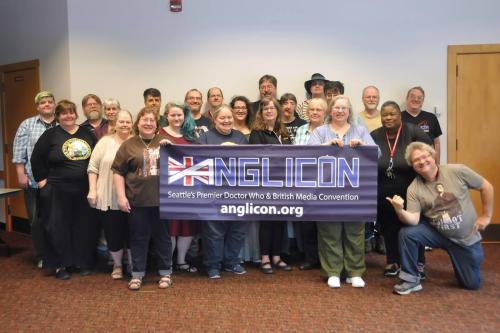
anglicon-staff-2017

The Plum Harvest

It was enormous this year. With help, I’ve taken at least sixty pounds of it off the tree so far, and there are more left. These are just a few:

DSC03988

our plum harvest

What does a person do with that many plums, anyway??? When I was growing up, our family made plum jam. Way too much work! Also, I like them raw, not cooked. Very best: sun-warmed and overripe. The only way to get that kind of plum is to have your own tree, or stay on good relations with a friend or neighbor who has a tree.

There’s a limit to how many fresh plums you can eat in a day and still crave them. I’ve gone over it. So . . . I’ve frozen some, made some into muffins, and given some away, to lots of different people. Some are going to a Food Security project, still in its infancy.  It’s an anti-capitalist effort.

Speaking of capitalism, and economics, what is the value of a fresh, ripe plum? The grocery store says it’s about $3.50 per pound, and since there are 12 of these plums in a pound, that would cost just about $0.30. In theory, if I wanted to sell all sixty pounds myself, I could get about $210. But that’s only if I could sell every last one, at that price. About half are bruised or have small bites, and we’re used to buying fruit that looks perfect. So it’s down to $105, barring clever marketing or packaging or whatnot.

Is that the only way to measure the value of a plum? What about its caloric value? About 30 calories. That would be 360 calories for a pound and 21,600 calories for the lot. Well, that’s interesting. Assuming that 2500 as an average daily caloric intake, those plums would feed a person for 8 days. (Do not try this at home, kids. Your colon can’t take it.) In a time of famine, this would be a windfall.

Or what about value in terms of time expended? Never mind the time it took to plant and water the tree, because it’s self-sufficient by now. But there’s pruning, keeping bindweed away, and hosing it down to prevent aphids. This year, an extra “climate change tax” of time because it rained ash, so I’m washing and drying the plums. Then of course, there’s the time it takes to pick the plums. Let’s estimate 30 hours annually. In that case, the plums are worth two pounds an hour.

In that case, one hour of labor gets me $7 worth of plums – not even minimum wage. Or, to see it another way, it gets me a third of my daily caloric intake. (Kids, again: Don’t eat all those plums in one sitting.)

These comparisons let me notice some things: first, we usually think of value in capitalism’s terms; and second, there are so many other ways to measure it.

What about the plums’ value to the tree? Clearly, since the tree just drops them on the ground, they’re worth nothing. On the other hand, if it wasn’t going to bear fruit, I wouldn’t have planted it in my back yard. So the tree owes everything to its plums.

How does the tree repay the favor? By sharing its plums. (Side note, it gives plums to the bees as well, which did the tree the favor of fertilizing the fruit in the first place, and which take bites of the fruit at harvest time.)

How do I repay the favor? Also by sharing the plums. And that brings me back to the food security project. It’s an anarchist thing. There is a hazy long-term goal of providing a sustainable source of food to a community, especially in case of economic collapse or whatnot. Will it succeed? Or will it go the way of many anarchist projects – abandoned in favor of something shinier? You can never tell.

All I know is that if people are truly interested in destroying capitalism, we have to build something else. And that “something else” depends on people not starving. It requires food to be produced, transported, distributed, and eaten. Somebody has to do that work. In any economic system.

In the meantime, twenty-some pounds of plums left my hands and went off to a meeting of anarchists, where they were shared and eaten and taken home. And valued.

Thanks, tree!

– Kristin


Muddled Privilege Conversations

Yesterday I came across a simple, effective lesson on privilege that missed out on something important. It came from a comic by Nathan Pyle, posted first on BuzzFeed and then on the Everyday Feminism site: “How One Teacher Taught the Class a Powerful Lesson about Privilege.”

The Lesson

The teacher instructed students to crumple up pieces of paper and toss them in a recycling bin. Students in the front row had it easy, but oddly enough, students in the back row had it much harder. So far so good. But. The moral at the end.

Your job — as students who are receiving an education — is to be aware of your privilege. And use this particular privilege called “education” to do your best to achieve great things, all the while advocating for those in the rows behind you.

What’s wrong here? In short, it’s all about preserving privilege and power. It’s assuming an audience of privileged people and presenting them with a recommended course of action–all the while ignoring the folks in the back, and with them, any possible chance of doing away with privilege altogether.

Rather than argue my points, let’s play with a couple of different scenarios and see what happens. We’ll name the students in the front row A and B; the second row C and D; and the third row E and F.

Scenario #1: Bow to the Teacher’s Wisdom

All the students throw their crumpled papers. A and B succeed, and consider it a job well done. The second row students try diligently. C barely makes it, while D misses, resolving to try better next time. E and F aren’t even close. They complain bitterly and start arguing with the rest of the class.

“Well, I didn’t make it either, and you don’t hear me complaining,” replies D.

The teacher imparts his wisdom and most of the students nod thoughtfully,  imagining themselves in the front row of life and resolving to be kind to those less fortunate. But the back row students feel something’s off.

After the bell rings, E complains to F: “You mean to say the best I can hope for is to throw my paper, fail, and get a pat on the head from B?”

F shrugs. “Guess so. Jerks.”

(Later that evening, the janitor comes in and cleans up the crumpled papers, feeling mild irritation at these careless, privileged students.)

Scenario #2: Classroom Warfare 

In the middle of the teacher’s speechifying, E breaks out and says, “That was not fair! I demand a redo!”

“What’s your problem?” asks A.

“You’re way up close!” says F.

“That’s not our fault!” says A.

In the second row, C turns around and says, “You sat in the back row. You don’t deserve to score. But I tried.”

E and F start crumpling fresh pieces of paper and get out of their seats for an impromptu redo.

“Sit down, students!” calls the teacher. “I wasn’t done explaining!”

E and F keep moving forward.  Afraid of violence, D asks everybody to quiet down and listen to the teacher. Meanwhile, A, B, and C have gotten out of their seats and formed a protective wall in front of the recycling bin.

A and F start yelling at each other. D starts shouting that it’s just a game. E pushes a chair up to the blockade and starts to climb up, B kicks it away, and A brandishes a ruler. D knocks over a desk. By the time the bell rings, the classroom is trashed and two kids are in detention.

(And the janitor is not pleased.)

Scenario #3: Somebody Uses their Imagination

Before any crumpled papers are thrown, F blows a whistle and says, “This is completely unfair!”

“So what?” says A. “It’s just a game. We sit in the front row, we win. It’s that simple.”

“You people are so sensitive,” says D.

The teacher tries to break in. “Students, this is a lesson about privilege. And your job, as students receiving an education, is to be aware of your privilege, and to advocate for others who are less fortunate.”

F blows the whistle again. “I vote we put the recycling bin in the back of the room. All in favor?” E shouts “Right on!” But C and D just look confused.

“This is a classroom, you moron, not a presidential election,” says A.

But C’s eyes light up. “Let’s put it in the exact middle.”

“Right next to you, of course,” A remarks. “As if.”

“Why do you care?” asks C. “It’s no farther away from you than it is now. You have the same chance of success.”

“Because it’s not FAIR to ME,” says A, with an eyeroll. B snickers and nods.

The teacher scolds A and B, saying, “Remember your privilege, and to advocate for those more fortunate.”

B looks a little abashed. “How about we give them more practice time?”

“Wait, I know!” says E. “We could move the chairs into a circle.”

“Sorry, but no,” says the teacher. “Moving furniture is not allowed for this exercise.”

All eyes turn to the teacher.

“Why?” asks E.

“Because I’m in charge, and I say so.”

“Now, that’s privilege,” says D.

“Well . . . no. . . ” says E, thinking hard. “Not privilege. Power. The power to impart privilege to some and not to others.”

The teacher makes eye contact with A and B and rolls his eyes conspiratorially. “That’s enough for today, students.”

F blows the whistle again. “All in favor of moving the chairs?”

The vote is not even close. The teacher vetoes, and A and B refuse to participate in the vote on the grounds that voting in a classroom is ridiculous. But the second and third rows are unanimous.  Chairs are moved. The game is played. Everybody wins.

(And the janitor has nothing to clean and goes home early.)

The Moral of the Story

It’s all well and good for the front-row students to understand their own privilege. But what then? What is to be done with that information, and who is capable of doing it?

(Aside from offering those questions, I have no Official Wisdom to impart. Make your own moral.)

Uneven_scales

– Kristin


Bye, bye, LiveJournal!

I love blogging. It’s like keeping a diary, but you self-edit so your posts are not so torturous to read later. And for those times you absolutely must splay your guts on the page, you can write a blog post and mark it “private.” It’s like having a secret pen pal.

I started blogging maybe around 2009? I quickly settled on LiveJournal, partly because other friends of mine were there too. Then Facebook came on the scene, and LiveJournal started doing pushy advertisements, so I switched to WordPress, leaving my old stuff on LiveJournal.

It’s not entirely the same. WordPress feels more professional and less personal, and with less of a sense of community. But it’s where I am.

Meanwhile, something happened with LiveJournal. It turns out it has been owned by a Russian company since 2007, and I neither knew nor cared. But after the 2016 presidential election, in which the Russian government explicitly meddled in the U.S. democracy, I care a damn lot. But more to the point, the servers are now living in Russia and subject to Russian espionage  (guess it wasn’t a secret pen pal after all), Russian law, and Russian censorship. This is happening in the context of human rights abuses in Chechnya relating to LGBT folks. (By the way, there is a call-out to folks to consider donating to an organization called All Out, for emergency evacuation of LGBT folks in Chechnya.  ) LiveJournal put out a new Terms of Service that everyone using LiveJournal had to agree to, and a bunch of people are leaving in droves and moving over to Dreamwidth.org.

Here’s a blog post with more info (especially see the comments): New LiveJournal Terms of Service.

So, goodbye LiveJournal. I made a backup on Dreamwidth (under an alias so I can splash fanfiction and whatnot on the page without worrying about the mess) and then I deleted my account. I am copying over some of my more interesting posts to this blog, as time permits, and back-dating them.

emma peel moved her blog

Teaching anti-fascism to kids

All my life I’ve heard “Never forget!” when it comes to the Holocaust. But clearly, something has gone awry. Maybe the meme was too weak. Maybe we needed “Pass it on to the children!” instead. Because there’s a big difference between remembering as an individual and keeping the memory alive in a culture that spans generations.

As a child I read The Diary of Anne Frank, and The Chocolate War, and I watched Fiddler on the Roof and The Sound of Music. These had a big impact on me. But what are my children reading and watching? My assumption was that since I knew the material, my children would know it too. Of course that’s false.

So I was searching for something unrelated (anti-fascism in Europe) and randomly came across a post too awesome not to share. It’s about a workshop done by a multi-ethnic youth arts and education organization in Bosnia. The facilitator reported back on what they did and for which age group, and it sounds like they had a blast!

“Anti-Fascism Day 2016”

And here’s an adorable graphic that had been up on Indymedia Scotland but was made as part of a poster for an anti-fascist meeting in Athens. Modern-day Athena?

girl-smashing-nazi-symbol

– Kristin

Do we value democracy?

A recent Guardian article got me thinking about how much people value democracy and what we expect out of it. The article, “Burst your bubble: five conservative articles for liberals to read as protests stymie Trump”, quoted a neoreactionary thinker who may have influenced Steve Bannon’s thinking. The quote, from “How I stopped believing in democracy,” is:

And, if our goal is really just the faithful execution of a trust, why assume that electoral suffrage of any sort is the most effective way to constitute it? . . . How does Google just skate along without any suffrage at all, whereas Georgia needs elections? And which trust would you guess is more effectively exercised?

Yes, folks, in addition to the voter suppression we saw in the last election, there is a serious effort underway to eliminate voting altogether. The current president, cabinet, and Congress do, collectively, have the ability to seriously erode suffrage.

There is one and only barrier standing in their way: public opinion.

If we have a populace ready to take to the streets in support of universal suffrage–to copy the women’s suffrage movement and the civil rights movement — then our right to vote cannot be taken away no matter what the federal government tries to do. This is the lesson history gives us.

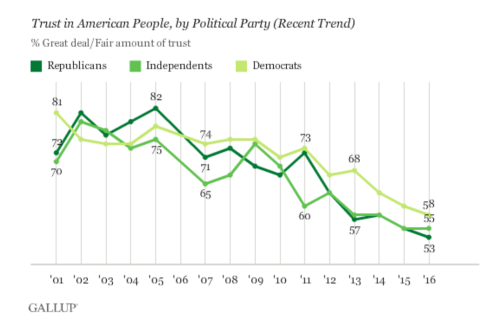
Unfortunately, we don’t. The twenty-first century has seen a significant crisis of faith not only in our political leaders but also in the American people, according to a recent Gallup poll.

gallup-poll-faith-in-voting

From Gallup article “American’s Trust in Political Leaders, Public at New Lows,” September 21, 2016.

A study by the Pew Research center from November 2016 is even less optimistic, with only 34% of the public trusting the collective political wisdom of the American people.

Well, it’s easier to take away universal suffrage from people who don’t believe in it, and that’s why it’s under attack now.

What is to be done? I have three outrageous proposals. Think ’em over.

1. Push for universal suffrage

Our laws exclude plenty of people from voting: undocumented immigrants, felons, ex-convicts, people with the same names as felons and ex-convicts, people who live in areas with limited polling stations, and people who physically can’t leave their house to vote. Is that reasonable? If not, what can be done to change it?

You might be thinking I’m going too far. But consider. Aren’t ex-convicts supposed to have “paid their debt” to society? And don’t undocumented immigrants pay local taxes such as sales tax? And wasn’t the rallying cry of the American Revolution “No taxation without representation“?

Right now, when our system is broken, is the time to question everything.

2. Use democracy everywhere

By this I mean family meetings, book groups, PTA meetings. Be a democracy nerd. Anytime you’re in a group and an unofficial leader says, “Well, it looks like we have consensus. . .” just pipe up and say, “Why don’t we vote on this?” The main objection I see raised is “Oh, we don’t need all that fancy structure” and “It will take too much time.”

Actually, democracy, even in small groups, takes very little time and is efficient. A person starts off by saying, “I move that. . . .” This clarifies the proposal in everybody’s heads. Someone else says, “I second that.” If nobody seconds it, then obviously nobody else thinks it’s a good idea, and it will obviously fail a vote, so the group can drop it and move on.  Then somebody says, “All in favor . . . all against . . . all abstaining.” Count the results, and presto! You know what the group wants to do.

Actually it’s not quite like that. There’s room for discussion after the second and before the vote. That can take time, but chances are it will be quicker than its alternative. And if the discussion drags on past the point of usefulness, somebody can always say, “Call the question!” That means “Shut up and vote already!”

(Geeky interlude here. Technically, if you’re following the official Roberts Rules of Order, you have to vote on whether or not to call the question. In practice, I’ve found this makes people very confused, especially the ones that were still talking. Are we voting on whether to vote, or are we voting on the motion? Then the facilitator explains, but the people who just started talking after the question was asked are confused all over again. A trained facilitator will know when the room is ready to call for a vote, or another method can be used, like a thumbs-up/thumbs-down “temperature check.”)

3. Use democracy in the private sector

This is the most outrageous proposal at all. It brings us full circle to the quote from “How I stopped believing in democracy.” The author asked, “How does Google just skate along without any suffrage at all, whereas Georgia needs elections?”

Well, why don’t workers have the right to vote at Google, or any other company?

If you’re looking at this question squinty-eyed and thinking “What in the heck is she on about?” then this is the time to notice that you’ve internalized a belief that the private sector–even nonprofits–should not be held accountable to the public interest. Maybe it’s true, maybe it’s not true, but most people have not even thought about it.

The thing is, when we work eight or more hours a day and every meeting we attend has a boss managing the discussion and making all the decisions, we come to expect that even in meetings we hold outside of work. (This goes back to my outrageous proposal #2.) We expect to be powerless everywhere. But what if it was the other way around? What if the public was powerful everywhere instead?


#

Democracy. Use it or lose it. Our choice.

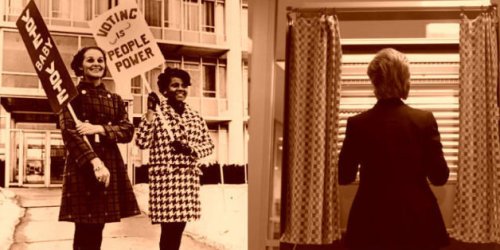
voting-is-people-power

– Kristin

Election fraud

There’s a debate within the U.S. about whether or not “voter fraud” happened. Did millions of people vote illegally, or is that just another lie? This is the wrong question to ask. It’s taking a big-picture problem and framing one small issue, in order to divide and mislead voters.

It also hides the fact that voters broadly agree on one thing: we want fair elections. The president is calling for a massive investigation of elections but such an investigation will likely exclude:

  • voter suppression — denying eligible citizens the right to vote
  • gerrymandering — dividing up districts in ways favorable to incumbents, and
  • election machines that can be hacked

There’s a lot at stake here. People are pinning their hopes on the 2018 midterm elections, but if we don’t keep a close eye on these three issues, those midterm elections won’t be free or fair. In fact, at the same time as Tromp is stealing center stage on the news, a House committee voted to eliminate the independent election commission because it is “fluff.” (Here’s a link to an article in the Guardian about it.)

So what do we do?

Step one: Pay close attention to language used by the media. If our news sources are talking about “voter fraud,” call them on it. Use a different term, like “election fraud” — one that won’t narrow the issue.

Step two: Get informed and talk to our friends and neighbors. And by the way, if we’re sharing news, let’s look for the most neutral sources possible. A conservative neighbor is no more likely to believe The Nation, for example, than I am to believe Breitbart.

Step three: pick our news sources deliberately rather than waiting to see what new and sensational terror comes through our social media. We should control our viewing of news, not the other way around.

Further Reading

Here are a few quick sources for further reading about ways elections can be compromised:

A Bloomburg Businessweek article on voter suppression, published before the election. These are the words of a senior official in the Tromp campaign:

Instead of expanding the electorate, Bannon and his team are trying to shrink it. “We have three major voter suppression operations under way,” says a senior official. They’re aimed at three groups Clinton needs to win overwhelmingly: idealistic white liberals, young women, and African Americans.

A New York Times article that discusses the background of partisan gerrymandering:

A panel of three federal judges said on Monday that the Wisconsin Legislature’s 2011 redrawing of State Assembly districts to favor Republicans was an unconstitutional partisan gerrymander, the first such ruling in three decades of pitched legal battles over the issue.

Federal courts have struck down gerrymanders on racial grounds, but not on grounds that they unfairly give advantage to a political party — the more common form of gerrymandering. The case could now go directly to the Supreme Court, where its fate may rest with a single justice, Anthony M. Kennedy, who has expressed a willingness to strike down partisan gerrymanders but has yet to accept a rationale for it.

That particular case focused on gerrymandering that unfairly favored Republicans, but the article asks us to rethink whether it’s a good idea to let incumbents of either party should have control of redistricting.

CBS article on whether election machines can be hacked:

Roughly 70 percent of states in the U.S. use some form of electronic voting. Hackers told CBS News that problems with electronic voting machines have been around for years. The machines and the software are old and antiquated. But now with millions heading to the polls in three months, security experts are sounding the alarm, reports CBS News correspondent Mireya Villarreal.

As a counterpoint, the federal Election Assistance Commission says it certifies voting systems:

The Election Assistance Commission told CBS News that it ensures all voting systems are vigorously tested against security standards and that systems certified by the EAC are not connected to the Internet.

But guess what? That’s the exact same Election Assistance Commission the House Republicans committee just voted to eliminate.

No voter, from either side of the aisle, should support that!

cats voting


– Kristin