Category Archives: that’s political

I’m always pondering how to build a better world. Or how to survive this one. I read, think, dream, act. It’s all here: utopias, dystopias, the hidden workings of power, resistance, organizing, and action.

Neo-fascism in science fiction, 2013 to 2015

DSC00443

Here’s a bizarre little story. In 2013, ten percent of a major science fiction / fantasy organization votes for a man who later turns out to be organizing neo-fascists and miscellaneous hate groups. The organization later ignores a complaint about the man sending extreme hate speech over an official Twitter feed, and then takes ten weeks of debate before it decides to expel him. In 2014, a publishing company is started by this man — in Finland, of all places. In 2015, a rather surprising number of people are mobilized to take an action that shakes the science fiction / fantasy community — a hijacking of the Hugo Award nominations.

I’m not using the name of the person here partly because everybody’s sick of talking and thinking about it, partly because the person has already too much publicity, and partly because the person appears to be using that publicity to draw fascists to his site. You can certainly google it, but in the words of author Amal El-Mohtar, only do it “if your day is suffering from a surfeit of happiness and sunshine.”

But I will give the context: for the last three years, a group called the “Sad Puppies” have published a slate of candidates to be nominated for the Hugo Awards, in protest against what they see as the “establishment.” This year, though, somebody else jumped on board with a “Rabid Puppies” slate, almost identical to the “Sad Puppies” one and made a call-out to the Gamergate folks. (That somebody is the same one who was expelled for hate speeech.) Now, some of the awards are populated exclusively by Sad Puppy and/or Rabid Puppy nominations.

So I got curious about the Rabid Puppies story. For such an organized action to succeed suggests to me that somebody has money they’re throwing around for some purpose beyond their stated goals.

So that’s how I accidentally started reading a blog I never would otherwise. And oh, my. It’s kind of like somebody went to the website of the Southern Poverty Law Center, which tracks hate groups, and decided to see how many varieties of hate speech they could include.

But I let’s go back a minute. I said neo-fascist, and here’s why. It’s an excerpt from the blog, in a section on how to submit to the publishing house.

coded fascism

It doesn’t say, “Hello, fascists, come join our publishing house!” But it’s suspiciously close.

The first full sentence here is a question addressed to the owner of the publishing house, and the second is the answer. With some help from Google Translate and a friend knowledgeable about fascism, I got the general gist. “How do Italians see the core difference between Nazism and Italian Fascism, beyond the added-on race stuff?” “I don’t believe this question is appropriate here, but in any case, I recommend such-and-so book by such-and-so author.”

Such-and-so book explains that the failure of the glorious leadership of Mussolini and co. was caused not only by military defeat but also by the supporters not being wholly committed to the cause.

It would be a bit dodgy to go calling somebody a neo-fascist for a statement like this, so I didn’t. But there’s more. Here’s a secondhand account of some holocaust-denial, ethnic cleansing hate speech that is no longer online.

From http://mediamatters.org/blog/2010/05/11/wnds-vox-day-on-reclaiming-traditional-white-an/164574

From mediamatters.org, 5/11/2010

And here’s some more hate speech commentary on a terrorist attack in which actual children were actually killed. This is from August 10, 2013.
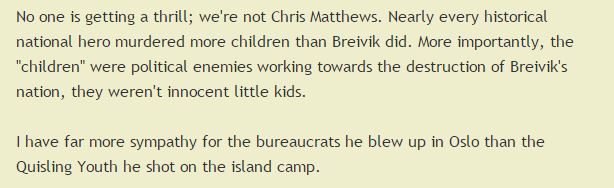
example of hate speech

Other stuff on the blog is calling out to Finnish fascists and other groups, as has been mentioned by authors Charlie Stross and Philip Sandifer.

These other groups, they’re not just mucking around in the field of books. No, they’re trying to ban immigrants of color, they’re hoping for a medical “solution” for homosexuality, they’re beating their wives at home. There are some real-world consequences for these views, which is exactly why hate speech is illegal.

And of course, fascism in its “Golden Age” was all about military and killing and all.

As you might expect, I quite naturally felt a bit alarmed at the thought of organized neo-fascism in the science fiction and fantasy community.

Fortunately, author N.K. Jemison calmed me down somewhat by giving some historical perspective. See, I was thinking of fascism in science fiction as this new thing that’s popping up, but really, it’s just an attempt to return to business as usual, to the “Golden Age of Science Fiction.”

As Jemison explains back in 2013,

“Straight white men have dominated the speculative literary field for the past few decades; their dominance is now going the way of the dinosaur; most are OK with that but a few (and their non-straight-white-guy supporters) are desperately trying to figure out how to bring things back to the way they were.”

So, I was thinking, it’s a garden-variety conservative backlash. But I disagreed, thinking, It’s a neo-fascist backlash, which is different. With all the hate speech going around, someone could get hurt!

But then I kept reading and came across this:

“Which I guess is why I’ve recently had to add some new entries to the file of death and rape threats I’ve already gotten over the years (pretty much since around the time I started publishing professionally, if you’re wondering).”

So I had to smack myself in the head for forgetting all the violence that is routinely being done to people of color, and once again for forgetting it while my Facebook feed is full of stories of people who “just happened” to have their spines break while in police custody.

But then I thought, “That’s racism and violence, not fascism,” because there is a line that divides fascism from other things. So then I had to ask, “What exactly is that line?”

And also, “How do you figure out where a person stands in relation to that line?”

One might wonder, “If somebody ends up accidentally supporting a neo-fascist, what’s their next step? Do they step back carefully, double down, or sit comfortably in a state of denial?” I think it would be fair to ask such a person: “Do you oppose fascism, support fascism, or are you neutral on fascism?”

(And yes, of course nobody can be neutral on fascism.)

Or I could just wait until the next thing happens, whatever this is, because this is an organized attack on feminists of all sorts, and see who sides with whom, and add 2016 to the title of this blog post.

So then the question became, “How do you counter fascism in science fiction and fantasy?”

And that was too big a topic for me to address before lunch, so I’ll just finish up with another couple quotes by N.K. Jemison:

“. . . all this anger and discussion reflects a struggle for the soul of the organization, which is in turn reflective of a greater struggle for the soul of the genre, and that overall struggle taking place globally.”

and

“SFF is going to become more diverse, with women and people of color taking their place as equals within its hierarchies, whether the scared white manly men want it to or not.** Nothing can stop this now; it’s inevitable.”

Oh yes, and the one action I’m going to take after all this research? Read a good book.  I have three new authors on my “to-read shelf” — N.K. Jemison, Charlie Stross, and  Philip Sandifer.

(Note: I edited this on 5/5/2015 and again on 5/7/2015 to include a little more context & details.)
Who makes public policy?

Lawmakers pass laws. Lobbyists influence lawmakers and therefore the laws. But who writes the laws? And most importantly, who decides on the public policy that shapes the laws? That’s the part of government that we don’t usually see. Luckily, it’s easy to find, if you know where to look.

The private sector creates public policy. This includes for-profit corporations, nonprofits, billionaire philanthropists, and think tanks. One well-known example of the private sector creating policy is the American Legislative Exchange Council (ALEC) – read more about them here.

ALEC does their work in secret, but many organizations do the same thing out in the open. I found this out when I started learning about corporate education reform, which mostly means creating opportunities for the private sector to take public education dollars and use them to “improve” public education and control what is taught to our kids. For the public to swallow this, I learned, it took quite a bit of propaganda. Being a curious person, I researched and wrote a post on the think tanks that create the propaganda.

As it turns out, these same think tanks are holding policy discussions on topics that affect us, and our children, quite intimately. Seattle Public Schools, along with thousands of schools across the nation, is about to administer a suite of tests called the Smarter Balanced Assessment Consortium. These tests are meant to measure student mastery of the Common Core, a set of education standards that was designed and promoted by the private sector — specifically, the National Governors Association (NGA) and the Council of Chief State School Officers (CCSSO), two nonprofits. These standards are copyrighted by the NGA and the CCSSO, meaning that any modifications to the standards are completely out of the control of the public.

Let’s go back to the think tanks for a minute. One of the think tankers I mentioned in my blog post on think tankers is named Rick Hess, or Frederick Hess. He’s a senior fellow with the American Enterprise Institute (AEI), which was founded in 1943 by a combination of thinkers, business leaders, and finance leaders. It has drawn fire over the years for spreading propaganda for the tobacco industry and for bribing scientists to disseminate information that undermined legitimate research on global warming. Not a poster child for the public good.

Hess, to my surprise, came out with criticism of the Common Core. Curious as always, I poked around a bit and found that the AEI had hosted a symposium with the topic “Common Core Meets the Reform Agenda.” It asked the question: “Going forward, will the Common Core initiative complement or conflict with the school reform agendas that states are currently pursuing?” That question was tackled by people who influence policy in one way or another (see participant bios).

The papers show a debate over various corporate reform policies such as high-stakes testing, charter schools, and the Common Core. For example, here is a policy recommendation from the article “The Common Core Standards and Teacher Quality Reforms” by Morgan Polikoff.

(A quick note: There is a note on this article claiming it is a draft and asking people not to cite it. That’s silly. Since it’s online, it is published, and citations fall under fair use guidelines.)

“Because these changes are happening simultaneously, both reforms might be more faithfully applied if there were a moratorium on making high stakes decisions about teachers (e.g., hiring, firing, tenure) until after the Common Core and its assessments are fully implemented.”

So the recommendation is to implement Common Core and assessments, and then work on legislation to use those assessments to make high-stakes decisions about teachers.

That conversation ought to have occurred in the public eye and with the involvement of the public, especially the parents, teachers, and students this recommended policy will impact.

It didn’t. That’s not how our government works.

But seeing what’s going on behind the scenes does give us the ability to stop it. Knowing about ALEC, for instance, has helped us oppose dangerous laws before they are passed.

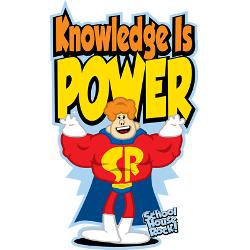
Knowledge is power.

Knowledge is Power!

Event recap – “We Want Something More”

On Friday night I attended an event titled “We Want Something More: Building Revolutionary Movements That Can Win.” I’m planning to give it a fuller recap, but right now, as often happens, I only have a few minutes before I need to get the kids going with breakfast. So I’ll give a few details now and more later.

It was a great success. There were more than 50 people in attendance — people who have been involved in revolutionary organizations and maybe felt there was something lacking, maybe suffered from burnout or watched others who were actively pushed away. People who want something quite different. And Jeremy, who gave the main talk, has a concrete proposal. It’s not perfect, but it’s a start. Here’s a quote from the handout:

Our Mission: Roots in the Movement is an open community of people who congregate together around our shared desire to build a transformative social justice movement. Through popular education, relationship building, and cultural activities, we aim to support and mutually inspire each other in the long and difficult struggle for a better world. We consider ourselves as just one part of a much larger liberation movement.

Consider that a teaser. There’s more information on a website that I currently can’t find.

I came to the event about a half hour late, having driven for 80 minutes straight in rush hour traffic. (Sigh.) Jeremy was speaking and showing slides about problems he’s seen with revolutionary organizations so far. He suggests that they actively push people away, and I agree. We broke into small groups and discussed it among ourselves, then came back to the larger group.

After laying out the problem, he began with some concrete proposals. I’ll get to those in another blog post, but suffice it to say that a whole lot of people came out of that energized and with new ideas.

So . . . breakfast now. More posts another day.

“I am a man”

“I am a man,” writes Ursula Le Guin in her book the wave in the mind: Talks and Essays on the Writer, the Reader, and the Imagination. She doesn’t mean it literally; instead, she’s making some potent observations on the past and present of Western culture.

She goes on. “Women are a very recent invention. I predate the invention of women by decades.” I love this! She’s telling a tall tale that makes us look at the world with fresh eyes and laugh at it. It’s the sugar that makes bitter truths go down.

“So when I was born,” she continues, there actually were only men. People were men. They all had one pronoun, his pronoun; so that’s who I am.”

She’s not, however, a particularly successful man: “I can’t write my name with pee in the snow, or it would be awfully laborious if I did.”

Le Guin goes on to explain all the other ways she fails at being a man, and then points out that she’s not much good at being young either, and suggests that perhaps she might as well start pretending that she is an old woman. “I am not sure that anybody has invented old women yet; but it might be worth trying.”

Of course she isn’t a man; she is an old woman, and a mighty fine one at that. If I’m ever fortunate enough to become an old woman, and I can pull it off half as well as she does, I’ll be happy. I hope she stays an old woman for a long, long, long time.

But I do resonate with what she says. I’m a man too. A feminist man. I became a feminist boy at the age of ten, when I read Enid Blyton’s Famous Five series and identified so strongly with George, the girl who insisted on being called a boy. George believed that boys were better than girls, and by being a boy, she was better than a girl.

Feminist discourse was right there with me, for quite a while. Women could be as good as men, but only by becoming like them. I didn’t see a separate and worthwhile female identity for a long time — or rather, it’s come into focus only slowly, as I stay home, do housework, and raise kids. I have to keep reminding myself that my work is valuable and important.

(That means it’s time to take an intermission from this blog post and listen to Carole King singing about The Enchanted One.)

Okay, that’s better. Anyhow, I’m gradually coming around to the concept that I might be a woman. Dresses — no. Purses — no. Lipstick and eyeshadow — no. Girls’ night out — you bet! Listening to the Verity Podcast — absolutely! Favoring books by woman — yes! It seems my gender changes as my activities change. Maybe that’s my superpower.

I absolutely loved what Ursula Le Guin had to say about women at the 2010 Winter Fishtrap gathering, themed “Learning From Women.” She was uncomfortable with defining what a “woman” was, and pointed out that women are required to learn how to be men, but the same is not true in reverse. A proposal went out that we might honor the men in the audience by letting them be honorary women. Well, that was mind-blowing!

Okay, now, I’ve managed 548 words without talking about Doctor Who, even though I’m really, REALLY excited about Doctor Who right now. We just saw an episode where a woman, Clara, played a man, the Doctor. She did it flawlessly. Why, she’s as good as a man!  Who knew? (Or you could look at it another way: the role of Doctor turned out to be gender-neutral and to fit a man or a woman equally well.)

So how come, I wonder to myself, how come I didn’t get all excited about seeing a woman Doctor, but instead wrote a blog post all about the man, and what he’s thinking and feeling? That question is right up there with, “Well, I’m a feminist, so why am I taken with this quite patronizing and patriarchal character?” Also, “If the role were to be played by a woman, would I like it as much?”

Another question: when I watch the show who am I identifying with? The female companion or the male Doctor? The answer is both, and that sometimes it’s one more than the other. When I first started watching the Doctor Who, I identified most strongly with the female companion, Zoe. She was about my age, and a good student, and she got to one-up the Doctor intellectually from time to time. I also identified with Liz Shaw, Jo Grant, Sarah Jane, Nyssa, and Ace.

Right now, though, I’m mostly identifying with the Doctor, as played by Peter Capaldi. And I’m doing it whenever he has a difficult choice to make or an ethical question to consider.

Curious.

canyonlands graffiti2

Cons, books, and guests of honor?

So there’s a convention called Readercon. It’s all about books. How awesome is that? This year the Guest of Honor was Andrea Hairston, a woman of color with a long list of credentials and awards. Unfortunately, the dealer’s room at the con neglected to carry her book.

Here’s a blog post about it, “Erasure Comes in Many Forms” by K. Tempest Bradford. She writes:

The fact that none of Andrea Hairston’s books were in the dealer’s room is bullshit of the highest order. Andrea was a Guest of Honor. You don’t fucking NOT stock the book of a guest of honor at a con where you are a book vendor. How is this not con vending 101?

In the comments, people who were involved or attended the conference talked about how that could possibly have happened, and who might have been responsible or not responsible for this failure. From what I gather, here were some of the reasons: 

  • cons don’t exercise authority in telling booksellers what to stock
  • booksellers at cons don’t necessarily make the effort to carry Guest of Honor books
  • the publisher, Aqueduct Press (a small press), applied for space in the dealer’s room and was turned down
  • the terms and availability from the book distributor made it difficult for booksellers to get the books

Does it all boil down to economics?

A little background on publishing and book distributing might be helpful here. Beginning with the era of big-chain bookstores like Barnes and Noble and continuing on with Amazon, it has been getting harder and harder for small bookstores and small presses to make any money on books. The industry does all kinds of mysterious things, invisible to readers, that impact the availability of the books we love.

See AmyCat’s comments on that. Sounds like book distributors don’t always offer the same terms to booksellers for small presses. She writes:

Only about 1/3 of the titles in the database, though, are in stock AND at full discount AND returnable… 😦   When small-press titles aren’t available at full discount, my choice is to make an even smaller profit on them, or mark them higher than cover price, and lose sales to Amazon

Some books can be returned to the distributor if they don’t sell, and others can’t. This is a big deal for bookstores, because they stand to lose money on books they can’t return. Another option is for authors to offer their books on consignment.

If the guest of honor had been a white person, I could just call it a Free-Market Fail. That is, basic economics got in the way of respect (and income!) for the Guest of Honor. 

Or does race play a part as well? And if so, how?

But here’s something interesting . . . one commenter wrote:

It wouldn’t have occurred to me except for reading this post, but now I recall that even a Big Name like Delany was not much in evidence amongst the booksellers, despite his prominent attendance at the con

Delany is another writer of color with a long list of accomplishments and honors, including being named the 30th “Grand Master” of the Science Fiction Writers of America. And he’s particularly well known on the convention circuit. So why wouldn’t his books be sold? 

And come to think about it . . .

As I’ve been pondering all these questions, I’ve also been considering my recent visit to my local library. There were about ten sci-fi / fantasy books singled out as being interesting to readers. All or almost all of the writers chosen were white. (One used a pseudonym, so who knows.) I later followed that up with a quick search on the library catalog and found that many respected SF/F writers of color are not represented except in ebooks. And there aren’t that many copies for the really big and well-established names, like Octavia Butler and Samuel Delaney. 

And yet here is one of the library’s guiding principles:

Respect and embrace the entire community

We celebrate Seattle’s diversity and strive to ensure that all people feel welcome in the Library. We strive to meet the needs and expectations of every Library patron. The Seattle Public Library actively supports efforts that combat prejudice, stereotyping and discrimination.

I see this guiding principle being followed in the children’s section, where I spend most of my time these days. The kids on the covers are more diverse than my neighborhood is, to tell the truth. But the sci fi / fantasy section is less so.

What is to be done?

Cons and libraries alike are fighting racism. But Fails like this one keep happening. How come? Everybody’s doing business as usual, aren’t they, so what’s the problem?

The problem is that everybody’s doing business as usual, in a society plagued by systemic racism of all kinds. It probably seems fair to some — like everyone is being treated equally. But they’re not, because the playing field isn’t level. Special effort has to be made to stop business as usual, to act intentionally, notice what goes wrong, and fix it. And that is happening, for sure. A lot of the people commenting on K. Tempest Bradford’s post gave suggestions for how to make sure this particular Guest of Honor fail doesn’t happen again. One suggestion was to have an “Authors Alley” where authors could sell their own stuff.

But perhaps there should also be a hard look at whether the dealer’s tables are stocking books by people of color — and if not, what are the barriers, economic and otherwise . . .

. . . and how do we tear them down?

breaking down the wall

Hmm, something’s missing here . . .

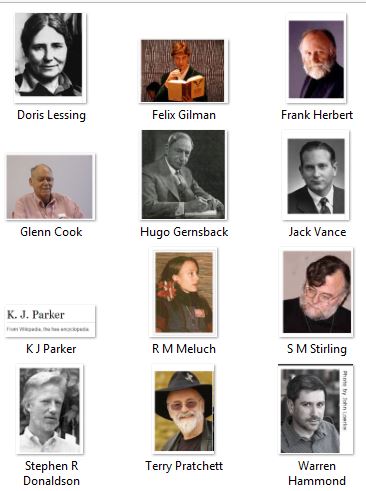
I was at the library today browsing the science fiction / fantasy section. I noticed that somebody had put tags under books of note, giving a “teaser” sentence or two. But something seemed to be missing. I googled the authors’ names, snipped the first photos I could find for each author, and collected them in this image. I have two questions here: 

1) What is missing; and 

2) How would somebody go about bringing this to a library’s attention? 

(One of the authors is not pictured because they use a pseudonym.) 

authors whose books are tagged

The gendered hand

When we think about physical differences between women’s bodies and men’s bodies, we usually think of the more obvious parts. But I wonder if our hands, too, have a gender. 

Let me back up a minute. I am taking my daughter to a handwriting tutor over the summer. Schools have cut down on the amount of direct instruction in handwriting they do, because they are focusing more and more on cramming data in so kids can pass the standardized tests. When kids turn out to have difficulty writing their schoolwork, the fix is to teach them to type. I can’t accept that. Handwriting is important.

So I’ve learned a lot about hands. Every single hand has 29 bones, 34 muscles, and 48 nerves. Who knew? It’s a miracle that our bodies and minds ever figure out how to use our hands. So when a child is having difficulty with handwriting, and many do, we shouldn’t be surprised.

From conversations with occupational therapists, I’ve learned that one of the reasons kids are having such trouble with handwriting is that they just don’t get the time, space, or freedom to play the traditional childhood games that just sort of happened at least through the 1970s, when I was a kid. Jacks, marbles, pick-up-sticks . . . things like that. Many of these games strengthen the muscles needed for the thumb and index finger to pinch together, as they must do to hold a pencil in a tripod grasp.

Thinking about traditional childhood games made me nostalgic, and being nostalgic led me to the toy store to buy a cat’s cradle string. (I know, I know, you can just get a string . . . but it was a birthday present.) I had forgotten how to do it, so my mom and I spent about a half hour figuring out how to use it and then playing with it.

In the morning, WOW were my forearm muscles sore!!! Cat’s Cradle was a great workout. Maybe people should do it on their coffee breaks so they don’t get carpal tunnel. I wonder if it helped me develop good handwriting as a girl.

And then I got to thinking. In the 1970s, Cat’s Cradle was a girl’s game. And so were jacks. And sewing. And marbles. And pick-up-sticks. The boys were off riding Big Wheels and bicycles and climbing trees and doing large motor activities. (This is of course a generalization. I climbed my share of trees, believe me!) And the boys had messy handwriting.

And typing and secretarial work was women’s work. Funny how that happened, gendered play preparing girls and boys for gendered occupations. This is all old history, except . . . I suppose that I never thought it would impact something as basic as the functioning of our hands.

Perhaps there’s a lesson for the feminist movement as well. Maybe it’s time to bring back some of these girls’ games — but not just for girls. As we give more opportunities for gross motor play for girls, we should also be thinking about the fine motor play for girls.

Is it time to teach Cat’s Cradle to my son?

The SCOTUS ruling and beyond . . .

I spent a couple hours reading up on the SCOTUS ruling. It was ridiculously complicated reading! To spare others the same time-sink, here’s what I learned in a nutshell.

1. Other for-profit companies are suing to avoid having to pay for insurance for contraception of any kind, and the Supreme Court is looking like it might find in favor of the companies. Why? Because the Supreme Court decided to review three cases in which the for-profit companies lost, but refused to hear three cases in which they won. More details here:

http://catholicherald.com/stories/Supreme-Court-moves-six-cases-after-Hobby-Lobby-ruling-adds-others-to-docket,26615

2. Meanwhile, the Supreme Court may also rule that an alternative currently available to women is unconstitutional. Part of the reasoning in the Hobby Lobby decision is that there was a less restrictive means for the government to ensure women have free birth control. They cited two examples: one, the government could pay for the four forms of contraception; or two, the government could use an existing accommodation that lets employees have birth control without employers have to pay for it. However, they have signaled that they might reconsider by issuing an injunction so a company wouldn’t use that means.

More details here:

http://www.washingtonpost.com/news/volokh-conspiracy/wp/2014/07/03/supreme-court-grants-wheaton-college-an-injunction-against-contraception-mandate-accommodation/

All very concerning. If all this goes through, could insurance companies also be exempted from having to pay for contraception? Could doctors be exempted from having to provide it? Could pharmacies be exempted from having to prescribe it?


Conversation-Fail Bingo Card

A unicyclist goes down the street. A passerby says, “Hey, you’re missing a wheel!” It’s a funny joke and the passerby thinks she just said something incredibly clever and original. The unicyclist shakes her head and moves on, because she’s heard it a thousand times before.

Online conversations with men and women often have the same kind of problem. A man says something offensive, and a woman gets angry not only because it was offensive, but also because she’s heard it a thousand times before.

To make matters worse, there’s a pattern at work in online conversation, a collection of ways that men frequently dominate the conversation, minimize women’s concerns, patronize women, and argue when they ought to be listening. Each of these things piss us off, and a big collection of them pisses us off even more.

To make matters even worse, this often starts a general communication breakdown in which women try to explain what’s happening and men argue with the women.

It can be difficult and time-consuming for us to explain what’s going on, because we have gotten angry without necessarily noting each individual thing that was a problem. The human brain is adept at recognizing patterns. Once we’ve learned a pattern, we see the forest but we can forget about the trees. So a woman might see this pattern, get angry, but not necessarily know which trees pissed her off. Meanwhile, it’s common for a man to demand that a woman produce the one tree that’s the problem, then argue with the women about that one tree. No learning occurs, no problems are solved, the conversation derails, and nobody’s happy.

This Bingo card is a way of addressing the problem. Men can use it as a self-education tool, and women can use it as a way to explain the problem without having to go through the hugely frustrating process of explaining each point one by one. Think of it as a diagnosis tool. If squares keep getting marked, there’s a problem. The more squares, the worse it is. Time for an intervention!

There’s also a companion card, a Conversation-Win Bingo Card, here.

If you don’t know what a Bingo card is, do a google search for “feminist Bingo card” or “racist Bingo card” or something like that, and you’ll find one. It’s full of offensive things that people say on a certain topic. Things that have been said a thousand times and piss people off more every time they’re said. If somebody can make Bingo, the conversation is a Fail. If you don’t know what a Fail is, do a google search for the word “racefail.”

Conversation-Fail Bingo Card

Conversation-Fail Bingo, a.k.a Mainsplaining Bingo, a.k.a. Bingo Card for Troubles with Online Communication Between Men and Woman

A companion to the “Conversation-Win Bingo Card”

Conversation-Win Bingo Card

My last post was a Conversation-Fail Bingo card. It’s a diagnosis tool to find out if there’s a problem in an online conversation between men and women. But then what? How can it be fixed? Or prevented in the first place? So here is a companion card, a Conversation-Win Bingo card. These are some things men can say to up the overall quality of a conversation between men and women. Or any conversation between any gender, for that matter!


A companion to the Conversation-Fail Bingo Card

A companion to the Conversation-Fail Bingo Card