Category Archives: that’s political

I’m always pondering how to build a better world. Or how to survive this one. I read, think, dream, act. It’s all here: utopias, dystopias, the hidden workings of power, resistance, organizing, and action.

What are our students’ privacy rights, really?

As a parent, I want to know that my children’s information is kept private. I tell them not to put their birthdates on any Web pages that ask for them, I keep their names out of this blog, and I have filled out FERPA opt-out forms to prohibit disclosure of student information.

But there are some things I can’t control, and information given away by my child’s school to the private sector is one of them. That’s because of recent changes to the federal privacy law (FERPA). These changes were made right around the time that it became possible to build massive databases of student data — databases that can be shared across states and over the life of my child, from cradle to grave. Let’s take a quick look at the law, to see where the weaknesses are.

A summary of the FERPA law is available here. It tells when schools need permission to disclose information, and when they don’t.

  • Generally, schools must have written permission from the parent or eligible student in order to release any information from a student’s education record. However, FERPA allows schools to disclose those records, without consent, to the following parties or under the following conditions (34 CFR § 99.31):

    • School officials with legitimate educational interest;
    • Other schools to which a student is transferring;
    • Specified officials for audit or evaluation purposes;
    • Appropriate parties in connection with financial aid to a student;
    • Organizations conducting certain studies for or on behalf of the school;
    • Accrediting organizations;
    • To comply with a judicial order or lawfully issued subpoena;
    • Appropriate officials in cases of health and safety emergencies; and
    • State and local authorities, within a juvenile justice system, pursuant to specific State law.

Schools may disclose, without consent, “directory” information such as a student’s name, address, telephone number, date and place of birth, honors and awards, and dates of attendance. However, schools must tell parents and eligible students about directory information and allow parents and eligible students a reasonable amount of time to request that the school not disclose directory information about them. Schools must notify parents and eligible students annually of their rights under FERPA. The actual means of notification (special letter, inclusion in a PTA bulletin, student handbook, or newspaper article) is left to the discretion of each school.

Note that organizations conducting studies on behalf of the school can get access to this data, and it’s nonconsensual — meaning that parents can’t opt out.

There’s also a little something in there that’s extremely misleading. School officials can get access. That’s reasonable, right? But wait — how are “school officials” defined?

For that, we have to check out the actual text of the law (20 U.S.C. § 1232g; 34 CFR Part 99). Under paragraph 99.31, it says, “A contractor, consultant, volunteer, or other party to whom an agency or institution has outsourced institutional services or functions may be considered a school official under this paragraph provided that the outside party—”

(It goes on to list the specific conditions that have to be met.)

That’s awfully misleading.

There are also conditions under which this information can be redisclosed by “school officials” to other parties. That gets tricky and complicated.

Paragraph 99.33(a)(1) says:

An educational agency or institution may disclose personally identifiable information from an education record only on the condition that the party to whom the information is disclosed will not disclose the information to any other party without the prior consent of the parent or eligible student.

That makes it safe, right?

Oops, no. Paragraph 99.33(b)(1) says:

Paragraph (a) of this section does not prevent an educational agency or institution from disclosing personally identifiable information with the understanding that the party receiving the information may make further disclosures of the information on behalf of the educational agency or institution if—

To make a long story short, there are times where a school can disclose personally identifiable information, such as social security numbers, to third parties in the private sector, and then those third parties can then disclose this information to somebody else. And this can be done without parental consent.

Even worse: if you dig into some other privacy laws, such as those protecting medical information and those protecting students with disabilities, you’ll find that they all point back to the FERPA law. This means that information can be shared to third parties as well.

Now we know this can be done. But is it?

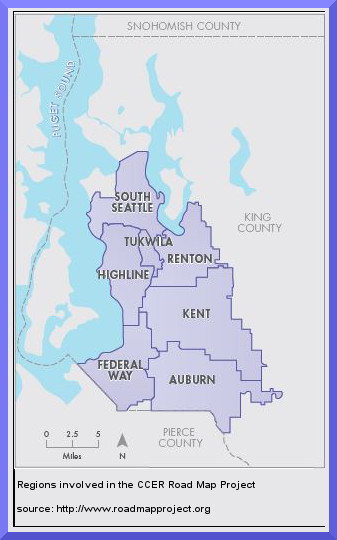
The long answer is a subject for another post. But the short answer is “yes.” There have been different releases for different regions of the U.S. In the Puget Sound region (Washington State), this data has been released to a nonprofit called the Community Center for Education Results for all students attending in public schools residing in these areas:
Image

If you live in any of the affected areas and want to know more, post a comment and I’ll get back to you.

How to check out a nonprofit, part two

In yesterday’s post, “How to Check Out a Nonprofit”, I showed how to find out who’s calling the shots. The board of directors makes the strategic plan, which must be in line with the funders’ wishes. Why? Because a nonprofit lives or dies by its funders. I’ll go through this one more time, adding a couple other details.First a caveat: know when to stop. There is so much information out there that you could spend an infinite amount of time investigating a nonprofit or looking at the various connections between the nonprofit sector, billionaire foundations, and corporations. Don’t do that.

Let’s look at the National PTA today. They partnered with the nonprofit DQC to put out a white paper called “What Every Parent Should Be Asking about Education Data and Privacy.” It was extremely reassuring and evaded the real questions, like “what exactly do the federal privacy laws allow, and what don’t they?” It turned out that DQC is funded and directed by corporate interests who stand to make a profit off student data.

Why would the National PTA partner with them?

The National PTA does a lot of good. It’s a powerful voice for children. It’s mission has maybe changed a little recently, though. Their new motto, “Every Child, One Voice,” is a little concerning. Aren’t there a whole lot of voices with conflicting ideas about what constitutes a good education? In particular, there’s the question over whether our schools should be privatized. Some parents think yes, some think no.

Who funds it?

The National PTA is funded partly by its members and partly by its sponsors. It’s accountable to both its members and its sponsors. By and large, the sponsors support privatization, and that’s enough to tip the balance. The sponsors are:

  • AXA Equitable
  • Jamba Juice
  • Lifetouch
  • Promethean
  • Target

Two jump out. Promethean is “a leading education company committed to developing interactive learning technologies that inspire teachers and engage students.” They have a business interest in big data.

And then there’s Target. I shop there sometimes. I see the big sign that says it gives back 5 percent of its income to local communities. It doesn’t say that it gets power and influence by doing so. Now, didn’t we see Target somewhere before? Oh yes, they are also a funder of DQC, which coincidentally authored the white paper with the PTA.

Who’s on the board of directors?

Looking at the board of directors, I see a lot of people doing a lot of good. Big shout-out to Laura Bay, who as head of the Washington PTA supported the “Simple Majority” initiative, which made it easier for local communities to pass school levies.

The president, elected just this year, is a little unusual. Usually you see people with a background in education.  But President Otha Thornton has a military background. From his bio:

He is a retired United States Army Lieutenant Colonel and his last two assignments were with the White House Communications Agency and United States Forces-Iraq in Baghdad. Thornton earned the Bronze Star Medal for exceptional performance in combat operations during Operation Iraqi Freedom 2009-2010.

The military hasn’t got an interest in the PTA, has it?

He is also currently a senior operations analyst with General Dynamics in Fort Stewart, Georgia. Well, what do they do? Oh, they’re a defense contractor. They have an Information Systems and Technology group, which works with “defense, intelligence, homeland security, civilian government and commercial sectors.” Oh.

I don’t have any time to look into this further. My kids need breakfast. Remember what I said earlier? Know when to stop.

But I promised to show to more ways to investigate nonprofits: their annual report and their IRS tax form (Form 990). Sometimes these are hard to find or unavailable online. New nonprofits aren’t required to file Form 990 for three years. But it’s worth taking a look. Sometimes you find out that a small nonprofit suddenly got a big influx of cash, and its mission changed.

The National PTA has a page for annual reports and financials. It links directly to their 990 form and their annual report.
You can also find the 990 form really easily by going to the Foundation Center’s “990 Finder”  page and typing in the official name of the organization. In this case it isn’t “National PTA,” it’s the “National Congress of Parents and Teachers”. Type that into the “Organization Name” box and there you go!

They did have a jump in income between 2009 and 2010, from 16.7 million to 24.3 million dollars in total assets. Somebody started giving them cash.

Checking their 2009 and 2010 annual reports, I see a big change. In 2010, for the first year, their annual reports got glossy and colorful. The annual reports don’t show the jump in income, so I can’t tell right off the bat where it came from. If I had more time, I could figure it out.

But it’s time for breakfast!

One positive sign: it looks like they take in more cash from members from sponsors. That means that in theory they are more accountable to the members. But that depends on people keeping a really close eye on them. And this is how to do it.

So that’s how to check out a nonprofit.

Also see:


How to check out a nonprofit

In yesterday’s post I asked the question “Are Nonprofits our Frenemies?” That is to say, are there any social benefit nonprofits that are also working behind our backs — for example, to close our neighborhood schools? And I explained how to find out. To recap:

1. Look at their board of directors.

2. Look at their funders.

Now let’s look at another example. I’ve been investigating problems with student data privacy, and I’ve learned that federal privacy laws were recently weakened and that very detailed, personally identifiable data, is being given out to a wide range of researchers. The national PTA has been looking into it as well, and they’ve very considerately put out a press release and guide on questions parents should be asking about data privacy. Strangely, though, it’s missing some of the key questions that parents really ought to be asking, and instead it has vague reassurances that “federal laws protect privacy” and what might just be an outright lie, that the vendors who get student information “can’t sell the data or let anyone else access it.”

Why might that be?

Well, the PTA didn’t put this out alone. They paired up with a nonprofit to write this guide: the Data Quality Campaign. The DQC is pushing for state and federal legislation that set up longitudinal (long term) databases. It also creates “public demand and discourse” for better education data. That is, it does PR.

So let’s check out the DQC.

Who are their funders?

  • The Bill and Melinda Gates Foundation
  • The Michael & Susan Dell Foundation
  • The Alliance for Early Success
  • AT&T
  • Target

Not too surprising, that a lot of foundations related to technology would want lots and lots of data collection. Companies like Microsoft, Dell, and AT&T will benefit financially from selling all those IT systems to the public schools. I don’t know what Target is doing there, but folks, when you shop at Target and they say they’re giving money to education, you don’t suppose it’s for stuff like this, do you?

Anyway, because nonprofits live or die by their funders, everything this nonprofit does is because its funders want it.

Who’s on their Board of Directors?

Okay, so I could find out, but I don’t feel like it today. I’m more interested in the Partners page.

Who are their partners?

They have a bunch of partners. I definitely don’t have time to look at all of them, especially since some are nonprofits. But I see some familiar faces. Specifically:

  • National Council on Teacher Quality – they advocate against National Board Certification for teachers and were infamous in Seattle for horning in on Seattle’s contract negotiations a couple years back. They also put out a biased rating survey of schools of education.
  • Northwest Evaluation Association – they make the MAP test, which has been quite controversial in Seattle
  • Schools Interoperability Framework Association – this is a not-for-profit corporation that oversees an industry initiative to make student data sharing easier
  • Oh dear, the Thomas B. Fordham Institute. They’re a think tank and PR organization focused on privatization.

That’s enough for one day. This nonprofit is run by, and partners with, corporate interests who want to privatize schools and collect and share large amounts of data on our students. They’re not really the people we should trust to tell us whether our children’s data is safe.

Curious that the National PTA would partner with them.

Next up: How to check out a nonprofit, part two

Also see: What are our students’ privacy rights, really?

Are nonprofits our frenemies?

In yesterday’s post, Mysterious timing for Chicago school closures, I talked about how the Teach for America Board of Directors sat down at a planning table and projected that they would be staffing 50 new charter schools in Chicago . . . several months before 50 public school closures were announced. The question is, did they help cause the closures?

I say yes, absolutely. Privatization of public schools is in their mission statement. Their board of directors is responsible for planning and strategy. They benefit financially from the conversion of public schools to charter schools, because they staff charter schools far more often than they staff public schools. And they have the means to influence public policy, through financial and personal ties between TFA, charter school organizations, and public officials. These ties are well documented here, here, here, and here.

However, “TFA is evil” is not the lesson we need to take away from all this. The lesson to take away is that 501c3 nonprofits make good frenemies. They can have a beautiful awe-inspiring mission statement. They can have lovely documentaries on PBS and Univision. And they can still be acting against you.

Why?

It’s because of what 501c3 nonprofits are. They’re organizations that claim to have a social benefit, and maybe they do or maybe they don’t. They’re tax-exempt because of that supposed benefit. Donations made to them are tax-deductible, making them a playground for the ultra-rich with their charitable foundations. And they live or die by their funders. That means their funders have to like the work they do in some way, shape, or fashion. The board of directors is responsible for making sure that a nonprofit follows its mission statement, and even more importantly, pleases the funders.

Maybe it pleases the funders and has a social benefit too. Yay. Except not exactly. Unlike the public sector, which is accountable to the public, the nonprofit sector has no accountability to the public or to the people it is “helping.” What’s lost here is the power of self-determination.

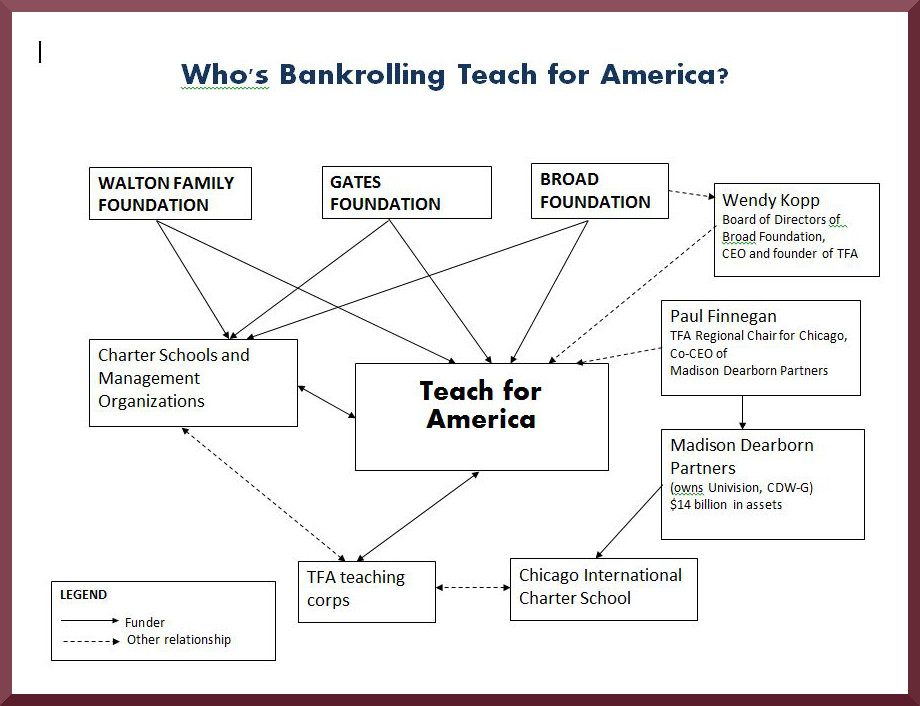
So to know what a nonprofit is really doing, you need to look at the funders and the board of directors. This is easy to do. Google “Teach for America donors” and “Teach for America board of directors” and there you have it. You can learn some interesting things that way. Well, here’s what I learned, starting from the Lines of Influence diagram made by Dora Taylor and Sue Peters, and going from there. I’ll start with a diagram and then explain a few of the highlights.

Image

The first thing to notice is that TFA’s big funders include the Gates Foundation, the Broad Foundation, and the Walton Family Foundation (owners of WalMart). Those three philanthropies hold enormous amounts of money — tax-free. They get the tax exemption because of their supposed social benefit. And they get to advance their aims, which in this case involves the privatization of public schools and teachers.

The second thing to notice is that these three funders donate both to Teach for America and to charter schools. In practical terms, that means that they have the power to use any of the organizations to advance the aims of any of the other organizations. And they do.

The third thing to notice is that charter schools and TFA have a symbiotic relationship. Charter schools provide opportunities for the TFA teaching corps, whereas TFA provides low-cost, inexperienced teachers to charter schools. So they have a natural tendency to help each other out.

The fourth thing to notice, Paul Finnegan, was just a sideline for me. It’s the kind of thing you find out when you go peeking into boards of directors and seeing what their members do. I have to be careful not to do too much of this, but since I looked at him, I might as well explain the connections.

I have to pause here and say I have not found a smoking gun or anything earthshattering or anything like this. This is just the normal way a nonprofit does business. The members of its board of directors often come from leadership positions in the private sector, because managing a nonprofit is a whole lot like managing a for-profit. And the members of its board of directors often come from funders, because after all, what happens if you say no to a funder who wants to sit on your board of directors?

Okay, so Paul Finnegan. He is the regional chair for Chicago. So of course, he makes strategic decisions for Chicago. I imagine he must have sat in on that board of directors meeting in January where they discussed the plan for 50 new charter schools.

When you look at his name on the TFA Board of Directors web page, you see the words “co-chair, Madison Dearborn Partners”. Well, what’s that? Bless you, Google and Wikipedia, for magically providing an answer:

Madison Dearborn Partners (MDP) is a private equity firm specializing in leveraged buyouts of privately held or publicly traded companies, or divisions of larger companies; recapitalizations of family-owned or closely held companies; balance sheet restructurings; acquisition financings; and growth capital investments in mature companies.”

I have to admit, a lot of this is gobbeldygook to me. But you know what isn’t?

“Total assets: 14 billion”

Holy cow! This guy is the co-CEO of a company with 14 billions of dollars worth of assets. That means he controls 14 billions of dollars worth of assets, as well as all the subdivisions and acquired companies and so forth.

I’m sort of starting to understand why a person like that wouldn’t care about the closure of the 50 public schools or the impact it will have on the communities, children, and displaced teachers. He just plain lives in a different world, that’s all. I just wish he would stay there and quit messing with things he doesn’t understand.

That was the big reveal there. 14 billion dollars. But it’s worth digging a little deeper. Madison Dearborn Partners own at least two interesting things:

  • Univision, a Spanish American TV company. Free PR for whatever nonprofit he wants to support! Yay!
  • CDW. Who-what? Wikipedia to the rescue again. “CDW Corporation, headquartered in Vernon Hills, Illinois, is a provider of technology products and services for business, government and education.” That’s profiting off another kind of privatization, outsourcing, but really beyond the scope of this post.

And they donate to something interesting as well: Chicago International Charter School (CICS). Haven’t I seen that somewhere before? Oh yeah, I have.

It was in this spreadsheet of charter schools that are expected to open. Six new schools, serving 3500 students, and providing a whole lot of jobs to TFA.

That’s convenient.

To recap: a 501c3 nonprofit, whatever its social benefit, is ultimately accountable only to its funders and its board of directors. And to understand what a nonprofit is up to, you don’t have to look any farther than that. Friend or frenemy? Check them out.

Next up: How to check out a nonprofit and How to check out a nonprofit, part two

The series “Persuasive Writing for Activists”

Okay folks, I promised new weekly updates on my series “Persuasive Writing for Activists” and I haven’t delivered. Life got in the way and then I got distracted and then I wasn’t sure anybody was wanting it. So if you want to see more, please leave a comment. That’ll guilt me into adding more. 🙂

Much obliged, astronomers!

Guess what? Astronomers have “eliminated most of the risk from global-scale, civilization-ending asteroid impact events during our lifetimes and the lifetimes of our grandchildren.”

They really ought to be bragging about this. But no. It was buried deep in the middle of an article in Sky & Telescope. The article was about the asteroid that hit the Russian city of Chelyabinsk this February. People wondered why astronomers didn’t detect the object before impact. Part of the answer is that it is relatively small, compared to the asteroids we really need to worry about. NASA began a program in 1992 called the Spaceguard Survey Report, with a goal of finding 90% of the objects that are near Earth and larger than 1 kilometer.

And . . . mission accomplished! Now they can look for the smaller stuff, the kind that has the ability to kill people but not wipe out entire civilizations.

(From “The Chelyabinsk Super-Meteor” by Daniel D. Durda in the June 2013 issue of Sky & Telescope.)

Image

Genderfail Sucker Punch!

Couple caveats: #1 I don’t know the whole story so I’m sure I left out important bits; and #2 that I don’t blame any individual people for this. It’s societal.

A sucker punch is “an unexpected blow” but to me holds the additional connotation that “you should’ve expected it, sucker!” When I think of a sucker punch, I think of Charlie Brown still trying to kick that football Lucy is holding.

Genderfail is Internet slang for some sort of failure to appropriately address issues of gender. To my mind it’s a sister term to “racefail,” which can be absolutely epic. For an example of racefail: “RaceFail ’09 is one of the names given to a large and tangled snarl of racism, misunderstanding, culture clash, poor behavior, and hurt which consumed several interconnected corners of fandom in early 2009.” (This is from http://fanlore.org/wiki/RaceFail_%2709)

So now I can explain how I’m using these terms in this blog post: a snarl of feminism, misunderstanding, culture clash, poor behavior, and hurt — that came as a surprise blow to me even though I really should have known better.

My suspicion is that any political organization comprising both men and women is going to have a genderfail at some point. I mean, how do you avoid it, really?

So anyway, there was a political organization. I joined it because although it was male-dominated, it had a core of feminists, and I thought that would be enough to bring real change. Then some things happened, and I went inactive. This part wasn’t genderfail, it was just your basic organizational dysfunction. (Note to self: if it takes an organization more than six months to make a new member packet, it’s time to run.) So I was on the listserv but mostly not paying attention.

Another woman went inactive after having a baby.

Meanwhile, the organization kept on doing what it was doing. Let me make a metaphor here. Let’s suppose that you have built a house, and some people have moved in. Then some more people have moved in, and it is determined that the house needs an add-on, which will take about three to six months. People get out of the way to accomodate the add-on. Maybe a couple people take temporary housing (that would be me) whereas others just move out and move on. Suddenly you don’t need the add-on, but you keep going. And it takes a year and a half, by which time other people have left. Meanwhile, next door, there is a high-rise condo going up. It is determined that the community who lives in the house will take part in the building of the high-rise condo, and about half the people go off and do that.

I guess I was waiting for the high-rise condo to be finished so I could move back into the house.

But meanwhile, back at the house, there was some bickering. Which wouldn’t have been so bad, except then the mansplaining set in, and then the resulting concerns were put down to interpersonal conflict, which was true enough, but not nearly as true as that there was a genderfail in the making.

The sucker punch is this: there were four women who could have stepped in to help, but instead, one bore the brunt of it alone.

Here’s the other reason it was a sucker punch: This house was a rebound relationship for me. The last house I was in had more women than men. It still had genderfail, and it still had racefail too.

And here’s why it was a sucker punch for the activist community as a whole: back then, when I related the genderfail to an activist from the 1980s, she nodded her head and said “Of course!”

We’ve come a long way, baby!

(Or not.)

Scored by Lauren McLaughlin: Some Thoughts

Note: This is an expansion of a book I reviewed on the blog post “Pleasures of Reading, Viewing, and Listening in 2012” on aqueductpress.blogspot.com.

Scored by Lauren McLaughlin
(http://www.powells.com/biblio/62-9780375867910-0)

This YA novel is the dystopia for our time. What happens when you put together No Child Left Behind high-stakes standardized testing with surveillance measures like spy-cams and GPS monitoring of cell phones, and then introduce a company whose product is a single score for every child, which colleges and corporations will then use to sort people?

That is the reality for Imani LeMonde, a high school student whose scores put her on track for a college scholarship — something that is otherwise out of reach for all but the very rich. The scores are supposed to establish a meritocracy to replace our system of inequalities, but something else is going on. Scores update minute-to-minute, and they depend not only on school performance but also day-to-day activities and peer group associations.

Imani’s troubles begin when her score drops precipitously because her friend Cady is kicked out of her house and moves in with a boy. This takes her off the college track, and if her scores drop farther, her only options will be welfare or the military. She has a choice to make — but it’s not the simple moral dilemma of whether or not to denounce Cady to regain her score, because that option is not open to her. Instead, she has to look deeply into the scoring system to understand how it works — and what matters to her.

The society pictured here is not far off the mark. Our teens and children will be subject to more surveillance than we ever imagined. Case in point: school records are kept in “longitudinal databases” where they can be tracked over long periods of time and across school district and state lines. And by school records I mean test scores, tardies, absences, ethnicity, dental records – you name it. (For a sneak peek of the hundreds of items that can be collected, visit http://nces.sifinfo.org/datamodel/eiebrowser/techview.aspx?instance=studentElementarySecondary.)

This information is being provided to the private sector without public comment or scrutiny. For example, the Seattle Public School district signed a Memorandum of Understanding with an organization called the Community Center for Education Results, indicating that the district would be sharing its database of student information with CCER. This database excludes “personally identifiable” information about the students according to the federal FERPA law, but because it is so specific, it is potentially identifiable information, particularly if you are nonwhite, use special education services, and so forth. Also, private sector organizations could easily combine this information with other databases.

(Thanks to the mirmac1 for her comment on Feb 21, 2013 on the blog saveseattleschools.blogspot.com.)

Just as one example among many, yesterday I went to the Pacific Science Center and visited an exhibit called “Professor Wellbody’s Academy of Health and Wellness.” This is a grant and foundation-funded exhibit. As part of the exhibit, children can join the “Academy” by entering information about themselves – first name, school attended, and health habits such as diet and sleep. So now there’s a database about kids per school, and a certain lack of clarity about who will get that information.

Ten years from now, could a prospective employer check the database for these types of information about my children? I bet. Could they get a score? I bet.

Persuasive Writing for Activists

This was a first attempt to introduce this topic, but I’ve done it better elsewhere. Check out https://kristinking.wordpress.com/2013/04/11/persuasive-writing-for-activists-intro/. I’ll be adding content about once a week. — 4/11/2013.

If you know me, you know that to say I have progressive politics is an understatement. If I see a progressive make an argument I agree with, half of me says, “Right ON!”

And the other half is saying, “Seriously? You expect that to persuade anybody? Preaching to the converted, folks.”

As much as I disagree with the conservative point of view, I have to give conservatives props for effective persuasive writing. And honestly, they get empathy points for at least knowing their audience.

There’s a reason for that. The corporate world teaches persuasive writing. And they teach it well.

How do I know? Back at the beginning of the millenium, I taught business writing at a university. That’s where I learned to do persuasive writing. I keep thinking I should create a document “Persuasive Writing for Activists” or make a Power Point and teach a course. That’s one on my list of several hundred things I wish I had time to do.

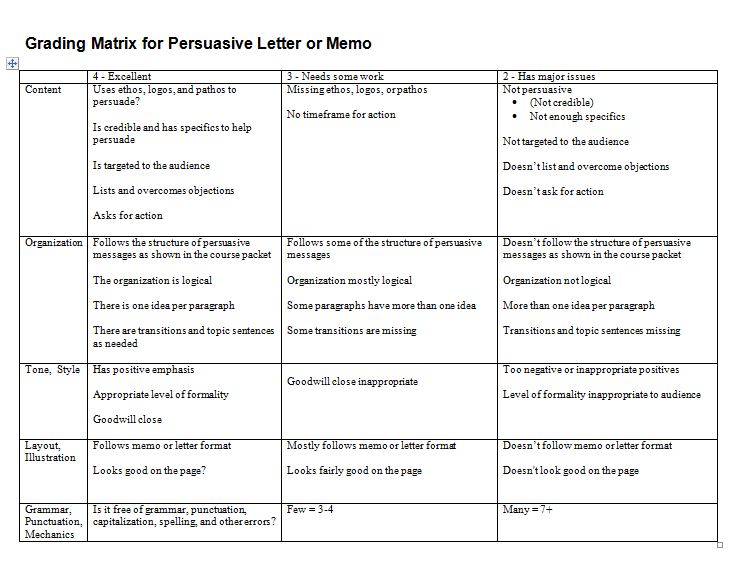
But until I get around to it, here’s a teaser: the grading matrix I used for the business writing course. (This was back in 2002, when some people still used memos.)

With an offer of free advice! Progressive activists: if you would like, I will grade your persuasive writing. Post a comment with your writing, or include a link to it. Then tell me who your intended audience is. I’ll tell you where it went wrong and where it went right.

(P.S. I would grade this blog post as follows: Content – 2; Organization – N/A; Tone and style – 2; Layout – 3; Mechanics – ?. We’re not always at our best, are we?)

Image

Thoughts on the MAP boycott

For whoever hasn’t been following this bit of news – it’s been in the national media – teachers in Seattle are boycotting a standardized test called Measures of Academic Progress, or MAP. The boycott was initiated by teachers at Garfield High School. Students there are on serious testing overload! There are a bazillion tests required for graduation, which is a problem in and of itself. And on top of that, there’s the MAP. This test is not required for graduation and students are not taking it seriously. At the same time, teachers evaluations are strongly affected by the student’s test results.

All these issues – testing overload, tests being used inappropriately – are a national problem. Some consider excessive testing to be child abuse. Testing is pushing out time for learning. Many people agree that basing teacher evaluations on student test scores is highly arbitrary. Parents are frustrated when standardized tests are used for student placement in lieu of the human judgment by teachers.

Something else is going on, too. Our schools are facing many different kinds of privatization, from privatization of schools (such as charter schools and vouchers) to privatization in schools (transforming schools in the model of the private sector, including dehumanized, centralized control). This is misleadingly called “education reform.” That’s where the push toward high-stakes testing is coming from. That’s why a lot of states have passed laws mandating that student test scores make up one-half of a teacher’s evaluation. And that’s why there’s a call for “multiple measures” of student achievement – that is, multiple tests. Test overload.

There’s pushback from the community affected. Students, parents, and teachers alike. At Garfield, all three have come together – the teachers are boycotting, the PTSA supports it, and the associated student body supports it. All over the city and nationally, people are supporting the boycott. By coming together, I think we could kill the MAP. It’ll be a major win not just for Garfield and not just for Seattle: it will provide inspiration nationwide.

But then what? This brings me to the rather inconvenient fact that most of us fighting this standardized testing overload seriously need to grapple with. Some parents, some teachers, and some students like the MAP. Some oppose it, some support it.

And to be honest, they do it for some good reasons. Kids fall through the cracks. They really do. Without testing, some struggling students are not identified and end up graduating high school without being able to read. Without testing, some advanced learners are not identified. The MAP test catches some of those. And in some cases, the MAP is the only tool that’s useful for that purpose.

But then on the other hand, the Seattle Public School District is using it to bar students from the advanced learning program. Kids who demonstrate the ability to work well above grade level, but who don’t meet a score cutoff on the MAP test, are denied access.

Parents do have a recourse, but it has the word “Privilege” smeared all over it. You can appeal. For an appeal to be successful, in many cases, that means private testing. Two groups of people can get that: the group of parents who can afford the $300 per child that you would need to slap down; and the group of parents whose kids qualify for free-or-reduced lunch AND who have the wherewithal to jump through all the hoops needed to locate and arrange private testing, get their child there on time and prepared, and appropriately fill out the forms. Plenty of kids are going to fall through the cracks.

Is it worth it? Is identifying some children’s education needs worth the price of barring others from programs they need?

And is it worth jeopardizing teachers’ jobs over an arbitrary measure?

And is it worth spending so much learning time and money and so many instructional resources (library space, tutor time, you name it)?

I don’t mean the answer is “no.” I mean that these are questions we need to be asking and answering as a community of students, teachers, and parents.

Also, we need to be asking these questions separately from and independent of the private sector individuals and organizations who are interested in privatizing schools. They want to know, “How can we transform education so it looks good to us?” But we want to know, “What’s the best way to bring up and educate our kids?”

We also need to be asking questions like, “How much testing is too much?” and “What kind of testing is appropriate for our kids and at what grade?” and “What is this test measuring?” and “What are the limitations of this test?”

(That last is a biggie. To understand what the limitations are, people need to understand some basic statistics concepts. Measurement error, confidence level, standard deviation. Almost nobody does. We’re using these numbers without understanding them. We’re worshipping the numbers.)

We need to be asking these questions.

Because even if the MAP goes away, it’s going to be replaced by something else. There will be a whole slew of new tests to measure mastery of the new Common Core Standards. (By the way, one organization that will be sitting pretty is Pearson, the company that makes tests and curriculum and as such, has a vested interest in promoting high-stakes testing and testing overload.) States will continue to pass laws mandating that student test results play a role in teacher evaluations. Communities will continue to resist.

So tell me, what do you think? How are these tests helpful? How are they harmful? Is there a way to use them without getting burned? Is there a way to stop using them without leaving some students’ needs unmet? Let me know what you think.