I stand with educators

Last night the Seattle educator’s union voted to strike if the district doesn’t provide an acceptable contract proposal. I’m in full support. I sent a letter to the school board and superintendent, and in so doing, realized exactly how angry I am with the school district. My laundry list of complaints includes: bus transportation withdrawn for my kids; no playground equipment last year due to unexpected placement of portables; learning time lost to the SBAC; and more. But in the letter I just stuck to the ones related to this contract.

A note: the Seattle Education Association is not just teachers. It also includes office staff, nurses, aides, and much more. If I’d thought of it before I sent the email, I would have replaced “teachers” with “educators.”


Please prevent a strike by giving the teachers a reasonable contract proposal. I’m a parent with an entering fifth grader and an entering sixth grader. My fifth grader had a tough year last year, and contributing factors were lack of appropriate recess facilities, stressed out teachers, and teaching to standardized tests.

The district has spent a lot of time, energy, and money trying to overrule teachers’ professional judgement with respect to standardized tests. But teachers are the only ones I trust to know my individual children’s learning needs. And of course I, as the parent, have the ultimate responsibility and authority over the education of my children. That’s why I opted my kids out of the SBAC last year.
You should know that, as a parent, I did not appreciate the district’s requirement that no instruction should take place for children who were opting out of the SBAC. You stole learning time from my child.
You should also know that, as a parent, I feel insulted by the P.R. put out by the district over contract negotiations. You haven’t given us all the information, and what information you have given us, has been slanted. Aren’t we supposed to be equal partners in our children’s learning?
I have high expectations for Seattle Public Schools. My children’s teachers have been meeting them; the district has not.
I stand with the teachers.
News article from 1985 with empty desks in the background

The last time Seattle educators struck was in 1985. They won.

An Etymology of Sad Puppy Terms

Now that the Sad Puppies have failed in their strategy to take over the Hugos by manipulating the nomination process, I thought I could safely ignore the rest of their sci fi and fantasy backlash. But the Wired article I’ve been discussing for several posts tells me I’m wrong. It took some of the terms coined by Sad Puppies and used them with a straight face. Other mass media outlets have done the same.

Some words are sneaky. They say more in connotation than denotation. (In other words, they say more by implication that by direct, concrete meaning.) They become shorthand for a whole set of assumptions. Sometimes digging into their pasts can help illuminate those assumptions. (For an example, see my analysis of the term “political correctness.”)

So let’s take a quick look at what those Sad Puppy words mean, and how they came to be. I’ll cover “trufan,” “CHORF,” and finally “Social Justice Warriors.”

Trufan

Trufan is the funny one, so let’s start there. Both Wired and Popular Science have latched on to it. It’s been around a while, but starting in February 2015, Sad Puppy supporters Sad Puppies started use it as shorthand to defend themselves against the claims that they’re not “real fans.”

Only one problem with that: I can’t find any evidence that more than one person ever made that claim.

I don’t know who that one person was, but I do know that they made it in the comments thread of some post or another. Somebody apparently accused a blogger named Patrick Richardson of not being a true fan, and he defended himself in the blog post “Not a Real Fan.”

However, I can’t find the accusation itself. The only thing I can find is a conversation in the comments thread. One person asked what had sparked this post, and Patrick Richardson replied that Larry Correia had been labeled “not part of fandom.” Another person then said, “I can find plenty of examples of Larry *claiming* people called him not a real writer or not a real fan. What seems thin on the ground is actual pages where people *did* so.” Author John C. Wright, Puppy supporter and beneficiary, then replied, “The comment that sparked this was in a private email which the recipient is unwilling to reproduce publicly.”

So the accusation of which Patrick Richardson was complaining came in a private email from one person to another.

Next up was a post by blogger Mike Glyer saying with the ultimate message that (1) if you try to attach yourself to fandom, you are a fan; and (2) you don’t need anyone’s permission to be there. The post, “Why You’re Not a Fan” began ironically, however, with a silly list of qualifications you must hold to be a fan. You have to read fanzines, join a club, own Star Wars action figures, join a Bardic Circle, AND do cosplay.

This irony is over-the top and obvious. Who could possibly meet these qualifications? It’s obvious, that is, unless you’re expecting a fight. And some people were, so the Internet exploded with outraged bloggers, from Bob Colfax’s “So I’m Not Cool Enough to be a Fan” to Brad Torgersen’s “My FANifesto.”

That’s “trufan” in a nutshell: a tempest in a teapot.

CHORF

Next up, CHORF. The etymology is simple. Puppy leader Brad Torgersen coined it in March 2015 to mean “Cliquish, Holier-than-thou, Obnoxious, Reactionary, Fanatics.” It was first used to refer to Teresa Nielsen Hayden, after an argument in the comment thread of “Distant Thunder, and the Smell of Ozone.” It is now broadly applied to a larger group of people.

Social Justice Warrior

“Social Justice Warrior,” like “CHORF,” is used broadly. The term has been around since at least 2009, when the Will Shetterley began the blog Social Justice Warriors: Do Not Engage. It’s also been used (very rarely) by activists to refer to themselves.

But in 2014, Gamergate happened. That was a backlash against female video game programmers and players. It appears to have been orchestrated by a small number of Twitter users, who also strategically planned the use of hashtags such as #notyourshield. The term “Social Justice Warrior” and its shorthand “SJW” was officially intended to apply to the worst form of Internet troll, but in actual usage it applied broadly to anybody who disagreed with Gamergaters. This meant that Gamergaters could imply somebody was a troll without actually saying so. Also, naming somebody as a warrior provided a pretext for attacking them.

In 2015, the term it made its way into the science fiction and fantasy blogosphere. Here are a couple of examples.

From “Sad Puppies, If I must” on Lawrence Person’s BattleSwarm Blog:

For the last several years, a vocal minority of Social Justice Warriors has wrecked havoc on the fabric of the science fiction community. Taking their clues from the Alinskyite “direct action” tactics of far-left political activists, they’ve carried out a virulent campaign against anyone unwilling to toe the political correct line on victimhood identity politics.

From “Why I Don’t Like Social Justice Warriors” on Larry Correia’s Monster Hunter Nation blog:

The issue with the Social Justice Warrior contingent isn’t just that they’ve got their causes, it is that they take those causes and use them to brow beat not only their opposition, but also the innocent bystanders, the undecided, and newcomers.

When a person uses the term “Social Justice Warrior,” it looks to me like they’re trying to start a fight. When a mass media journalist uses it, they’re setting the stage for that fight and taking a side. For example, here’s a quote from the Wired article “Who Won Science Fiction’s Hugo Awards and Why It Matters”:

But from the start, Correia had some serious complaints. He felt that the Hugos had become overly dominated by what he and others call “Social Justice Warriors,” who value politics over plot development.

It was lazy journalism to use the term without trying to provide an actual definition. I get why it happened, though: there isn’t a definition. Social justice warriors are [who?] who do [what?] That question can’t be answered.

What to do?

When faced with words like these, it helps to have a critical eye and a handle on what’s being implied and what’s being hidden. It’s worth the time to look for more accurate replacements and advocate for their use. For example, “Social Justice Warriors” means “left-leaning Internet troll” in some cases and “feminist” in others. And finally, hold the mass media accountable.

Words have power. Use them with care.
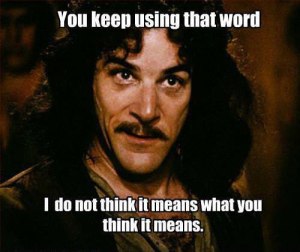
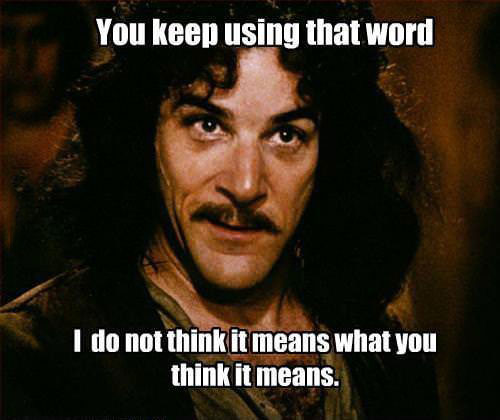
inigo montoya

On choosing a (Hugo) winner

Wikipedia tells me that “the Hugo Awards are a set of awards given annually for the best science fiction or fantasy works and achievements of the previous year.” But Wikipedia is wrong. Worldcon, the organization that gives the awards, defines them as “the most prestigious awards” and “awards for excellence.” That’s more sensible, because there is no such thing as a “best” creative work.

I didn’t realize this until I started reading the nominations, but the question is not “which work is best?” but “which work deserves this particular award?” This leads to an even more interesting question, which is, “what is the basis for deciding which work deserves this award?”

My first impulse was to vote for the book I enjoyed most, Ancillary Justice. It’s thought-provoking, the storytelling is tight, and the characters are interesting, the science is strong and logically self-consistent, and the novel acts as a cautionary tale about technology that is just now emerging in our own world, artificial intelligence.

But then I thought, “This is a sequel, and the first book in the series won the award last year. Maybe it’s time to give another author a chance.”

I was making an assumption there: that the purpose of the Hugo awards is to reward the author. But maybe instead it’s about helping readers find excellent works. Hugo-award-winning novels get listed in the handy trifold brochures that libraries stock.

So I thought, “Maybe it’s time to give the reader a chance to encounter a new author.” In that case, my vote would go for my other favorite, Goblin Emporer. It is a fresh take on court intrigue, with a fascinating and likable main character, a complex multiracial society, and it doesn’t gloss over the problems of class and power that come up when your hero has the power of life and death over the rest of the kingdom. It was a thoroughly enjoyable read, and I’ll be on the lookout for more books by the author.

I was all set to go with Goblin Emporer when I struck up a conversation with a long-time science fiction fan, and he said that yes, it was an amazing book, but at the same time, he felt that it didn’t push the boundaries of science fiction and fantasy. To him, that was a key criterion for the Hugo award.

That criterion had never occurred to me, so I had to stop and think. Should I base my selection on boundary-pushing? And if I did, would Goblin Emporer count? It does push boundaries of class and race in ways I’ve never seen before.

Then there was the third candidate, The Three-Body Problem. That is a hard sci-fi novel with a highly imaginative scenario and vivid world-building. I had difficulty connecting — the science sometimes overwhelmed the story and the characters, and I found myself skipping paragraphs. I still found it a worthy candidate, though, based on its originality. Also, I consider it a boundary-pusher for an English-speaking audience because it was first written in China for a Chinese audience. Especially considering the organization that grants the award is called Worldcon, it’s only fair to include non-Western works.

All these books made it onto my ballot, and any one of them could have made first place depending on the criteria I used. Vote for the one I enjoyed most? Should I pick the one with the most science? Choose on the basis of diversity? Decide which one most expanded the boundaries of science fiction and fantasy?

Once I started to ask these questions, I realized the Hugo awards do something else for the field of fantasy and science fiction. Every nomination and every ballot choice is a vote for the direction of future works. And it lends legitimacy to new forms of creative expression. (Don’t even ask me how excited I was when the Doctor Who episode “The Empty Child” won a Hugo.) Should we encourage writings that escape the geological boundaries of North America and Europe? Push for diversity? Delve into near-future technologies?

So my vote could be for personal preference. It could be for sub-genre. It could be for the future of speculative fiction. My power, and my responsibility. My choice.

It’s a heady thing, democracy. I recommend it.

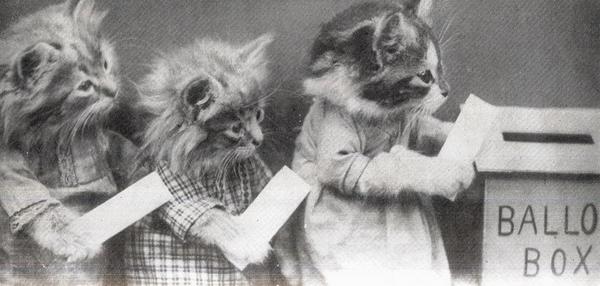
cats voting

Analyzing the Wired article on the Hugo awards, Part Three

Today let’s take a look at slant in the Wired article on the Hugo awards. In Part One, I used a word frequency analysis to show gender bias, and in Part Two, I challenged the claim that the Hugo awards are about identity politics.

Today I’ll look at the way the Wired article is slanted in favor of some sub-genres and against others. This is a common error: many readers and reviewers have an unconscious hierarchy, and if a work doesn’t match up to the expectations of a favored sub-genre, then they consider the work itself to be inferior. People often do this without even noticing sub-genres exist.

What are the sub-genres? Here’s one list: contemporary fantasy, court intrigue, cyberpunk, epic fantasy, hard sci fi, military sci fi, parallel/alternate universe sci fi, science fantasy, space opera, quest fantasy, time travel, and urban fantasy.

And the hierarchy? Going by what I’ve heard many people say, it starts off with hard sci fi, space opera, military sci fi, cyberpunk, and then everything else. I’ve often heard it said that you can’t write sci fi unless you get the science right.

I don’t give a crap about the hierarchy. Personally, I prefer science fantasy, contemporary and urban fantasy, time travel, and space opera — but I’ll read anything that strikes my fancy. I also understand that even if I don’t like a work, that doesn’t mean it isn’t good.

The Wired article does have an unacknowledged hierarchy. Most obviously, as I mentioned yesterday, it keeps forgetting the Hugo awards include fantasy. I’ll repeat the quote here:

[T]he balloting had become a referendum on the future of the genre. Would sci-fi focus, as it has for much of its history, largely on brave white male engineers with ray guns fighting either a) hideous aliens or b) hideous governments who don’t want them to mine asteroids in space? Or would it continue its embrace of a broader sci-fi: stories about non-traditionally gendered explorers and post-singularity, post-ethnic characters who are sometimes not men and often even have feelings?

Meanwhile, according to the article, the genre has Gods, and they are:

Isaac Asimov, Arthur C. Clarke, Harlan Ellison, Philip K. Dick, and Robert A. Heinlein.

These are all highly influential authors from a certain era, often called “The Golden Age” of science fiction. Here’s a look at the sub-genres they wrote in:

  • Isaac Asimov (1920-1992) wrote hard sci fi. His Robot series introduced robots with a self-contained system of rules that was intended to protect humans, and then broke it. His Foundation series reached forward into the far future and chronicled a dying empire.
  • Arthur C. Clarke (1917-2008) wrote hard sci fi, most notably 2001: A Space Odyssey, a far-future novel with spaceships, AI, and powerful aliens.
  • Harlan Ellison (1934-present) writes in a variety of genres including speculative fiction, science fiction, and fantasy.
  • Philip K. Dick (1928-1982) wrote postmodern, philosophical works that often included authoritarian governments and altered states of consciousness.
  • Robert A. Heinlein (1907-1988) wrote a wide variety of sci fi on a great number of themes, from rockets to free love to libertarian governments.

According to the Wired article, those sub-genres represent the pinnacle of SF/F in the past. Which sub-genres might it propose for the present and the future?

Would sci-fi focus, as it has for much of its history, largely on brave white male engineers with ray guns fighting either a) hideous aliens or b) hideous governments who don’t want them to mine asteroids in space? Or would it continue its embrace of a broader sci-fi: stories about non-traditionally gendered explorers and post-singularity, post-ethnic characters who are sometimes not men and often even have feelings?

Does this “broader sci-fi” fit into any of the categories I listed earlier? No, it does not. Let’s add a new one: feminist sci fi. It’s not a sub-genre unto itself, though. It always intersects with another one. For example, I never sit down and say, “Okay! Today I’m going to write feminist sci fi!” No, I say, “Today I’m going to write about time travel and clones!” And it’s feminist because I have a feminist world view.

Feminist sci fi isn’t some upstart newcomer, by the way. The first feminist sci fi was Mary Shelley’s Frankenstein, published in 1818. It’s about creating human life outside  the womb, and it’s about prejudice and “othering.” Oh yeah, and that new life has feelings.

The above quotation refers to feminist sci fi but follows the lead of the Sad Puppies in omitting the word “feminist.” And it follows the lead of the Sad Puppies in failing to acknowledge that feminist sci fi could be about anything other than feminism. Finally, it denigrates feminist sci fi in subtle ways, by repeating what the Sad Puppies have said without providing any counterarguments.

For example:

But from the start, Correia had some serious complaints. He felt that the Hugos had become overly dominated by what he and others call “Social Justice Warriors,” who value politics over plot development. Particular targets of Puppy derision include . . . Ann Leckie’s debut novel Ancillary Justice, whose protagonists do not see gender. Leckie conveys this by using female pronouns throughout.

Wow, an entire novel just about female pronouns, that values the politics of female pronouns over plot development? Actually, no. Ancillary Justice is an exploration of a far-future empire, following in the footsteps of Asimov’s Foundation series. And it’s about human-AI-machine hybrids. The genre here is not SJW politics but hard sci fi. The female pronouns? I’ve read so much feminist sci fi that I barely noticed them.

The article goes on to quote Sad Puppy leader Torgersen as saying:

“they’re like: ‘Ooh, we can vote for this author because they’re gay, or for this story because it’s got gay characters,’ or, ‘Ooh, we’re going to vote for this author because they’re not white.’ As soon as that becomes the criteria, well, quality goes out the window.”

The author doesn’t question the assertion that quality goes out the window. Nor does she counter a quote it gives from a Puppy supporter at Sasquan as saying some science fiction has a certain academic torpor and is self-indulgent and unreadable. That amounts to tacit approval of a Puppy view of literature.

To sum up, the hierarchy of genres in this article has hard sci fi at the top and feminist science fiction and literary fiction and fantasy at the bottom.

That’s quite a slant.

design by david ngo at http://www.ngocrump.com/

design by david ngo at http://www.ngocrump.com/

Analyzing the Wired Article on the Hugo Awards, Part Two

Yesterday I kicked off an analysis of the Wired article “Who Won Science Fiction’s Hugo Awards, and Why It Matters” with a word frequency analysis. It’s ironic that an article covering a struggle over diversity in science fiction would focus so heavily on men. Here are a few of the findings:

  • The pronoun “he” was used 74 times, and the pronoun “she” only 16.
  • The nouns that were mentioned 20 or more times were, in order of frequency, Puppies, people, Beale, and Hugo.
  • Mentions of male authors greatly outnumbered mentions of female authors.
  • Mentions of white authors greatly outnumbered mentions of people of color.
  • The list of people who had won Hugos that appeared at the beginning of the article included only white men. Ursula Le Guin, Octavia Butler, and Connie Willis–women and people of color who have also won Hugos–had to wait until the very end, after the leaders of the Sad and Rabid Puppies, people who gave up Hugo nominations, Pancho Villa, MC Escher, Darth Vader, Churchill, FDR, and Stalin.

This isn’t unusual. This is same-old, same-old, an everyday erasure of diverse voices. It’s the sort of thing that happens when a journalist goes with the flow in the midst of a backlash. Worth pointing out, but let’s move on. I have two more interesting erasures to look at.

Here’s an obvious one that I bet most everybody missed.

[T]he balloting had become a referendum on the future of the genre. Would sci-fi focus, as it has for much of its history, largely on brave white male engineers with ray guns fighting either a) hideous aliens or b) hideous governments who don’t want them to mine asteroids in space? Or would it continue its embrace of a broader sci-fi: stories about non-traditionally gendered explorers and post-singularity, post-ethnic characters who are sometimes not men and often even have feelings?

There’s a word missing here, and that word is fantasy. The Hugo awards are for science fiction and fantasy. So this article that is supposedly about the future of the genre has left out half.

Oops.

What else has been left out? Well, let’s look at the choice given in the paragraph I just quoted. It’s between white men with ray guns fighting aliens and mean governments and stories about diverse characters with feelings.

This is really just a fancy rephrasing of the Sad and Rabid Puppies claims that anything with diversity is just about identity politics.

No way, nohow.

Believe it or not, authors who include diverse characters also include diverse plots and new ideas. Feelings are only one aspect of a genre that is constantly pushing boundaries, always going bravely “where no one has gone before.”

Just off the top of my head . . .

  • Mary Shelley’s Frankenstein asks us: what happens when human beings use science to play God?
  • Octavia Butler’s Parable of the Sower gives us a possible vision of life-after-apocalypse, and her trilogy Lilith’s Brood explores not only the complexities of interspecies mating but also the way they’re affected by a differential of power.
  • Ursula Le Guin’s The Dispossessed shows us a vision of a post-capitalist world and then questions her own utopia.
  • Amy Thompson’s The Color of Distance dives into the hard science of ecosystems.
  • Nnedi Okorafor’s book of short stories Kabu-Kabu invites us to jump into a taxicab driven by a magical madman and then cheats us of the kind of endings we have been conditioned to expect.
  • Molly Gloss’ Dazzle of Day gives us a spaceship with plausible physics — one that didn’t break the speed of light.
  • Samuel Delaney’s Dhalgren presents an apocalypse that breaks time and space, with a book that breaks the genre.

I would suggest that anybody who reads books like these and sees only identity politics is missing out. These books represent an ever broadening horizon of new life, new civilizations, and new ideas.(1) They help us understand the world in a different way, see possible consequences of new technologies, look at different options for the running of human society. In short, they’re the future of science fiction and fantasy.

Which is what the Wired article was supposed to be about, after all.

By Robbert van der Steeg (originally posted to Flickr as Eternal clock), via Wikimedia Commons

By Robbert van der Steeg (originally posted to Flickr as Eternal clock), via Wikimedia Commons

Notes:

1. You might be asking, “But what about the menz? Are you saying they can’t have diverse plots and fresh ideas?” On the contrary: white male authors moved beyond ray guns decades ago.  I just finished rereading Roger Zelazny’s Nine Princes in Amber and gorged myself on the setting, which was so vivid it turned into one of the most compelling protagonists I’ve ever met. Short of Robert Holdstock’s worlds, that is. Meanwhile, China Mieville gets an A+ for the antihero in UnLunDun. And I will never look at parasites the same way again, after devouring Scott Westerfeld’s Peeps. Don’t even get me started on what Steven Moffat and Neil Gaiman did for Doctor Who. And then there’s George Orwell, whose dystopia 1984 is one of my three favorites.

Analyzing the Wired article on the Hugo Awards

I have a lot to say about the Hugo awards, but even more to say about the discourse surrounding the Hugo awards. Let’s start with the Wired article, “Who Won the Hugo Awards and Why it Matters.” For an objective-seeming article, they sure did give a lot of air time to Theodore Beale and the Sad Puppies. They reduced the various arguments over the aesthetics of science fiction to identity politics. And they privileged male voices over female ones.

Don’t take my word for all that, though. Wired is for geeks, yes? Let me be a geek for a moment and give you a word frequency analysis. Here’s a list of words sorted by frequency. (Many of the “little words” like articles and prepositions have been removed, and where the same word was used the same number of times, they’re listed in the order in which they appeared in the article.)

Enjoy.

(74 to 30 words)

He is I who Puppies

(29-20 words)

people are said have with it not been they his Beale be was like Hugo

(19-10 words)

their Sad Hugos had We about one me has she no When because more just were you Martin all I’m don’t up some fiction winners sci-fi want Best doesn’t which says other white Would Awards into out Her from Torgersen told very Bellet

(9-5 words)

year what science New it’s nominated those most Writer them Story Black Puppy Correia can then going go first Day fans women ballot writers Though After much even author blog will him say got My mean nomination Award among fantasy come authors time Past years many male While Rabid few where before John ever over Worldcon room did also man novel made same we’re woman how that’s get asked something think being enough back Losers

(4-3 words)

SINCE future words too nominees voters World night often Puppies? there Short won us understand know goes way year-old see really two gay do book against thinks Both books merely called saying they’re he’s Vox considered reason once Jemisin consider every away political little win winner down withdrew Sasquan Three-Body Problem dream love trophy voted include genre color three final movement broke felt voting number Puppygate record Convention announced question popularity slates February categories W Campbell its history sometimes men vote Game wasn’t fan turned rocket Editor Mixon winning female There’s here ways our matter Puppies’ Brad Why novelist phone name named politics person whose Times racist actually popular need stuff himself slate son American example point if around half-savage including anyone gets let idea still any certain replaced Now attempt sense read write Annie together sister own honor Martin’s too? give Liu translator Cixin Liu’s Novel-winning don rubber coneheads Alfie

(2 words)

highest writing K Robert Gods changed each hands tell stories backlash campaign dominated mostly leaders faction calls itself rules process meanwhile plus Spokane Saturday everybody’s minds year’s released finalists Hugos’ become largely fighting either hideous characters membership least closed George RR novels HBO defend wrong single took home five only Related Long Here’s gave far behavior left-leaning troll middle added simply human lives none explaining could care less thing former reached didn’t came based explained Wendell serious right? start call Justice value Water Falls beset whenever Leckie’s debut using earlier Army assertions fact pretty oppose currently quality Ooh well married leader Theodore Voice complex later speaks four published age Native rode genetic racial women’s suffrage democracy America feels claims use acknowledged she’s run screaming Nora should dark system your am Given Certainly hard Look blogged went off outspoken wanted hole nerds sworn continued simple started gains literary makes Thor Culture Max message heard these lesbian shit decades You’re right force names toys acknowledge met may aren’t ones tie-dye week turning community guy loves lot brings having attended rejects everyone agrees Baen teenagers optimistic showed Ken L Wesley Chu Alfies data committee Kloos

(1 word)

honors TRUE travel extraterrestrials tales imagined rocket-shaped Isaac Asimov Arthur C Clarke Harlan Ellison Philip Dick Heinlein recent expanded storytellers gays lesbians presentation August rockets joined Goddesses ethnicities genders sexual orientations whom spaceships Early shift sparked organized resulted two-pronged played dirty taking advantage loophole arcane enables relatively dominate Motivated bought memberships Washington PM vast auditorium packed trufans dressed wizard garb corsets chain mail prevail? upon mere contest recommending balloting referendum focus brave engineers ray guns aliens b governments mine asteroids space? continue embrace broader non-traditionally gendered explorers post-singularity post-ethnic feelings? stake forked dues allowed June cast ballots whopping percent bestselling epic adapted Thrones gathering integrity predicted dramatic evening began appearance cosplaying Grim Reaper Puppy-endorsed candidate Puppy-provided Novella Work Form instead preferred full list Laura J stirring speech post meticulously described venomous Internet troll-troll ground between belong here’ believe must find non-toxic discuss conflicting points view closing stand marginalized groups seek seen fully Birth helps pedigrees towards motivation entitled outrage wake defeat compatriots silver ship looks marital aid begs target them? campaigns fairness Larry Utah accountant gun store owner NRA lobbyist created ago seeing SPCA ad featuring forlorn canines staring camera singer Sarah McLachlan joke That leading cause puppy-related sadness boring message-fic laughing initially spokesman cartoon manatee speak English kept super complaints overly others Social Warriors plot development Particular targets derision Chu’s Nowhere decides traditional Chinese family phenomenon lies inexplicably Ann Ancillary protagonists gender Leckie conveys pronouns throughout Correia’s York best-selling Warbound finalist lobbying effort chief warrant officer Reserve preachy fun bristle blogosphere sexist homophobes argument interesting beef class-based Torgerson blue-collar speculative snobby exclusionary ignore conservative CHORFS Cliquish Holier-than-thou Obnoxious Reactionary Fanatics East deployed lamented cognitive dissonance soon becomes criteria window notes interviews African-American know-it-all lecture race identity anti-diversity storytelling ought Ah course particularly add militant self-described libertarian blogger loosely God origins offered recommendation absolute posted directed followers nominate precisely Beale? electronic rocker shortlived group Psykosonik wealthy Minnesota entrepreneur Republican jailed tax evasion languages father children youngest boy six great-grandfather Pancho Villa according SJW blood details significant kids qualify tribal mix Mexican analysis Nonetheless voluminous writings writes hobby working designer openly opposes diversity homosexuality quibbles Northern Italy representative um highly inclined security liberty thus easy manipulate favors direct obviously emailed disappointed failed quote Wall Street Journal’s label despised conversation sort walking designed MC Escher turns unexpected dizzying sampling noted NK educated ignorant launched explication research expect supports term intentionally baiting word overtones calling offend crap next beat half-savages Europe actual proper Africans African-Americans leads problems shitting top toilets indoor plumbing okay? civilized Hundred Thousand Kingdoms populated brown-skinned matriarchal warrior Darre characterized interaction opens comments section stop train bitch standard modus operandi supremacists jail helped believes character plays Performance art Andy Kaufman embraces nemesis role inhabits star circling outer rim solar Darth Vader breathing heavily wants enraged flipping tearing hair completely losing chaos generally destructive kind incendiary rhetoric possible naïve piggyback worst accused providing politely moderate front shit-stirring provocateur worked distinguish themselves Churchill FDR wound side Stalin whether tarnished association hacked found part lead small publishing company Castalia House editors goals leave big smoking giant Fuck massive gesture contempt watch burn forward administrators modify nominating try prevent manipulation proposals supporters control Specifically numbered vile faceless minions hardcore shock troops mindless perfect obedience acknowledging solely contrary anti-SJW Okay might deploy lord minion acts mainstream press reporting gaming April fan-favorite edged outside field cared treated nerd-on-nerd violence unfortunate ugly confined literature’s crummier neighborhoods inconsequential longshot revolt push traditionally underrepresented maligned sub-genre they’ve everywhere sound starship engines exist vacuum Adria Richards Twitter-shames dudes cracking off-color jokes PyCon tech developer conference fired fields murder threats GamerGate threatening rape temerity offer opinion videogame strain comic apoplectic Captain hatred change frog yes happened uttered peep ribbit Wars raging levels corners society Substitute weaponry verbiage easily so-called mens’ rights driven froth Mad Fury Road Charlize Theron seeks rescue bunch sex slavery sidekick another flashpoint emerged telephone weeks plan Xanatos gambit set enemy does loses surprise email sent ceremony crowing scorched earth strategy pursued SJWs evidence hold initiative wrote major demonstrates extent politicized degraded left predicting convert send loud clear Bring claimed victory Scalzi three-time opponents war folks straight anywhere stands shoulders minority trans- bisexual folk put groundwork laid lots position firmly plant feet bullshit large absolutely rabbit vanguard creators consumers nerdiverse several protest minute subset playing getting taken else defined curiosity if? yearning wonder modern feel infected academic torpor correctness aside supporter grumbled self-indulgence MFA kid yourself knew wouldn’t sell unreadable support waiting Sasquan’s annual Masquerade costume competition begin Friday overheard clad swathed companion similar type promoting agree self-published urban things Goodnight Stars received partly days emotional interview hall controversy bullied SJWs’ awesome public face figure ball abstractions knows great seven-book Monster Hunter series ally workshop baby friends tense wiping tears hurt Blonde-haired fair-skinned covered tattoos Portland Oregon adopted who’s Vietnamese mom grew liberal inclusive environment noses [after hearing] N-word growing trying persecution narrative ponies freeway different cars heading direction Dude car driving What’s folded everything badge queer shape-shifters crap’ real’ grasp Nerd everybody Khaleesi roundabout select works surely million written proof? collected linked File well-considered almost without fail special sustaining lost counting show utter sincerity hoity-toity accolade bestowed Ivy Leaguers frequent claim caliber included Ursula Le Guin Octavia Butler Connie Willis referred Meryl Streep longshoreman excluded highbrow politically correct shouldn’t second reward truckloads money sat hotel overlooking center River Can’t sells copies doing innovative? enormous success blinded struggles nearly except amidst throngs acknowledges merit self-publish increasingly reckoned predicts eventually share formally discriminated learn necessarily anything campaigning nominations logrolling gone during run-up graying fandom concerned average event free volumes audience? nominee Toni Weisskopf stirred home? swarmed hateful discourse name-calling? People’s refusal under trufan tent? broken sure repaired throw Party tradition he’d fall printed invites Welcome Mocked Assholes hired band rented square-foot historic mansion magic markers winners’ cones Kevin midnight hopefully last bestowing dubbed Alfred Bester Demolished first-ever streamlined s hood ornament take sting Late parallel universe hadn’t intervened trophies extra decided Eric Flint eloquence rationality posts kerfuffle legendary Silverberg biggest cheers honored Marko who’d first-time until would’ve anyway clearly stunned important German-born Hampshire Puppy-powered making again shaking hand knowing tonight beats

pencil and notebook3

On voting or not voting

Today’s the ballot deadline for primaries in Seattle. I’m voting.

Every time ballots come due, somebody starts arguing about whether or not people should vote. Somebody says, “If you don’t vote, you’ve lost your moral right to complain.” That’s unfair. People who don’t vote aren’t lacking in morality — they have a different morality. They think it’s pointless because the choices presented to them are all bad. Or because voting is rigged (and, in some places, it is.) Then on the other hand, somebody says, “If voting accomplished anything, it would be illegal.” To that I would say, “Yes, and sometimes it is.”

My personal view is that the power of the vote increases as voting gets more and more local. For instance, voting for the president of the U.S. has little effect unless you’re in a swing state. And the choices are usually between bad and worse. A vote on a community council has a lot of power.

And city races, like today’s? Those have consequences. I’ve followed the school board races for the past three years, and the candidates are often for or against privatization, which I oppose. In today’s race, one of the candidates, Jill Geary, has been fighting hard for the rights of special education families. I voted for her before anybody else. And I voted for John Persak for city council because I know he’s competent, fights for the working class, gets his funding from people instead of corporations, and understands the issues I care about.

(I wish I’d been more out in front of this and told everybody I knew who I was voting for or why. I’ve been distracted. I also wish I hadn’t waited until the morning of election day to search online to research the rest of the races. )

The power of voting extends beyond the choice of candidate. Voters can put pressure on elected officials. If you can show that you are part of a large voting bloc, the pressure is even greater. (Unfortunately, that’s easy for the wealthy to exploit.)

So I’m not in the “lose your moral right” camp and I’m not in the “if voting had power” camp. And there’s one big thing both camps miss out on.

Voting is a practice that should be in our everyday lives. All of our decision-making bodies should use it. But most don’t, or they use it in ways that slant the vote. Ever been presented with a slate of candidates, rather than voting for each one individually? Ever been in a group when somebody says, “Well, it looks like we have consensus on this . . .”?

I could write pages and pages of experiences I’ve had. Right now, and this is by no means my only example, I’m thinking about the experience I had when I went to the state PTA legislative assembly and was told by the entire state leadership that I couldn’t distribute a half-page information sheet, despite the lack of explicit rules against it, and despite the fact that the state PTA had provided information about only one side of the issue. That was funky.

Anyway, it seems to me that people in the U.S., whether they vote for political office or not, have gotten out of the habit of democracy. And that’s what we need to fix.

Vote.

cats voting

Reading the Hugo nominations

A year ago, I thought the Hugo awards were determined by some Highly Knowledgeable Panel of Experts. I didn’t realize it was a vote available to a broad range of science fiction fans, and so I never expected to be able to participate in the decision. Now, thanks to all the ruckus, I paid my $40 supporting membership to WorldCon, and I’m doing my due diligence to read through the nominations.

That $40 is a stupendously good deal! You get to download excerpts or full versions of most of the nominated works. (This is at the discretion of the nominee.)

However, the voting is a big job indeed. There are a lot of categories, and five works per category.  I’ve decided to limit myself to only a few categories and to stop reading a selection if I determine it should go below No Award or if I decide not to vote in that category. My priority is the novel category, since the winner gets listed in the public library’s Hugo and Nebula winner handouts, which I’ve consulted many times over the years. However, I’ve been sampling other things as well.

Here are a couple of things I’ve looked at:

The Goblin Emporer, Novel. I bought this yesterday and am about 1/4 way through it. It will be a contender, though I haven’t looked at the others yet.

“Listen,” a Doctor Who episode. Pretty good psychological drama, though not the quality of the first Doctor Who episode that was ever nominated. I’ll likely not vote in this category, because I’m not all that interested in three of the competitors, so it wouldn’t be fair.

Voters everywhere are puzzling over what to do about the Sad and Rabid Puppy nominations. Cross them off the list because they were produced by slate voting? Cross the Rabid Puppy nominations off the list because the guy who made the list and then threw out a call to fascists and gamergaters and men’s rights activists, Theodore Beale, is a self-described Good Sociopath who advocates white nationalism, “peaceful” ethnic cleansing, and an end to women’s sufferage?

I haven’t made up my mind. I’ve started with due diligence, but that led me to this gem of a quote, from a collection edited by Beale:

With Brad’s present offering, “The General’s Guard”, the casual reader might be tempted to dismiss it as just another “anything boy can do girl can do better” propaganda piece, written in placative submission to the tripartate goddess of modern feminism: Hysteria the Relentless, Outrage the Untiring, and Unreason, handmaiden of PMS . . .

Whew. Unless I have accidentally flipped over to a mirror universe, I can safely say that most readers would not enjoy a book filled with this kind of political diatribe.

However, I will give Sad Puppy nominations a fair chance.

cats voting

(edited on 7/12 to remove mention to short story collections, which are not actually on the ballot)

Sweltering, unmotivated, and concerned

Are Seattle’s gorgeously temperate summers at an end? It’s been between ten and twenty degrees hotter. I can’t count the number of times we’ve been in the nineties. I’m miserable. Why am I here in Seattle? Because I can’t take the heat. Especially this muggy heat that triggers claustrophobic feelings.

My Marie Kondo tidying project? Forget it! Wake me up in September.

My garden’s straggling along. Peas and strawberries are tasty but go out of town for a couple days and they all dry out. Plum tree’s infested by aphids. I’m covered in mosquito bites from a camping trip. Miserable, in short.

Work’s piling up. I can’t bear to look at my papers. Email inbox? Folks, if you sent me something, or want me to do something, it got buried. Remind me.

I am keeping up with my Clarion writeathon goals. However, the characters sort of limp along and mope. They’re a little like my pea plants.

More than miserable, I’m concerned. This is climate change. What’s next for us?

too hot by Guldehen at http://guldehen.deviantart.com/

too hot by Guldehen at http://guldehen.deviantart.com/

Sponsor me for the Clarion West 2015 Writeathon!

It’s that time of year again. Serious students of SF/F writing are sitting down to six weeks of intensive study with award-winning authors. They write at the grueling pace of one story a week, while also reading and workshopping everybody else’s story a week. (For some perspective, the MFA program I took required three stories per quarter, and that was HARD.) They learn the craft of writing SF/F, and they make connections that will support their writing and their careers. Maybe five, ten years later, some book of theirs shows up on the shelves of your local bookstore, and you pick it up and stay awake all weekend reading it.

The workshop is expensive. Some of the most amazing voices could never afford the tuition. Hence, the Clarion West Writeathon! It supports scholarships for the students who have been selected to participate. Here’s how it works: I set a writing goal for myself. When that goal’s met, you donate to the workshop.

So please sponsor me for the Clarion West Writeathon! You’ll be doing two great things at once – you’ll be helping guilt me into writing, and you’ll be helping train the award-winning speculative fiction authors of tomorrow. Pledge whatever you’re comfortable with — even a $10 pledge helps!

Here’s my official write-a-thon page, with all the details! While you’re there, be sure to check out the other fabulous writers who are taking part in this write-a-thon!

P. S. Check back on my blog for weekly updates on my progress — I’ll be keeping a log of how many words I wrote.

clarion-west