Category Archives: daily life

On leaving Utah (three times)

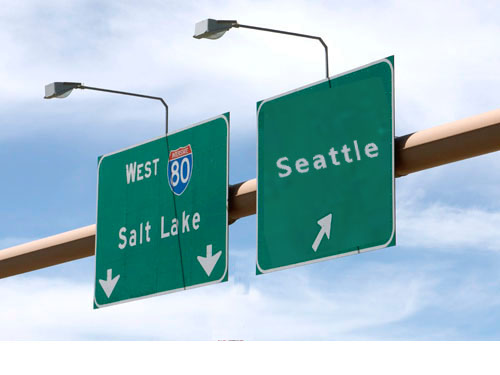
The first time I moved away from Utah, I was in preschool, so I doubt I cared. My family moved to Olympia and Seattle, where I spent those formative years up through eighth grade. We went back to Utah most summers for a visit, and I got to see my grandma and my cousins. I used to dream that I could teleport between Salt Lake City and Seattle so that I could see my grandma whenever I wanted. But I grew to love Seattle. I was in the generation where parents still let their kids out to roam the neighborhood, and so I owned my neighborhood, from the Fremont library all the way up to the Woodland Park Zoo, from the blackberry bushes west of Phinney to the little grocery store on Fremont.

At the beginning of eighth grade, we moved back to Utah. I missed Seattle — a lot. But I made friends, and roamed the neighborhood — the park, the library, the mall, the junior high, and the high school. Once I started driving, I drove all over the city — the library, Beans and Brews, Trolley Square, everything. It was my city. I belonged to it, and it belonged to me. I got jobs I liked. I made close friends, hopefully lifelong ones. It was my home, and I loved it.

But I never did stop missing Seattle. All my happy memories of Seattle got mixed up with the childhood nostalgia we always feel. And I never did quite belong in Utah. And I had to go to graduate school.

So the second time I moved to Seattle, I went to the University of Washington for an MFA in creative writing, going straight from my mom’s house to my own apartment. Two heady years of learning and writing and traveling and making friends! But I missed Utah, and I missed my job, and I missed my family, and I missed my boyfriend. It was cheap to fly back home, and so I did it a lot. It was always disconcerting. I had been one person in Salt Lake City, but now I was a different person in Seattle, and when I visited, the two people didn’t know how to fit back into one. And I got homesick all over again. It was also hard because my parents had recently divorced, and so I had to face not only the loss of a home (Salt Lake City) but also the loss of a united family and the stress that I felt whenever I saw both parents at once, and whenever I had to choose between visiting with one or the other. It was also hard because I had recently joined, and then left, the Mormon Church, and so all that baggage was always waiting for me. 

After graduate school was finished, I had a hard time choosing where to live. I loved both cities, in their own way. In Salt Lake I had roots, and in Seattle I had dreams. Seattle is the place for Kristin-the-writer. In either city, I would be with my boyfriend. I made one decision and then another. I wanted the independence, and I was afraid of it too. My boyfriend and I went looking for apartments. We found a good one and met with the landlord and started writing the check — and I chickened out. Moved back to Utah.

My boyfriend got us an apartment in a complex called the Villa Franche. (Pronounce it Franch-ie.) I went back to my old job. We had good times! But going back to Salt Lake City made me realize I belonged in Seattle. Our mothers both freaked out, for different reasons, and so we got engaged. It was a five-year engagement, because we were nowhere near ready to get married, but we did want to leave Salt Lake with some semblance of propriety and some feeling that we were family to each other.  

And so I left Salt Lake City for the third, and probably the last, time. Of course, I keep going back. My family is still there, and so are my friends. Every time I go back, I get homesick for everyone all over again. But the city itself is like a place from a past life.

My home is Seattle.

But I’m visiting Salt Lake City soon! And this time will be different than all the other times. I’ve finally, after quite a long time achieved my dream of publishing a book. In keeping with my dual-heritage history, this book was written almost entirely in Seattle . . . but it’s about Utah.

Go figure.
Image

On being asked to share genomes

I got my DNA tested through 23andme. I thought long and hard about privacy and how giving someone else access to knowledge about my genome, but in the end I was just too darn curious. That’s the bane and the gift of humanity, isn’t it? I just crossed my fingers that they would abide by their privacy statement, paid the money, spit into a test tube, and mailed it off.

One of the things you get is a list of genetic cousins, along with whatever information they want to share. They don’t have to share anything, even their name, but they can optionally share family surnames and places their ancestors have lived. They can send you contact requests, which is cool. I’m interested in sharing genealogy information. But all the requests start off with something like:

“Would you please share genomes with me?”

Now, these people may be my relatives, but they’re often pretty distant ones. We might share a great-great-great-great-great grandparent, for instance. So the question comes off to me like a stranger coming up to me and very politely asking,

“Would you please show me your underpants?”

So my reply is:

“I’m not comfortable sharing my genome with you right now.”

Codeswitching vs. Coat-switching

Last night I went to a reading of Mixed Blessings by Rhoda Berlin MS Lmft, and Harriet Cannon M. C. Lmft Lmhc. It’s a guidebook written by marriage and family therapists. Here’s a quick description:

Mixed Blessings explores the impact of migration, appearance, social class, spiritual/religious and cultural practices on individual, couple and family identity. It is practical and nourishing, an inclusive resource for modern times. The book is intended for those living mixed blessings and for helping professionals who help them navigate these challenges.
It was a lovely reading, mixed with music — the Beatles “All You Need is Love” and “Let’s Call the Whole Thing Off” sung by Ella Fitzgerald and Louis Armstrong. They even got the audience to sing along a little bit, and I am ALWAYS ready to sing along.
Lot of good information about how socio-cultural differences affect relationships and some eye-openers from me, including some differences between “individualist culture” and “collectivist culture” in plain-speaking terms instead of academia-terms.
They talked a little about “coat-switching,” and I thought, “Yes indeed, I have done that. I have switched coats as I moved from one culture to another.”
Later, glancing through the book, I saw that they were not in fact talking about “coat-switching,” but instead about “code-switching.” Code-switching means shifting the way you talk and act based on the culture you’re in at the moment. We all do it.
But it’s a big word. I like the term “coat-switching” quite a bit and might just use it instead. It’s an approachable and friendly term.
Just like the reading was! Thank you, authors, for an enjoyable evening.

But what are we changing into?

Yesterday I talked about coming to grips with the rapid pace of technological change. But today I’ll take a step back and ask: what are we changing into? What are we gaining? What are we losing?

Our brains are changing. Scientific American recently published an article, “How Google is Changing Your Brain,” pointing out that quick access to the cloud is changing the way we think. We use the Internet to get information we used to get by asking friends and family — essentially, as an external hard drive. Yes, indeed. I bought a Kindle Fire because my kids keep asking me questions, and although I don’t know the answer, I can get it in just a few seconds. Yesterday my daughter asked me what a Rube Goldberg device was. It was right at bedtime, so I gave her the accelerated version with hand gestures: “Ping, ping, roll, crash, clatter clatter pop — ding!” But then, once their teeth were brushed, I googled it, read Rube Goldberg’s biography, and showed them two youtube videos of Rube Goldberg devices.

Whoops! That violated our house rule of “no screen time just before bedtime.” And sure enough, bedtime was late and everyone woke up groggy. Screens are so very tempting.

The kids use computers way more than I’d like them to. Sure, I set limits, but they’re higher than mine were when I was a kid, and it’s easy to slide. Even easier if I’m on the computer when I didn’t mean to be. The temptation’s higher, too. When I was a kid, “screen time” wasn’t a word. It was “TV.” And it was broadcast TV, which meant that it had a predictable beginning and end. When the Muppet Show was over, we turned the TV off.

On the flip side, what the kids are doing with their screen time is a bit mindblowing. They’re playing Minecraft, a game that’s a lot more than a game. At its core, Minecraft is a 3D building program. They make buildings, trains, you-name-it. Their spatial skills probably already exceed mine. And very likely, they’re learning stuff they’ll need in tomorrow’s world. They’re also programming in Scratch, a language designed especially for kids.

But what’s being lost? Easy. Exercise and reading. Exercise was already in trouble, because most kids don’t roam the neighborhood freely. Too many cars and too many parents afraid of child molesters. But screen time is so tempting, they get even less. As for reading, my kids read, yes, but not as much as I did.

In fact, I don’t read books as much as I used to. I read blog posts, Facebook entries, and links from the Facebook entries. This gives me less opportunity to just cuddle down with a book and lose an hour in pleasant concentration. In fact, when I do have that opportunity, my mind races a bit. It’s used to speedy browsing. I have to always remind myself to slow down, unplug, enjoy the life right in front of me. And teach my kids to do it too.

There’s some kind of balance to be struck here, but I don’t know what it is. How can I? Our world, and the people in it, are changing. Into what?

I don’t have an answer. Do you?

On entering the 21st century

I’ll admit it: I’m having some trouble coping with the proliferation of doodads in the twenty-first century. Smartphone, Iphones, Ipods, Ipads, bluetooth, PS3s, Xbox 1s, Kinect, cams, blueray, thumb drives, kindles, Android, chargers of every make and model, cigarette chargers for the ipod, battery packs for phones, charging, running out of batteries, charging, losing your phone, cameras locking up, ipods locking up, miskeying phone numbers, screens going black unexpectedly, GPS vertigo. You know? I’m the sort of person who hangs on to old technologies (paper and pencil, for instance) with my fingernails, while the future grabs me by the waist and pulls me forward. I still own the old cell phone I bought eleven years ago, under protest.

It wasn’t always like this. I was one of the very first people to use computers, back in the olden days. My dad, a computer programmer, used to bring me into work to play Adventure on his company’s mainframes. Big, big, enormous things! They had to have their own room and their own air conditioners. And I was one of the first people to use a modem. My dad brought it home, cradled our telephone on it, and we listened as it squeaked and squawked and blipped into the line, speaking to the mainframe on the other end. We used it to play Pong. I loved it all. And I loved my first scientific calculator. I read the instruction manual front to back and learned all about exponents, sines, and cosines. And I loved my first VCR. Again, I learned it front to back. (Is it any wonder I became a technical writer?) In college I learned how to do all sorts of things on UNIX (precursor to Linux).

The new technologies were fascinating, exciting, and took a lot of brains. But compared to the devices that are coming out now, they were downright straightforward. I miss that. Everything is happening so fast, and the graphical interfaces keep changing, and I’m thinking that in five years we’ll need to be rocket scientists just to keep track of which charger goes with which device.

However . . . the times, they are a-changing. And so must I! I’m married to a programmer and have two children who are increasingly tech-savvy. I can grouse all I want, but I’m going to have to learn to type on a cell phone keyboard even though it looks patently impossible for my huge finger to accurately tap the tiny keys.

I got an Ipod Nano for my birthday, and I’ve been gradually poking around with Itunes, figuring out how to do this and that. Over the weekend, I figured out how to check out a digital audiobook from the library and put it on the Ipod. Score! And yesterday, I very nearly figured out how to subscribe to a podcast. I clicked the “Subscribe” button, and it said I was subscribed, but it downloaded nothing. Off to do some google searching, I guess. I finally managed to download one episode and listen to it. It was fabulous! I picked Verity Podcast, a Doctor Who podcast in which six women from around the world natter on about Doctor Who. I am now listening to Episode 32 – “Doctor Stew is Required.” All six are having a blast dissecting the Christmas Special, “Time of the Doctor.” Everyone has different viewpoints and insights. Just lovely.

Future, here I come.

Thinking about family traditions

My daughter’s teacher assigned her the homework of finding out about our family traditions and learning what our ancestors’ lives were like. I’m having an unusually difficult time with this. The thing is, these conversations about family traditions are happening in connection to the Nelson Mandela memorial curriculum our teachers are doing. The typical “Our family came from Scotland and here are some shortbread cookies” seems completely inappropriate in this context.

We celebrate all the standard US-Christian holidays: Christmas, Easter, the Fourth of July, Thanksgiving. But we don’t do it because it’s a family tradition; we do it because we’ve assimilated into a culture that celebrates them.

What about holidays “from the old country”? Well, which old country, anyway? These kids have thirty-two great-great-grandparents. They came from Scotland, Germany, Sweden, Britain, Ireland, and miscellaneous Scandinavian countries. Each of them had different family traditions, and most of them died out when the person with that tradition married into a family that had a different one. Or traditions died out when living conditions changed. My grandparents did “the harvest dance.” We don’t farm now, or even live in rural areas, and we don’t have a harvest dance. Conditions are changing faster than ever. The family I grew up in had fabulous Easter egg hunts. But we don’t do that. We go to the neighborhood Easter egg hunt, with plastic Easter eggs, and brunch afterward.

How about religious traditions? Thirty-two great-great grandparents, and sixteen great-grandparents, and nine grandparents, and four parents, and they tended to have conflicting beliefs. If I pick a tradition, why exactly would I pick that particular one?

So I have a vague general sense of unease about this whole thing. Maybe I feel like I should do a better job than usual, in honor of Nelson Mandela. Maybe I feel like when I tell our children about our heritage, I tell them nothing of use.

I’m also struggling because I’ve been reading up on our heritage in a much more broad, sweeping way. I’m fascinated by our cultural heritage, reaching back to the beginnings of written language in Mesopotamia. The people who lived back then were probably my ancestors, but even if they’re not, they brought me my cultural heritage. And then way, way back, we all have ancestry from Africa. That’s in our heritage.

So too much flows into my head whenever I think about heritage, and none of it is ready to be explained to an eight-year old.

If you want to learn GIMP . . .

Open-source programs can be hit or miss. How about a graphic manipulation program? Specifically, GIMP — the one to get if you can’t afford Photoshop. GIMP is hit and miss and hit again and miss again and finally, bingo!

I think I learned it the hard way:

  1. Try to edit a photograph using GIMP.
  2. Read the online manual.
  3. Use my newfound knowledge to try to edit pictures using GIMP.
  4. Repeat step 2 and 3 till I know how to use it.

That’s usually how I master new programs. But it’s really not a good idea, unless you already know terms like “RGB color” and “channels” and “alpha mask.” This is what I should have done:

  1. Try to edit a photograph using GIMP.
  2. Watch a Youtube tutorial.
  3. Refer to the online manual if confused.
  4. Try out what I learned.
  5. Repeat steps 1-4.

And here are links to the Youtube videos I should’ve watched.

http://www.makeuseof.com/tag/top-10-beginner-level-video-tutorials-learn-gimp-fast/#

I watched the Paths one today because that was one thing I didn’t know how to do. Coulda saved myself maybe 50 hours if I’d watched it sooner.

http://www.unixmen.com/30-great-tutorials-for-gimp/

Today I watched #12. In it, a kid uses GIMP to create a piece of surreal art involving trees and waterfalls and a castle in someone’s cupped hand. That’s worth watching just to be impressed with the kid.

So that’s that. Just in case the “me” from last spring is listening.

Day-before-school todo list

1. Launder tomorrow’s clothes.

2. Get list of library books that need returning.

3. Ask daughter what she wants in lunches.

4. Make grocery list.

5. Convince kids to eat breakfast and brush teeth.

6. Label kids’ school supplies with their names.

7. Find pencil sharpener with screw-top lid.

8. Call a teacher to find out what is going on with the contract teachers will vote on tonight.

9. Make contingency plan in case school doesn’t start tomorrow.

10. Look up when the back-to-school picnic is and whether I need to bring anything.

11. Figure out what time the kids have to go to bed.

12. Gather library books.

13. Photocopy the two pages out of library books that contain information I need.

14. Make sure I have enough cash to pay library fines.

15. Call friend to invite for Nerf battle in park.

16. Check weather to see if it will be raining.

17. Convince kids to take showers and brush hair.

18. Go to library.

19. Go to grocery store.

20. Go to park.

21. Make contingency plans in case we need to do strike support for teachers tomorrow.

22. Play Ni No Kuni, but not before I’ve done a bunch of these items.


I just want to go back to bed . . . .

Image

Guardian of the beach

Guardian of the beach

I came across this guardian of the beach on the Olympic Peninsula and took a picture of her with the “watercolor” function on the camera. What is she guarding, I wonder? A fairy realm up the cliffs? What kind of riddle would she ask before she let you pass?

Much obliged, astronomers!

Guess what? Astronomers have “eliminated most of the risk from global-scale, civilization-ending asteroid impact events during our lifetimes and the lifetimes of our grandchildren.”

They really ought to be bragging about this. But no. It was buried deep in the middle of an article in Sky & Telescope. The article was about the asteroid that hit the Russian city of Chelyabinsk this February. People wondered why astronomers didn’t detect the object before impact. Part of the answer is that it is relatively small, compared to the asteroids we really need to worry about. NASA began a program in 1992 called the Spaceguard Survey Report, with a goal of finding 90% of the objects that are near Earth and larger than 1 kilometer.

And . . . mission accomplished! Now they can look for the smaller stuff, the kind that has the ability to kill people but not wipe out entire civilizations.

(From “The Chelyabinsk Super-Meteor” by Daniel D. Durda in the June 2013 issue of Sky & Telescope.)

Image