I do want a standardized test, BUT

I opted my kids out of the state Smarter Balanced Assessment Consortium (SBAC) test last spring, joining the thousands of students and parents who felt it was fatally flawed — but the truth is that I do want my kids to take a standardized test that measures mastery of Common Core standards in math. Ironically, though, despite the millions upon millions of dollars that have been spent on Common Core assessments, the kind of test I think my kids should have does not seem to be available.

Let me back up a minute and talk about what the Common Core standards are. They’re a set of national standards, pushed on states across the country essentially by the private sector, that are clearly delineated. In the opinion of many education activists, they’re a complete mess. I won’t comment on that just now. I will say that having clearly delineated national standards in math makes sense to me. If everybody knows what’s supposed to be taught and when, that is a win. You can build off that knowledge to differentiate instruction, and you can keep track of what each child does and doesn’t know.

But oddly, that’s not what’s happening. The general concept was for the Common Core standards to be adopted by the states and for the private sector to start making textbooks and assessments and online curricula and so forth. In other words, free-market chaos.

So on the national and state level, our government is pouring enormous amounts of money into tests whose only practical purpose is to compare the performance of teachers, schools, school districts, and states according to whether or not the students have mastered Common Core standards. These are high-stakes tests. Because of the high stakes, their content is not open for public inspection, and we can’t evaluate their quality. Also, they are summative tests, given at the end of the school year to determine what was taught that year. In the case of the SBAC, the results were not available until well into the next school year.

What schools actually need are formative or interim assessments that can be used in the classroom, like we had in the olden days when schools had textbooks and the publishing company provided tests and quizzes.

But Common Core adoption has broken that this year, at least for Seattle Public Schools elementary kids. It shouldn’t have. Washington State has always had standards, and textbook companies have always adapted their curriculum to those standards, more or less. When Common Core came out, the same thing happened — apparently. The district spent several years on a textbook adoption process for elementary school and ultimately chose Math in Focus, which was supposed to be aligned with the Common Core.

This year, though, the school district has dictated that teachers abandon the “scope and sequence” (the content, plus the order in which subjects are taught) of Math in Focus and instead use a district-made “scope and sequence” document.

That breaks all the classroom tests from the Math in Focus textbooks–but doesn’t replace them with anything.

Why did they mandate the new scope and sequence? I would hazard a guess that they were told, or decided, that Math in Focus wasn’t the right textbook to prepare schools for the SBAC. Were they right? Were they wrong? Who knows! I bet that, as often happens, the private sector got way too much input in our schools.

This is the third year in a row that elementary school curriculum has been changed at our school. The district spent two years planning for a curriculum adoption. Two years ago, our school piloted a textbook called My Math. Then the district adopted Math in Focus, and we used that. Now we’re still kinda using Math in Focus but only as far as it matches the “scope and sequence.” How the teachers can adapt to all these changes, I have no idea.

And how is it going to be assessed? Probably with the SBAC. We’ve been promised formative assessments, but the tests the district got weren’t available to all schools, had serious privacy issues, and didn’t satisfy most teachers.

It’s a muddle for everybody, advanced learners included. Our school offers ALOs (advanced learning opportunities) for kids who qualify or just need extra challenge. By the end of last year, I figure that my fourth grade student had mastered all of the fourth grade curriculum, most of the fifth, and some sixth and seventh. In other words: all over the map. Next year, under normal circumstances, she’d enter sixth grade doing seventh grade math. But will she be ready?

Without appropriate assessments, I don’t see how her teachers could possibly know the answer to that question, or even what to teach her. Getting a handle on what parts of fifth grade curriculum she has and has not mastered is hard enough.

It didn’t have to be this hard. The SBAC and Amplify tests were designed top-down, to be sold to upper (mis)management. But for a whole lot less money, tests that gave the information we need could have been designed from the bottom up by teachers who are actually in the classroom with kids.

Here are the qualities I wish a Common Core assessment could have:

  1. Open and transparent (no high-stakes);
  2. Easily administered and quickly scored;
  3. Quickly given;
  4. Able to measure the curriculum in discrete chunks;
  5. Able to measure content above and below grade level;
  6. Easily modified for disability accommodations.

If such a test existed, then chances are, I wouldn’t opt my kids out.

Should I hold my breath? I don’t know. I doubt the ability of the Smarter Balanced Assessment Consortium to bring it to me, but efforts are being made by other organizations. For my own child, Khan Academy is a reasonable choice. But it’s not for everyone, especially kids with certain types of disabilities or kids without access to computers. There are also organizations like OERCommons and others that collect educational materials that are licensed for free use (though with no guarantee of quality). And the New York Department of Education appears to have done something clever in designing and delivering its own educational content.

But on the other hand, even in the best of times, good tests are hard to design and time-consuming to take and to grade.

All I know is, my family needs appropriate assessments for sixth grade math. And we need them now.

– Kristin

(Post updated 12/4/2015)
3088780713_c5fe7c9f10_o


Speculation for “The Zygon Inversion”

If you haven’t watched the Doctor Who episode “The Zygon Invasion,” this blog post is not for you. Not only might it have spoilers, it will be just plain cryptic. Give it a miss. If on the other hand, you watched it and are thinking, “Wait — what?” and you love speculating, this post is definitely for you.

Continue reading

If racism were volleyball

This post is for white people who feel unjustly accused because they’ve been called out on something. I know how you feel, because I’ve been there too.

So you’re in the middle of a great volleyball game. Everybody’s having fun, you’re really into it. Then you step on somebody’s toe.

“Ouch!” they say. “That really hurt!”

You’re shocked. You look around at all the other players and you imagine a scarlet J (for “Jerk”) has just appeared on the front of your jersey. You gotta protect your reputation.

“I didn’t mean anything by it!” you protest. “Why are you so sensitive?”

You’re absolutely right that you weren’t a jerk for stepping on the toe. That was an accident. You were a jerk for what you said next.

Now there are a half-dozen volleyball players shaking their heads. They go back to the game slightly annoyed and it’s not so fun any more. The person whose toe got hurt thinks you’re a jerk. They were going to ask you out on a date, but they’ve changed their mind. Or worse, somebody starts arguing about whether it was your fault, and next thing you know there’s a big fight. The game’s cancelled.

It’s a bit of a contrived situation. That’s not part of your typical volleyball game. Here’s what would usually happen instead.

“Ouch!” they say. “That really hurt!”

“I’m sorry!” you say. “You okay?”

“Yeah, I’ll be fine.” Everybody goes back to the game and has a good time. The end.

If that’s what happens when you accidentally step on somebody’s toe, how come it’s not what happens when you accidentally make a racist remark? (I’m not talking the n-word here — there are a thousand tiny slights that people of color experience, which cumulatively add up to a badly bruised toe.) The intent is about the same, the harm is about the same. The difference is in our culture. Racism is taboo. You make a racist remark, pretty soon you imagine you’re walking around with a big “R” on your shirt. You’re thinking about you, not the other person.

But there’s a simple fix. A casual “I’m sorry!” usually erases that imaginary R. And it magically helps the toe feel better, too.

How come I know all this? First, because I’ve done it both ways. I go home a lot happier if I said “I’m sorry.” And second, because I have friends who have gotten their toes stepped on, and they’ve told me what it’s like.

Questions? Comments? Thoughts?

volleyball-294492_1280

Classic Who to Try

Suppose you like New Doctor Who and you want to try out Classic Who, but maybe you don’t know where to start, or maybe you watched a serial and you got bored because it was too slow. Don’t despair: there’s no wrong way to watch Doctor Who. But, as I mentioned in my last blog post, you might not want to start at the beginning and watch straight through. Think of it as a buffet. Start at any part of the table, pick up some stuff, and watch it. That’s what Italo Calvino would have done.

One thing to keep in mind: the show is made up of stories, or serials, with several episodes each. You don’t always have to watch every episode in a serial to get the gist of it.

In this blog post, I’ll suggest some serials that might be fun as starters. Be forewarned: there’s plenty of sexism, racism, ableism — any kind of “ism” you can think of, it’s in there. The show is a product of its time. Also be aware that every single one of these serials is ridiculous. I mean, seriously — a time traveling police box?

Accept it and move on. There’s plenty of fun to be had.

First Doctor: William Hartnell (1963-1966)

Ah, the mid 1960s. Globally, that was a great time for experimentation in film and TV. The first Doctor, William Hartnell, began as an irascible old man who kidnapped two schoolteachers in a fit of pique. And the show began as a combination of history lessons and outer space adventure.

Try these:

An Unearthly Child – The episode that started it all. It firmly establishes the Doctor’s character as an erratic and unpredictable man with a time machine. The focus, though, is on his granddaughter Susan, an exceptionally bright young woman. If you like, you can watch just the first episode in this serial and skip the rest.

The Daleks – First appearance of the iconic pop hit monster. They are scary, even to my modern sensibility.

The Edge of Destruction – A psychological thriller set entirely in the TARDIS. They had no special effects budget and very little time to write the script, and they did a lot with what they had.

The Web Planet – If you enjoy giant bug monsters on a low special-effects budget, watch an episode or two. I watched them all and I still have their spacey wacey high-pitched chirping in my head.

The Space Museum – This serial is a puzzle involving time’s multiple dimensions. It deals with a topic central to time travel stories: can you change the future or not? And there’s a subtle jibe in the script at the phenomenon of female characters leaving the TARDIS to get married.

The Time Meddler – The villain is the Meddling Monk, a time traveler like the Doctor. In apparent contrast to the Doctor, the Meddling Monk tries to change history for the better. What happens when he tries to stop the Viking invasion of 1066?

Second Doctor: Patrick Troughton (1966 – 1969)

Patrick Troughton’s acting superpowers are his slapstick and his ability to panic magnificently. He’s often compared to Moe from the Three Stooges. He’s got a warm personality and a melodious voice. Every so often he impersonates the villains so well that you do start to wonder. He’s the first Doctor I ever saw, and my favorite.

I suggest:

The Tomb of the Cybermen – The first appearance of second most famous Doctor Who monster. And they’re scary.

The Enemy of the World – The Doctor’s doppleganger is a ruthless dictator, and I had great fun watching them impersonate each other. It’s beautifully written and well acted, although the dictator’s accent is a weird combination of Italian, German, and Latin American.

The Web of Fear – All the wandering through abandoned subways you could ever hope for.

The Mind Robber – More ridiculous than most, and also one of the most inventive. Lovely metafiction.

The Krotons – This is the story that made me sit up and take notice of the show. The character of Zoe, a young woman, outdoes the Doctor on a math test. Go, Zoe!

The War Games – This one has ten episodes largely about wandering through battlefields, getting captured, escaping, and getting recaptured. I found the endless escapes fascinating and enjoyed watching the Doctor talk smack to generals. Somebody else might be deathly bored. Either way, I wouldn’t recommend watching more than two episodes at a time.

Third Doctor: Jon Pertwee (1970-1974)

Jon Pertwee is a dandy, with his ruffled sleeves and aristocratic accent. He’s paternalistic and arrogant. If you can’t stomach that, move on. I’m fond of him because sometimes I crave the illusion that somebody else knows what’s going on in this crazy world of ours. He was also the perfect Doctor to be challenged by 1970s “women’s lib.”

I suggest:

Inferno – A nightmare parallel world, in which drilling down to the center of the earth leads to worldwide cataclysm. Most vivid end-of-the-world scenario in Doctor Who, both Classic and New. It’s not pleasant getting there — the parallel world is more authoritarian, and all the characters we rely on are corrupt. There’s a hint that the Doctor has become the ruthless dictator we last saw in “Enemy of the World.”

Terror of the Autons – The Autons are a scary “uncanny valley” kind of monster, so successful that they were brought back as the villain for the first episode of New Who.

The Mind of Evil – Features a standoff between the Doctor and his arch-enemy the Master, including a lot of psychological drama. The Master became a favorite villain who appeared in quite a few of the following serials.

The Three Doctors – This serial brings together Jon Pertwee, Patrick Troughton, and William Hartnell. It’s fun to watch the dynamics between them, especially since they dislike each other so much.

The Time Warrior – This serial introduces Sarah Jane Smith, a long-term beloved companion. She enters as a determined women’s libber and confident journalist, who thinks the Doctor is a villain and opposes him with great gusto.

Planet of the Spiders – The Doctor goes on a solo mission to face the consequences of his actions, and Sarah Jane investigates a suspicious meditation group while also using compassion as a secret superpower. It’s full of mental powers and cool caves.

Fourth Doctor: Tom Baker (1974-1981)

This Doctor is many people’s favorites. He’s the “all teeth and curls” one with the long scarf. He adds comedy to all the serials, some of which are just plain cheesy and some of which deal with more serious topics.

A few to try:

Robot – This story deals with machine intelligence and ethics. Sarah Jane rocks it as a journalist / spy.

Genesis of the Daleks – This is the Dalek origin story, and introduces Davros, who genetically modifies the compassion out of his people. It asks serious questions: What if you could go back in time to stop the architect of a genocide? And what is the ethical responsibility of science?

Revenge of the Cybermen – Tom Baker faces off against the Cybermen.

Pyramids of Mars – Okay, lots of cheese here, including robots disguised as mummies and then Tom Baker disguised as a robot who’s disguised as a mummy . . .  but I liked that they brought in a god from a non-Western mythology. Plus, Sutekh, destroyer of all, has a great voice.

Brain of Morbius – Major cheese, as the villain is a Doctor Frankenstein type. There is also a powerful group called the Sisterhood of Karn, who have a relationship of equals with the Time Lords but who are strangely idiotic in their understanding of the lifegiving “sacred flame” they guard. I suggest it because the Sisterhood of Karn becomes really important, and much wiser, in New Who.

Warrior’s Gate – A stone gateway, a magical mirror, and a struggle by the Doctor’s companion, Romana, to help stop slavery. She leaves the Doctor and the TARDIS as a hero.

Logopolis – It has math, the Master, and a cool looking world. It’s fun.

Fifth Doctor: Peter Davison (1982-1984)

This is the friendliest, pleasantest, most pacifist Doctor. He’s a nice guy.

Here are a couple of good ones:

Castrovalva – This serial takes place in an Escher-like world with a dangerous secret at its heart. The Doctor is unconscious for much of it, leaving the companions to carry off the adventure.

Kinda and Snakedance – These two serials can be watched separately or together. The Doctor and his companions visit the same world, aeons apart, to face the same monster. The Mara manifests physically as a giant, low-budget snake, but also exists in the inner reaches of the mind. Both serials tackle colonialism and introduce non-western ways of thinking about our world.

Black Orchid – This is a classic tale of a Victorian household with a secret in the attic. The Doctor impersonates . . . well, a doctor. And there’s a costume ball.

Mawdryn Undead – A paradox with disastrous consequences. It also introduces an “evil companion” who spends the next several serials trying to muster the nerve to kill the Doctor.

Enlightenment – This serial concludes the enjoyable “evil companion” plot, so you might not want to watch it until you’ve seen the rest. But it’s got outer space sailboats piloted by bored and lonely immortals. And people get to dress fancy and dance. First serial written by a woman.

The Five Doctors – Okay, if you can only watch one Classic Who serial, this is it. An evil mastermind is playing with Doctor Who action figures. Or, in other words, all the Doctors and some of the favorite companions are pulled out of time and into a forbidden battlezone on the Doctor’s home planet, where they get to reprise the best of their old roles.

Sixth Doctor: Colin Baker (1984-1986)

Sadly, the fifth Doctor was poisoned, and the regeneration went wrong. Colin Baker flirts with insanity throughout his serials in what was supposed to be a satisfying story arc but was cut short by fan disapproval and/or failures at the BBC. He’s mercurial, arrogant, patronizing, and prone to occasional fits of violence. Sometimes this comes off well.

Here are a couple serials I liked:

Mark of the Rani – Rani is a Time Lord scientist who lacks ethical constraints. In this serial, she’s taking advantage of the Luddite riots to drain hormones out of workers. She lures the Master into helping her and kidnaps the Doctor. It’s always fun to see smart villains with actors who relish their parts. Also, she pairs off quite nicely with this unbalanced version of the Doctor.

The Two Doctors – This one features Colin Baker, Patrick Troughton, and genetic manipulation by a mad scientist. There’s a lot of fun as Troughton starts turning into an Androgum — a species with a taste for sentient flesh.

Seventh Doctor: Sylvester McCoy (1987-1989)

This is my second favorite Classic Who doctor. He brings vaudevillian fun and a lovely Scottish accent, but under the surface is a lot of Machiavellian scheming. His run was cut short by the cancellation of the show.

I suggest any serial by him, but particularly:

Paradise Towers and Happiness Patrol – Two shows with two different brightly colored dystopias. In Paradise Towers, rival gangs fight with red and blue spray paint, elderly women eat their neighbors for tea, while something monstrous is gradually making its way up from the basement. In Happiness Patrol, blues are outlawed and execution is by candy syrup.

Ghost Light – It’s another creepy Victorian house with a madman in the attic. There are also things coming to life that should have stayed dead, a Pygmalian story, and a monster who didn’t factor evolution into his plans. The Doctor (and the show too) shows interest in character development for the companion, Ace. This is a first.

The Mark of Fenric – This serial, set during World War Two, involves spies, codebreaking machines, complicated evil machinations, and also a rare glimpse into what women do during a war. Ace has even more character development.

Survival – Because cats.


Okay, that’s it: a Classic Doctor Who starter course. Enjoy.

How to Watch Classic Doctor Who

I keep meeting people who like New Doctor Who and either can’t get into Classic Who or wonder where to start.

My answer to “where to start” is always: in the middle. You can’t go too far wrong by grabbing any Classic Who episode, watching it, and then turning off the TV for a day or a week. That’s because the show was produced in half-hour(ish) segments with cliffhangers at the end of each one. There might be anywhere from two to eight episodes per story (which is called a serial). Since it was the nature of television that viewers would often miss some of the episodes in any given serial, there was always enough backfilling that a viewer could figure out more or less what was going on.

So let’s suppose you try watching just one episode. One of two things will happen. One: you’ll be so interested that you’ll want to watch the next part of the serial. Two: you’ll decide that particular serial is boring, but at least you’ve gotten the flavor of the show. And you can rest assured that there will be a lot of different kinds of stories you can try. Also, there are a lot of different flavors of the Doctor and the companions.

I started with Patrick Troughton, the 2nd Doctor. I recommend any of his stories. They’re over-the-top, inventive, frivolous — lots of things I like, but that might not be everyone’s cup of tea. It was shown for one hour a week, which is twice as much as originally broadcast, but still manageable.

When Patrick Troughton regenerated into Jon Pertwee, I was shocked and dismayed. I had no idea that regeneration was part of the story, I didn’t much like the character of the new Doctor, and I didn’t like him being stuck on Earth for such a long time. I warmed up to him more by the time his companion Jo Grant showed up and adored him by the time of “Planet of the Spiders.”

I was down with the whole regeneration business by the time we got to Tom Baker. By then I was on a quest to find the old Patrick Troughton episodes, and the old William Hartnell episodes. I had to join a local Doctor Who club to do it . . . and later became the president and stored a life-size foam replica of the TARDIS in our family’s shed . . . but that’s another story.

William Hartnell episodes are awfully slow by today’s standards. I wouldn’t recommend starting there for most people, and if you do, absolutely don’t start with The Gunslingers.

You can’t go too far wrong watching the very first episode of the first serial “An Unearthly Child,” because it introduces the concept and the Doctor and the companions. However, you don’t have to watch the rest of that serial if you don’t want to. You could skip ahead to any other serial in Season 1, depending on what you like. Sci fi? Daleks? Historical fiction? I particularly enjoyed the episodes “Edge of Destruction” and “Brink of Disaster” because they were written with zero special effects budget and just featured suspense and characterization. Your mileage might vary, though.

In the next post I’ll talk more about some of my favorite Classic Who episodes and why I liked them.

waters of mars lanscape

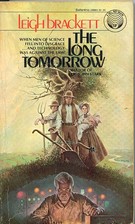
Leigh Brackett’s The Long Tomorrow

A couple months ago, Wired magazine came out with a truly dreadful article on the history of science fiction — one that suggested diversity is new to SF. I wrote my own response to that, and in the comments another blogger suggested the author Leigh Brackett, who wrote in the 1950s but is now largely forgotten. (Thank you!)

I checked the library and found her novel The Long Tomorrow. It was part of an anthology of the best works of the 1950s, and I accidentally started reading it halfway in. And that didn’t spoil it one little bit. On the contrary — it heightened the suspense, because I knew where the characters were headed, but I didn’t know how, and I didn’t know what would happen when they got there.

It’s an amazing postapocalyptic novel set in a rural New Mennonite town. In the novel’s history, nuclear war took out all the cities, which in turn demolished our technology. Mennonites survived, because they only used technology they could make themselves. And New Mennonites, and others, copied their culture because it made practical sense. This is a well-thought-out scenario, and the New Mennonite communities and surrounding countryside are richly drawn. Brackett really takes her time to let you get to know the people.

The people in this world are terrified that nuclear war might return, and this fear has extended to technology and cities. They’ve built a cultural narrative that says the cities were destroyed because God didn’t like them, and they punish anyone who might remotely appear to be bringing them back with stonings and fire.

And then, of course, the main character and his friend, Len and Esau, find ancient technology and go looking for a fabled city. They are two teenage boys brought up in a strict Biblical tradition who now question their community, but for slightly different reasons.

The story of Len and Esau is a coming-of-age tale, a story about growing up, a story about discovering and understanding the world they live in, and an exploration of a complicated moral problem.

I’ve read a lot of post-apocalyptic novels, but this one stands out because of its depth and breadth, the strong characterization, and the way it makes you think. It’s one of those books that will stick with me for years.

Off to see what else she’s written . . .

P.S. Here’s a link to a more in-depth but more spoilery review by author Nicola Griffith. She points out the limitations in a novel that’s a product of the age, but all in all likes it even more than me.

The Long Tomorrow by Leigh Brackett

The Long Tomorrow by Leigh Brackett

The House With a Clock in Its Walls

This book by John Bellairs scared the dickens out of me when I was a child, so I’ve been hunting for a while now. Only I had forgotten the author’s name and got the title mixed up with  Bell, Book, and Candle, maybe because it has  books and lights and noisy things in it, or maybe because the same author wrote The Bell, The Book, and the Spellbinder. But it was one of the books from childhood that I remember deeply.

Then one day I went to a new library branch and the book jumped out at me. The House With a Clock in its Walls. And I’ve just finished it. Sometimes when you reread a book you loved as a child, by the time you reach adulthood you’ve grown so much that the book is now dull. But this one did not disappoint.

This is a deeply scary book. Not just because of the clock hidden somewhere in the walls of a creepy old house, not just because it’s a doomsday clock set to end the world, and not just because the illustrations were done by Edward Gorey. It’s scary mainly because the main character, a boy named Lewis, made a serious ethical mistake, and he nurses his fear and guilt through much of the book.

I bet every child can identify.

Bellairs is quite gentle on Lewis, and on the reader as well. He’s careful to mention that Lewis’ uncle would understand, and he’s also considerate enough to mention that Lewis will make it to adulthood. Bellairs is also kind to all the characters in the book. (Well, the living ones, at any rate.) Even the bully.

And the prose is lovely – expressive, surprising, and smooth. Here’s a short excerpt:

Lewis got up, wiped his hands on his trousers, and tugged at the enormous cardboard suitcase that hung out over the edge of the metal rack. Lewis’ father had brought the suitcase in London at the end of World War II. It was covered with ripped and faded Cunard Line stickers. Lewis pulled hard, and the suitcase lurched down onto his head. He staggered back across the aisle with the suitcase held perilously in the air; then he sat down suddenly, and the suitcase landed in his lap with a whump.

“Oh, come on! Don’t kill yourself before I have a chance to meet you!”

There in the aisle stood a man with a bushy red beard that was streaked in several places with white.”

All in all, it’s a hard read but a good one. I’m glad to have read it. (Twice.)

The House with a Clock in its Walls by John Bellairs

The House with a Clock in its Walls by John Bellairs

Doctor Who Series 9 so far, with spoilers!

(Just skip this post if you haven’t watched “The Magician’s Apprentice” and “The Witch’s Familiar.”)

The first two episodes of series 9 were among the best Doctor Who so far, but they weren’t my favorite — and for the same reason! They delved deep into some seriously heavy topics. In general, I love that (see my article “Fall of a Superhero: Doctor Who and the Waters of Mars” that appeared in Strange Horizons). But it’s been happening so much I’m looking forward to a bit more light and fluffy.

And it’s funny to hear myself say that, because these first two episodes had amazing comedy. Michelle Gomez, playing the villainous Missy, stole the show. She’s an unapologetic, flamboyant murderer. She and Jenna Coleman, playing the Doctor’s companion Clara, passed the Bechdel test, then chopped it up into tiny pieces and had it for tea.  (BTW, there is some lovely commentary on how the Missy/Clara dynamic outshone the  Doctor/Davros dynamic in the Verity Podcast episode “Trials of the Witch’s Familiar.“)

Behind the comedy, though, is some heavy material on morality. There’s a time travel trope of “What if you could go back in time and kill Hitler as a boy/as a baby?” It’s been done to death. But there’s a twist. What if you wander about in time and one day, in the middle of saving an innocent boy’s life, you discover he’s Hitler? (Davros, in this case.)

What do you do?

Reader, I warned you about spoilers, but I will try to go easy on them, and not tell what the Doctor does. But whatever it is, it lands him in such trouble that his (second-worst) arch-enemy (slash best friend) has to come save him. This leads to a complicated examination of friends, enemies, the enemy inside the friend, and the friend inside the enemy.

It culminates with a truly horrifying scene. The Doctor’s companion, Clara, is trapped inside the shell of a Dalek. Roughly speaking, a Dalek is comprised of two parts: a mush of tentacles genetically modified to be without empathy, and a deadly traveling machine. Daleks have been scaring Doctor Who viewers since 1963. They’re unquestionably evil — bound and determined to exterminate every other race in the universe.

But when Clara gets trapped inside a Dalek, she learns something new. When she speaks inside the Dalek, the machine part rasps out a bad translation. So if she says, “I am your friend,” anybody standing in front of the Dalek would instead hear, “I am your enemy.” If she gets upset and says something, the machine starts saying “Exterminate!” and shooting.

So of course she ends up in a confrontation with the Doctor. And it’s horrifying to watch, especially since we’ve been told that Jenna Coleman will be leaving the show during this season. Trapped inside a traveling weapon . . . not a good way to go.

Luckily, the Doctor figures it out and rescues her.

Only there’s a more lasting horror. I’m not sure everyone caught it. What if, all along, throughout the history of the Daleks, there have been good Daleks imprisoned their whole lives inside a metal machine? What if they come up against the Doctor, a man sworn to save people, with a gesture of peace, only to be killed horribly?

Only they’re unquestionably evil, right? That’s been show canon ever since the episode “Genesis of the Daleks” in 1975.

Well . . . no. As it turns out, when the Doctor saves the young boy Davros, he deliberately introduces the concept of mercy to Davros. So there could indeed be dissenting Daleks, forever trapped in a fascist empire . . . shudder.

By chance, I ran into Richard Wright’s novel Black Boy at the library and started reading it like a woman possessed. In that novel, there is a stark and horrifying contrast between the inner life of an ordinary young boy and the “black devil” as he is seen by others. Words that he speaks in innocence are misheard. So now I’m thinking about Daleks, and I’m thinking about race. What if, no matter what you say or do, others will only see a violent and murderous enemy?

So that’s why I say these two episodes are among the best, but also my least favorite. I’m looking forward to something with a bit less horror!

Last week’s episode “Under the Lake” turned out more of an adventure. Scary ghosts, an underwater base that’s turning the lights off randomly, a puzzle to solve, and lots of running around. Pure fun so far, but is something deeper lurking in the shadows? We’ll find out next time, in “Before the Flood.”

The enemy inside the friend?

The enemy inside the friend?

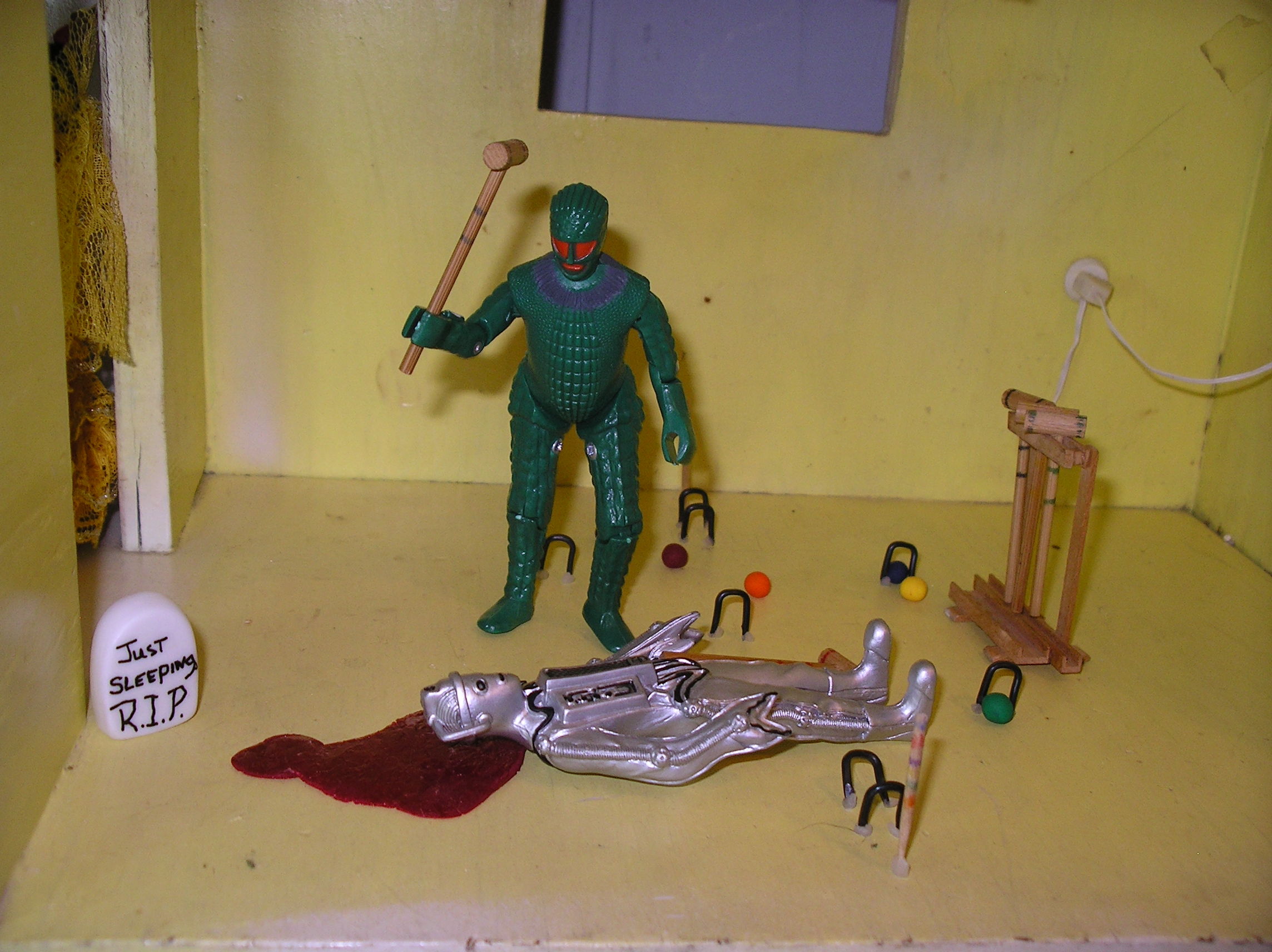
When croquet goes wrong

(This is from my collection of Doctor Who dollhouse photos.)

Croquet Gone Wrong - kristinking.org

Croquet Gone Wrong – kristinking.org

Catching my breath!

This past week has been a whirlwind of activity. What was supposed to be the first week of school turned into organizing strike support for educators through the Facebook page Soup for Teachers. We worked hard, learned a lot, and now I’m exhausted!

Some amazing things happened during this process. The amount of parent support was unprecedented. We were quick, we were loud, and we were out there strong. Also, parents managed to work across the district to help support every single school. We were all fighting together for goals that went far beyond teacher pay. The educators’ union won some important concessions from the school district they’d never have gotten without a week-long strike.

It’s just a beginning, though. I’m catching my breath, because we’re in this struggle for the long haul. The bargaining team for the union reached a tentative agreement with the school district, and a representative assembly approved it and suspended the strike. But we won’t know until Sunday evening whether or not educators will sign the contract. As I understand it, they have some options:

  • stop the strike and sign the contract
  • resume the strike on Monday
  • keep working under the old contract while continuing to negotiate
  • keep working under the old contract and set a strike date

Whatever they do I’ll support them. And whatever they do, we have a long way to go. Bottom line: the state legislature needs to pony up and obey the state Supreme Court order to fully fund schools. We’ll be underwater until then. Our educators can’t afford housing in Seattle. There aren’t any caps on the number of students per nurse. And more stuff.

For now, though, I’m just glad my kids are back in school!!!

too hot by Guldehen at http://guldehen.deviantart.com/

too hot by Guldehen at http://guldehen.deviantart.com/