My last sci fi culture war post

June 22 2015 – Time for me to move on and get cracking on the Clarion West writeathon! Over the last few months I’ve been blogging about a sci fi culture war declared by a creepy weirdo. All the drama and excitement is still going on, and I’m probably gong to continue to be interested in it and writing about it. But dear readers, I’ll spare you any future posts. If I have anything else to say, I’ll just edit one of the earlier posts or append my thoughts to this blog post.

Here’s a summary of what I’ve written so far.

The bizarre story of how sci fi fandom reacted when a member of the Science Fiction and Fantasy Writers of Amercia called a fellow author a half-naked savage and followed it up with more hate speech: Neo-fascism in science fiction, 2013-2015.

Some follow-up thoughts I had on the concept of political correctness, including my general opinions and the history of the term as one-percenter propaganda.

A suggestion on how to deal with hate speech of the kind the sci fi community has been facing.


A look at how the culture wars might affect TOR Books.

That’s all!

6/22/2015 Update – Very happy to see that the TOR boycott has been countered by a book-buying campaign.

Oh, that’s bad news for sci fi publishing

So there are some culture wars going on in the world of sci fi book publishing, and by culture wars, I mean that a neo-fascist with influence has openly declared war on feminists and dragged all kinds of people from all ideological stripes into it. What happened yesterday is all-around bad news for readers and writers of sci fi.

Some context: we’re in the throes of a controversy over Hugo ballot nominations. A group of conservatives who have been complaining about anti-conservative bias in sci fi publishing have been putting together slates of mostly conservative authors. They called it the “Sad Puppy” slate. For the first two years, it included nominations in several categories. This year, though, it included so many nominations in so many categories that it almost entirely pushed out non-Puppy nominations.

There have been many accusations and a lot of outrage, but this wasn’t necessarily the intent of the Sad Puppies. The Puppy nominations swept the ballot in part because Vox Day, owner of the new publisher Castalia House, put out his own Rabid Puppies slate the very next day, which had considerable overlap with the Sad Puppies slate, and then made a call out to Gamergaters to pay the thirty bucks or so to make nominations. (As it turns out, only the Sad Puppies nominations that were also on the Rabid Puppies slate made it onto the final ballot.) If you give Sad Puppies the benefit of the doubt, their movement was co-opted by Day.

As part of the general atmosphere of accusations and outrage, an editor at Tor books made a Facebook comment that was broadly taken to slander all Puppy supporters and authors. Ordinarily, it would have gone unremarked and unnoticed by almost everybody and dropped out of the Facebook feed, as such things do . . .

. . . except that Day saw fit to take a screen capture and release it several weeks later, thereby re-igniting the firestorm.

To make a long story short, Tor — which publishes a wide variety of conservative and other works — is now facing a boycott. It was called by Day, and also by others. (To his credit, Larry Correia, the original Sad Puppies slate-maker, has asked people not to boycott Tor. Thank you for that.)

Day went farther than this. He wrote:

. . . if Ms. Gallo and Mr. Nielsen Hayden are still employed by Tor Books in 2016, I will not nominate any books published by Tor Books for any awards. . . . I am the leader of the Rabid Puppies, I do speak for them, and I have absolutely no doubt whatsoever that they will follow my lead in this regard. I am not concerned about whether the boycott is “successful” or not. The simple fact is that if Macmillan is at all interested in the long-term success of Tor Books, it will jettison both Ms Gallo and Mr. Nielsen Hayden . . .

In chess terms, this is what would be called a “fork.” If Gallo and Hayden are fired, many progressives will be angry and stop buying Tor books. On the other hand, if Gallo and Hayden are not fired, Tor also faces a boycott, plus a threat to take away Hugo nominations — which is a credible one, since Day swept the nominations this year.

Either way, Tor’s hurt, and who loses out? The readers.

Meanwhile, who benefits? Vox Day, who openly spouts hate speech of every flavor, and the publishing house he runs. That’s creepy.

The other bad news? Day is likely to keep on with his war, distracting authors fro the important job of writing and readers from the important job of reading.

Anyhow, I went ahead and ordered a book from Tor, The Goblin Emporer by Katherine Addison. New author, hope I like her!

Further reading

For a firsthand look at Vox Day’s most extreme views, without the noxiousness of going to his blog, try the google search:

“Vox Day” site:http://wehuntedthemammoth.com/

For more on the Tor boycott, including who supports it and who doesn’t, visit “The Hammer of Tor 6/19

For more on the overlap between the Sad and Rabid Puppy slates, visit this post from the ComixMix website.

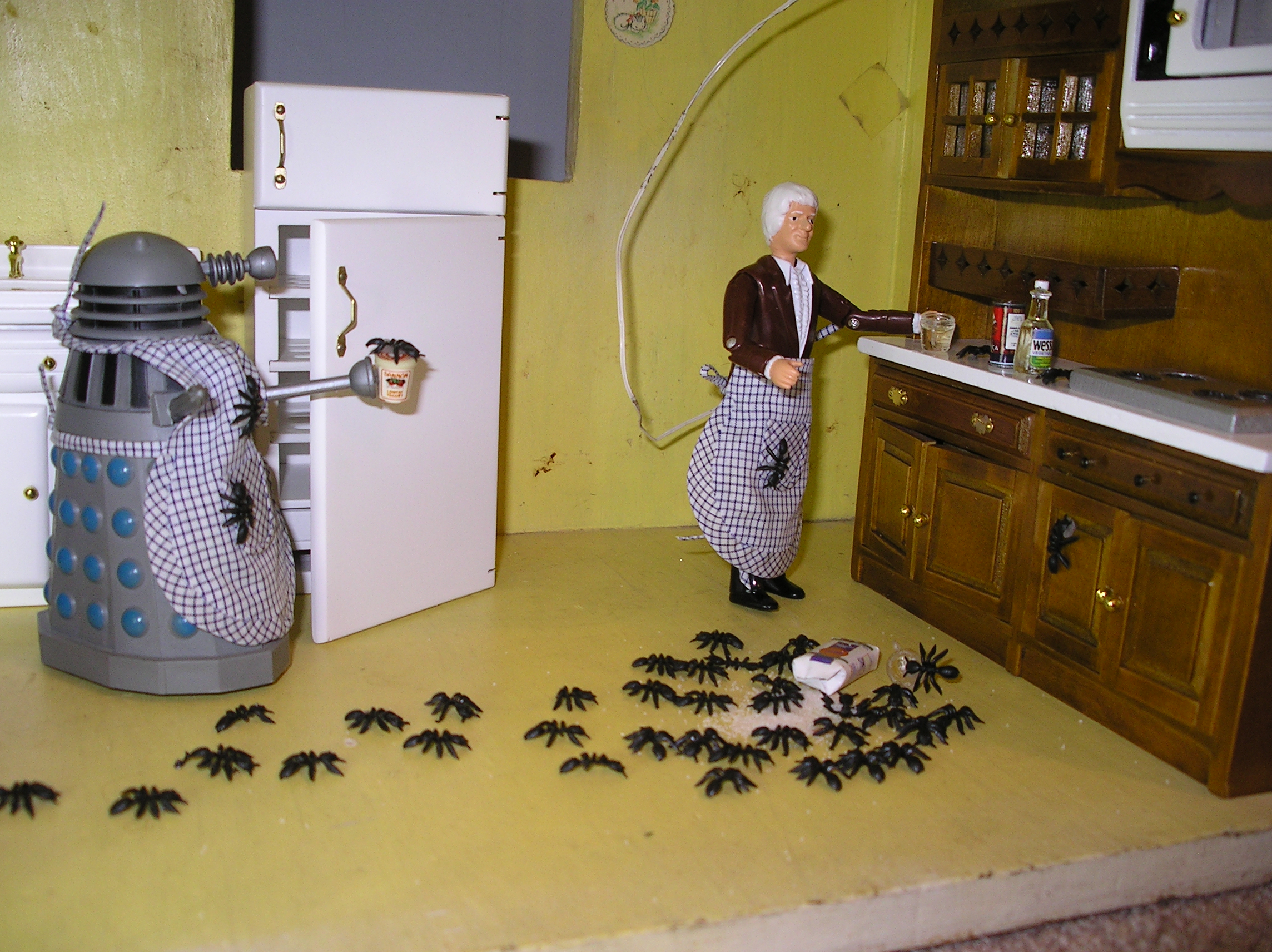
Doctor Who: Invasion of the Ant People

From my collection of dollhouse pictures, I bring you . . .

Picture of dollhouse living room invaded by ants

kristinking.org

A living room full of ants. Because . . .

Picture of an ant invasion featuring a Dalek and the Jon Pertwee Doctor.

kristinking.org

The Third Doctor dropped a bag of flour, and apparently his Dalek housemate didn’t notice.

Tisk, tisk.


Enid Blyton on gender, class, and race

Updated Feb 2018

Children’s author Enid Blyton helped shape my gender identity as a “tomboy.” Her Famous Five series included a girl who called herself George, dressed as a boy, and was always delighted to be mistaken as one. In contrast, her cousin Anne liked dolls and dresses and always leaped at the opportunity to keep house. Both characters were sympathetic, but Blyton clearly favored George.

I liked dolls and was offended to be mistaken as a boy, but if I could have chosen, I’d have been George. She ran around getting dirty and she could row a boat all by herself, to the island she owned. She didn’t take nonsense from anybody. She was powerful.

I read every single Famous Five book I could find. The library didn’t carry all of them, but most libraries carried at least a couple. So any time I found myself at a new library, I went straight for the card catalog.

I returned to Blyton in adulthood, once again scouring libraries for her books. The minute I found her books online, I ordered them all straight from the U.K. Now I own every single one Famous Five book, and my spouse and I have been reading them to our kids off and on for several years.

I enjoy them as an adult now, and not uncritically. Blyton wrote in the 1940s-1960s in the U.K., and back then people had much different views of race, class, and gender. So I take note of those aspects in her books.

Let’s start with gender. George is powerful, but Anne is disempowered. She’s a scaredy-cat and her love of dolls is “babyish.” She goes along with the group but never initiates anything. Her love of traditional feminine activities is looked down upon. It’s not all bad, of course. Her caution makes her a good spy and often keeps her from getting captured so she can run for help. But on the whole, I absorbed the message that girlishness made you weak.

Next, class. The Five were solidly middle-class. The villains were mostly working class. The Five often hooked up with another child in their adventures, and those children often tended to be working class — often the unwashed masses who were in need of shoes or a pocket handkerchief, but once given them, used them wrong. Sometimes their parents were the villains and they had to be sent to a civilized home after the Five landed their parents in jail.

On the other hand, the working class status of the friends gave them spunk, critical climbing and exploration skills, a range of animal companions, and the freedom to sneak around. So long as they were willing to conform to the middle class standards of the Five, they were accepted as equals.

And finally, race. I saved this one for last because it’s most interesting to me. One of the books featured a possibly* mixed-race boy nicknamed “Sooty” because the kids at his school thought his black face looked like soot. (Side note: I edited this to say “possibly” because in the comments, J makes a good case for Sooty being mixed Anglo/Mediterranean or “Black Irish” with dark hair, dark eyes, and olive skin.)

My spouse and I had a heck of a time with the name “Sooty”! We were worried that if we read the book as is, our kids use the nickname on the playground and we’d get called into the principal’s office. Nobody wants to get called into the principal’s office! So we explained to the kids that “Sooty” was rude nowadays and substituted his actual name, Pierre, which was quite tricky to do on the fly. I kept saying “Soo-Pierre.” (We did well enough, by the way, that there weren’t any playground incidents.)

Pierre’s nickname was offensive by today’s standards, but the kid himself was cool. He invented nifty gadgets, he was a star student at school, and he was clever and brave. With Pierre, Blyton subverted a whole bunch of racial stereotypes. Nicely done.

The other people of color that the Five run into are “travellers,” which in modern terms would mean Roma. (The term “gypsies” is actually a nasty racial slur). The color of their skin is not important to the narrative and is rarely called out — the books focus on the Roma characters’ class status much more strongly.

One Roma girl, Jo, appears in many adventures. She’s one of the barefoot and dirty people, and also one of the most admired. Most fascinating to me, though, is that in more than one adventure, she is George’s doppleganger. (Check out the excerpt below.)

What does that make George?

I have no answer to that question, so I have to leave it hanging.

So I have no definitive answers to the question of race in Enid Blyton’s work, but quite a bit of curiosity! I updated this post today because of the recent Guardian article, “First modern Britons had ‘dark to black’ skin, Cheddar Man DNA analysis reveals.”

But I will say that I enjoy her books. Give them a try. You might too.

Excerpt

Five Fall into Adventure by Enid Blyton.

‘What’s your name?’

‘Jo,’ said the girl.

‘But that’s a boy’s name,’ said Dick.

‘So’s George. But you said she was a girl,’ said Jo, licking the last bits of ice-cream from her fingers.

‘Yes, but George is short for Georgina,’ said Anne. ‘What’s Jo short for?’

‘Don’t know,’ said Jo. ‘I never heard. All I know is I’m a girl and my name is Jo.’

‘It’s probably short for Josephine,’ said Julian.

. . .

‘It’s really strange,’ said Anne, at last, ‘but Jo is awfully like you, George – same short curly hair – only Jo’s is terribly messy and tangly – same freckles, dozens of them – same turned-up nose . . .’

‘Same way of sticking her chin up in the air, same scowl, same glare!’ said Dick. George put on her fiercest glare at these remarks, which she didn’t like at all.

‘Well, all I can say I hope I haven’t her layers of dirt. . .’

For Further Reading

“Primary school removes Enid Blyton’s Famous Five children’s classics so it could win a race equality award”, Craig McKenzie, The Daily Mail,  December 7 2013.

Blyton, who died in 1968, wrote some 800 books. They have been translated into nearly 90 languages and sold more than 600million copies worldwide.

One of her best-known characters is Noddy, although her greatest output involved adventure books such as The Famous Five and The Secret Seven.

Many contained references that were commonplace at the time but were later deemed racist, sexist or anti-Semitic and subsequently cut or altered.

“Are the Famous Five as racist and sexist as I remember?” by Anna-Marie Crowhurst, Xojane, May 29, 2012.

. . . erm yes, yes they are. They’re still amazing though.

“Jo, the gypsy,” Serge, from the website serge-passions.fr.

Jo is the most recurrent secondary character in the Famous Five series. We see her again in “Five Have A Wonderful Time” and then in “Five Have Plenty of Fun”. Enid Blyton often calls on Travellers (gypsies) in her books. The Galliano Circus series shows us young Carlotta [?], a circus rider, whom we also meet in the “St Clare’s” series. Those characters give the author the opportunity to get us closer to people of a different background, who are often critized, and whose talents and qualitites she underlines.

and

An attaching character, Jo loves her freedom, and refuses any constraints. She loves walking barefoot, singing and dancing in front of the fire. It’s the rebellious, free, primary side of childhood that Enid Byton makes us feel, and we are not insensitive to it.

Hate speech not welcome

At my kid’s school, there’s an assembly every Monday morning. A student is given the honor of reading the school expectations, which are posted conspicuously:

I use respectful language. I am in the right place at the right time. I keep my body in my personal space. I move safely on school grounds. I care for school property in a responsible way. I am considerate and respectful of others.

And there’s a sign (from the Safe Schools Coalition) that I see when I walk in the door of the school. It says,

“Degrading racial, ethnic, sexist or homophobic remarks not welcome here. RESPECT the differences.”

The message simple and clear. Our community tries hard to follow it. The call for consideration and respect protects everybody. The sign on the door makes a call out to groups that are protected from hate speech because of historic and continuing oppression. We don’t do a perfect job, but when something goes awry, we are much better equipped to handle the situation because we are all on the same page.

There is broad-based agreement at our school that these are legitimate social expectations, for practical reasons. None of us want our kids to come in from recess with bloody noses and scraped knees.

Until recently, I would have thought there was broad-based agreement within the science fiction and fantasy community as well. However, recent dramas have shown this is not so. There are a sizable number of people who think it’s perfectly fine to make degrading racial, ethnic, sexist or homophobic remarks — but that it’s not okay for a community to try to stop them. There is also a backlash against people the extreme right wing are calling “Social Justice Warriors.”

This by itself is not so surprising to me. What’s surprising is that middle-of-the-road people seem to be going along with them to some extent. Why?

Well, for one thing, the phrase “political correctness” has made a comeback. That phrase is vague and muddles the conversation about what is okay to say and what isn’t. (In a recent post, I suggested there was a reason for that: the millions of dollars that conservative philanthropies have thrown into think tanks and other propaganda efforts.)

The phrase “political correctness” also hides a critical distinction between the kinds of people who use it and the reasons they use it. Some people use it maliciously and nefariously, to cover up or defend hate speech. Others use it sincerely, out of frustration that they don’t feel free to express opinions that do not rise to the level of harrassing, discriminatory, or hate speech.

There’s a need for the science fiction and fantasy community to come up with clear expectations for speech and fair consequences if they are violated. And these expectations should treat hate speech differently than other kinds. I’m not talking censorship here. I’m talking about a community setting standards for itself.

What happens if we don’t? Well, at the moment, somebody’s job is at stake (Irene Gallo) over some comments that she made. Here are the comments:

There are two extreme right-wing to neo-nazi groups, called the Sad Puppies and Rabid Puppies respectively, that are calling for the end of social justice in science fiction and fantasy. They are unrepentantly racist, misogynist, and homophobic. A noisy few but they’ve been able to gather some Gamergate folks around them and elect a slate of bad-to-reprehensible works on this year’s Hugo ballot.

Her employer, the major SF/F publisher Tor, is being financially threatened by a boycott if she is not fired. The reasoning behind the call for firing is that conservatives have been fired for their public comments, so she should too.

But what’s not mentioned is that some of the firings conservatives are complaining about involved degrading racial, ethnic, sexist or homophobic remarks. If that’s not even mentioned, then as a community how can we possibly set consequences that most people think are fair?

We’re now in a situation that’s bad for everyone, including Tor. If she’s fired, Tor will face a boycott from the left. If she’s not fired, Tor will face a boycott from the extreme right.

Tor’s response was perhaps the best they could do under the circumstances to appease both groups. But there’s something that bugs me. A lot.

In short, we seek out and publish a diverse and wide ranging group of books. We are in the business of finding great stories and promoting literature and are not about promoting a political agenda

There’s that little political correctness complaint again. What political agenda is he talking about? Gallo criticized the Puppies for being openly racist, misogynist, and homophobic. So her political agenda is what?

More important, though, the political agenda of the Puppies is off limits for discussion here. I kind of get that Tor would want to avoid a discussion that would alienate many of its customers. But the discussion needs to happen somewhere, or rather, in as many venues as possible. And it needs to include an acknowledgement that hate speech is not welcome.

As a community, science fiction and fantasy authors, readers, and editors can and should set standards for discourse. The work on that has already begun, but it looks like there’s a long way to go.

For Further Reading 

A balanced post about complaints of political correctness by blogger and cartoonist Amptoons, “Chait Criticizes Exactly The Kind Of Speech We Should Want More Of”.) This post also has an excellent list of links at the end.

From blogger Julian Sanchez, a post from a leftist about the mistakes the left is making when it comes to political correctness, “Chait Speech.”

From the ADA Initiative website, a post about anti-harassment speech that is being done, “Conference anti-harassment work in SF&F, 2014 edition: N. K. Jemisin’s speech, Hugo battles, Frenkel saga & more”.

A blog post by Laura “Tegan” Gjovaag about the Puppies, “The ongoing Hugo mess comes to haunt me again. . .” This is coming from a fan perspective and is written in lively prose.

Science Fiction Writers of America (SFWA) anti-harassment policies and social media policies on discriminatory speech.

And finally, the Safe Schools Coalition, which created the “Respect the Differences” Sign.

from http://www.safeschoolscoalition.org/

from safeschoolscoalition.org

Steven Moffat’s work is more complicated

I read with great pleasure a post by Jack Graham on the multiple failings of Steven Moffat, showrunner for Doctor Who. Though a devoted fan of Doctor Who, I also enjoy shredding it to bits on the grounds of politics, gender, and race. It gives my brain something fun to do. I’m in agreement with Graham’s closing remarks:

The people in power, the privileged, deliver something, and instead of saying “thanks boss”, you say “not enough – do better.”  Moffat has a harder time pleasing everybody because more people are politicised and vocal about stuff like sexism.  The neoliberal feminism of a privileged ‘ally’ isn’t good enough for them.  And that’s as it should be.  Be reasonable, I say.  Demand the impossible.

I also agree with mostly everything Graham says in his post. For instance: “In Moffat’s show, women are overwhelmingly defined by their traditional gender roles or bodily functions.” Yes. That’s very annoying. Also: “I think the reason that lots of people think Steven Moffat’s version of Doctor Who is sexist is because it repeatedly acts and sounds sexist. Yes. I agree. And: “Moffat’s repeated tendency to have him cosy up to rulers, presidents, kings and queens, bosses, presidents, etc., is quite revolting.” Good point, and a disturbing departure from Classic Who. Finally: “He makes Doctor Who safe for neoliberalism.” Whoa . . . hadn’t noticed that, but now that Graham mentions it. . . yeah. A lot of Classic Who is about the rebels beating the empire, and I miss that.

At the same time, though, under Steven Moffat’s direction the show has done some remarkable things with both gender and politics. Here are five things (out of many) I’ve absolutely loved:

1. In “The Beast Below,” an authoritarian is deadlocked by a moral dilemma it can’t solve. It uses a fake kind of democracy to enforce the status quo: those who dissent are thrown into a pit to be eaten. The status quo relies on everybody forgetting the underlying societal injustices. What ultimately solves the problem? Amy Pond forcing the queen to abdicate.

2. Male domesticity plays a key role in the show. Most dramatically, in “Closing Time,” the plot resolution hinges on the bond between a father and his baby.  For example, Rory is the one who wants to settle down and have a baby, and Amy is the one who wants to put off her wedding in favor of having adventures. Rory has a nurturing occupation (nurse).  And Rory’s father is shown doing household chores. In short, men are moving beyond their traditional gender roles.

3. Shows often revolve around women’s issues of every sort. What saves the day in “The Doctor Dances”? A recognition of the plight of unwed mothers during World War Two.

4. Finally, the power dynamics between men and women are complex. The flirtation between River Song and the Doctor, which spans Seasons Four through Seven, is all about power. They’re engaged in a struggle for domination that lasts four seasons, and that they both clearly enjoy. She has power no other companion has ever managed: she can drive the TARDIS and she knows his name. And, although he apparently traps her in an artificial reality at the close of her story, she reappears inexplicably in a disembodied/embodied state.

5. The TARDIS got sentience under Moffat’s watch. She got to tell her own story and explain the role in his adventures that she’s always had. Sweet.

There’s such a wild abandon of creativity in Moffat’s work. It’s stretching in new directions all the time, and it’s offending and delighting people of every political persuasion. Art does that! So, while I’m perfectly happy to criticize him until I’m blue in the face, I’m equally happy to celebrate him.

But not just him — the show, and all the many writers who craft the characters and situations. It’s easy to oversimplify and place the criticism and celebration on him, which does everybody else a discredit. I’ve just started going back to my favorite episodes and seeing who wrote them, and my life is all the richer for it.

Update on June 15th, 2015

I neglected to mention that I found Jack Graham’s post through Philip Sandifer. It was a response to a post of Sandifer’s that I just got around to reading, “The Definitive Moffat and Feminism Post.”  Good stuff in there.

Here’s a quote:

Yes, the Moffat era of Doctor Who is sexist. Because it’s television made in a sexist society. But it has things to say about that society, and they are not kind things. I genuinely fail to understand anybody who claims that the Moffat era is sexist in excess of background radiation. This is a show that’s repeatedly telling girls that they can be as cool as the boys, that the boys don’t always know better than them, and that love and independence don’t have to be antagonistic qualities for women. It’s a show that tells rape survivors that it’s OK to not be defined by the terrible things that happen to them. It’s a show that says that women aren’t done being sexy once they get a grey hair and their first wrinkle, and that tells the Doctor off for thinking otherwise.

My tangential conclusion

Let’s end with a youtube video from the Chameleon Circuit, “Big Bang Two,” and a picture from the video. (Why? Because I like it!)

https://www.youtube.com/watch?v=jsFleDHX3G4 

big bang two

Getting to the ending

Well, it’s been a year since I started my project on documenting the fanfiction workshop I taught in my son’s fourth/fifth grade class. I got distracted by the end of the school year and never came back to it.

There’s a lovely irony in the place I got stuck: “Getting to the ending.” Endings are, apparently, difficult.

The main thing I told the kids is that there are no hard and fast rules, but people have an intuitive sense of when something is ended or not. The main question to ask is, “Does it feel finished?”

I gave them three general options:

  1. Solve the problem or mystery or find the treasure
  2. Have the character fail to solve the problem or mystery
  3. Leave the solving of the problem or finding of the mystery to the future, but add a resolution

I also provided some examples by reading ending sentences out of various books and asking the kids why they felt a sense of completion.

From that small amount of guidance, most students were able to generate an ending. Some were stuck, and we worked with them individually, offering suggestions if needed. But in keeping with the rest of the course, I kept adult visions of “the proper story” out of it.  Once they felt the story had a sense of completion, it was done.

Next up: revision!

Still got legs!

Legs! Still got legs! There’s life in this old horse yet, and I know there’s gonna be an awful lot of running to do!

. . . and . . .

“Yes, I am, well, yes I was, it’s complicated but I won’t explain it now because,” then he disappeared into a hazy fuzz, that man, I can’t explain why he does the thing he does. Oh my god, I don’t have a clue! These paradoxes are hard to construe! My mind is blown, I bet your is too. Well, I guess this is . . .”

It took FOREVER for the album to come in the mail. I figured I could just listen to the songs, over and over, on youtube. My son was considerably more anxious. Six-thirty in the morning: “Has it come yet?” My daughter complained the first ten times he played the song “The Doctor is Dying” but now she’s singing it too.

When it finally arrived my son abandoned screen time to listen to it. I drank fruit V-8 Juice and sprawled out on the hot concrete of the front porch, just listening. I think we might have to print out the lyrics and memorize them.

Anyway, this band is amazing.

chameleon-circuit-band-01

It’s not the words I most love, though they are brilliant, but the tunes. Deep, melodious, hauntinghappysadish, Idontevenknowwhat.

Enjoy.

The history of political correctness

Gustave Doré [Public domain], via Wikimedia Commons

Confusion of Tongues, Gustave Doré [Public domain], via Wikimedia Commons

When someone complains about “political correctness,” it feels grossly unfair to those of us on the left. But often, when people are using it, they’re complaining about a situation that feels grossly unfair to them. Both sides sense injustice but fail to articulate its specifics. No understanding is possible and the argument festers.

I’m inclined to blame the term itself.  In my last blog post, I suggested that the term is slippery and vague. Well, there’s a reason for that. Although the word “political correctness” has been around for a while, its meaning changed in the early 1990s when the one percent funded a comprehensive attack on “the liberal bias” in education — an attack that continues to this day.

There is a good summary of this attack in the article “Buying a Movement – Right-Wing Foundations and American Politics” by People for the American Way, September 11th, 1996. It explains how corporate foundations pour millions and millions of dollars into shaping public debate on key political issues. They paid for mass media coverage, conservative think tanks, and an organization of conservative university scholars.

I’m interested in just one part of that attack — the use of the terms “politically correct” and “political correctness.” I researched it by logging on to my public library account and searching its article database for those terms in the years 1990 and 1991. (Thank you to my friend Phyllis Fletcher for pointing me to that resource!)

There’s not much until November of 1990, when the Wall Street Journal and New York Times began running articles on the horrors of censorship by liberal faculty and administration.

Who wrote these articles and what were the horrors? It turns out that the National Association of Scholars (NAS) played a key part. The NAS was founded in the 1980s as a network of conservative faculty. In the early 1990s, it received funding from the Lynde and Harry Bradley Foundation, the John M. Olin Foundation, and others. It was strongly opposed to multicultural education, and in the 1990s it burst into the spotlight by blocking the inclusion of civil rights readings into an English course and by defunding a Chicano newspaper.

Basically, they were bent on censoring diversity in curriculum. But they couldn’t say that in so many words. Propaganda was necessary to make their efforts palatable to the public.

In November of 1990, an editorial writer for the Wall Street Journal, Dorothy Rabinowitz, wrote the opinion piece “Vive the Academic Resistance” (Wall Street Journal, Nov 13 1990). She defined political correctness here:

PC-ism, as it has come to be called, reigns on campuses from sea to shining sea. Dissent from politically correct positions on women, minorities, multiculturalism and the like comes at a high cost — a cost that may include threats, vandalism, sit-ins, shout-downs, charges of racism and sexism and, frequently, administrative punishment.

This article framed people who dissented from “politically correct positions” as underdogs. It framed attempts to add diversity to the campus as an attack on Western culture. And it framed opposition to NAS scholars as an assault on free speech.

Once Rabinowitz had framed the problem, she presented a solution. She introduced the NAS as a “Resistance Movement.” This meant that, among other things, her article was recruiting conservative university scholars who were “opposed particularly to the new doctrine of multiculturalism.” These scholars would later add their voices and their horror stories to the charges of political correctness that the Wall Street Journal and New York Times were all too happy to print.

A year later, a think-tanker named Dinesh D’Souza wrote the book Illiberal Education, which criticized multicultural education and affirmative action, spoke against student groups formed around skin color, and said that political correctness was “chilling freedom of thought and speech on American campuses.”

D’Souza, who holds extreme views on colonialism, feminism, and black culture, worked for the American Enterprise Institution through a grant from the John M. Olin Foundation. That foundation’s goals were to:

provide support for projects that reflect or are intended to strengthen the economic, political and cultural institutions upon which the American heritage of constitutional government and private enterprise is based.

To translate, “economic” means “free market economy.” “Political” means “a power structure that promotes the free market economy.” And “cultural” means the canon of Western literature. Marxists, feminists, people of color, and environmentalists are not welcome.

Let’s take a quick look at how Dinesh D’Souza articulated his vision of political correctness in the article “PC So Far” published in the journal Commentary in October 1991. There isn’t a simple, clear definition of “political correctness” anywhere.  D’Souza does mention the dictionary definition of politically correct from Merriam-Webster:

marked by or adhering to a typically progressive orthodoxy on issues involving especially race, gender, sexual affinity, or ecology

If you stop and think about the “politically correct” definition, there’s nothing sinister about it. You could just as easily make up a word and call it:

marked by or adhering to a typically conservative orthodoxy on issues involving especially race, gender, sexual affinity, or ecology

But it got sinister overtones in this article. Why? Because in the first paragraph D’Souza suggested that it

seems to have originated in the early part of the century, when it was employed by various species of Marxists to describe and enforce conformity to their preferred ideological positions.

Seems to have? Yes, that’s the kind of slippery wording you often find in propaganda. Where did he get his evidence for this? Who knows! But by inserting this quasi-historical statement, D’Souza had the opportunity to insert the concept of enforced conformity into the definition of political correctness. Neatly done, if sleazy. The next phrase that is almost a definition of political correctness is:

a political and social atmosphere in which politically incorrect opinions are discouraged, villified, and ostracized.

Who are the agents of this villification? Who knows! Which are the politically incorrect opinions? Who knows! What happens to the people who made these opinions in the first place? Who knows! As far as actual meaning goes, this sentence only says, “Some people discourage, villify, and ostracize opinions.” That’s almost true but again, not sinister. I’d wager to say that everybody discourages and villifies opinions. Not sure how somebody ostracizes an opinion, but whatever.

To sum up, D’Souza wrote an entire article on political correctness without defining it. Instead of a definition, he used scaremongering.

###

That was twenty-four years ago. Since then, the propaganda machine built by corporate foundations and think tanks has kept right on chugging along. Foundations have spent a lot of money over the years loading the definition of “political correctness” with innuendo, so it can be used as a weapon against progressive speech. (The NAS, by the way, is still around, still promoting its free-market, anti-multicultural agenda. At the moment, they’re up in arms about the A.P. US History curriculum.)

How do you fight that kind of verbal manipulation? I would just avoid the phrase “politically correct” altogether. It’s been used as manipulation by a disreputable crowd for twenty-four years. Isn’t that enough?

Instead, when there’s a complaint about some situation and the term “political correctness” is used, it’s probably better for both sides to go back to the specifics of the situation itself. This means asking whowhatwhenwherewhy, and how.

For instance, take the word retard. Nobody uses that word any more, and good riddance! But attempts to substitute the word special needs were criticized for political correctness. Who wanted to change the word, and whyWhat did they want to change it to? And how? Meanwhile, who wanted to preserve its use? How did they want to use it? And what kinds of situations did they want it for?

Now, that’s a conversation worth having.
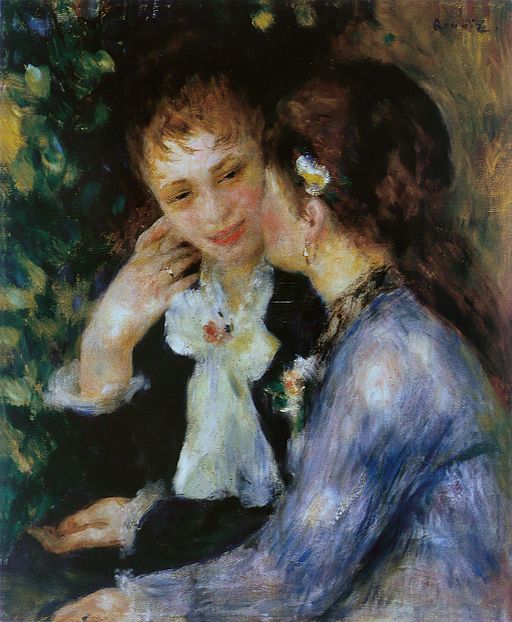
Pierre-Auguste Renoir - Confidences

Pierre-Auguste Renoir – Confidences

Considering political correctness

Close your eyes for a moment and think back to the last debate you heard about political correctness. Done? Thank you. Now I don’t have to summarize it. It’s a tired debate and I suspect both camps have reached an impasse.

But there’s something I’m interested in. How is “political correctness” defined? With great vagueness and many allusions, so far as I can tell.

When somebody refers to political correctness, they are referring to . . .what? What kinds of speech gets classified as PC? And on the flip side, when somebody uses that kind of speech, what are they saying?

Definition time! Let’s go with Merriam-Webster:

Political correctness definition: conforming to a belief that language and practices which could offend political sensibilities (as in matters of sex or race) should be eliminated

This isn’t all that helpful. What does “should be eliminated” mean, anyway? Does political correctness refer to the avoidance of certain terms, the act of asking others to avoid using those terms, the exertion of social control over people who use those terms, or some Orwellian “say those things and you’ll get dragged away in the middle of the night to our PC Prison”?

When I hear the term “political correctness,” it’s usually referring to a complaint about racism or sexism in a book, speech, or movie. But it carries all those other connotations. It’s a term that means more than it says. It’s sneaky.

So where did it come from? What did it mean originally? Let’s go back to the guy who popularized it as an insult. His name is Dinesh D’Souza, and he used it in his book Illiberal Education. From his website:

Dinesh D’Souza argues that by charging universities with being “structurally” racist, sexist, and class-biased, a coalition of student activists, junior faculty, and compliant administrators have imposed their own political ideals on admissions, hiring, curriculum, and even personal conduct, while eschewing the goals of liberal education

He was referring specifically to university campuses, where a huge cultural shift was taking place. Groups who had been historically marginalized were standing up and asking for respect.

Is it so hard to meet a request for respect? To avoid demeaning terms and phrases? Apparently so.

Fortunately, asking is the wrong word. No, they were demanding. “Power concedes nothing without a demand. It never did and it never will.” (Frederick Douglass)

Let me offer an alternative definition then.

The term “political correctness” is a perjorative used when responding to a demand for respect by a historically marginalized group or by an ally.

I don’t think that definition’s going to win me any arguments, but there it is. Somebody says “political correctness,” that’s what I hear.

just a little bit

just a little bit