Category Archives: doctor who

What is that certifiably insane time traveler up to THIS TIME?

Is Doctor Who for kids any more?

(Removed and expanded from another post.)

Season 8 of Doctor Who has been billed as “a darker season” with “a darker Doctor” than the previous two, more flippant Doctors. Is it still appropriate for kids?

In a review of the episode “Dark Water,” columnist Sam Wollaston from The Guardian points out all the disturbing elements he enjoyed and then writes:

“I suspect my approval may mean he gets the opposite from the kids. Yeah, well, so what, it’s not your show any more. Love you, now go to bed.”

Yeah, well, fuck you Sam Wollaston, from the bottom of my motherly heart. Should my kids be deprived of this show just to make you happy? Plus, you’re dissing the future adult fan base of Doctor Who. Don’t forget that it was rebooted by adults who watched it as children.

This, by the way, is nothing to do with wanting or not wanting the show and the Doctor to be “darker,” whatever that means. Children are fully capable of dealing with “darker.” Read any Roald Dahl lately? Any Brothers Grimm fairy tales? In fact, many children’s ordinary lives are a lot scarier than any episode of Doctor Who could ever be.

Anyhow, when my spouse and I sit down to watch Doctor Who, the kids join in. My oldest loves to be scared, and my youngest leaves the room when the going gets too rough. She didn’t actually leave the room during “Dark Water” — I have a feeling it was scarier for the grownups, who think more about death. Nobody had nightmares, except me.

I think the show is good for kids in many ways. For instance, it’s a great source of metaphors and a way to understand our rapidly changing world. When a child asks, “But whyyyyyy can’t I have a cell phone? Even second-graders at my school have them!!!” I can say, “Because they will turn you into Cybermen,” and they get it.

The show is also a great way to expose children to some of the frightening truths that adults grapple with (badly) without overwhelming the kids. How many apocalypses have we had on the show? Ecological disasters? Megalomaniac rulers? But there’s almost always been a counterbalance, a ridiculous and fallible Doctor who saves us from the monsters, while tripping over his own shoes.

That’s the magic formula of the show, the one that’s kept fans coming back for more. The world is scary, but you can go out into it, explore, confront danger, because somebody’s got your back. It’s a lie, of course, but it’s a lie that children need in order to learn and grow and take risks. (As an adult who figured out that lie, and learned we have to save the frigging world ourselves, I do love the mental health break of stepping inside that blue box to watch that magic formula in action.)

This season has done a beautiful job of keeping that magic formula while still exploring all the troubling aspects of being the Doctor. But I do have a perpetual worry that Doctor Who might stray too far from the formula and stop being fun for kids. Of any age. As an extreme example, I don’t want Doctor Who to turn into “Torchwood: Children of Earth.” That episode had the kind of gut-wrenching impossible choice no hero could live with. And I don’t want the companions to get killed — especially Clara, the character my daughter adores. Finally, I don’t want the underlying optimism and humor to be lost. Fortunately, for now at least, we have a showrunner who remembers and values what it’s like to be a Doctor Who fan as a child. Don’t forget. Run, you clever show, and remember.

And hey, kids — Doctor Who is and always has been your show. Stay up late.

Have a jelly baby.

Have a jelly baby.

Have a jelly baby.

Other opinions about Missy in Doctor Who

Nov 7, 2014

Update: after considering all week and checking out various opinions, I have decided I like Missy. A lot. She’s basically a walking, talking, kissing piece of comic meta. I took down one of my posts (Doctor Who Dark Water – A Near Miss) because I’ve changed my mind about it.

Keeping this post though, because it’s basically a summing up of various opinions I’ve heard around the net. Spoilers below.

Nov 4, 2014

I’m conflicted about the character of Missy in Doctor Who. What are other people saying? Here’s a little summary of what I’ve found around the net.

From Cogpunk Steamscribe – “From a feminist viewpoint, this is a brilliant addition to the Doctor Who canon.” and “All the . . . shippers must be screaming in delight.”

Personally, I think half are screaming in delight and the other half are pissed.

From freethoughtblogs – Missy is one of a number of cookie-cutter female characters.

She sure channeled River Song in this episode.

From Radio Times – She’s a strong female character and shows Moffat to be a feminist. “Surely, this puts paid to any whingers who, for reasons that escape me, have labelled Moffat a misogynistic writer.”

Nice try.

From feministfiction.com (and by the way, how have I not found this before???) – very excited by the plot twist but yet another female character being in love with the doctor is setting up potential alarm bells.

Yes, that’s it exactly. That’s how I feel.

From ibishtar.livejournal.com – was hoping for Missy to be who she is but is concerned about how it was handled.

Yes. But I can’t personally decide how I would rather have had it handled.

Various comments on doctorwho.livejournal.com

From gildinwen – “You Troll Moffat…you epic epic troll *G*”

Also from gildinwen – “He did bring us Jack and River…..like flexible sexuality was kinda introduced into the Doctor Who universe via Moffat….and thank you for that kiss!!!!”

angelophile – “it manages to be both sexist and homophobic at the same time. Double whammy.”

eowyn – “Why are all female villains the same? Karabraxos, Miss Foster, Kovarian, Missy – they’re all basically interchangeable.”

gonzo21 – “And yes! Moffat knows how to write precisely 2 female characters. They’re either Amy/Clara or Missy/Kovarian/River/etc. ”

norahsilverbird – “I thought it was hilarious how she decided to kiss the Doctor.”

femme_slash_fan – “the way Missy has been spouting off about her ‘boyfriend’ just hits me as needy and a little overly sexualised”

gonzo21 – “I’m also not convinced Moffat is the writer we want to be handling trans-gender issues like this.”

sharaz-jek – “. . . it’s good to see an example of genderfluidity, even if it is . . . ”

pinguthegreek – ” Transgender issues are a relatively new thing to many people who may not have any experience or contact with trans people. To expect writers of a mainstream, flagship, prime time show to carefully consider those kind of sensitivities in this particular instance is kind of shooting for the moon. . . Progress has to be in small steps . . .”

ibishtar – “. . .a writing move that I found cissexist, heteronormative and sexist . . .”

Sexuality Dragon (warning: blog contains mature themes): “My reaction so far has been to squeal, cry, yell, swear, say things like: ksjdfbkwebtksdvkbdsfansbdn l I can’t I can’t oh god it’s so beautiful am I betraying everything I believe in if I start watching DoctorWhoagain”

Verity Podcast – The Verities interpreted Missy as an excellent continuation of the Master, complete with a typical crazy “Master plan,” flirting through destruction of planet Earth, flair for style, invasion of the Doctor’s personal space, and more. As for the gender dynamics, there was one interpretation that this is how the Master thinks he ought to behave now that he has a woman’s body.

Quite the range of opinions! If nothing else, this is a move that’s making people think.

Any other feminist opinions about Missy? Let me know and I’ll link to them here.

Kill the moon?

–Spoilers for Doctor Who: “Kill the Moon”–

A man puts on a red spacesuit and walks onto a planet, to find a team of people grappling with an alien threat. It’s a very special moment, a time when big things are about to be decided. In response to the threat, there’s a nuclear bomb that might have to be set off.

The leader of the team says to him, “Who the hell do you think you are?” Well, he’s a Time Lord, a superintelligent alien being, with the power to step into special moments like these and shape the future. He can help . . . but maybe he shouldn’t.

This is the premise of the Doctor Who episode “Kill the Moon.” Curiously, it’s also the premise of a previous episode, “The Waters of Mars.” Although “Kill the Moon” works perfectly well as its own story, it also works as a duet with “The Waters of Mars.” And when the two are put together, they ask some philosophical questions I’d be hard-pressed to answer.

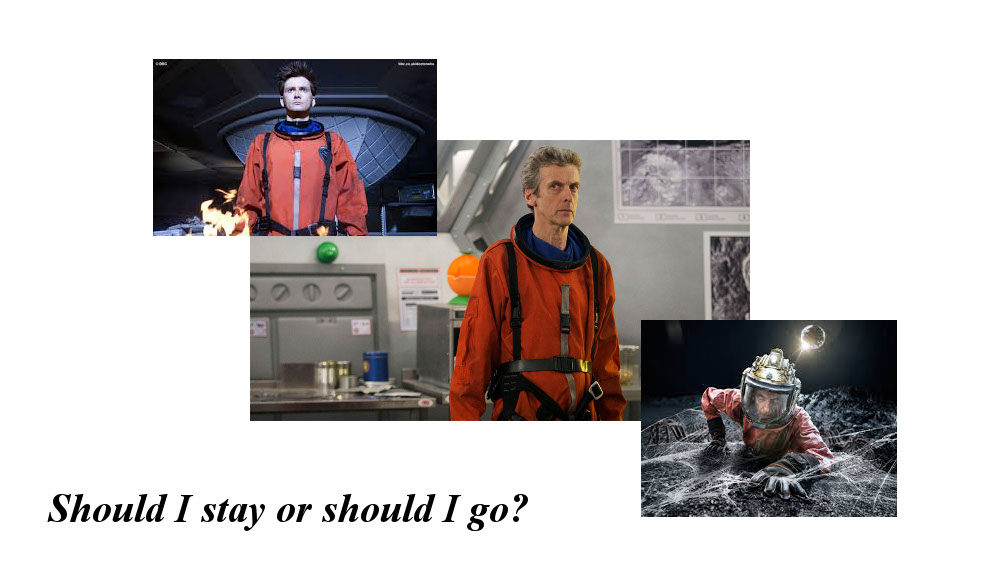
In brief, here are the two plots. In “The Waters of Mars,” which takes place in 2059, the Doctor as played by David Tennant finds himself on Mars, at what he calls a “fixed point in time and space.” There are some moments he is not allowed to change, based on laws of time that only he understands. The inhabitants there are forced to blow up the colony with a nuclear weapon, sacrificing themselves to save the Earth from malicious aliens. But when it comes right down to it, he can’t sit back and let that happen. He’s grown so attached to the people on the base that he tries to save them at any cost. This is the wrong choice, and it makes him cross the line from good to evil. “Who the hell do you think you are?” asks one of the women he saves, Captain Adelaide Brooke.

In “Kill the Moon,” which takes place in 2049, the Doctor as played by Peter Capaldi finds himself and two companions on a space shuttle on the Moon, where some mighty strange things are going on. He meets up with a team of astronauts, and the first thing the captain says is “Who the hell do you think you are?” The Earth is at risk because the Moon has become “gravity flexible,” and a team of astronauts have come up with a hundred nuclear bombs to destroy the alien threat. Only it turns out that the alien is innocent, and killing it might or might not save humanity. In a moment of apparent cruelty, the Doctor washes his hands of the whole affair and walks off, stranding three human women in a room where the terrible decision awaits.

“Kill the Moon” has a number of deliberate allusions to “The Waters of Mars” — the year, the color of the Doctor’s space suit, the nuclear bomb dilemma, the concept of a pivotal moment in time, the Doctor’s acknowledgment that he shouldn’t be there, and the Doctor’s conflicting view of humans as “little people” or greatly important.

Along with allusions, the two episodes have some important contrasts, beginning with their personalities. Tennant is fairly warm and fuzzy and considerate. He wrings his hands over difficult decisions and pays explicit attention to others’ well-being. So when he makes his initial decision to leave the Mars colony to his fate, he is near tears. His downfall comes from caring too much.

In contrast, Capaldi is often dismissive of others’ feelings — at least outwardly. When he decides to leave the three women on the Moon, he is positively rude about it. “I’m sorry,” he says. “Well, actually, no, I’m not sorry! It’s time to take the stabilizers off your bike. It’s your moon, womankind!” That’s patronizing and quite cruel.

Another important contrast is the choice itself. Tennant makes the wrong one. Through some combination of caring too much about the colonists and growing too attracted to power, he risks humanity’s future and ultimately dooms himself and is forced to regenerate (which is as close to death as the Doctor can get).

Capaldi’s choice is the opposite. On the surface, he doesn’t care about the three women, and he leaves them to live or die, depending on their actions. Had they detonated the nuclear bombs, they presumably would have been killed right along with the alien creature.

Another contrast lies in how the Doctor treats a human woman’s right to choose. Tennant’s wrong choice overrules a human woman’s choice. Captain Adelaide Brooke makes up her mind to die to sacrifice herself, and he saves her instead. Luckily for the Doctor and the future of humanity, Brooke shoots herself, undoing Tennant’s mistake.

In contrast, Capaldi forces three women to make a choice on their own, despite repeated pleas for help. “It’s your moon, womankind,” he says. “It’s your choice.” He even goes so far as to drag a fifteen-year-old girl out of the TARDIS to participate in the impossible decision.

Here’s what I’m wondering: did Capaldi do the right thing? Faced with a similar situation, he made the opposite choice. Was it the right one, or did he veer too far in the other direction? It’s hard to tell. Unlike the two previous Doctors, Capaldi rarely explains himself, and when he does, we don’t know whether or not he’s telling the truth.

On the other hand, he deserves credit for refusing to sugarcoat the hard truths he lives by. He could have easily made the same choice but won over Clara’s heart, and the viewers’ hearts, if he had wrung his hands or shed a tear before he left. Instead, he overtly patronized and manipulated people so that at the end of the episode when Clara gave him a spectacular telling off, a lot of viewers were right there with her. Who the hell does he think he is?

I’d like to think Capaldi made the right choice — that he’s brusque and arrogant but underneath it all has a more mature understanding of morality than either of the two previous Doctors.

But maybe that’s not the point. Maybe the point of “Kill the Moon,” in combination with “Waters of Mars,” is not the Doctor, but the viewers. We’re asked to look critically at our hero’s actions, to question his motives, and to ponder what we might do in the same situation. We’re right there with him, seeing the universe in all its cruelty and splendor, and hoping, as he hopes, that humanity can be saved.

should i stay or should i go

Goodness had nothing to do with it

(Caution – spoilers for Doctor Who, “Flatline”!)

This last week’s episode of Doctor Who, “Flatline,” has pleased me to no end. It was great to see a woman playing the Doctor, for one thing. That deserves a squee post all on its own. (While I’m at it, I really ought to post about Barbara Benedetti, who played the Doctor in a series of fan-made films produced by Ryan K. Johnson.) But even more exciting, to me, was its exploration of morality.

I started watching Doctor Who with Patrick Troughton and went straight through to the end of Classic Who, with Sylvester McCoy. The Doctor was a fine, though ridiculous, hero. Most of the time, the show never questioned the Doctor’s innate goodness. He was just this guy who saved us from the monsters. I have to admit, I liked it that way. I wanted, and I still do want, the Doctor to be “the good guy.”

But I also have to admit that I was fascinated when the Doctor took a wrong step in “The Waters of Mars.” What happens when a superhero goes too far? I was so intrigued that I wrote an article about it for Strange Horizons: “Fall of A Superhero in Doctor Who and the Waters of Mars.” I said:

It is asking the grown-up questions that need to be asked. Can we really count on our superheroes? We need them to be powerful enough to fight our villains and win, but what do we do if our heroes become villains themselves?

This is not a new question. Lately, many movies and graphic novels have been exploring the theme of good and evil with superheroes. But I felt that “The Waters of Mars” and the two following episodes explored that question exceptionally well. My opinion is that superheroes can be “good” only if there is a counterbalance to their power. And when the Doctor stepped over the line, a woman did step up to stop him.

I hoped that when the Doctor regenerated, he could go back to being “the good guy.”

Did he? Is he a good man?

This season of Doctor Who has taken this question as one of its main mysteries. The Twelfth Doctor was terrified when we first saw him — probably of himself. He asked Clara if he was a good man, and she replied, “I don’t know.” Like Clara, we’re not sure. The Eleventh Doctor always explained himself, but the Twelfth Doctor is both cagey and brutally honest about his reasons for doing what he does.

But there’s another question behind that one. What does it even mean for a superhero to be “good?” Which actions should s/he take in the face of difficulty? And what if there are no good choices?

That’s the question that “Flatline” tackled. To summarize the episode, the Doctor gets trapped in his TARDIS and hands Clara his tokens of power (sonic screwdriver and psychic paper), his name, and his leadership tips and tricks. Clara flawlessly executes the usual monster-fighting strategy, managing to save the world plus at least a couple survivors.

And that’s why the Doctor compliments her halfway through, saying, “You were good, and you made a mighty fine Doctor!”

But at the end of the adventure, after everything has been said and done, he changes his story. “You were an exceptional Doctor, Clara,” he said. But then he adds, “Goodness had nothing to do with it.” He walks off into his TARDIS, leaving Clara puzzled.

What was it? What went wrong? Clara did a brilliant job. If she hadn’t done it, our entire world would have been taken over by malicious monsters from a two-dimensional world, and the Doctor and his TARDIS would have been utterly destroyed. Some people died along the way, but it was through no fault of hers. Why wouldn’t that count as “good?”

Well, there are hints throughout the episode that something is amiss.

Early on, the Doctor catches Clara lying to him about her boyfriend. He congratulates her, saying that lying is a survival skill  . . . and a terrible habit. Later, while Clara is leading a group of people to safety, knowing they might or might not live, she realizes that part of the Doctor’s strategy is to lie to people. She consults the Doctor to see if she’s right.

“Lie to them. Lie to them,” she says. “Give them hope. Tell them they’re all going to be fine. Isn’t that what you would do?”

Taken aback, he stammers, “In a manner of speaking, I-i-it’s true that people who have hope tend to run faster. . .”

Clara also guesses his “Rule 1.” Each incarnation of the Doctor has had its own series of rules. For example, for many of the Doctors, “Rule 1” was for the companions not to wander off. (Of course, they always did, because otherwise, how would they have adventures?) For the 11th Doctor, Rule 1 was “The Doctor lies.”  But for this 12th Doctor, the rule appears to be, “Use your enemies’ power against them.” What’s happened to Rule 1? It’s gone from a joke to an admission of Machiavellian techniques and from there to a military strategy.

Could this be why the Doctor tells Clara “Goodness had nothing to do with it?” Has he seen his morality mirrored in her actions and decided it’s flawed?

Yes, maybe. But there could be another explanation. Perhaps the moral issue is not with Clara’s actions — which were as “good” as possible under the circumstances — but with Clara’s later processing of the situation.

The Doctor asks her a question at the end. “You okay?” He looks more considerate in that one moment than he has this entire season. He knows she’s been responsible for a group of people and seen some of them die.

“I’m alive,” she replies. She’s wearing a poker face, as she usually does. If she’s in pain, she tends to hide it.

“A lot of people died,” he says, still sympathetic.

And here they are interrupted by Fenton, a morally degenerate survivor. The survivor compares what has just happened to a forest fire. You save the big trees, but you let the brush go. He refers to the dead, who had been doing mandatory community service, as “scum.”

The Doctor is not pleased by this analysis. He says, “It wasn’t a fire, those weren’t trees, those were people.”

Clara, however, does not appear to have quite followed this interchange. She is listening from a distance, a slight smile on her face. She  wants the Doctor’s approval, so she says, “Yeah, but we saved the world, right?”

The Doctor smiles. “We did! You did.”

“Okay, so on balance . . .”

I think this is where Clara goes wrong. She has taken all the right actions, but she’s failed to consider the impact of those actions on her own sense of right and wrong. She’s nothing like Fenton, but just as he is comparing people to expendable trees, Clara is weighing one group of lives against another.

Perhaps this is why the Doctor later says that goodness had nothing to do with it. Perhaps he’s trying to tell Clara to step back and consider the moral implications of her actions.

Or maybe something else is going on.

“Balance!” says the Doctor, disgusted.

“Yeah! That’s how you think, isn’t it?” She’s still looking for his approval.

“Largely so other people don’t have to.”

Well, it looks like the Doctor has his own issues there. He doesn’t want other people to weigh one life against another, but he does it himself. It’s the classic “Do as I say, not as I do.”

So perhaps when the Doctor says, “Goodness had nothing to do with it,” he actually means, “Goodness had nothing to do with being the Doctor.”

If that’s what he means, he’s challenging the morality of the entire series, all the way back to the 1960s. This was a pretty run-of-the-mill episode, with clear-cut choices and answers. The same plotline would have easily worked with Patrick Troughton as the Doctor, or Tom Baker, or any other “Classic Who” Doctor — and without that enigmatic statement from the Doctor, we would never have batted an eye.

Maybe we should have.

Anyway, whatever the Doctor means, I’m hooked. Can’t wait to hear what next week’s episode has to say!

–Kristin
screwdriver and book2


This weekend’s panel at Geek Girl Con

Cross-posted on the Washington Lawyers for the Arts website, http://thewla.org/blog/.

This weekend I had the opportunity to participate in a panel at Geek Girl Con on “Fanfiction: Sharing, Creating, and the Law,” put on by the Washington Lawyers for the Arts. It was a great experience! It was fun to work with the knowledgeable and friendly panelists, and I got answers to questions I’ve had for a long time. I’ve spent a lot of time researching the concept of fair use and learned a lot of legalities, but less about how I could apply them in a practical sense. Now I’m armed with a lot of knowledge and a solid sense of direction. Very helpful!

Just being at Geek Girl Con was amazing in itself. I brought my spouse and children, and we all spent some time exploring the con, dressed as characters from Doctor Who or Nancy Drew. Who knew you could find a life-sized robotic Dalek standing next to a woman in a TARDIS costume singing along to “Let it Go”? Or make a pocket-sized model of the solar system?

The panel was moderated by Allison Durazzi, Executive Director of the Washington Lawyers for the Arts, and the participants were Kristin Ann King (myself); Rachel Buker, WLA board member; and Brian Rowe, chair of the WLA Board of Directors. Our goal was present both creative and legal perspectives on creating fan fiction.

I went first and talked a little about my background. I write short stories, blog posts, and critical essays. My first book, Misfits from the Beehive State, was published last year. It’s not fanfiction — it’s a book of surreal short stories set in Utah, all about people who aimed for perfection but fell down the rabbit hole instead. I also write fanfiction, mostly for the Doctor Who fanfiction site A Teaspoon and An Open Mind. That site has tens of thousands of stories, all put out there for free by fans, mostly using a pen name. It’s a wonderful avenue for storytelling, but I do often wish I felt free to put it out under my own name. I’ve had many questions over the years about the practicality and legality of borrowing others’ work. What happens if someone thinks I’m infringing? Is it possible to know for sure whether my use of a copyrighted work is protected by law?

Rachel went next, and she covered the fundamentals of copyright, including thorough definitions of copyright and the public domain. In brief, copyright is a bundle of rights that protects “original works of authorship” that are fixed in a tangible form of expression. It has to be creative expression — for example, ideas and facts are not covered by copyright. Those kinds of works, works whose copyrights have expired, and certain other types of work are in the public domain. She gave links to tools for determining whether a work might be in the public domain. For a fuller explanation of these concepts, check out the PowerPoint slides from the talk .

Then we broke for a little bit of Q&A, and the audience asked thoughtful, interesting questions.

Next Brian discussed ways that people can legally use copyrighted works. Free speech is a first amendment protection, and it’s also built right into copyright law in the form of “fair use.” When courts are considering whether or not it’s fair use, they consider four factors: the purpose of the use, the nature of the copyrighted work, the amount of work used, and the effect of the use on the market of the copyrighted work. Brian covered several cases in which that the courts decided whether or not fair use applied, as well as a few cases that were settled before a decision could be handed down. He encouraged the audience to create transformative works and pointed out that every creative work is a remix of one kind or another. Star Wars, for example, borrowed heavily from other movies. Brian also provided a list of legal resources, including the Washington Lawyers for the Arts, free and low cost resources, and organizations that help defend these free speech rights, such as the ACLU and the Electronic Frontier Foundation.

These resources are in the slides, but they’re worth adding here as well:

We finished up with more audience questions, and once again they were thought-provoking.

I learned a lot from this panel that I can take home and use in my writing and publishing endeavors. Here are just a few of my key takeaways:

  1. The fair use clause of the copyright is extremely fuzzy and open to interpretation by the courts.
  2. If a copyright holder thinks someone is infringing on their work, it does not always go straight to court, and most cases end up being settled. There are specific steps that can be taken, such as a “cease and desist” letter or a “takedown request,” and specific right and wrong things to do in that situation.
  3. There are organizations out there that provide free and low-cost legal assistance, depending on the situation.

I also came out of this panel with a whole lot more hope for the future of fanfiction as a legal activity. Fanfiction writers always have a cloud hanging over us: we think our specific use of copyrighted material is legal, but it’s impossible to know for sure unless it goes to court.

But maybe this situation can change. Other countries treat copyright and fair use differently. For instance, in Japan, fan works has more respect, and there are more specific rules for whether or not they violate copyright.

One of the audience members asked about the possibility of having a Hugo Award for fanfiction. The idea has been kicked around, but people are a little concerned. Rachel took the question, and of course, there was no definitive answer. But she did ask whether there was a monetary prize given out, and the answer was no, just a statue. She then inquired as to what the statue was made out of, joking, “If it’s chocolate, that might be OK!”

I would be delighted to see a Hugo award for fanfiction. I would love to see a world where fanfiction can be freely shared and professionally respected.

Thanks to the WLA for the opportunity to participate on this panel!

My reaction to the Doctor Who Christmas special

The first Doctor Who regeneration I ever saw came as a huge shock. I was watching the Patrick Troughton episodes on Saturday night reruns with my family, and as far as I knew, there was one, and only one, Doctor. I loved him and his panicky nature and his musical voice and his companions Zoe and Jamie. He was like no hero I’d ever seen before, defeating the bad guys with his brain instead of his guns, holding power while still sharing it with his companions, and keeping a delicate balance between authority and childishness. And then the Time Lords got hold of him and changed him into this whole new face and body. He was going to change back, right? Wasn’t he?

I held out hope, and the next week, when the show was on, I grabbed on to the TV for dear life. (I mean literally. It was the only TV in our house, and my dad wanted to watch something on a different channel, and I physically blocked him from doing it. He brought in my mom for backup, and she suggested I videotape it to watch later. So I set up the VCR to record and then kept watching, just in case.) I watched the first twenty minutes of the Jon Pertwee Doctor for hints that he might just change back. And no, he never did.

Unfortunately for me, this was the very first time I had ever videotaped Doctor Who. You know what that meant? I didn’t have any copies of the Patrick Troughton Doctor Who to watch. And no, they didn’t have any DVDs or videotapes or youtube videos. This was the olden times, remember. The kind of times where we had to walk to school uphill both ways. I had to wait until our local PBS station played through all the Doctors and then rolled back through the beginning. I waited patiently but with longing for my first Doctor — the one who, for me, epitomized the character. And yes, absence makes the heart grow stronger.

Unfortunately for me, after the time the PBS station got through its run, it skipped the first two Doctors and went straight back to Jon Pertwee. What was a girl to do? I took extreme measures. To make a long story short, in order to get my hands on those episodes, I had to become the president of the local Doctor Who club for a while. And that led to storing a full-size replica of the TARDIS in our family shed.

So that was my first experience with a Doctor Who regeneration. Traumatic.

I’ve coped well with all the regenerations since then, to the point that I was nearly shouting at the screen for David Tennant to stop crying, for heaven’s sake, and just get on with it! But this Matt Smith regeneration hit me hard. He’s the closest to Patrick Troughton so far, even more than Sylvester McCoy. Also, and some people are going to look at me quite strangely for this, I find him the sexiest. I’ve been mourning him for months. So, knowing that the Christmas special was going to be the regeneration one as well, I knew I wasn’t going to be happy with it.

But when the regeneration actually came around, I was touched. The Doctor got to live his “happily ever after” life and grow old. He took out a Dalek fleet with one part regeneration energy and one part pure, unadulterated joy. And then he went, without fear or sorrow, like the last fizz of sparkly champagne or the last spoonful of a delicious custard. A good send-off for him.

It’s sad, but I am a grown-up now. (Technically.) I can handle it. I have the Verity podcast episode, which I have a feeling I will be listening to more than once. Most importantly, I have the DVDs. Matt Smith is not leaving my house.

Forward to the next Doctor, Peter Capaldi! I was really apprehensive about this one. In the back of my mind, I’m always worried that somebody will come along and destroy the Who-ishness of Doctor Who, as defined by me, with Patrick Troughton as the touchstone. I like my Doctor to save us from the monsters without omnipotence. I like him to panic and get into trouble he doesn’t know how to get out of, and then, despite all the odds, to win. Using jelly babies and jammy dodgers, and with the help of Daleks who make souffles out of imaginary milk and eggs.

Why do I like that so much? Because we’re all in quite a bit of trouble we don’t know how to get out of. Global warming, nuclear meltdowns, austerity, endless war, you name it. I like to imagine someone crashing down from the sky, as confused as we are, to save us from our own monstrosities.

Luckily, the Christmas special got it right. Matt Smith regenerates, Peter Capaldi appears, gives Clara a long intense look that could mean anything (aggression, fascination, confusion, nearsightedness), makes a comment about not liking the color of his kidneys (eww, gross!), and then says,

“Do you happen to know how to fly this thing?”

Sigh of relief! It’s my Doctor, all right.

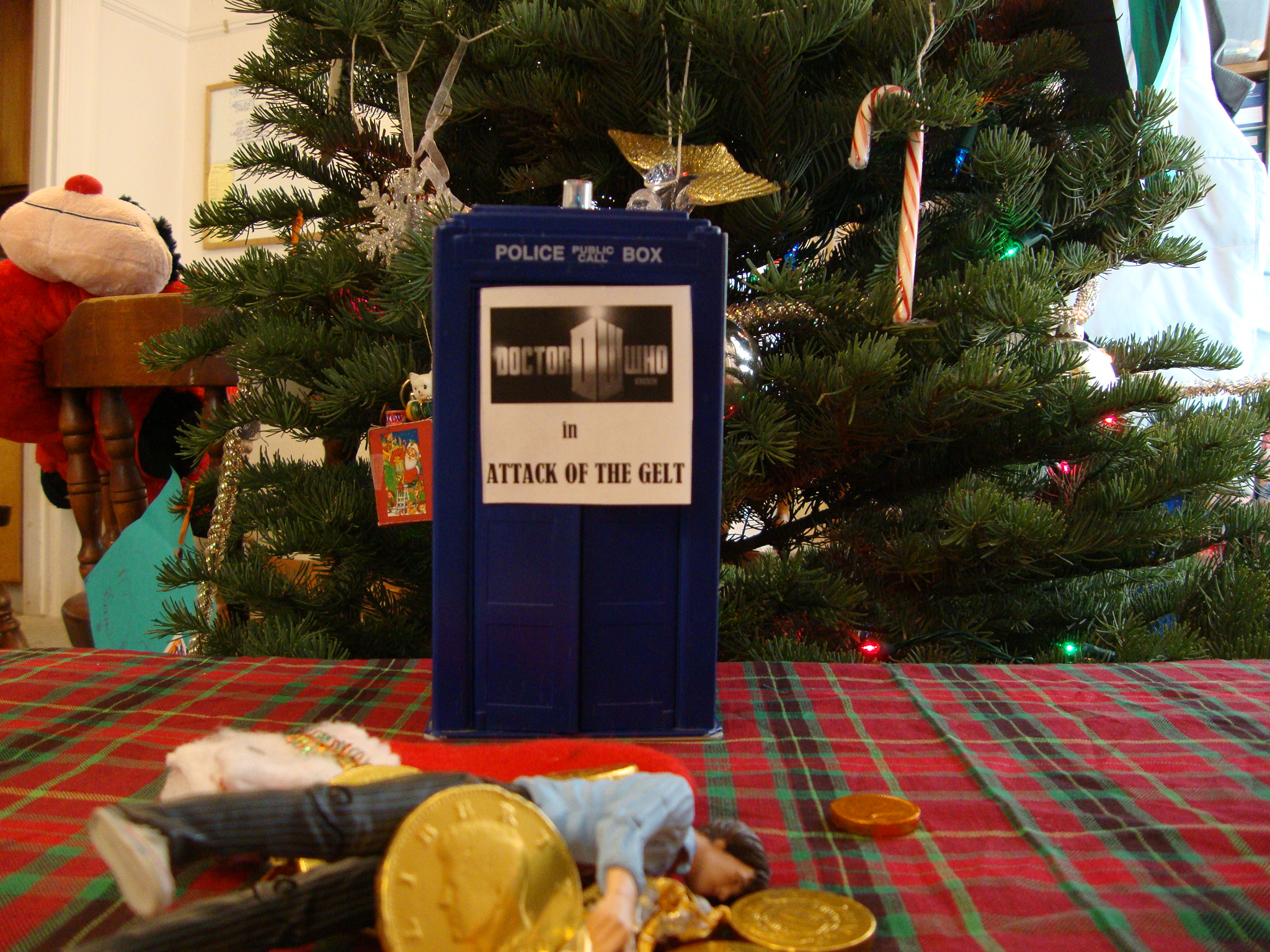
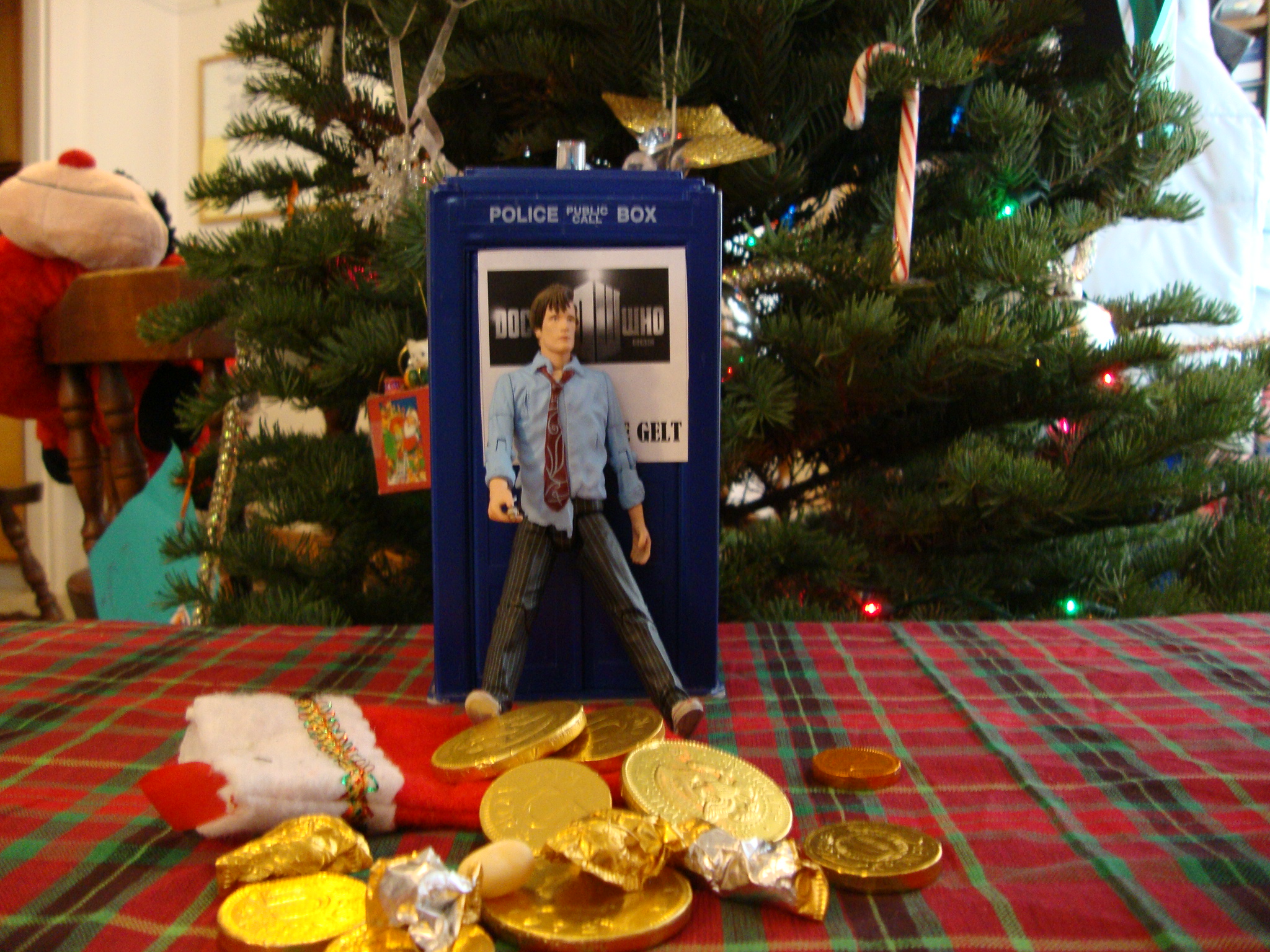
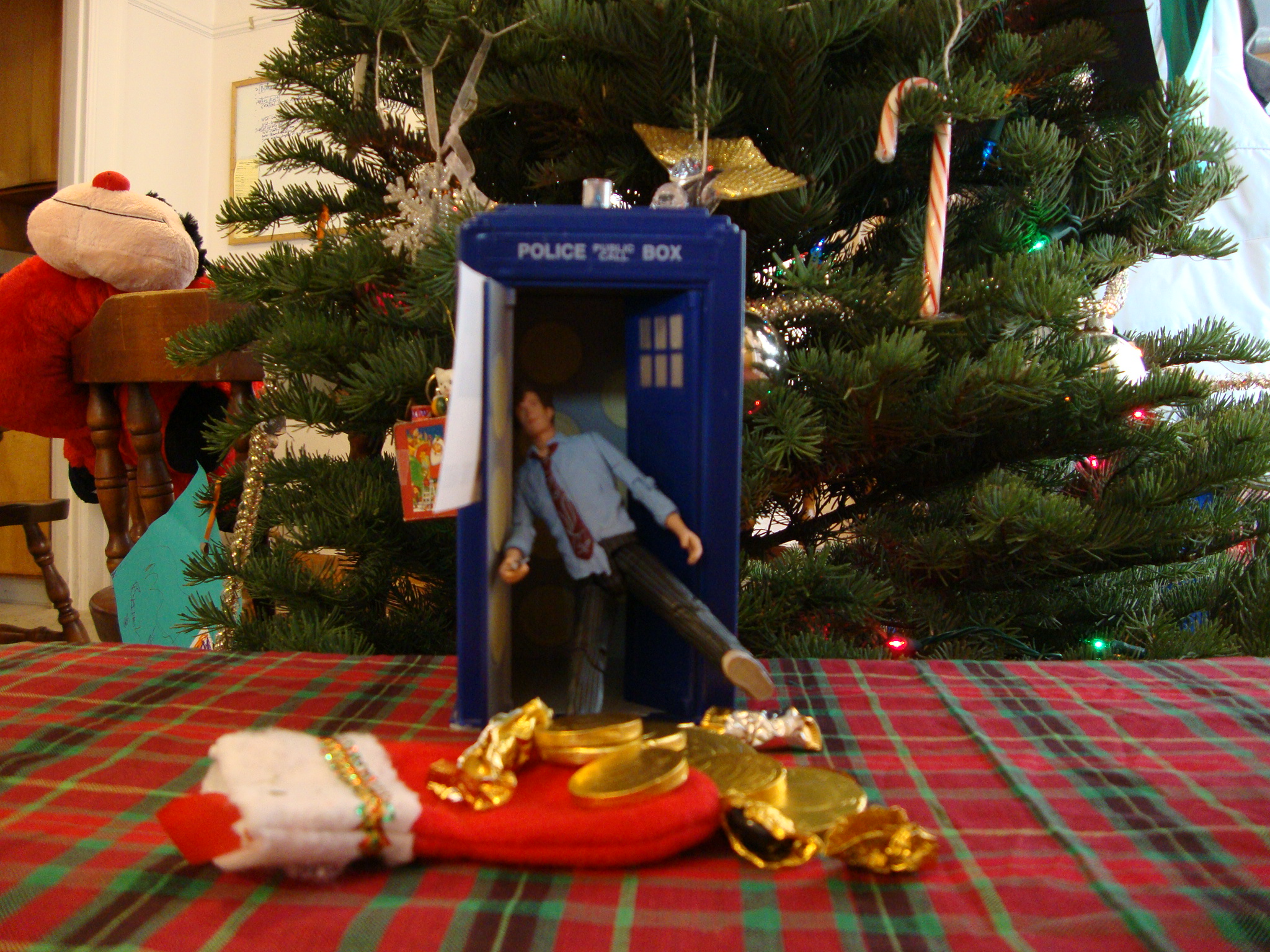
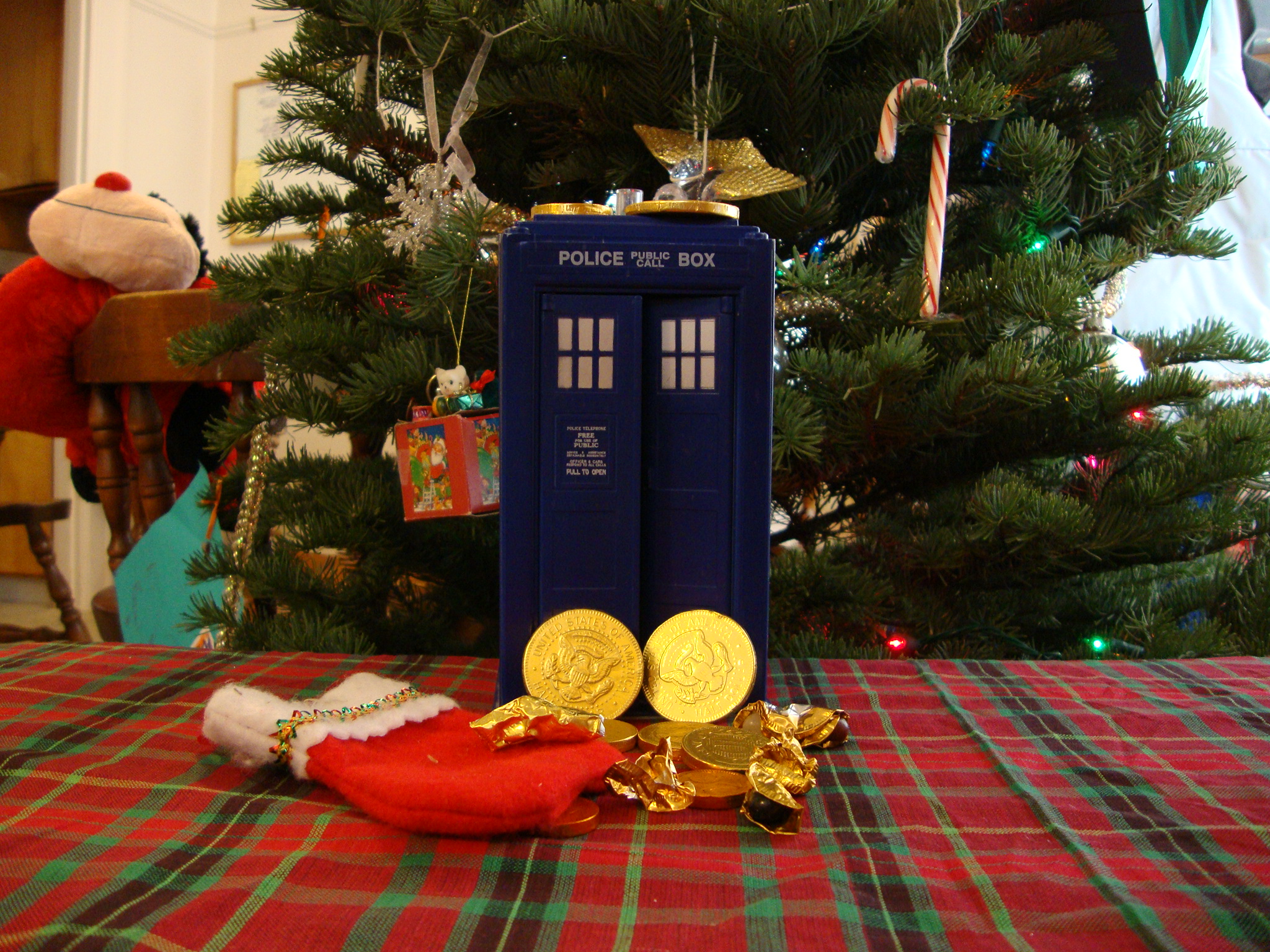
Doctor Who: Attack of the Gelt

As a little girl, I enjoyed playing with dolls and my wonderful dollhouse my parents built for me when I was six. I still enjoy it, but in much geekier ways.

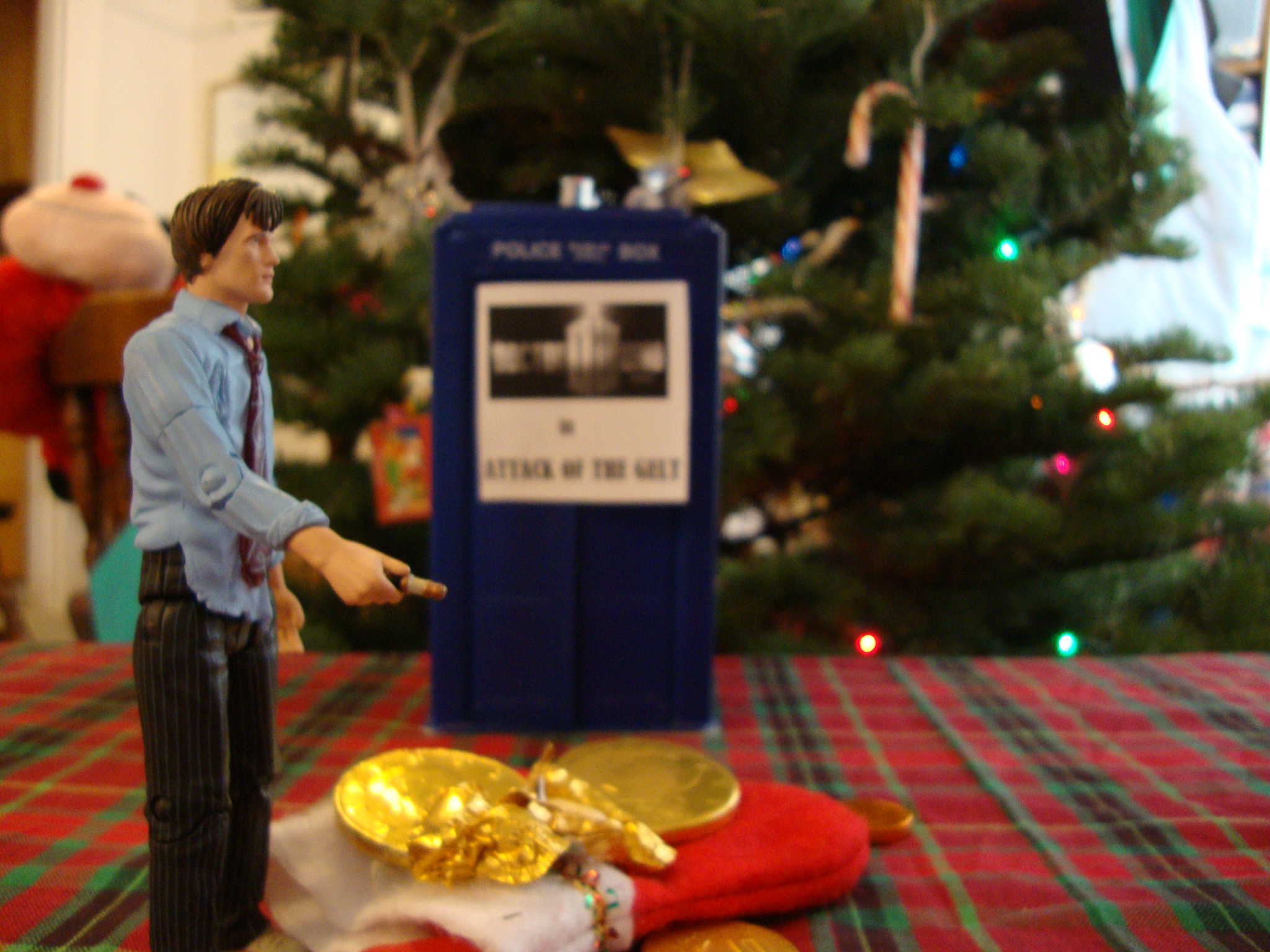
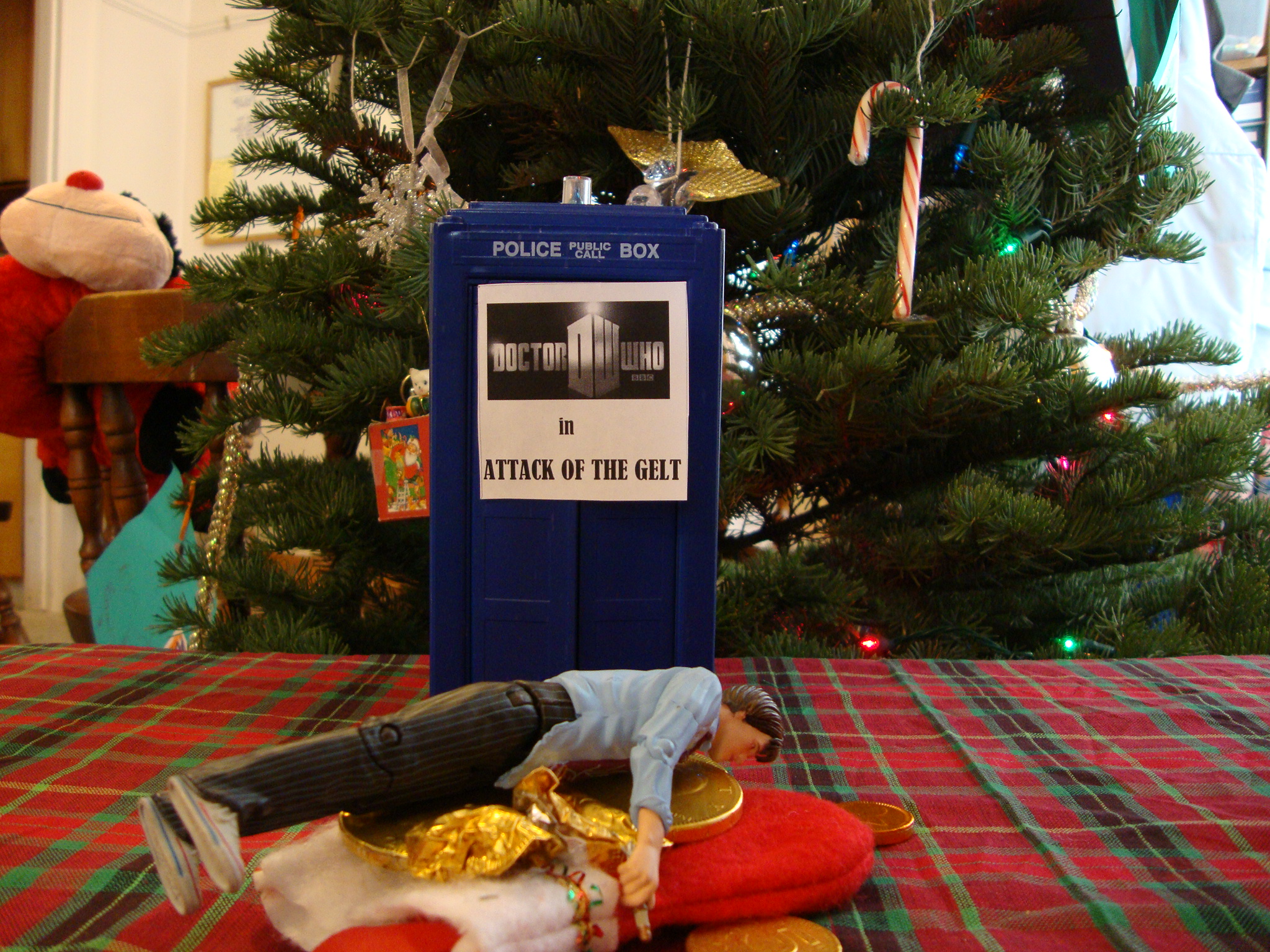
Here’s a stop motion animation I did a few years back, Doctor Who: Attack of the Gelt. The moment you link to it you’ll get an annoying video ad, but it seems to shut up if you move your mouse over it.

http://kristinking.livejournal.com/21819.html#cutid1

I don’t actually know where on my computer I put that, so I’ll just add a couple images here. Watch out, Doctor. Candy is dangerous!

DSC03115 DSC03116 DSC03119 DSC03122 DSC03136 DSC03140 DSC03142


– Kristin

Image

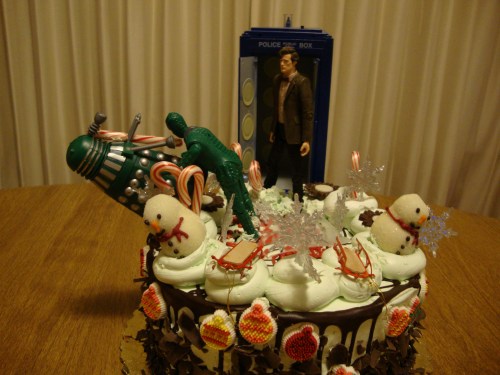
Doctor Who and the Cake Invasion

Doctor Who and the Cake Invasion

Don’t worry, the Ice Warrior is on the good guy side. She’s saving the snowmen by clocking a Dalek with a candy cane. The Doctor, as often happens, is about to take credit for the whole thing.

Doctor Who Series 7 for the Reluctant

I loved Series 7 of Doctor Who . . . mostly . . . but I have a friend who lost patience with it during the Stephen Moffat years, and hasn’t watched any of Series 7. So I offered to make a list of what I think are the best of the lot. And here it is:

Series 7 for the Reluctant

“The Doctor, the Widow and the Wardrobe” – skip it. I enjoyed it, but then, I am easy to please.

“Asylum of the Daleks” – watch it. Be forewarned that the scriptwriter doesn’t appear to understand marriage. Clara is a fabulous character and the Daleks were well done. It has depth.

“Dinosaurs on a Spaceship” – watch it because it is fun, especially if you like dinosaurs. Bonus points for showing a father/son relationship with Rory and his dad.

“A Town Called Mercy” – skip it. It has a weird analysis of war criminals.

“The Power of Three” – skip it. It is all angsty over the upcoming departure of Amy and Rory, and if you’re already reluctant, you won’t care.

“The Angels Take Manhatten” – skip it unless you really like the creepy Weeping Angels monsters. This episode was strictly to tug at the heartstrings of fans who love Amy and Rory. River Song was brilliant until she called the Doctor a demigod and told Amy not to grow old in front of him.

“The Snowmen” – watch it. The barmaid/governess character is well done, as is the Jenny/Vastra/Strax team that now has its own following of people who want it to be its own TV show.

“The Bells of Saint John” – watch it. Good comedy, social commentary, and the companion character is great.

“The Rings of Akhaten” – skip it. I enjoyed it, but again, I’m easy to please.

“Cold War” – watch it if you were born after 1975. Because you might not have been exposed to much about the Cold War. Otherwise, skip it.

“Hide” – skip it. Fails the Bechdel test even though more than one woman was present, and has annoying romance.

“Journey to the Centre of the TARDIS” – watch it, especially if you like the TARDIS or interesting explorations of time travel.

“The Crimson Horror” – watch it. It has Vastra, Jenny, and Strax, and it has Diana Rigg (from the Avengers) playing a delicious baddie.

“Nightmare in Silver” – watch it. Neil Gaiman wrote the script. The Doctor’s companion, awesomely, gets to do an important job.

“The Name of the Doctor” – skip it. Why? It is the culmination of a couple of mysteries that have been ongoing in Season 7, and if you’re a reluctant viewer, you won’t necessarily . . . care.

Rating the Winners:

Asylum of the Daleks * * * * *

Dinosaurs on a Spaceship * * *

The Snowmen * * *

The Bells of Saint John * * * * *

Cold War * * *

Journey to the Centre of the TARDIS * * * * *

Nightmare in Silver * * * * *

The Crimson Horror * * * *

What if I didn’t like it?

If you watched one of my three-starred choices and didn’t like it, no harm done. But if you watched one of my four-starred choices and didn’t like it, there’s a serious problem here. You know what it is? I’m the wrong reviewer for you. 🙂

screwdriver and book2

A Feminist Take on Doctor Who’s Zoe Heriot

This post is part of a series of feminist takes on Doctor Who companions. I ask these questions: Are they strong? Do they get to be the protagonists? To what extent are they the equal of the Doctor? Which stereotypes do they fit into, and which do they resist?

So far I’ve looked at Amy Pond, River Song, and Clara Oswin Oswald, all characters from New Who. Now it’s time for me to jump back in time to my favorite companion ever: Zoe Heriot.

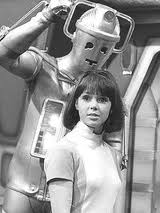
zoe in front of cyberman

If you’re looking for a critique of feminist aspects of her character, you won’t get any here. Somebody else can criticize this or that. Nope, it’s pure appreciation. I adore her. She was the first female companion I’d ever seen, and if it hadn’t been for her, I doubt I’d have even started watching Doctor Who.

Who was Zoe Heriot?

She appeared in Doctor Who alongside Patrick Troughton, the 2nd Doctor, and Frazer Hines, his companion Jamie.  She was one smart girl:

Zoe Heriot is the Wheel’s parapsychology librarian (which means that she’s received brainwashing-like training in logic and memory), an astrophysicist, an astrometricist first class, and a major in pure maths.

(From the TARDIS Data Core wiki entry on “The Wheel in Space.”)

She was emotionally underdeveloped at first. But after she met the Doctor and Jamie, who taught her the power of intuition and instinct, she decided to set out on a journey of personal growth by stowing away on the TARDIS and becoming an Adventure Hero.

She was an Adventure Hero par excellence. Brave, smart, thoughtful, full of initiative, curious, you name it. And she developed emotionally pretty darn fast, building warm relationships with Jamie and the Doctor. She was a bit of a screamer. That’s the 1960s for you. But honestly, faced with the horrors she saw, I’d scream too. And her screaming wasn’t at all out of place: her Doctor was the panickiest Doctor ever.

Zoe was also Jamie’s equal. Jamie was a Highland Scot from the 18th century. He’d left a war for independence to travel in the TARDIS, but he was ready any minute to jump back into the fight. They complemented each other nicely: Jamie fought with his hands, and Zoe with her mind. Both were young and depended on the Doctor at times, but took initiative whenever needed.

She was also a match for the Doctor, intellect-wise. In “The Krotons,” she beat the Doctor on a computer-based test. I think this was my very favorite moment. As a young woman myself, in school, I was so excited to see a woman be smarter than the Doctor. At other times, she conversed with him in scientific gobbledygook — something few of his companions have done since.

Her ending was not ideal. The Time Lords wiped her memory, just as the Tenth Doctor later did to Donna Noble. That was unfair! But at least she got to retain the memory of her first adventure with the Doctor. She resumed her life on the spaceship, and in my mind at least, her character development stuck and she led a full and happy life.

A taste of her character

Here’s a snippet of dialogue in which Zoe interrogates the Doctor:

Zoe: [to the Doctor] How did you pilot the rocket ship? You see, I’ve calculated its original course. It was a surface and supply station for Number Five Station, overdue and presumed lost nine weeks ago. Well the rocket couldn’t have drifted eighty seven million miles off course.
Dr. Who: So what’s your theory?
Zoe: Well, there is a record of the last contract with the Silver Carrier rocket. It had seven million miles to touchdown, and enough fuel for twenty million. Well, it couldn’t have drifted here off course in the time involved. It must have been driven and piloted.
Jamie: Och, you are a right wee space-detective!
Zoe: There’s only one solution. That rocket was re-fuelled in space. – Provided for at least with another twelve fuel rods.
Dr. Who: Well, it is an interesting theory…
Zoe: Oh, it isn’t a theory. You can’t disprove the facts. It’s pure logic.
Dr. Who: Logic, my dear Zoe, merely enables one to be wrong with authority. Supposing there was a faulty automatic pilot?
Zoe: To drive a rocket eighty seven million miles on fuel for twenty million?
Dr. Who: Well, it’s a possibility.
Zoe: That rocket was driven here somehow. I know it was.

Smug, isn’t she? She doesn’t back down if she thinks she’s right.

Oh, did I forget to mention?

Zoe is also a computer programmer. Here she is giving a computer an insoluble problem in ALGOL.

 How about the actress?

The actress who played Zoe, Wendy Padbury, went on to become a theatrical agent. In a bit of a quirk of fate, she was the one who discovered Matt Smith, the actor who plays the current Doctor. She tells the story in this Youtube video. She was also a theatrical agent for other actors who appeared in Doctor Who: Nicholas Courtney, Colin Baker, and Mark Strickson. Small world, eh? I wonder who her other clients were . . .

screwdriver and book2