Tag Archives: doctor who

Ambiguity in Doctor Who: “Hell Bent”

The character of the Doctor in the Steven Moffat era is a trickster. As the Matt Smith incarnation says, “Rule One: The Doctor lies.” In the Doctor Who episodes “Heaven Sent” and “Hell Bent,” the Doctor’s lie is critical to our literal understanding of events.

Spoilers ahead. If you haven’t watched these two episodes, you don’t want to hear what I’m about to say.

The narrative arc in Series 9 hinges on a monster known only as “the Hybrid.” The Hybrid, as prophesied, is a combination of two powerful warrior races that will either bring peace or fracture time itself. What is the Hybrid? And who knows its true nature?

Perhaps the Doctor knows. In the episode “Hell Bent,” he ends up in a torture chamber where he is repeatedly interrogated by a creature who kills him if he does not confess the truth. He makes two statements. The first is a confession, which means it must be true. The second is not a confession and may or may not be true.

True:


Long before the Time War, the Time Lords knew it was coming. Like a storm on the wind. There were many prophecies and many stories. Legends before the fact. One of them was about a creature called the hybrid. Half-Dalek, half-Time Lord. The ultimate warrior. But whose side would it be on? Would it bring peace or destruction? Was it real or a fantasy? I confess, I know the Hybrid is real. I know where it is and what it is. I confess, I’m afraid.

Possibly true:

Hello again. No more confessions, sorry. But I will tell you the truth. The Hybrid is a very dangerous secret. A very very dangerous secret. And it needs to be kept! So I’ll tell you nothing.

After escaping the torture chamber, he makes two more statements about the Hybrid.

He tells the Gallifreyans:

The Hybrid is not a half-Dalek, nothing is half-Dalek. The Daleks would never allow that. The Hybrid, destined to conquer Gallifrey and stand in its ruins… is me.

That statement alone could mean two different people: “me, the Doctor” or Me, the woman that the Doctor immortalized. In fact, both “me’s” do end up standing in the ruins of Gallifrey.

But he later implies to Clara that he does not know the identity of the Hybrid, saying:

It doesn’t matter what the Hybrid is. It only matters that I convinced them that I knew. Otherwise they’d have kicked me out and I’d have nothing left to bargain with.

Finally, when he reaches the universe where he finds only the woman Me, she asks him about the Hybrid. He reiterates that he does not know and offers several theories, and then she offers an interpretation that he acknowledges is plausible.

Me suggests that the Hybrid is a combination of the Doctor and Clara, traveling the universe together. Her two pieces of evidence are the damage to time that he has wreaked in trying to save Clara, and the fact that Missy, “the lover of chaos,” brought Clara to him. He accepts this and allows himself to be separated from Clara.

As viewers, we are also asked to accept this interpretation of the Hybrid. And we do, but only because it’s the most recent one given. The Doctor does not know what the Hybrid is. In the torture chamber, he pretended to know so that he could ultimately escape and save Clara. He was motivated, then, by his love for his friend. A plot of epic proportions narrows itself down to a touching personal event.

But there’s another, deeper reading. In the torture chamber, the Doctor allowed himself to be killed billions of times rather than reveal the secret of the hybrid to Rassilon, the power-hungry President of the Time Lords. When he said the secret was too dangerous ever to be told, the Doctor was telling the truth.

It can get even scarier. The Doctor had three options in the torture chamber: tell the truth and theoretically escape, refuse to tell the truth and allow himself to die the final death, or follow an escape route that requires him to be killed and resurrected billions of times. He takes this last option so that he can save Clara.

Well, suppose the Hybrid is Clara herself. She’s been a Dalek — twice — and has in certain ways become the Doctor. She fits the exact wording of some of the prophecies, which is that the Hybrid is a Dalek/Time Lord combination. If Clara is the Hybrid, then the Doctor’s determination to save her is still personal, but the personal has become an epic struggle for the future of the universe.

That interpretation also changes the meaning of all Peter Capaldi’s interactions with Clara. At the end of “Flatline,” the first episode where Clara is shown explicitly becoming the Doctor (of sorts), Capaldi concerns himself largely with Clara’s moral development. This effort continues throughout Series 8 and 9 and culminates in “The Zygon Inversion” when she does help bring peace. Suppose he knew she was the Hybrid of prophecy, and he spent all that time helping her find the right path. It’s only one of many possibilities for the Hybrid, but I confess I like it best. It gives all the Doctor’s interactions a deeper layer of meaning. There’s more to the world than we can ever see.

Which lie did the Doctor tell? Did he know or not? Who is the Hybrid? Is it still out there, ready to fracture time or bring peace? It will probably always be a mystery. And that’s delicious.

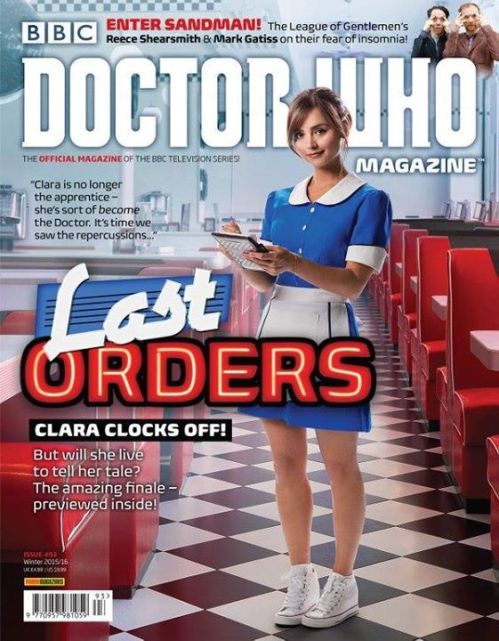
Update #3 to the Feminist Take on Clara Oswald

A couple years back, I started a series of “feminist takes” on Doctor Who companions, including Amy Pond, River Song, and Clara Oswald. I looked at ways they were, or were not, poster children for feminism.

But after three posts on Clara Oswald, I just plain gave up. She was such a squirrelly character that I couldn’t say anything definitive about her. As far as I’m concerned, she breaks feminist analysis. Maybe it’s a mistake to give characters “poster child” awards.

Here’s a recap of my commentary from Season 7. In the first post, I suggested that the character of Clara was suffering from a Bechdel test failure, but that even so, she was pretty amazing — in face, a mirror of the Doctor.

In my next post, I looked at the interactions between Clara and the TARDIS, arguing that it passed the Bechdel test and helped explore her character. But I also felt she was too perfect and not recognizably human. (I wonder if that’s why some fans have had strong negative reactions to her: maybe she’s an uncanny valley character.)

In the last post, I admitted defeat. I thought Modern Clara was a cardboard cutout of a person, but when you combined her with Dalek Clara and Victorian Clara, you got a rich characterization. But I decided to hold my opinions for later.

I didn’t put a post together after the stunning reveal of “Day of the Doctor.” To be honest, I didn’t know what to say. It was just beautiful and strange and blew my mind.

After “Day of the Doctor,” I believed everything Clara said and did. Dalek Clara and Victorian Clara suddenly made sense. Modern Clara did not. Modern Clara was acting like the post-transformation Clara. That’s going to bother me every time I watch Series 7. But it’s a critique of the narrative, not of the feminism. So I didn’t make an update.

Clara was amazing through most of Series 8. She was part human, with all the frailties and strengths a woman would have. But her character was also merging with the Doctor’s. I loved that. As a Doctor Who fan, part of me has always wanted to run off with him in the TARDIS and be his “Doctor Who Girl” (nod to Mitch Benn). And part of me has always wanted to be him. So I got to live vicariously. The episode “Flatline,” where she gets to play the part of the Doctor while he’s stuck inside her Mary Poppins carpetbag, was funny and amazing and thought-provoking too. Loved it.

Also fabulous: Series 8 Clara is transformed. She’s jumped into the Doctor’s – what? Mind? Time stream? She’s been thousands of people who were just as amazing as Dalek Clara and Victorian Clara. After that transformation, I believed every “too good to be true” moment.

Not so great: the narrative didn’t respect her transformation. She got this weird plotline in which she was trying to have a normal life with this Danny Pink character, but she kept lying to him, and she was blamed for all the lies. The Verity podcasters suggested it was an addiction storyline, which I guess it was. But why? Why expect that it would ever be possible for post-transformation Clara to live a normal life? The disconnect jarred me. But once again, it’s a critique of the narrative, not the feminism.

Now here we are in Series 9. This is the “Clara is going to die” series. Also the “Oh, and then she didn’t” series. But in “Face the Raven,” she really did. Except the actress is going to appear in the series finale, “Hell Bent.” How-what-who-I-don’t-even-know-what’s-going-on.

So I have nothing to say, really. I’m on a roller coaster and it’s about to plunge into the depths of the unknown. Maybe when the ride stops, I’ll have something sufficiently feministy to say.

Maybe not.

-Kristin

clara-doctor-who


Speculation for “The Zygon Inversion”

If you haven’t watched the Doctor Who episode “The Zygon Invasion,” this blog post is not for you. Not only might it have spoilers, it will be just plain cryptic. Give it a miss. If on the other hand, you watched it and are thinking, “Wait — what?” and you love speculating, this post is definitely for you.

Continue reading

Classic Who to Try

Suppose you like New Doctor Who and you want to try out Classic Who, but maybe you don’t know where to start, or maybe you watched a serial and you got bored because it was too slow. Don’t despair: there’s no wrong way to watch Doctor Who. But, as I mentioned in my last blog post, you might not want to start at the beginning and watch straight through. Think of it as a buffet. Start at any part of the table, pick up some stuff, and watch it. That’s what Italo Calvino would have done.

One thing to keep in mind: the show is made up of stories, or serials, with several episodes each. You don’t always have to watch every episode in a serial to get the gist of it.

In this blog post, I’ll suggest some serials that might be fun as starters. Be forewarned: there’s plenty of sexism, racism, ableism — any kind of “ism” you can think of, it’s in there. The show is a product of its time. Also be aware that every single one of these serials is ridiculous. I mean, seriously — a time traveling police box?

Accept it and move on. There’s plenty of fun to be had.

First Doctor: William Hartnell (1963-1966)

Ah, the mid 1960s. Globally, that was a great time for experimentation in film and TV. The first Doctor, William Hartnell, began as an irascible old man who kidnapped two schoolteachers in a fit of pique. And the show began as a combination of history lessons and outer space adventure.

Try these:

An Unearthly Child – The episode that started it all. It firmly establishes the Doctor’s character as an erratic and unpredictable man with a time machine. The focus, though, is on his granddaughter Susan, an exceptionally bright young woman. If you like, you can watch just the first episode in this serial and skip the rest.

The Daleks – First appearance of the iconic pop hit monster. They are scary, even to my modern sensibility.

The Edge of Destruction – A psychological thriller set entirely in the TARDIS. They had no special effects budget and very little time to write the script, and they did a lot with what they had.

The Web Planet – If you enjoy giant bug monsters on a low special-effects budget, watch an episode or two. I watched them all and I still have their spacey wacey high-pitched chirping in my head.

The Space Museum – This serial is a puzzle involving time’s multiple dimensions. It deals with a topic central to time travel stories: can you change the future or not? And there’s a subtle jibe in the script at the phenomenon of female characters leaving the TARDIS to get married.

The Time Meddler – The villain is the Meddling Monk, a time traveler like the Doctor. In apparent contrast to the Doctor, the Meddling Monk tries to change history for the better. What happens when he tries to stop the Viking invasion of 1066?

Second Doctor: Patrick Troughton (1966 – 1969)

Patrick Troughton’s acting superpowers are his slapstick and his ability to panic magnificently. He’s often compared to Moe from the Three Stooges. He’s got a warm personality and a melodious voice. Every so often he impersonates the villains so well that you do start to wonder. He’s the first Doctor I ever saw, and my favorite.

I suggest:

The Tomb of the Cybermen – The first appearance of second most famous Doctor Who monster. And they’re scary.

The Enemy of the World – The Doctor’s doppleganger is a ruthless dictator, and I had great fun watching them impersonate each other. It’s beautifully written and well acted, although the dictator’s accent is a weird combination of Italian, German, and Latin American.

The Web of Fear – All the wandering through abandoned subways you could ever hope for.

The Mind Robber – More ridiculous than most, and also one of the most inventive. Lovely metafiction.

The Krotons – This is the story that made me sit up and take notice of the show. The character of Zoe, a young woman, outdoes the Doctor on a math test. Go, Zoe!

The War Games – This one has ten episodes largely about wandering through battlefields, getting captured, escaping, and getting recaptured. I found the endless escapes fascinating and enjoyed watching the Doctor talk smack to generals. Somebody else might be deathly bored. Either way, I wouldn’t recommend watching more than two episodes at a time.

Third Doctor: Jon Pertwee (1970-1974)

Jon Pertwee is a dandy, with his ruffled sleeves and aristocratic accent. He’s paternalistic and arrogant. If you can’t stomach that, move on. I’m fond of him because sometimes I crave the illusion that somebody else knows what’s going on in this crazy world of ours. He was also the perfect Doctor to be challenged by 1970s “women’s lib.”

I suggest:

Inferno – A nightmare parallel world, in which drilling down to the center of the earth leads to worldwide cataclysm. Most vivid end-of-the-world scenario in Doctor Who, both Classic and New. It’s not pleasant getting there — the parallel world is more authoritarian, and all the characters we rely on are corrupt. There’s a hint that the Doctor has become the ruthless dictator we last saw in “Enemy of the World.”

Terror of the Autons – The Autons are a scary “uncanny valley” kind of monster, so successful that they were brought back as the villain for the first episode of New Who.

The Mind of Evil – Features a standoff between the Doctor and his arch-enemy the Master, including a lot of psychological drama. The Master became a favorite villain who appeared in quite a few of the following serials.

The Three Doctors – This serial brings together Jon Pertwee, Patrick Troughton, and William Hartnell. It’s fun to watch the dynamics between them, especially since they dislike each other so much.

The Time Warrior – This serial introduces Sarah Jane Smith, a long-term beloved companion. She enters as a determined women’s libber and confident journalist, who thinks the Doctor is a villain and opposes him with great gusto.

Planet of the Spiders – The Doctor goes on a solo mission to face the consequences of his actions, and Sarah Jane investigates a suspicious meditation group while also using compassion as a secret superpower. It’s full of mental powers and cool caves.

Fourth Doctor: Tom Baker (1974-1981)

This Doctor is many people’s favorites. He’s the “all teeth and curls” one with the long scarf. He adds comedy to all the serials, some of which are just plain cheesy and some of which deal with more serious topics.

A few to try:

Robot – This story deals with machine intelligence and ethics. Sarah Jane rocks it as a journalist / spy.

Genesis of the Daleks – This is the Dalek origin story, and introduces Davros, who genetically modifies the compassion out of his people. It asks serious questions: What if you could go back in time to stop the architect of a genocide? And what is the ethical responsibility of science?

Revenge of the Cybermen – Tom Baker faces off against the Cybermen.

Pyramids of Mars – Okay, lots of cheese here, including robots disguised as mummies and then Tom Baker disguised as a robot who’s disguised as a mummy . . .  but I liked that they brought in a god from a non-Western mythology. Plus, Sutekh, destroyer of all, has a great voice.

Brain of Morbius – Major cheese, as the villain is a Doctor Frankenstein type. There is also a powerful group called the Sisterhood of Karn, who have a relationship of equals with the Time Lords but who are strangely idiotic in their understanding of the lifegiving “sacred flame” they guard. I suggest it because the Sisterhood of Karn becomes really important, and much wiser, in New Who.

Warrior’s Gate – A stone gateway, a magical mirror, and a struggle by the Doctor’s companion, Romana, to help stop slavery. She leaves the Doctor and the TARDIS as a hero.

Logopolis – It has math, the Master, and a cool looking world. It’s fun.

Fifth Doctor: Peter Davison (1982-1984)

This is the friendliest, pleasantest, most pacifist Doctor. He’s a nice guy.

Here are a couple of good ones:

Castrovalva – This serial takes place in an Escher-like world with a dangerous secret at its heart. The Doctor is unconscious for much of it, leaving the companions to carry off the adventure.

Kinda and Snakedance – These two serials can be watched separately or together. The Doctor and his companions visit the same world, aeons apart, to face the same monster. The Mara manifests physically as a giant, low-budget snake, but also exists in the inner reaches of the mind. Both serials tackle colonialism and introduce non-western ways of thinking about our world.

Black Orchid – This is a classic tale of a Victorian household with a secret in the attic. The Doctor impersonates . . . well, a doctor. And there’s a costume ball.

Mawdryn Undead – A paradox with disastrous consequences. It also introduces an “evil companion” who spends the next several serials trying to muster the nerve to kill the Doctor.

Enlightenment – This serial concludes the enjoyable “evil companion” plot, so you might not want to watch it until you’ve seen the rest. But it’s got outer space sailboats piloted by bored and lonely immortals. And people get to dress fancy and dance. First serial written by a woman.

The Five Doctors – Okay, if you can only watch one Classic Who serial, this is it. An evil mastermind is playing with Doctor Who action figures. Or, in other words, all the Doctors and some of the favorite companions are pulled out of time and into a forbidden battlezone on the Doctor’s home planet, where they get to reprise the best of their old roles.

Sixth Doctor: Colin Baker (1984-1986)

Sadly, the fifth Doctor was poisoned, and the regeneration went wrong. Colin Baker flirts with insanity throughout his serials in what was supposed to be a satisfying story arc but was cut short by fan disapproval and/or failures at the BBC. He’s mercurial, arrogant, patronizing, and prone to occasional fits of violence. Sometimes this comes off well.

Here are a couple serials I liked:

Mark of the Rani – Rani is a Time Lord scientist who lacks ethical constraints. In this serial, she’s taking advantage of the Luddite riots to drain hormones out of workers. She lures the Master into helping her and kidnaps the Doctor. It’s always fun to see smart villains with actors who relish their parts. Also, she pairs off quite nicely with this unbalanced version of the Doctor.

The Two Doctors – This one features Colin Baker, Patrick Troughton, and genetic manipulation by a mad scientist. There’s a lot of fun as Troughton starts turning into an Androgum — a species with a taste for sentient flesh.

Seventh Doctor: Sylvester McCoy (1987-1989)

This is my second favorite Classic Who doctor. He brings vaudevillian fun and a lovely Scottish accent, but under the surface is a lot of Machiavellian scheming. His run was cut short by the cancellation of the show.

I suggest any serial by him, but particularly:

Paradise Towers and Happiness Patrol – Two shows with two different brightly colored dystopias. In Paradise Towers, rival gangs fight with red and blue spray paint, elderly women eat their neighbors for tea, while something monstrous is gradually making its way up from the basement. In Happiness Patrol, blues are outlawed and execution is by candy syrup.

Ghost Light – It’s another creepy Victorian house with a madman in the attic. There are also things coming to life that should have stayed dead, a Pygmalian story, and a monster who didn’t factor evolution into his plans. The Doctor (and the show too) shows interest in character development for the companion, Ace. This is a first.

The Mark of Fenric – This serial, set during World War Two, involves spies, codebreaking machines, complicated evil machinations, and also a rare glimpse into what women do during a war. Ace has even more character development.

Survival – Because cats.


Okay, that’s it: a Classic Doctor Who starter course. Enjoy.

How to Watch Classic Doctor Who

I keep meeting people who like New Doctor Who and either can’t get into Classic Who or wonder where to start.

My answer to “where to start” is always: in the middle. You can’t go too far wrong by grabbing any Classic Who episode, watching it, and then turning off the TV for a day or a week. That’s because the show was produced in half-hour(ish) segments with cliffhangers at the end of each one. There might be anywhere from two to eight episodes per story (which is called a serial). Since it was the nature of television that viewers would often miss some of the episodes in any given serial, there was always enough backfilling that a viewer could figure out more or less what was going on.

So let’s suppose you try watching just one episode. One of two things will happen. One: you’ll be so interested that you’ll want to watch the next part of the serial. Two: you’ll decide that particular serial is boring, but at least you’ve gotten the flavor of the show. And you can rest assured that there will be a lot of different kinds of stories you can try. Also, there are a lot of different flavors of the Doctor and the companions.

I started with Patrick Troughton, the 2nd Doctor. I recommend any of his stories. They’re over-the-top, inventive, frivolous — lots of things I like, but that might not be everyone’s cup of tea. It was shown for one hour a week, which is twice as much as originally broadcast, but still manageable.

When Patrick Troughton regenerated into Jon Pertwee, I was shocked and dismayed. I had no idea that regeneration was part of the story, I didn’t much like the character of the new Doctor, and I didn’t like him being stuck on Earth for such a long time. I warmed up to him more by the time his companion Jo Grant showed up and adored him by the time of “Planet of the Spiders.”

I was down with the whole regeneration business by the time we got to Tom Baker. By then I was on a quest to find the old Patrick Troughton episodes, and the old William Hartnell episodes. I had to join a local Doctor Who club to do it . . . and later became the president and stored a life-size foam replica of the TARDIS in our family’s shed . . . but that’s another story.

William Hartnell episodes are awfully slow by today’s standards. I wouldn’t recommend starting there for most people, and if you do, absolutely don’t start with The Gunslingers.

You can’t go too far wrong watching the very first episode of the first serial “An Unearthly Child,” because it introduces the concept and the Doctor and the companions. However, you don’t have to watch the rest of that serial if you don’t want to. You could skip ahead to any other serial in Season 1, depending on what you like. Sci fi? Daleks? Historical fiction? I particularly enjoyed the episodes “Edge of Destruction” and “Brink of Disaster” because they were written with zero special effects budget and just featured suspense and characterization. Your mileage might vary, though.

In the next post I’ll talk more about some of my favorite Classic Who episodes and why I liked them.

waters of mars lanscape

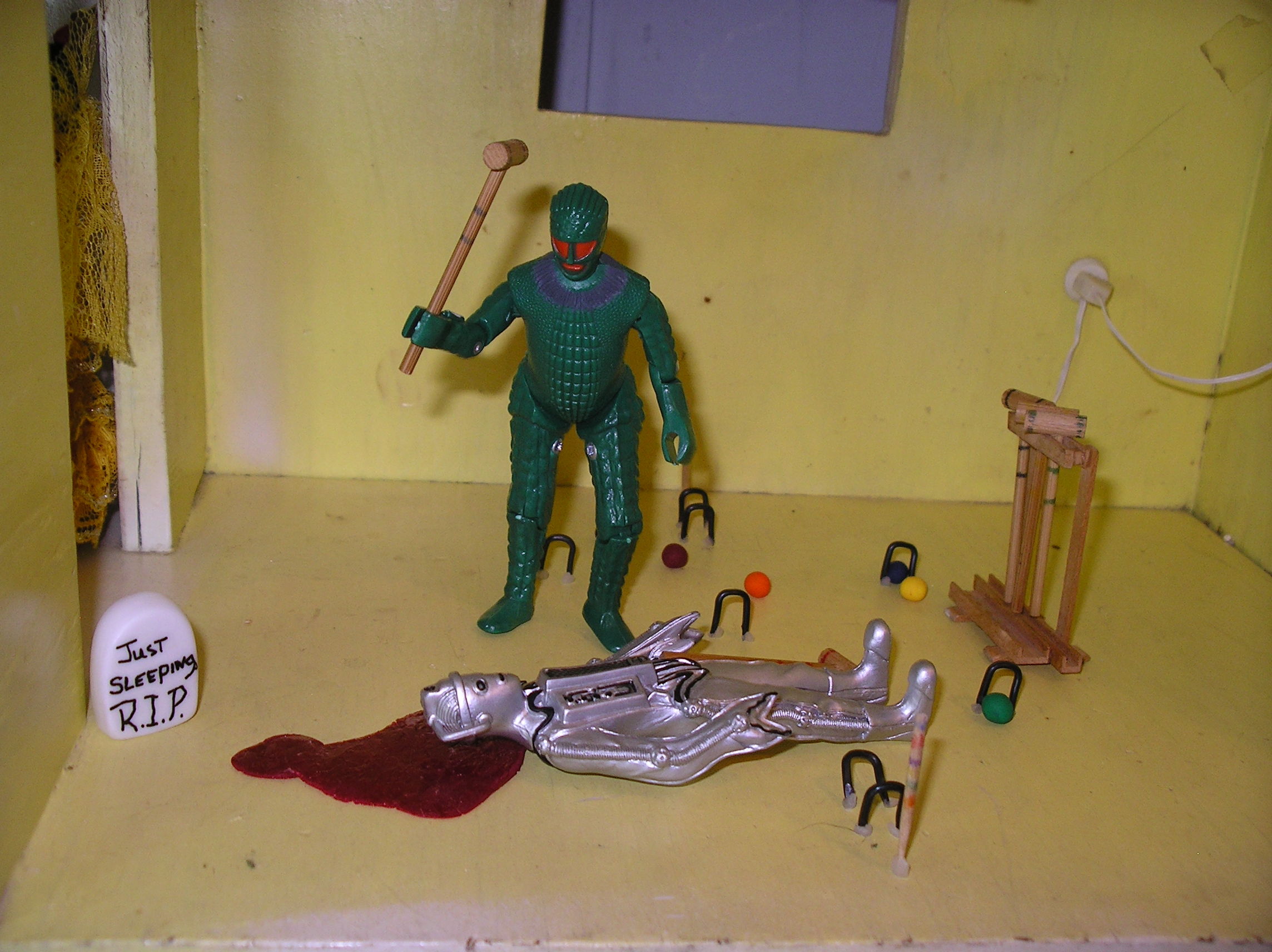
When croquet goes wrong

(This is from my collection of Doctor Who dollhouse photos.)

Croquet Gone Wrong - kristinking.org

Croquet Gone Wrong – kristinking.org

Steven Moffat’s work is more complicated

I read with great pleasure a post by Jack Graham on the multiple failings of Steven Moffat, showrunner for Doctor Who. Though a devoted fan of Doctor Who, I also enjoy shredding it to bits on the grounds of politics, gender, and race. It gives my brain something fun to do. I’m in agreement with Graham’s closing remarks:

The people in power, the privileged, deliver something, and instead of saying “thanks boss”, you say “not enough – do better.”  Moffat has a harder time pleasing everybody because more people are politicised and vocal about stuff like sexism.  The neoliberal feminism of a privileged ‘ally’ isn’t good enough for them.  And that’s as it should be.  Be reasonable, I say.  Demand the impossible.

I also agree with mostly everything Graham says in his post. For instance: “In Moffat’s show, women are overwhelmingly defined by their traditional gender roles or bodily functions.” Yes. That’s very annoying. Also: “I think the reason that lots of people think Steven Moffat’s version of Doctor Who is sexist is because it repeatedly acts and sounds sexist. Yes. I agree. And: “Moffat’s repeated tendency to have him cosy up to rulers, presidents, kings and queens, bosses, presidents, etc., is quite revolting.” Good point, and a disturbing departure from Classic Who. Finally: “He makes Doctor Who safe for neoliberalism.” Whoa . . . hadn’t noticed that, but now that Graham mentions it. . . yeah. A lot of Classic Who is about the rebels beating the empire, and I miss that.

At the same time, though, under Steven Moffat’s direction the show has done some remarkable things with both gender and politics. Here are five things (out of many) I’ve absolutely loved:

1. In “The Beast Below,” an authoritarian is deadlocked by a moral dilemma it can’t solve. It uses a fake kind of democracy to enforce the status quo: those who dissent are thrown into a pit to be eaten. The status quo relies on everybody forgetting the underlying societal injustices. What ultimately solves the problem? Amy Pond forcing the queen to abdicate.

2. Male domesticity plays a key role in the show. Most dramatically, in “Closing Time,” the plot resolution hinges on the bond between a father and his baby.  For example, Rory is the one who wants to settle down and have a baby, and Amy is the one who wants to put off her wedding in favor of having adventures. Rory has a nurturing occupation (nurse).  And Rory’s father is shown doing household chores. In short, men are moving beyond their traditional gender roles.

3. Shows often revolve around women’s issues of every sort. What saves the day in “The Doctor Dances”? A recognition of the plight of unwed mothers during World War Two.

4. Finally, the power dynamics between men and women are complex. The flirtation between River Song and the Doctor, which spans Seasons Four through Seven, is all about power. They’re engaged in a struggle for domination that lasts four seasons, and that they both clearly enjoy. She has power no other companion has ever managed: she can drive the TARDIS and she knows his name. And, although he apparently traps her in an artificial reality at the close of her story, she reappears inexplicably in a disembodied/embodied state.

5. The TARDIS got sentience under Moffat’s watch. She got to tell her own story and explain the role in his adventures that she’s always had. Sweet.

There’s such a wild abandon of creativity in Moffat’s work. It’s stretching in new directions all the time, and it’s offending and delighting people of every political persuasion. Art does that! So, while I’m perfectly happy to criticize him until I’m blue in the face, I’m equally happy to celebrate him.

But not just him — the show, and all the many writers who craft the characters and situations. It’s easy to oversimplify and place the criticism and celebration on him, which does everybody else a discredit. I’ve just started going back to my favorite episodes and seeing who wrote them, and my life is all the richer for it.

Update on June 15th, 2015

I neglected to mention that I found Jack Graham’s post through Philip Sandifer. It was a response to a post of Sandifer’s that I just got around to reading, “The Definitive Moffat and Feminism Post.”  Good stuff in there.

Here’s a quote:

Yes, the Moffat era of Doctor Who is sexist. Because it’s television made in a sexist society. But it has things to say about that society, and they are not kind things. I genuinely fail to understand anybody who claims that the Moffat era is sexist in excess of background radiation. This is a show that’s repeatedly telling girls that they can be as cool as the boys, that the boys don’t always know better than them, and that love and independence don’t have to be antagonistic qualities for women. It’s a show that tells rape survivors that it’s OK to not be defined by the terrible things that happen to them. It’s a show that says that women aren’t done being sexy once they get a grey hair and their first wrinkle, and that tells the Doctor off for thinking otherwise.

My tangential conclusion

Let’s end with a youtube video from the Chameleon Circuit, “Big Bang Two,” and a picture from the video. (Why? Because I like it!)

https://www.youtube.com/watch?v=jsFleDHX3G4 

big bang two

The pleasures of reading, viewing, and listening

I’ve been AWOL from this blog for a little while, but I have been busy elsewhere! Check out my post on the Aqueduct Press blog, “Pleasures of Reading, Viewing, and Listening in 2014”. I talk about The Theory of Everything, Maplecroft, Doctor Who (of course), Daniel Orozco’s “Orientation,” and more!

Is Doctor Who for kids any more?

(Removed and expanded from another post.)

Season 8 of Doctor Who has been billed as “a darker season” with “a darker Doctor” than the previous two, more flippant Doctors. Is it still appropriate for kids?

In a review of the episode “Dark Water,” columnist Sam Wollaston from The Guardian points out all the disturbing elements he enjoyed and then writes:

“I suspect my approval may mean he gets the opposite from the kids. Yeah, well, so what, it’s not your show any more. Love you, now go to bed.”

Yeah, well, fuck you Sam Wollaston, from the bottom of my motherly heart. Should my kids be deprived of this show just to make you happy? Plus, you’re dissing the future adult fan base of Doctor Who. Don’t forget that it was rebooted by adults who watched it as children.

This, by the way, is nothing to do with wanting or not wanting the show and the Doctor to be “darker,” whatever that means. Children are fully capable of dealing with “darker.” Read any Roald Dahl lately? Any Brothers Grimm fairy tales? In fact, many children’s ordinary lives are a lot scarier than any episode of Doctor Who could ever be.

Anyhow, when my spouse and I sit down to watch Doctor Who, the kids join in. My oldest loves to be scared, and my youngest leaves the room when the going gets too rough. She didn’t actually leave the room during “Dark Water” — I have a feeling it was scarier for the grownups, who think more about death. Nobody had nightmares, except me.

I think the show is good for kids in many ways. For instance, it’s a great source of metaphors and a way to understand our rapidly changing world. When a child asks, “But whyyyyyy can’t I have a cell phone? Even second-graders at my school have them!!!” I can say, “Because they will turn you into Cybermen,” and they get it.

The show is also a great way to expose children to some of the frightening truths that adults grapple with (badly) without overwhelming the kids. How many apocalypses have we had on the show? Ecological disasters? Megalomaniac rulers? But there’s almost always been a counterbalance, a ridiculous and fallible Doctor who saves us from the monsters, while tripping over his own shoes.

That’s the magic formula of the show, the one that’s kept fans coming back for more. The world is scary, but you can go out into it, explore, confront danger, because somebody’s got your back. It’s a lie, of course, but it’s a lie that children need in order to learn and grow and take risks. (As an adult who figured out that lie, and learned we have to save the frigging world ourselves, I do love the mental health break of stepping inside that blue box to watch that magic formula in action.)

This season has done a beautiful job of keeping that magic formula while still exploring all the troubling aspects of being the Doctor. But I do have a perpetual worry that Doctor Who might stray too far from the formula and stop being fun for kids. Of any age. As an extreme example, I don’t want Doctor Who to turn into “Torchwood: Children of Earth.” That episode had the kind of gut-wrenching impossible choice no hero could live with. And I don’t want the companions to get killed — especially Clara, the character my daughter adores. Finally, I don’t want the underlying optimism and humor to be lost. Fortunately, for now at least, we have a showrunner who remembers and values what it’s like to be a Doctor Who fan as a child. Don’t forget. Run, you clever show, and remember.

And hey, kids — Doctor Who is and always has been your show. Stay up late.

Have a jelly baby.

Have a jelly baby.

Have a jelly baby.

Other opinions about Missy in Doctor Who

Nov 7, 2014

Update: after considering all week and checking out various opinions, I have decided I like Missy. A lot. She’s basically a walking, talking, kissing piece of comic meta. I took down one of my posts (Doctor Who Dark Water – A Near Miss) because I’ve changed my mind about it.

Keeping this post though, because it’s basically a summing up of various opinions I’ve heard around the net. Spoilers below.

Nov 4, 2014

I’m conflicted about the character of Missy in Doctor Who. What are other people saying? Here’s a little summary of what I’ve found around the net.

From Cogpunk Steamscribe – “From a feminist viewpoint, this is a brilliant addition to the Doctor Who canon.” and “All the . . . shippers must be screaming in delight.”

Personally, I think half are screaming in delight and the other half are pissed.

From freethoughtblogs – Missy is one of a number of cookie-cutter female characters.

She sure channeled River Song in this episode.

From Radio Times – She’s a strong female character and shows Moffat to be a feminist. “Surely, this puts paid to any whingers who, for reasons that escape me, have labelled Moffat a misogynistic writer.”

Nice try.

From feministfiction.com (and by the way, how have I not found this before???) – very excited by the plot twist but yet another female character being in love with the doctor is setting up potential alarm bells.

Yes, that’s it exactly. That’s how I feel.

From ibishtar.livejournal.com – was hoping for Missy to be who she is but is concerned about how it was handled.

Yes. But I can’t personally decide how I would rather have had it handled.

Various comments on doctorwho.livejournal.com

From gildinwen – “You Troll Moffat…you epic epic troll *G*”

Also from gildinwen – “He did bring us Jack and River…..like flexible sexuality was kinda introduced into the Doctor Who universe via Moffat….and thank you for that kiss!!!!”

angelophile – “it manages to be both sexist and homophobic at the same time. Double whammy.”

eowyn – “Why are all female villains the same? Karabraxos, Miss Foster, Kovarian, Missy – they’re all basically interchangeable.”

gonzo21 – “And yes! Moffat knows how to write precisely 2 female characters. They’re either Amy/Clara or Missy/Kovarian/River/etc. ”

norahsilverbird – “I thought it was hilarious how she decided to kiss the Doctor.”

femme_slash_fan – “the way Missy has been spouting off about her ‘boyfriend’ just hits me as needy and a little overly sexualised”

gonzo21 – “I’m also not convinced Moffat is the writer we want to be handling trans-gender issues like this.”

sharaz-jek – “. . . it’s good to see an example of genderfluidity, even if it is . . . ”

pinguthegreek – ” Transgender issues are a relatively new thing to many people who may not have any experience or contact with trans people. To expect writers of a mainstream, flagship, prime time show to carefully consider those kind of sensitivities in this particular instance is kind of shooting for the moon. . . Progress has to be in small steps . . .”

ibishtar – “. . .a writing move that I found cissexist, heteronormative and sexist . . .”

Sexuality Dragon (warning: blog contains mature themes): “My reaction so far has been to squeal, cry, yell, swear, say things like: ksjdfbkwebtksdvkbdsfansbdn l I can’t I can’t oh god it’s so beautiful am I betraying everything I believe in if I start watching DoctorWhoagain”

Verity Podcast – The Verities interpreted Missy as an excellent continuation of the Master, complete with a typical crazy “Master plan,” flirting through destruction of planet Earth, flair for style, invasion of the Doctor’s personal space, and more. As for the gender dynamics, there was one interpretation that this is how the Master thinks he ought to behave now that he has a woman’s body.

Quite the range of opinions! If nothing else, this is a move that’s making people think.

Any other feminist opinions about Missy? Let me know and I’ll link to them here.