Category Archives: books, movies, tv, music

A book, a movie, a show, a song. Was it amazing? Fun? Did I hate it? Am I now thinking deep thoughts about it? Come along for the ride.

Speculation for “The Zygon Inversion”

If you haven’t watched the Doctor Who episode “The Zygon Invasion,” this blog post is not for you. Not only might it have spoilers, it will be just plain cryptic. Give it a miss. If on the other hand, you watched it and are thinking, “Wait — what?” and you love speculating, this post is definitely for you.

Continue reading

Classic Who to Try

Suppose you like New Doctor Who and you want to try out Classic Who, but maybe you don’t know where to start, or maybe you watched a serial and you got bored because it was too slow. Don’t despair: there’s no wrong way to watch Doctor Who. But, as I mentioned in my last blog post, you might not want to start at the beginning and watch straight through. Think of it as a buffet. Start at any part of the table, pick up some stuff, and watch it. That’s what Italo Calvino would have done.

One thing to keep in mind: the show is made up of stories, or serials, with several episodes each. You don’t always have to watch every episode in a serial to get the gist of it.

In this blog post, I’ll suggest some serials that might be fun as starters. Be forewarned: there’s plenty of sexism, racism, ableism — any kind of “ism” you can think of, it’s in there. The show is a product of its time. Also be aware that every single one of these serials is ridiculous. I mean, seriously — a time traveling police box?

Accept it and move on. There’s plenty of fun to be had.

First Doctor: William Hartnell (1963-1966)

Ah, the mid 1960s. Globally, that was a great time for experimentation in film and TV. The first Doctor, William Hartnell, began as an irascible old man who kidnapped two schoolteachers in a fit of pique. And the show began as a combination of history lessons and outer space adventure.

Try these:

An Unearthly Child – The episode that started it all. It firmly establishes the Doctor’s character as an erratic and unpredictable man with a time machine. The focus, though, is on his granddaughter Susan, an exceptionally bright young woman. If you like, you can watch just the first episode in this serial and skip the rest.

The Daleks – First appearance of the iconic pop hit monster. They are scary, even to my modern sensibility.

The Edge of Destruction – A psychological thriller set entirely in the TARDIS. They had no special effects budget and very little time to write the script, and they did a lot with what they had.

The Web Planet – If you enjoy giant bug monsters on a low special-effects budget, watch an episode or two. I watched them all and I still have their spacey wacey high-pitched chirping in my head.

The Space Museum – This serial is a puzzle involving time’s multiple dimensions. It deals with a topic central to time travel stories: can you change the future or not? And there’s a subtle jibe in the script at the phenomenon of female characters leaving the TARDIS to get married.

The Time Meddler – The villain is the Meddling Monk, a time traveler like the Doctor. In apparent contrast to the Doctor, the Meddling Monk tries to change history for the better. What happens when he tries to stop the Viking invasion of 1066?

Second Doctor: Patrick Troughton (1966 – 1969)

Patrick Troughton’s acting superpowers are his slapstick and his ability to panic magnificently. He’s often compared to Moe from the Three Stooges. He’s got a warm personality and a melodious voice. Every so often he impersonates the villains so well that you do start to wonder. He’s the first Doctor I ever saw, and my favorite.

I suggest:

The Tomb of the Cybermen – The first appearance of second most famous Doctor Who monster. And they’re scary.

The Enemy of the World – The Doctor’s doppleganger is a ruthless dictator, and I had great fun watching them impersonate each other. It’s beautifully written and well acted, although the dictator’s accent is a weird combination of Italian, German, and Latin American.

The Web of Fear – All the wandering through abandoned subways you could ever hope for.

The Mind Robber – More ridiculous than most, and also one of the most inventive. Lovely metafiction.

The Krotons – This is the story that made me sit up and take notice of the show. The character of Zoe, a young woman, outdoes the Doctor on a math test. Go, Zoe!

The War Games – This one has ten episodes largely about wandering through battlefields, getting captured, escaping, and getting recaptured. I found the endless escapes fascinating and enjoyed watching the Doctor talk smack to generals. Somebody else might be deathly bored. Either way, I wouldn’t recommend watching more than two episodes at a time.

Third Doctor: Jon Pertwee (1970-1974)

Jon Pertwee is a dandy, with his ruffled sleeves and aristocratic accent. He’s paternalistic and arrogant. If you can’t stomach that, move on. I’m fond of him because sometimes I crave the illusion that somebody else knows what’s going on in this crazy world of ours. He was also the perfect Doctor to be challenged by 1970s “women’s lib.”

I suggest:

Inferno – A nightmare parallel world, in which drilling down to the center of the earth leads to worldwide cataclysm. Most vivid end-of-the-world scenario in Doctor Who, both Classic and New. It’s not pleasant getting there — the parallel world is more authoritarian, and all the characters we rely on are corrupt. There’s a hint that the Doctor has become the ruthless dictator we last saw in “Enemy of the World.”

Terror of the Autons – The Autons are a scary “uncanny valley” kind of monster, so successful that they were brought back as the villain for the first episode of New Who.

The Mind of Evil – Features a standoff between the Doctor and his arch-enemy the Master, including a lot of psychological drama. The Master became a favorite villain who appeared in quite a few of the following serials.

The Three Doctors – This serial brings together Jon Pertwee, Patrick Troughton, and William Hartnell. It’s fun to watch the dynamics between them, especially since they dislike each other so much.

The Time Warrior – This serial introduces Sarah Jane Smith, a long-term beloved companion. She enters as a determined women’s libber and confident journalist, who thinks the Doctor is a villain and opposes him with great gusto.

Planet of the Spiders – The Doctor goes on a solo mission to face the consequences of his actions, and Sarah Jane investigates a suspicious meditation group while also using compassion as a secret superpower. It’s full of mental powers and cool caves.

Fourth Doctor: Tom Baker (1974-1981)

This Doctor is many people’s favorites. He’s the “all teeth and curls” one with the long scarf. He adds comedy to all the serials, some of which are just plain cheesy and some of which deal with more serious topics.

A few to try:

Robot – This story deals with machine intelligence and ethics. Sarah Jane rocks it as a journalist / spy.

Genesis of the Daleks – This is the Dalek origin story, and introduces Davros, who genetically modifies the compassion out of his people. It asks serious questions: What if you could go back in time to stop the architect of a genocide? And what is the ethical responsibility of science?

Revenge of the Cybermen – Tom Baker faces off against the Cybermen.

Pyramids of Mars – Okay, lots of cheese here, including robots disguised as mummies and then Tom Baker disguised as a robot who’s disguised as a mummy . . .  but I liked that they brought in a god from a non-Western mythology. Plus, Sutekh, destroyer of all, has a great voice.

Brain of Morbius – Major cheese, as the villain is a Doctor Frankenstein type. There is also a powerful group called the Sisterhood of Karn, who have a relationship of equals with the Time Lords but who are strangely idiotic in their understanding of the lifegiving “sacred flame” they guard. I suggest it because the Sisterhood of Karn becomes really important, and much wiser, in New Who.

Warrior’s Gate – A stone gateway, a magical mirror, and a struggle by the Doctor’s companion, Romana, to help stop slavery. She leaves the Doctor and the TARDIS as a hero.

Logopolis – It has math, the Master, and a cool looking world. It’s fun.

Fifth Doctor: Peter Davison (1982-1984)

This is the friendliest, pleasantest, most pacifist Doctor. He’s a nice guy.

Here are a couple of good ones:

Castrovalva – This serial takes place in an Escher-like world with a dangerous secret at its heart. The Doctor is unconscious for much of it, leaving the companions to carry off the adventure.

Kinda and Snakedance – These two serials can be watched separately or together. The Doctor and his companions visit the same world, aeons apart, to face the same monster. The Mara manifests physically as a giant, low-budget snake, but also exists in the inner reaches of the mind. Both serials tackle colonialism and introduce non-western ways of thinking about our world.

Black Orchid – This is a classic tale of a Victorian household with a secret in the attic. The Doctor impersonates . . . well, a doctor. And there’s a costume ball.

Mawdryn Undead – A paradox with disastrous consequences. It also introduces an “evil companion” who spends the next several serials trying to muster the nerve to kill the Doctor.

Enlightenment – This serial concludes the enjoyable “evil companion” plot, so you might not want to watch it until you’ve seen the rest. But it’s got outer space sailboats piloted by bored and lonely immortals. And people get to dress fancy and dance. First serial written by a woman.

The Five Doctors – Okay, if you can only watch one Classic Who serial, this is it. An evil mastermind is playing with Doctor Who action figures. Or, in other words, all the Doctors and some of the favorite companions are pulled out of time and into a forbidden battlezone on the Doctor’s home planet, where they get to reprise the best of their old roles.

Sixth Doctor: Colin Baker (1984-1986)

Sadly, the fifth Doctor was poisoned, and the regeneration went wrong. Colin Baker flirts with insanity throughout his serials in what was supposed to be a satisfying story arc but was cut short by fan disapproval and/or failures at the BBC. He’s mercurial, arrogant, patronizing, and prone to occasional fits of violence. Sometimes this comes off well.

Here are a couple serials I liked:

Mark of the Rani – Rani is a Time Lord scientist who lacks ethical constraints. In this serial, she’s taking advantage of the Luddite riots to drain hormones out of workers. She lures the Master into helping her and kidnaps the Doctor. It’s always fun to see smart villains with actors who relish their parts. Also, she pairs off quite nicely with this unbalanced version of the Doctor.

The Two Doctors – This one features Colin Baker, Patrick Troughton, and genetic manipulation by a mad scientist. There’s a lot of fun as Troughton starts turning into an Androgum — a species with a taste for sentient flesh.

Seventh Doctor: Sylvester McCoy (1987-1989)

This is my second favorite Classic Who doctor. He brings vaudevillian fun and a lovely Scottish accent, but under the surface is a lot of Machiavellian scheming. His run was cut short by the cancellation of the show.

I suggest any serial by him, but particularly:

Paradise Towers and Happiness Patrol – Two shows with two different brightly colored dystopias. In Paradise Towers, rival gangs fight with red and blue spray paint, elderly women eat their neighbors for tea, while something monstrous is gradually making its way up from the basement. In Happiness Patrol, blues are outlawed and execution is by candy syrup.

Ghost Light – It’s another creepy Victorian house with a madman in the attic. There are also things coming to life that should have stayed dead, a Pygmalian story, and a monster who didn’t factor evolution into his plans. The Doctor (and the show too) shows interest in character development for the companion, Ace. This is a first.

The Mark of Fenric – This serial, set during World War Two, involves spies, codebreaking machines, complicated evil machinations, and also a rare glimpse into what women do during a war. Ace has even more character development.

Survival – Because cats.


Okay, that’s it: a Classic Doctor Who starter course. Enjoy.

How to Watch Classic Doctor Who

I keep meeting people who like New Doctor Who and either can’t get into Classic Who or wonder where to start.

My answer to “where to start” is always: in the middle. You can’t go too far wrong by grabbing any Classic Who episode, watching it, and then turning off the TV for a day or a week. That’s because the show was produced in half-hour(ish) segments with cliffhangers at the end of each one. There might be anywhere from two to eight episodes per story (which is called a serial). Since it was the nature of television that viewers would often miss some of the episodes in any given serial, there was always enough backfilling that a viewer could figure out more or less what was going on.

So let’s suppose you try watching just one episode. One of two things will happen. One: you’ll be so interested that you’ll want to watch the next part of the serial. Two: you’ll decide that particular serial is boring, but at least you’ve gotten the flavor of the show. And you can rest assured that there will be a lot of different kinds of stories you can try. Also, there are a lot of different flavors of the Doctor and the companions.

I started with Patrick Troughton, the 2nd Doctor. I recommend any of his stories. They’re over-the-top, inventive, frivolous — lots of things I like, but that might not be everyone’s cup of tea. It was shown for one hour a week, which is twice as much as originally broadcast, but still manageable.

When Patrick Troughton regenerated into Jon Pertwee, I was shocked and dismayed. I had no idea that regeneration was part of the story, I didn’t much like the character of the new Doctor, and I didn’t like him being stuck on Earth for such a long time. I warmed up to him more by the time his companion Jo Grant showed up and adored him by the time of “Planet of the Spiders.”

I was down with the whole regeneration business by the time we got to Tom Baker. By then I was on a quest to find the old Patrick Troughton episodes, and the old William Hartnell episodes. I had to join a local Doctor Who club to do it . . . and later became the president and stored a life-size foam replica of the TARDIS in our family’s shed . . . but that’s another story.

William Hartnell episodes are awfully slow by today’s standards. I wouldn’t recommend starting there for most people, and if you do, absolutely don’t start with The Gunslingers.

You can’t go too far wrong watching the very first episode of the first serial “An Unearthly Child,” because it introduces the concept and the Doctor and the companions. However, you don’t have to watch the rest of that serial if you don’t want to. You could skip ahead to any other serial in Season 1, depending on what you like. Sci fi? Daleks? Historical fiction? I particularly enjoyed the episodes “Edge of Destruction” and “Brink of Disaster” because they were written with zero special effects budget and just featured suspense and characterization. Your mileage might vary, though.

In the next post I’ll talk more about some of my favorite Classic Who episodes and why I liked them.

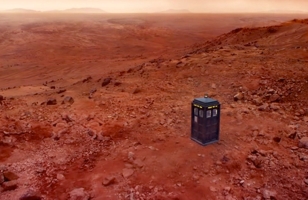
waters of mars lanscape

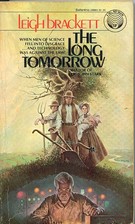
Leigh Brackett’s The Long Tomorrow

A couple months ago, Wired magazine came out with a truly dreadful article on the history of science fiction — one that suggested diversity is new to SF. I wrote my own response to that, and in the comments another blogger suggested the author Leigh Brackett, who wrote in the 1950s but is now largely forgotten. (Thank you!)

I checked the library and found her novel The Long Tomorrow. It was part of an anthology of the best works of the 1950s, and I accidentally started reading it halfway in. And that didn’t spoil it one little bit. On the contrary — it heightened the suspense, because I knew where the characters were headed, but I didn’t know how, and I didn’t know what would happen when they got there.

It’s an amazing postapocalyptic novel set in a rural New Mennonite town. In the novel’s history, nuclear war took out all the cities, which in turn demolished our technology. Mennonites survived, because they only used technology they could make themselves. And New Mennonites, and others, copied their culture because it made practical sense. This is a well-thought-out scenario, and the New Mennonite communities and surrounding countryside are richly drawn. Brackett really takes her time to let you get to know the people.

The people in this world are terrified that nuclear war might return, and this fear has extended to technology and cities. They’ve built a cultural narrative that says the cities were destroyed because God didn’t like them, and they punish anyone who might remotely appear to be bringing them back with stonings and fire.

And then, of course, the main character and his friend, Len and Esau, find ancient technology and go looking for a fabled city. They are two teenage boys brought up in a strict Biblical tradition who now question their community, but for slightly different reasons.

The story of Len and Esau is a coming-of-age tale, a story about growing up, a story about discovering and understanding the world they live in, and an exploration of a complicated moral problem.

I’ve read a lot of post-apocalyptic novels, but this one stands out because of its depth and breadth, the strong characterization, and the way it makes you think. It’s one of those books that will stick with me for years.

Off to see what else she’s written . . .

P.S. Here’s a link to a more in-depth but more spoilery review by author Nicola Griffith. She points out the limitations in a novel that’s a product of the age, but all in all likes it even more than me.

The Long Tomorrow by Leigh Brackett

The Long Tomorrow by Leigh Brackett

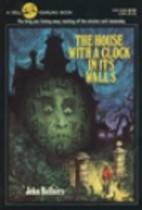
The House With a Clock in Its Walls

This book by John Bellairs scared the dickens out of me when I was a child, so I’ve been hunting for a while now. Only I had forgotten the author’s name and got the title mixed up with  Bell, Book, and Candle, maybe because it has  books and lights and noisy things in it, or maybe because the same author wrote The Bell, The Book, and the Spellbinder. But it was one of the books from childhood that I remember deeply.

Then one day I went to a new library branch and the book jumped out at me. The House With a Clock in its Walls. And I’ve just finished it. Sometimes when you reread a book you loved as a child, by the time you reach adulthood you’ve grown so much that the book is now dull. But this one did not disappoint.

This is a deeply scary book. Not just because of the clock hidden somewhere in the walls of a creepy old house, not just because it’s a doomsday clock set to end the world, and not just because the illustrations were done by Edward Gorey. It’s scary mainly because the main character, a boy named Lewis, made a serious ethical mistake, and he nurses his fear and guilt through much of the book.

I bet every child can identify.

Bellairs is quite gentle on Lewis, and on the reader as well. He’s careful to mention that Lewis’ uncle would understand, and he’s also considerate enough to mention that Lewis will make it to adulthood. Bellairs is also kind to all the characters in the book. (Well, the living ones, at any rate.) Even the bully.

And the prose is lovely – expressive, surprising, and smooth. Here’s a short excerpt:

Lewis got up, wiped his hands on his trousers, and tugged at the enormous cardboard suitcase that hung out over the edge of the metal rack. Lewis’ father had brought the suitcase in London at the end of World War II. It was covered with ripped and faded Cunard Line stickers. Lewis pulled hard, and the suitcase lurched down onto his head. He staggered back across the aisle with the suitcase held perilously in the air; then he sat down suddenly, and the suitcase landed in his lap with a whump.

“Oh, come on! Don’t kill yourself before I have a chance to meet you!”

There in the aisle stood a man with a bushy red beard that was streaked in several places with white.”

All in all, it’s a hard read but a good one. I’m glad to have read it. (Twice.)

The House with a Clock in its Walls by John Bellairs

The House with a Clock in its Walls by John Bellairs

Doctor Who Series 9 so far, with spoilers!

(Just skip this post if you haven’t watched “The Magician’s Apprentice” and “The Witch’s Familiar.”)

The first two episodes of series 9 were among the best Doctor Who so far, but they weren’t my favorite — and for the same reason! They delved deep into some seriously heavy topics. In general, I love that (see my article “Fall of a Superhero: Doctor Who and the Waters of Mars” that appeared in Strange Horizons). But it’s been happening so much I’m looking forward to a bit more light and fluffy.

And it’s funny to hear myself say that, because these first two episodes had amazing comedy. Michelle Gomez, playing the villainous Missy, stole the show. She’s an unapologetic, flamboyant murderer. She and Jenna Coleman, playing the Doctor’s companion Clara, passed the Bechdel test, then chopped it up into tiny pieces and had it for tea.  (BTW, there is some lovely commentary on how the Missy/Clara dynamic outshone the  Doctor/Davros dynamic in the Verity Podcast episode “Trials of the Witch’s Familiar.“)

Behind the comedy, though, is some heavy material on morality. There’s a time travel trope of “What if you could go back in time and kill Hitler as a boy/as a baby?” It’s been done to death. But there’s a twist. What if you wander about in time and one day, in the middle of saving an innocent boy’s life, you discover he’s Hitler? (Davros, in this case.)

What do you do?

Reader, I warned you about spoilers, but I will try to go easy on them, and not tell what the Doctor does. But whatever it is, it lands him in such trouble that his (second-worst) arch-enemy (slash best friend) has to come save him. This leads to a complicated examination of friends, enemies, the enemy inside the friend, and the friend inside the enemy.

It culminates with a truly horrifying scene. The Doctor’s companion, Clara, is trapped inside the shell of a Dalek. Roughly speaking, a Dalek is comprised of two parts: a mush of tentacles genetically modified to be without empathy, and a deadly traveling machine. Daleks have been scaring Doctor Who viewers since 1963. They’re unquestionably evil — bound and determined to exterminate every other race in the universe.

But when Clara gets trapped inside a Dalek, she learns something new. When she speaks inside the Dalek, the machine part rasps out a bad translation. So if she says, “I am your friend,” anybody standing in front of the Dalek would instead hear, “I am your enemy.” If she gets upset and says something, the machine starts saying “Exterminate!” and shooting.

So of course she ends up in a confrontation with the Doctor. And it’s horrifying to watch, especially since we’ve been told that Jenna Coleman will be leaving the show during this season. Trapped inside a traveling weapon . . . not a good way to go.

Luckily, the Doctor figures it out and rescues her.

Only there’s a more lasting horror. I’m not sure everyone caught it. What if, all along, throughout the history of the Daleks, there have been good Daleks imprisoned their whole lives inside a metal machine? What if they come up against the Doctor, a man sworn to save people, with a gesture of peace, only to be killed horribly?

Only they’re unquestionably evil, right? That’s been show canon ever since the episode “Genesis of the Daleks” in 1975.

Well . . . no. As it turns out, when the Doctor saves the young boy Davros, he deliberately introduces the concept of mercy to Davros. So there could indeed be dissenting Daleks, forever trapped in a fascist empire . . . shudder.

By chance, I ran into Richard Wright’s novel Black Boy at the library and started reading it like a woman possessed. In that novel, there is a stark and horrifying contrast between the inner life of an ordinary young boy and the “black devil” as he is seen by others. Words that he speaks in innocence are misheard. So now I’m thinking about Daleks, and I’m thinking about race. What if, no matter what you say or do, others will only see a violent and murderous enemy?

So that’s why I say these two episodes are among the best, but also my least favorite. I’m looking forward to something with a bit less horror!

Last week’s episode “Under the Lake” turned out more of an adventure. Scary ghosts, an underwater base that’s turning the lights off randomly, a puzzle to solve, and lots of running around. Pure fun so far, but is something deeper lurking in the shadows? We’ll find out next time, in “Before the Flood.”

The enemy inside the friend?

The enemy inside the friend?

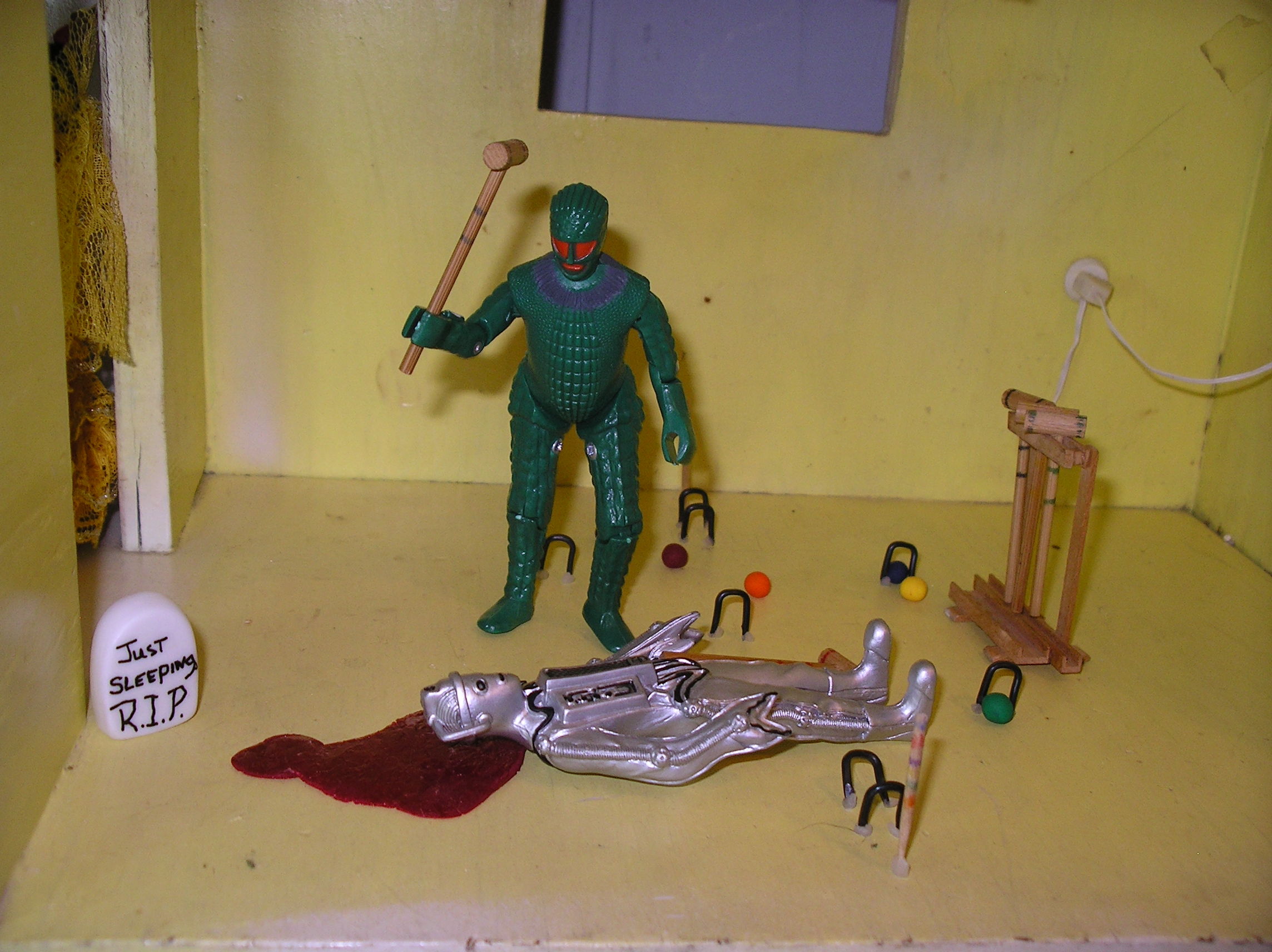
When croquet goes wrong

(This is from my collection of Doctor Who dollhouse photos.)

Croquet Gone Wrong - kristinking.org

Croquet Gone Wrong – kristinking.org

An Etymology of Sad Puppy Terms

Now that the Sad Puppies have failed in their strategy to take over the Hugos by manipulating the nomination process, I thought I could safely ignore the rest of their sci fi and fantasy backlash. But the Wired article I’ve been discussing for several posts tells me I’m wrong. It took some of the terms coined by Sad Puppies and used them with a straight face. Other mass media outlets have done the same.

Some words are sneaky. They say more in connotation than denotation. (In other words, they say more by implication that by direct, concrete meaning.) They become shorthand for a whole set of assumptions. Sometimes digging into their pasts can help illuminate those assumptions. (For an example, see my analysis of the term “political correctness.”)

So let’s take a quick look at what those Sad Puppy words mean, and how they came to be. I’ll cover “trufan,” “CHORF,” and finally “Social Justice Warriors.”

Trufan

Trufan is the funny one, so let’s start there. Both Wired and Popular Science have latched on to it. It’s been around a while, but starting in February 2015, Sad Puppy supporters Sad Puppies started use it as shorthand to defend themselves against the claims that they’re not “real fans.”

Only one problem with that: I can’t find any evidence that more than one person ever made that claim.

I don’t know who that one person was, but I do know that they made it in the comments thread of some post or another. Somebody apparently accused a blogger named Patrick Richardson of not being a true fan, and he defended himself in the blog post “Not a Real Fan.”

However, I can’t find the accusation itself. The only thing I can find is a conversation in the comments thread. One person asked what had sparked this post, and Patrick Richardson replied that Larry Correia had been labeled “not part of fandom.” Another person then said, “I can find plenty of examples of Larry *claiming* people called him not a real writer or not a real fan. What seems thin on the ground is actual pages where people *did* so.” Author John C. Wright, Puppy supporter and beneficiary, then replied, “The comment that sparked this was in a private email which the recipient is unwilling to reproduce publicly.”

So the accusation of which Patrick Richardson was complaining came in a private email from one person to another.

Next up was a post by blogger Mike Glyer saying with the ultimate message that (1) if you try to attach yourself to fandom, you are a fan; and (2) you don’t need anyone’s permission to be there. The post, “Why You’re Not a Fan” began ironically, however, with a silly list of qualifications you must hold to be a fan. You have to read fanzines, join a club, own Star Wars action figures, join a Bardic Circle, AND do cosplay.

This irony is over-the top and obvious. Who could possibly meet these qualifications? It’s obvious, that is, unless you’re expecting a fight. And some people were, so the Internet exploded with outraged bloggers, from Bob Colfax’s “So I’m Not Cool Enough to be a Fan” to Brad Torgersen’s “My FANifesto.”

That’s “trufan” in a nutshell: a tempest in a teapot.

CHORF

Next up, CHORF. The etymology is simple. Puppy leader Brad Torgersen coined it in March 2015 to mean “Cliquish, Holier-than-thou, Obnoxious, Reactionary, Fanatics.” It was first used to refer to Teresa Nielsen Hayden, after an argument in the comment thread of “Distant Thunder, and the Smell of Ozone.” It is now broadly applied to a larger group of people.

Social Justice Warrior

“Social Justice Warrior,” like “CHORF,” is used broadly. The term has been around since at least 2009, when the Will Shetterley began the blog Social Justice Warriors: Do Not Engage. It’s also been used (very rarely) by activists to refer to themselves.

But in 2014, Gamergate happened. That was a backlash against female video game programmers and players. It appears to have been orchestrated by a small number of Twitter users, who also strategically planned the use of hashtags such as #notyourshield. The term “Social Justice Warrior” and its shorthand “SJW” was officially intended to apply to the worst form of Internet troll, but in actual usage it applied broadly to anybody who disagreed with Gamergaters. This meant that Gamergaters could imply somebody was a troll without actually saying so. Also, naming somebody as a warrior provided a pretext for attacking them.

In 2015, the term it made its way into the science fiction and fantasy blogosphere. Here are a couple of examples.

From “Sad Puppies, If I must” on Lawrence Person’s BattleSwarm Blog:

For the last several years, a vocal minority of Social Justice Warriors has wrecked havoc on the fabric of the science fiction community. Taking their clues from the Alinskyite “direct action” tactics of far-left political activists, they’ve carried out a virulent campaign against anyone unwilling to toe the political correct line on victimhood identity politics.

From “Why I Don’t Like Social Justice Warriors” on Larry Correia’s Monster Hunter Nation blog:

The issue with the Social Justice Warrior contingent isn’t just that they’ve got their causes, it is that they take those causes and use them to brow beat not only their opposition, but also the innocent bystanders, the undecided, and newcomers.

When a person uses the term “Social Justice Warrior,” it looks to me like they’re trying to start a fight. When a mass media journalist uses it, they’re setting the stage for that fight and taking a side. For example, here’s a quote from the Wired article “Who Won Science Fiction’s Hugo Awards and Why It Matters”:

But from the start, Correia had some serious complaints. He felt that the Hugos had become overly dominated by what he and others call “Social Justice Warriors,” who value politics over plot development.

It was lazy journalism to use the term without trying to provide an actual definition. I get why it happened, though: there isn’t a definition. Social justice warriors are [who?] who do [what?] That question can’t be answered.

What to do?

When faced with words like these, it helps to have a critical eye and a handle on what’s being implied and what’s being hidden. It’s worth the time to look for more accurate replacements and advocate for their use. For example, “Social Justice Warriors” means “left-leaning Internet troll” in some cases and “feminist” in others. And finally, hold the mass media accountable.

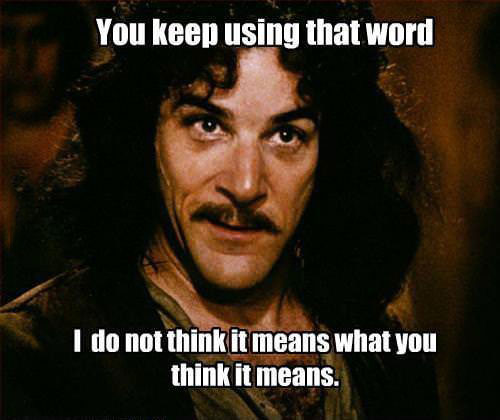
Words have power. Use them with care.

inigo montoya

On choosing a (Hugo) winner

Wikipedia tells me that “the Hugo Awards are a set of awards given annually for the best science fiction or fantasy works and achievements of the previous year.” But Wikipedia is wrong. Worldcon, the organization that gives the awards, defines them as “the most prestigious awards” and “awards for excellence.” That’s more sensible, because there is no such thing as a “best” creative work.

I didn’t realize this until I started reading the nominations, but the question is not “which work is best?” but “which work deserves this particular award?” This leads to an even more interesting question, which is, “what is the basis for deciding which work deserves this award?”

My first impulse was to vote for the book I enjoyed most, Ancillary Justice. It’s thought-provoking, the storytelling is tight, and the characters are interesting, the science is strong and logically self-consistent, and the novel acts as a cautionary tale about technology that is just now emerging in our own world, artificial intelligence.

But then I thought, “This is a sequel, and the first book in the series won the award last year. Maybe it’s time to give another author a chance.”

I was making an assumption there: that the purpose of the Hugo awards is to reward the author. But maybe instead it’s about helping readers find excellent works. Hugo-award-winning novels get listed in the handy trifold brochures that libraries stock.

So I thought, “Maybe it’s time to give the reader a chance to encounter a new author.” In that case, my vote would go for my other favorite, Goblin Emporer. It is a fresh take on court intrigue, with a fascinating and likable main character, a complex multiracial society, and it doesn’t gloss over the problems of class and power that come up when your hero has the power of life and death over the rest of the kingdom. It was a thoroughly enjoyable read, and I’ll be on the lookout for more books by the author.

I was all set to go with Goblin Emporer when I struck up a conversation with a long-time science fiction fan, and he said that yes, it was an amazing book, but at the same time, he felt that it didn’t push the boundaries of science fiction and fantasy. To him, that was a key criterion for the Hugo award.

That criterion had never occurred to me, so I had to stop and think. Should I base my selection on boundary-pushing? And if I did, would Goblin Emporer count? It does push boundaries of class and race in ways I’ve never seen before.

Then there was the third candidate, The Three-Body Problem. That is a hard sci-fi novel with a highly imaginative scenario and vivid world-building. I had difficulty connecting — the science sometimes overwhelmed the story and the characters, and I found myself skipping paragraphs. I still found it a worthy candidate, though, based on its originality. Also, I consider it a boundary-pusher for an English-speaking audience because it was first written in China for a Chinese audience. Especially considering the organization that grants the award is called Worldcon, it’s only fair to include non-Western works.

All these books made it onto my ballot, and any one of them could have made first place depending on the criteria I used. Vote for the one I enjoyed most? Should I pick the one with the most science? Choose on the basis of diversity? Decide which one most expanded the boundaries of science fiction and fantasy?

Once I started to ask these questions, I realized the Hugo awards do something else for the field of fantasy and science fiction. Every nomination and every ballot choice is a vote for the direction of future works. And it lends legitimacy to new forms of creative expression. (Don’t even ask me how excited I was when the Doctor Who episode “The Empty Child” won a Hugo.) Should we encourage writings that escape the geological boundaries of North America and Europe? Push for diversity? Delve into near-future technologies?

So my vote could be for personal preference. It could be for sub-genre. It could be for the future of speculative fiction. My power, and my responsibility. My choice.

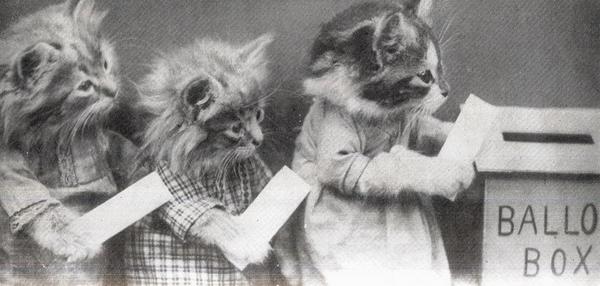
It’s a heady thing, democracy. I recommend it.

cats voting

Analyzing the Wired article on the Hugo awards, Part Three

Today let’s take a look at slant in the Wired article on the Hugo awards. In Part One, I used a word frequency analysis to show gender bias, and in Part Two, I challenged the claim that the Hugo awards are about identity politics.

Today I’ll look at the way the Wired article is slanted in favor of some sub-genres and against others. This is a common error: many readers and reviewers have an unconscious hierarchy, and if a work doesn’t match up to the expectations of a favored sub-genre, then they consider the work itself to be inferior. People often do this without even noticing sub-genres exist.

What are the sub-genres? Here’s one list: contemporary fantasy, court intrigue, cyberpunk, epic fantasy, hard sci fi, military sci fi, parallel/alternate universe sci fi, science fantasy, space opera, quest fantasy, time travel, and urban fantasy.

And the hierarchy? Going by what I’ve heard many people say, it starts off with hard sci fi, space opera, military sci fi, cyberpunk, and then everything else. I’ve often heard it said that you can’t write sci fi unless you get the science right.

I don’t give a crap about the hierarchy. Personally, I prefer science fantasy, contemporary and urban fantasy, time travel, and space opera — but I’ll read anything that strikes my fancy. I also understand that even if I don’t like a work, that doesn’t mean it isn’t good.

The Wired article does have an unacknowledged hierarchy. Most obviously, as I mentioned yesterday, it keeps forgetting the Hugo awards include fantasy. I’ll repeat the quote here:

[T]he balloting had become a referendum on the future of the genre. Would sci-fi focus, as it has for much of its history, largely on brave white male engineers with ray guns fighting either a) hideous aliens or b) hideous governments who don’t want them to mine asteroids in space? Or would it continue its embrace of a broader sci-fi: stories about non-traditionally gendered explorers and post-singularity, post-ethnic characters who are sometimes not men and often even have feelings?

Meanwhile, according to the article, the genre has Gods, and they are:

Isaac Asimov, Arthur C. Clarke, Harlan Ellison, Philip K. Dick, and Robert A. Heinlein.

These are all highly influential authors from a certain era, often called “The Golden Age” of science fiction. Here’s a look at the sub-genres they wrote in:

  • Isaac Asimov (1920-1992) wrote hard sci fi. His Robot series introduced robots with a self-contained system of rules that was intended to protect humans, and then broke it. His Foundation series reached forward into the far future and chronicled a dying empire.
  • Arthur C. Clarke (1917-2008) wrote hard sci fi, most notably 2001: A Space Odyssey, a far-future novel with spaceships, AI, and powerful aliens.
  • Harlan Ellison (1934-present) writes in a variety of genres including speculative fiction, science fiction, and fantasy.
  • Philip K. Dick (1928-1982) wrote postmodern, philosophical works that often included authoritarian governments and altered states of consciousness.
  • Robert A. Heinlein (1907-1988) wrote a wide variety of sci fi on a great number of themes, from rockets to free love to libertarian governments.

According to the Wired article, those sub-genres represent the pinnacle of SF/F in the past. Which sub-genres might it propose for the present and the future?

Would sci-fi focus, as it has for much of its history, largely on brave white male engineers with ray guns fighting either a) hideous aliens or b) hideous governments who don’t want them to mine asteroids in space? Or would it continue its embrace of a broader sci-fi: stories about non-traditionally gendered explorers and post-singularity, post-ethnic characters who are sometimes not men and often even have feelings?

Does this “broader sci-fi” fit into any of the categories I listed earlier? No, it does not. Let’s add a new one: feminist sci fi. It’s not a sub-genre unto itself, though. It always intersects with another one. For example, I never sit down and say, “Okay! Today I’m going to write feminist sci fi!” No, I say, “Today I’m going to write about time travel and clones!” And it’s feminist because I have a feminist world view.

Feminist sci fi isn’t some upstart newcomer, by the way. The first feminist sci fi was Mary Shelley’s Frankenstein, published in 1818. It’s about creating human life outside  the womb, and it’s about prejudice and “othering.” Oh yeah, and that new life has feelings.

The above quotation refers to feminist sci fi but follows the lead of the Sad Puppies in omitting the word “feminist.” And it follows the lead of the Sad Puppies in failing to acknowledge that feminist sci fi could be about anything other than feminism. Finally, it denigrates feminist sci fi in subtle ways, by repeating what the Sad Puppies have said without providing any counterarguments.

For example:

But from the start, Correia had some serious complaints. He felt that the Hugos had become overly dominated by what he and others call “Social Justice Warriors,” who value politics over plot development. Particular targets of Puppy derision include . . . Ann Leckie’s debut novel Ancillary Justice, whose protagonists do not see gender. Leckie conveys this by using female pronouns throughout.

Wow, an entire novel just about female pronouns, that values the politics of female pronouns over plot development? Actually, no. Ancillary Justice is an exploration of a far-future empire, following in the footsteps of Asimov’s Foundation series. And it’s about human-AI-machine hybrids. The genre here is not SJW politics but hard sci fi. The female pronouns? I’ve read so much feminist sci fi that I barely noticed them.

The article goes on to quote Sad Puppy leader Torgersen as saying:

“they’re like: ‘Ooh, we can vote for this author because they’re gay, or for this story because it’s got gay characters,’ or, ‘Ooh, we’re going to vote for this author because they’re not white.’ As soon as that becomes the criteria, well, quality goes out the window.”

The author doesn’t question the assertion that quality goes out the window. Nor does she counter a quote it gives from a Puppy supporter at Sasquan as saying some science fiction has a certain academic torpor and is self-indulgent and unreadable. That amounts to tacit approval of a Puppy view of literature.

To sum up, the hierarchy of genres in this article has hard sci fi at the top and feminist science fiction and literary fiction and fantasy at the bottom.

That’s quite a slant.

design by david ngo at http://www.ngocrump.com/

design by david ngo at http://www.ngocrump.com/